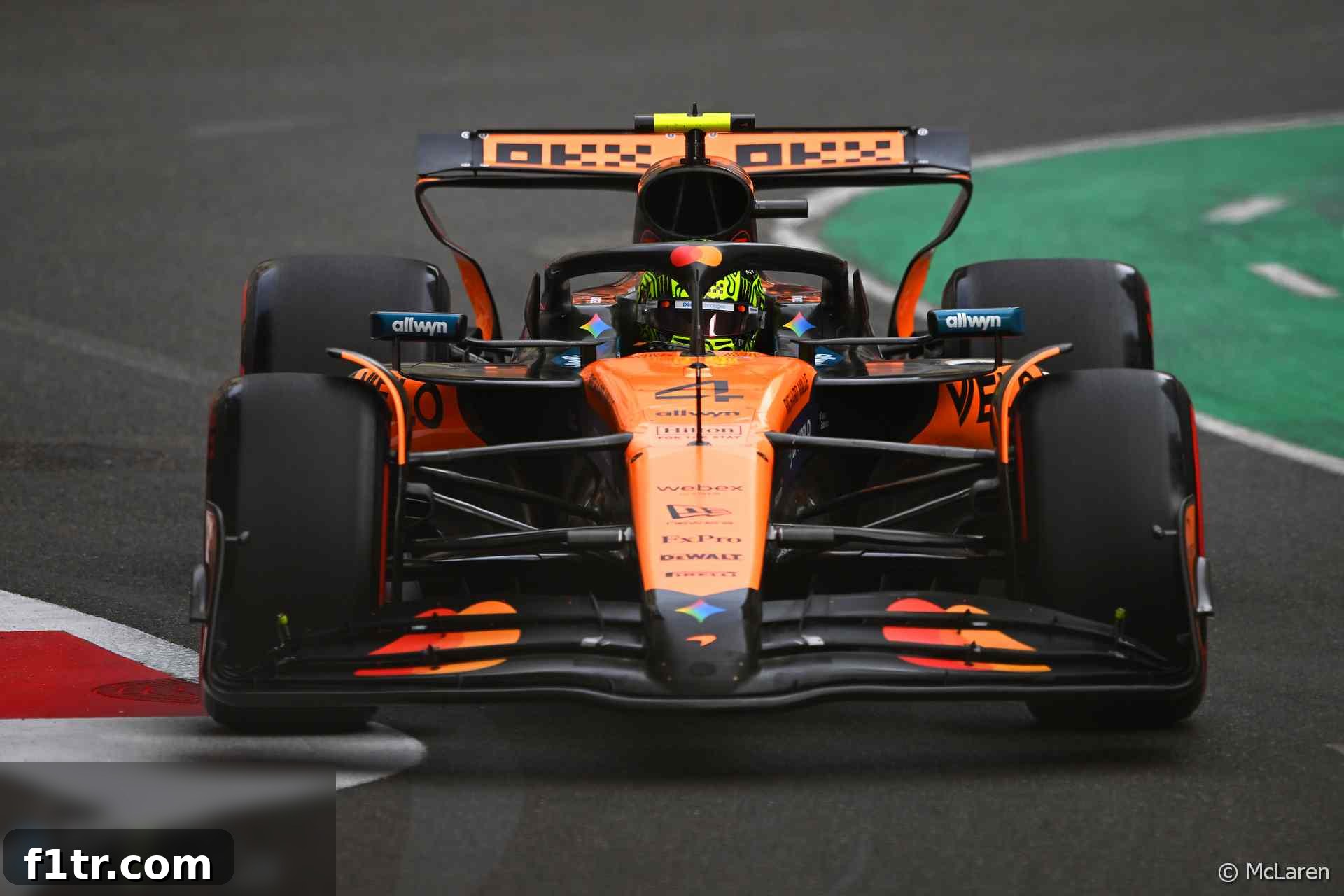
Lando Norris endured a challenging start to the Azerbaijan Grand Prix weekend, admitting his early crash in Friday practice would be a significant setback for McLaren. The incident severely curtailed his track time, leaving him with a mere seven laps completed in the crucial second free practice session.
Advert | Become a Supporter & go ad-free
The McLaren driver’s session came to an abrupt end when he clipped the unforgiving wall at the exit of turn four on the Baku City Circuit. The contact inflicted damage to his car’s left-rear suspension, necessitating lengthy repairs and keeping him sidelined for the remainder of FP2. This unfortunate turn of events contrasted sharply with his strong showing in the opening session, where Norris demonstrated promising pace by setting the quickest time.
“It’s a costly one, especially here,” Norris conceded to the official Formula 1 channel, reflecting on the incident. “I was feeling good until then, and the car felt competitive in FP1. But Baku is a street circuit that demands precision, and any slight misjudgment can have big consequences, as I found out today.”
Despite the frustration, Norris maintained a philosophical stance, emphasizing his proactive approach to finding the limits of the car and the track. “I’d rather have this and push and find the limits than not push at all,” he asserted, highlighting the aggressive mindset often required from top drivers, even in practice sessions. The challenging nature of Baku, with its blend of ultra-fast straights and incredibly tight, technical sections, often encourages drivers to explore the very edge of performance, where mistakes can be heavily penalized.
Lost Opportunities: The Impact of Limited Running
The loss of extensive running time in FP2 was particularly detrimental, as it prevented Norris from completing his planned qualifying and race simulation runs – vital components of any Grand Prix weekend preparation. “It’s annoying,” Norris admitted, acknowledging the missed opportunity. “I would have liked to get some high-fuel laps in, especially on these tyres, which are a softer compound compared to last year. But it is what it is, and I’ll have to make up for it.”
Practice sessions at a street circuit like Baku are more than just an opportunity to set quick lap times; they are critical for gathering data on tyre performance, understanding track evolution, and fine-tuning the car’s setup for both single-lap pace and race-long consistency. Without these crucial data points, Norris and his McLaren engineering team will face an uphill battle to optimize their strategy and setup ahead of qualifying and Sunday’s main event.
Pirelli’s Softer Compounds: A Key Strategic Variable
For the fourth time this year, Pirelli has introduced the softest tyres in its range for the Azerbaijan Grand Prix. These compounds are a full step softer than those utilized last year, promising increased grip and potentially faster lap times, but also posing significant challenges in terms of degradation and overall tyre management over a race distance. The unique characteristics of the Baku circuit, with its high-speed sections and heavy braking zones, further complicate tyre strategy.
“The [tyres] are very different to last year,” Norris explained, highlighting the shift. “It’s quite a bit quicker and it’s a softer compound which we don’t use that often. Certainly, I’m behind on the learnings now.” This lack of track time on the specific soft compounds could prove costly, as understanding their behaviour – particularly in terms of wear, temperature sensitivity, and optimal operating windows – is paramount for extracting maximum performance in both qualifying and the race. Teams will need to balance aggression with conservation, a task made harder for McLaren due to Norris’s curtailed running.
Advert | Become a RaceFans supporter andgo ad-free
McLaren’s Collective Challenge: Piastri’s Setback
The challenges for McLaren were not exclusive to Norris. His rookie team mate, Oscar Piastri, also experienced a momentary lapse during the session, clipping a barrier himself. While Piastri was fortunate enough to continue without significant damage, the incident still meant a disrupted session and potentially compromised data collection for the team. In a sport where every tenth of a second and every byte of data counts, such disruptions can have a ripple effect.
Norris acknowledged the collective struggle: “It was a scrappy session, I guess, from my side and I think from Oscar’s side. He seemed to be struggling a little bit with the car as well, so we’ll see what we can make up for tomorrow.” The synchronized difficulties mean McLaren as a whole will have less representative data to pore over, potentially forcing them into more conservative setup choices or relying more heavily on simulator data and the limited information gathered. This shared experience underscores the high-wire act that is Formula 1, especially on a street circuit notorious for catching drivers out.
The Competitive Landscape: Ferrari and Red Bull Loom Large
Looking ahead to the competitive dynamics of the weekend, Norris had a clear view of the primary challengers. Ferrari demonstrated formidable pace in the second practice session, topping the timesheets and signaling their intent. Norris is confident they will be strong contenders throughout the Grand Prix weekend. “They were easily the quickest here last year, even though Oscar won,” he commented, perhaps alluding to a potential strategy or race incident that secured Piastri his victory, rather than outright raw pace dominance.
The Scuderia’s performance at Baku historically has been strong, often suiting their car’s characteristics, particularly its ability to navigate the slower, twisty sections with precision. With their strong showing in FP2, Ferrari has firmly established themselves as a team to watch, likely to be at the sharp end of the grid in qualifying and a major threat for victory on Sunday.
Then there’s Red Bull, the reigning champions, who, according to Norris, often mask their true potential on Fridays. “Ferrari will be quick, Red Bull are going to be quick. They’ve never been [quick] on Friday, but then they go to sleep and they wake up and then they’re just quick again,” Norris quipped, reflecting a widely held belief within the paddock. Red Bull is renowned for its ability to extract significant performance gains between Friday practice and qualifying, often revealing a car that is a class apart when it truly matters.
This characteristic makes predicting their ultimate pace based on Friday’s times a fool’s errand. Their strategic approach to practice sessions, often focusing on long runs and data gathering rather than outright qualifying simulations, frequently sees them lower down the leaderboard only to dominate when the points are on offer. “So I expect a challenge from at least three other cars tomorrow,” Norris concluded, indicating that Mercedes, or even another dark horse team, could also be in the mix, adding another layer of intrigue to what promises to be a thrilling qualifying session and race.
Anticipating the Baku Grand Prix Weekend
For Lando Norris and McLaren, the task ahead is clear yet daunting. The limited practice data, particularly on the critical soft tyres, means that Saturday’s final practice session will be more crucial than ever for fine-tuning the car. They will need to perform a rapid analysis of the available data, make informed decisions on setup, and hope that Norris can quickly regain his rhythm and confidence to extract maximum performance from the car.
The Baku City Circuit has a reputation for delivering unpredictable races, often punctuated by Safety Cars and dramatic shifts in fortune. While Norris’s practice crash represents an early setback, the chaotic nature of this Grand Prix could still present opportunities for a comeback. The team’s ability to recover from this challenging start and adapt to the evolving track conditions will be a true test of their resilience and strategic acumen. Fans can expect a weekend filled with intense competition, strategic gambles, and undoubtedly, more drama on the streets of Azerbaijan.
Miss nothing from RaceFans
Get a daily email with all our latest stories – and nothing else. No marketing, no ads. Sign up here:
2025 Azerbaijan Grand Prix
- Sainz praises “hardest working” engineer who wept after his Baku podium
- McLaren had best car for “95% of races” but Red Bull have caught up – Norris
- Norris couldn’t close a 69-point gap in 14 rounds. Verstappen has to do it in seven
- “That’s not what we discussed”: Ocon’s complaint about Haas’s team orders in Baku
- Verstappen has led more laps than Norris in 2025: Azerbaijan GP stats
Browse all 2025 Azerbaijan Grand Prix articles