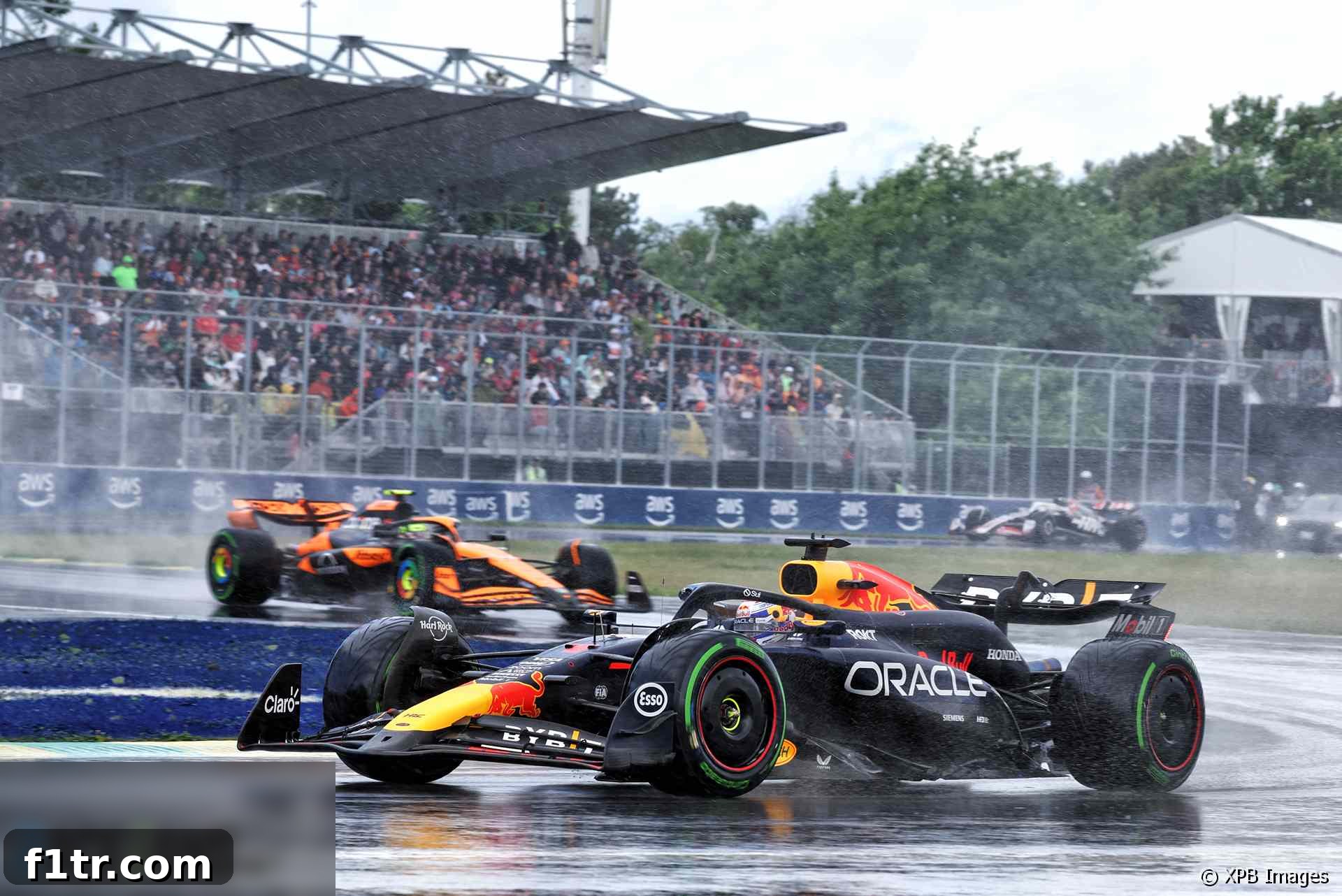
The 2024 Canadian Grand Prix, held at the challenging Circuit Gilles Villeneuve, was set to be a momentous occasion for several rising stars in Formula 1. Early predictions suggested it could have been the day George Russell or Lando Norris secured their second career victories, showcasing their mastery over the unpredictable conditions that often define races in Montreal. Instead, the race unfolded into a captivating strategic battle across three top teams, ultimately culminating in a familiar outcome: Max Verstappen’s unmatched precision and blistering pace secured his 60th career win, further cementing his dominance in the sport.
Advert | Become a Supporter & go ad-free
Arriving at the Circuit Gilles Villeneuve on race day, George Russell of Mercedes found himself on pole position, a feat achieved through a tie-breaker after an identical qualifying time with Max Verstappen. This third career pole for Russell was a testament to his skill and Mercedes’ improving form, as he had managed to outmaneuver the formidable Red Bull, McLaren, and Ferrari contenders. With the team in the midst of its second-longest win drought, the pressure was immense for Russell to convert this prime starting spot into a victory and break the spell.
The weather, however, had other plans for Montreal. The preceding two days of practice and qualifying had been punctuated by frequent rain, and race day afternoon brought more of the same. As drivers headed out for their reconnaissance laps, the track was completely soaked, with significant standing water visible across the circuit. Despite a brief respite from the downpour, conditions remained treacherous, guaranteeing poor grip and severely reduced visibility for the crucial opening phase of the race. This meteorological challenge added an extra layer of complexity, transforming the strategic landscape and heightening the drama before the lights had even gone out.
Having experienced firsthand during Friday practice how rapidly the newly resurfaced Montreal track could dry, most drivers made a pragmatic choice for the start. George Russell, Max Verstappen, Lando Norris, Oscar Piastri, Daniel Ricciardo, Fernando Alonso, Lewis Hamilton, and ten other competitors all opted for intermediate wet tyres, betting on conditions to improve. In contrast, the Haas duo of Kevin Magnussen and Nico Hulkenberg gambled on full wet tyres, hoping to exploit the initial standing water for an early advantage.
Despite the heavily saturated track, Race Director Niels Wittich greenlit a standing start, placing his trust in the elite skills of the Formula 1 grid. As the starting lights sequence concluded, a subtle creep from Daniel Ricciardo’s RB earned him a later penalty, but otherwise, the field roared into Turn 1 with remarkable composure. The challenging Virage Senna sequence, often a flashpoint for incidents, was navigated without major drama, a testament to the drivers’ precision under pressure. Russell emerged from the first corner complex retaining his lead, establishing a two-car length advantage over Verstappen, with Norris, Piastri, Alonso, and a fast-starting Hamilton – up from seventh to sixth – in close pursuit.
Advert | Become a RaceFans supporter andgo ad-free
The initial laps quickly vindicated the Haas strategy; the full wet tyres proved exceptionally effective in the torrential conditions. Kevin Magnussen launched an aggressive charge, gaining six places within the first lap, while Nico Hulkenberg climbed five positions through the initial 14 corners. Their bold gamble placed them amongst the front-runners momentarily. However, the rain had ceased, and with all 20 cars circulating, the conventional wisdom suggested the track would rapidly dry, bringing the intermediate runners into their own. This dynamic created an exciting tension between those who had committed to the full wets and the majority on intermediates.
Russell maintained a two-second lead after two laps but made a minor error, missing the final chicane at the end of the second tour. Despite this, he held his position. Meanwhile, Magnussen and Hulkenberg continued to impress, with Magnussen briefly soaring as high as fourth place, nestled between the McLarens. The opening laps, though chaotic in appearance, saw drivers demonstrate incredible skill to avoid significant incidents. Yet, the razor-thin margin for error was starkly highlighted when Logan Sargeant, on lap six, slid off the track at Turn 6 before rejoining, a precursor to later events.
By lap eight, Russell had stretched his lead to two seconds, having just clocked the fastest lap of the race. Behind him, Lando Norris, now free from the challenge of Magnussen (who had wisely pitted for intermediates as the track dried), began to close in on the leading duo. Red Bull, sensing Norris’s growing threat, urged Verstappen to intensify his pressure on Russell and try to snatch the lead. Verstappen, in turn, eagerly sought the activation of DRS (Drag Reduction System), which remained disabled due to the tricky conditions. Red Bull assured him they were lobbying the stewards, but the eventual activation would soon prove a double-edged sword for the reigning champion.
Verstappen’s request for DRS was finally granted on lap 18. However, a crucial mistake through the opening corners on the preceding lap meant he was no longer attacking Russell but instead found himself under intense pressure from a rapidly approaching Lando Norris. Just two laps later, Norris executed a clean, decisive DRS pass along the back straight, sweeping past the world champion to claim second place. On the very next lap, the McLaren driver repeated the manoeuvre, dispatching Russell and seizing the lead. Russell compounded his loss of position with another costly error, missing the chicane and conceding a further place back to Verstappen. The race was now firmly in Norris’s hands, leading from Verstappen and Russell.
As Norris confidently led the pack, the weather once again became a focal point, with forecasts predicting a return of rain within a few laps. The leader expressed concern that his well-used intermediate tyres might not withstand a significant downpour. However, with clear air ahead and pulling seconds out of the chasing duo, Norris had a buffer that allowed for a degree of caution and strategic flexibility if the rain did arrive as predicted. This delicate balance of speed and foresight would soon be tested by an unexpected turn of events.
Lando Norris’s hard-earned advantage vanished when Logan Sargeant made his second error of the day, triggering the Safety Car. The Williams driver lost control, swiping the outside wall at Turn 4 before spinning to a halt, facing the wrong way just off the racing line. Crucially, Norris had already passed the pit lane entry when the Safety Car was deployed. This meant he had to complete almost a full lap at reduced speed behind the Safety Car, while his closest rivals, Verstappen and Hamilton (who were among the first cars on the scene of Sargeant’s incident), had the opportunity to pit under Safety Car conditions without losing significant track position. Verstappen, Russell, and Piastri seized this chance, diving into the pits for fresh intermediate tyres and rejoining the race order, effectively erasing Norris’s hard-won lead. This strategic divergence was a pivotal moment, reminiscent of, yet distinct from, Norris’s stroke of luck in Miami where a Safety Car deployment had played perfectly into his hands. This time, fortune decidedly favoured his rivals.
Advert | Become a RaceFans supporter andgo ad-free
While Norris had built a commanding 31-second lead over the trio before they pitted, his advantage was brutally cut. By the time he eventually entered the pit lane to change tyres, his lead had dwindled to a mere 17 seconds. Rejoining the race, Norris found himself unable to beat Verstappen or Russell to the Safety Car line, ultimately re-emerging in third place, just ahead of his McLaren teammate Oscar Piastri. The strategic gamble had backfired, handing the initiative directly to Verstappen.
Verstappen led the field for the restart at the beginning of lap 30, with Russell and the two McLarens hot on his heels. A light rain had begun to fall again, but its mild intensity posed no significant threat to those on new intermediate tyres. A more unusual concern, however, arose on the second green flag lap. Approaching the chicane, Verstappen narrowly avoided a marmot attempting to cross the track, a testament to the unexpected challenges drivers face at the Canadian circuit. “He was almost dead,” Verstappen later recounted. “I thought it was debris, initially. So I started to close in and then I’m like, ‘oh my god, it’s an animal!’. So I swerved right at the last moment.”
Having earned the silent appreciation of animal lovers worldwide, Verstappen gradually established a small but crucial lead over Russell as the sun began to break through the clouds for the first time that day. Behind them, Lando Norris made an error at the first corner, forcing him to cut Turn 2 to rejoin the track. He managed to do so just in front of his teammate, retaining his position. The stewards reviewed the incident but ultimately determined that Norris had not gained a lasting advantage from his excursion. The race was now entering a fascinating dry-wet transition phase, forcing teams to weigh the risks and rewards of switching to slick tyres.
Lewis Hamilton, running in fifth, was the first front-runner to commit to slick tyres, opting for hard compounds at the end of lap 43. This bold move prompted a reaction from the leaders. Two laps later, both Verstappen and Russell pitted in unison for medium slick tyres, recognizing the rapidly drying track. Lando Norris, however, displayed exceptional pace on his used intermediates and made the strategic decision to extend his stint, attempting an ‘overcut’ on his rivals. His engineer, Will Joseph, confirmed his pace: “Lando, you’re currently the fastest car on track.” Norris responded, “I can do one more, maybe,” to which Joseph affirmed, “Yes please – stay out.” This high-stakes call underscored McLaren’s confidence in their driver and his ability to manage the delicate tyre conditions.
Norris finally committed to the pits at the end of the next lap. A moment of intense drama unfolded as he cut the pit exit line just as Verstappen was rocketing down the pit straight. Norris rounded the second turn ahead of the Red Bull, and on a completely dry track, he might have retained the lead. However, the damp outer line robbed him of the crucial ability to put down full power through the exit of the right-hander. Seizing the opportunity, Verstappen, on his much warmer and dry-line-optimised tyres, swiftly slipped up the inside, reclaiming the lead. Despite missing out on the top spot, Norris had successfully jumped Russell for second place, a testament to his bold strategy. Yet, the fight was far from over. Russell, now with fresh mediums, was soon applying immense pressure. He slipstreamed the McLaren along the back straight, utilizing DRS to reclaim second place. However, a couple of laps later, a mistake at Turn 9 saw Russell bounce awkwardly over the kerbs, opening the door for Norris to snatch second place back without further invitation. The battle for the podium was intensifying dramatically.
Advert | Become a RaceFans supporter andgo ad-free
With the track now largely dry enough for slick tyres, there was ample grip available on the racing line. However, the omnipresent danger of straying onto the darker, damp patches remained, presenting a potentially race-ending mistake. Sergio Perez unfortunately discovered this unforgiving reality when he made a similar error to Sargeant at Turn 6. His Red Bull RB20 sustained significant damage, prompting his team to urge him to nurse the car back to the pits, discarding parts along the way. Red Bull’s primary motivation was to avoid triggering another Safety Car period, which could have jeopardized Verstappen’s hard-won lead. This incident drew the ire of the stewards, who later fined the team €25,000 and handed Perez a grid penalty for his actions in the next race, deeming it an unsafe return to the pits.
Despite Red Bull’s efforts, fate seemed determined to reintroduce the Safety Car. Just moments later, Carlos Sainz Jnr lost control of his Ferrari at the very same corner, collecting Alexander Albon’s Williams in the process. The double incident left another wrecked Williams for the marshals to clear, necessitating a second Safety Car deployment. With no concerns about reaching the end of the race on their medium tyres, Verstappen and the two McLarens opted to stay out. Mercedes, however, seized the opportunity, pitting Russell from third and Hamilton from fifth for fresh hard tyres. Hamilton retained his fifth position, while Russell dropped just one place to Piastri. This strategic move armed Mercedes with potentially sharper tools for the climactic final ten laps, setting the stage for an intense fight for the podium positions.
Verstappen expertly managed the restart on lap 59, quickly re-establishing his lead and keeping Norris at bay. With his fresh medium tyres, Russell was immediately on the attack, rapidly closing in on Piastri. On lap 63, benefiting from a DRS assist along the back straight, Russell opted for the outside line into the final chicane. The two former Formula 2 champions ran side-by-side, making contact, which forced Russell to miss the chicane. This error cost him a position to his teammate, Lewis Hamilton, on exit. The stewards later reviewed the clash and deemed no action necessary, confirming it as a legitimate racing incident.
Soon after, Lewis Hamilton demonstrated a masterclass in overtaking, clinically picking off Piastri into the chicane on lap 65 to claim third place. Russell, not to be outdone, successfully executed his move on Piastri the very next lap. Mercedes now had both cars in podium contention, a significant boost after their challenging season. The team issued a clear warning to their drivers to keep it clean. In a thrilling internal battle, Russell managed to outmaneuver Hamilton, taking the damp inside line on the run into the chicane and snatching the final podium position from his esteemed teammate. This intense intra-team skirmish highlighted the fierce competition even within the same garage.
While the Mercedes drivers engaged in a spirited duel behind them, Verstappen and Norris maintained a picture of remarkable calm at the front. Despite his earlier impressive pace, Norris found himself unable to match the relentless consistency of Verstappen, who was now firmly on course for his sixth victory of the season. The world champion expertly navigated the final laps, even enduring a light brush with the infamous Wall of Champions. He ultimately took the chequered flag to secure what he described as the hardest-fought of his 2024 wins so far, and arguably one of the most impressive of his illustrious 60-career victories. The treacherous conditions and relentless pressure only amplified the magnitude of his achievement.
“It’s very rewarding,” Verstappen reflected after the race, visibly pleased with his performance. “It’s easy to make mistakes, especially on the inters when they were almost becoming slicks.” He further added, “It’s a lot of fun to drive these kind of races now and then. You don’t want it all the time because that’s too stressful, but I had a lot of fun out there today.” His comments underscored the mental and physical challenge of such a dynamic race, and his satisfaction in emerging victorious from it.
Advert | Become a RaceFans supporter andgo ad-free
Lando Norris crossed the finish line just under four seconds behind Verstappen, a result that left him unequivocally frustrated. There was no doubt in his mind that this was a victory that had slipped through his fingers, and he firmly rejected any notion that it was cosmic justice for his earlier good fortune in Miami. Instead, he pinpointed a specific strategic misstep.
“We should have won today. Simple as that,” he stated emphatically. “We didn’t do a good enough job as a team to box when we should have done and not get stuck behind the Safety Car. So I don’t think it was a luck or unlucky kind of thing. I don’t think it was the same as Miami. This was just making a wrong call.” His candid assessment highlighted the fine margins in Formula 1 strategy.
George Russell secured Mercedes’ first podium of the season in third place, a commendable achievement given the team’s struggles. However, having started from pole position and led the opening 20 laps, he admitted he couldn’t be entirely satisfied. Despite the tinge of disappointment, Russell expressed genuine happiness with what the performance signified for his team’s prospects. “This pace increase that we’ve seen from us this weekend, it hasn’t been a surprise to us because all the numbers back at the factory told us we’re going to be finding a big chunk of performance with these upgrades,” he explained. He concluded with a hopeful outlook, “So Barcelona is going to be interesting for everybody, but I’m confident we can be in the fight.” This sentiment injected a much-needed dose of optimism into the Mercedes camp ahead of the European leg of the season.
Lewis Hamilton, finishing fourth, was deeply dissatisfied with his performance, believing he had more potential. Oscar Piastri brought his McLaren home in a solid fifth place. The two Aston Martins, driven by Fernando Alonso and Lance Stroll, found renewed confidence with strong sixth and seventh-place finishes, respectively, a particularly satisfying result for Stroll in his home race. Daniel Ricciardo also delivered a badly needed strong result in eighth, arriving just as Canada’s only world champion had publicly questioned his continued presence in the sport. His race engineer later apologized for the pre-start creep that led to his penalty, blaming a car fault. This result provided a crucial morale boost for Ricciardo and his team.
Advert | Become a RaceFans supporter andgo ad-free
Pierre Gasly secured ninth place after his Alpine teammate Esteban Ocon reluctantly followed a team order to let him past. Alpine’s double points finish of the season thus came amid more internal tension and bad blood between their teammates, who are undoubtedly counting down the races until they part ways at the end of the year. For Ferrari, the joy of victory in Monaco just two weeks prior turned into a bitter taste of defeat in Canada. Neither Carlos Sainz Jnr nor Charles Leclerc managed to reach Q3, and they were never a factor in the fight at the front. While Sainz ultimately crashed out, Leclerc endured a day ruined first by persistent power unit problems, followed by a risky gamble on slick tyres during a mid-race shower that Ferrari hoped would be milder than it appeared. It wasn’t, compounding their misery.
Much like the Imola Grand Prix two rounds prior, Max Verstappen and Red Bull had prevailed despite not always looking like the quickest overall package during the weekend. They were forced to fight harder than usual for this victory, highlighting the increasing competitiveness of their rivals. With a long season still ahead and their three biggest competitors appearing closer than they had all year, Verstappen was acutely aware of the challenge his team faced upon their return to Europe. He expressed gratitude for having managed to secure such a crucial result despite immense pressure and the tightening field.
“It definitely keeps us on our toes,” Verstappen concluded. “We cannot afford to make mistakes or tiny mistakes any more. So every little detail matters now.” His words served as a stark reminder that while Red Bull remains at the pinnacle of Formula 1, the margin for error is shrinking, promising an exhilarating second half of the 2024 season.
Become a RaceFans Supporter and Go Ad-Free
RaceFans thrives thanks to the generous support of its dedicated readers. By contributing just £1 per month or £12 per year (or the equivalent in your local currency), you can play a vital role in covering the ongoing costs of creating, hosting, and continually developing RaceFans. Your support ensures we can continue to deliver high-quality Formula 1 content, analysis, and news.
Join the RaceFans Supporter community today and enhance your browsing experience by going completely ad-free across the site. Find out more about the benefits and sign up via the links below:
- Become a RaceFans Supporter Today
- RaceFans Supporter FAQ – Learn More
More on the 2024 Canadian Grand Prix
- “He needs to be more careful”: Unheard radio messages from the Canadian Grand Prix
- Marko contradicts stewards’ reason for Red Bull and Perez penalties
- Only one F1 championship looks like a worthwhile fight in 2024
- Red Bull can fix kerb-riding without losing RB20’s major strengths – Verstappen
- Mercedes suspect Montreal track layout ‘made us look quicker’
Browse all 2024 Canadian Grand Prix articles
Explore More F1 Race Reviews
- Antonelli lucks in for second win and becomes youngest F1 championship leader
- Emotional Antonelli grabs first Formula 1 victory in Chinese Grand Prix
- Russell sees off Ferrari threat to lead Mercedes one-two in Melbourne
- Norris clinches F1 title by two points as Verstappen wins finale at Yas Marina
- McLaren strategy blunder in Losail hands Verstappen crucial win and shot at title
Read all F1 race reviews