The Unseen Challenge: Why Sergio Perez and Others Struggle Beside Max Verstappen at Red Bull
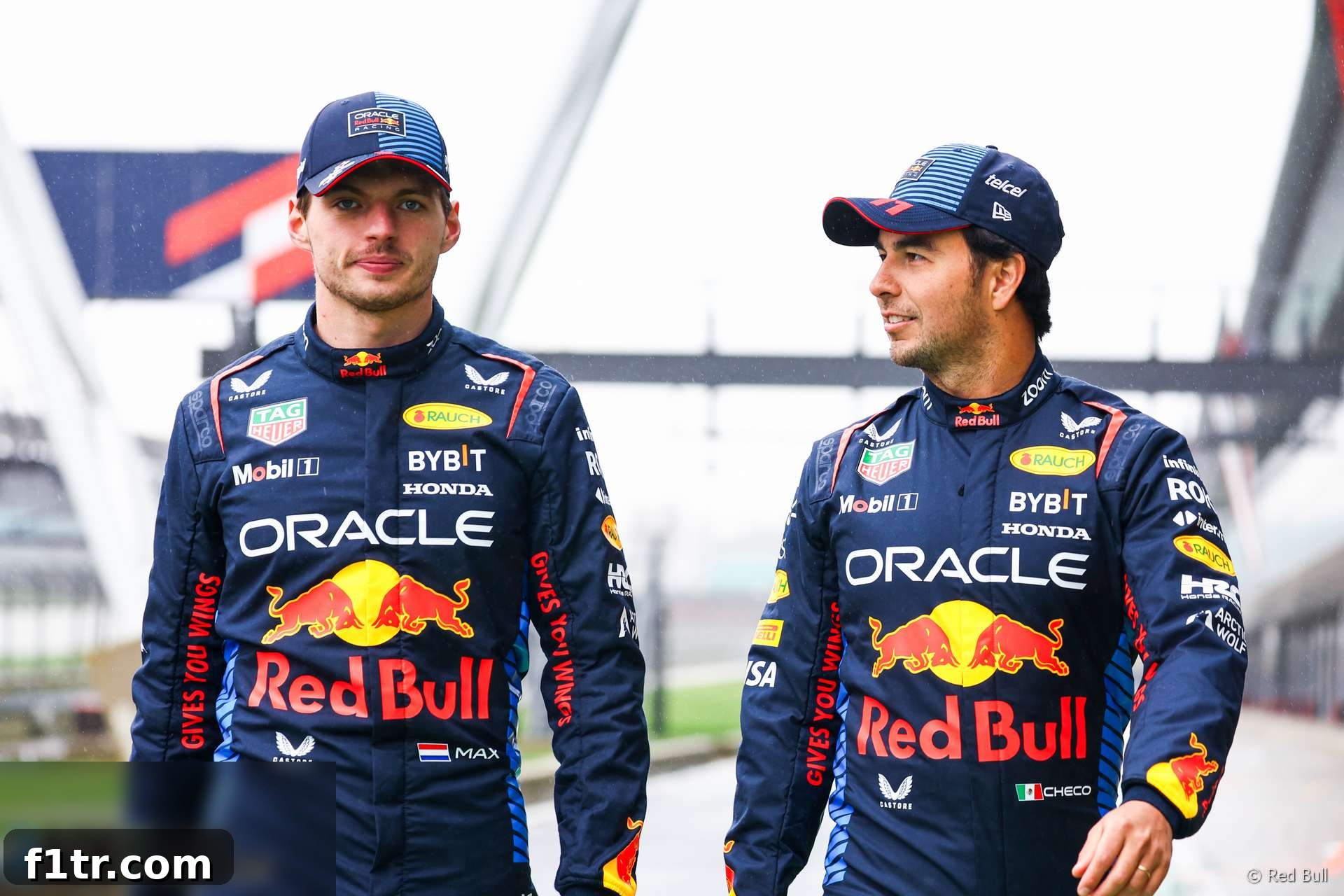
Formula 1 is a sport of brutal competition, where driver talent and machine performance converge to create legends. Yet, even within the most dominant teams, a unique hierarchy often emerges. For years, the spotlight at Red Bull Racing has been firmly on Max Verstappen, a prodigious talent who has rewritten record books. But what does it truly mean to be his teammate? Sergio Perez, who spent four seasons alongside Verstappen, recently offered a candid insight into this incredibly demanding role, suggesting that the environment within Red Bull itself amplifies the challenge, making it a near-impossible task for any driver, no matter their calibre.
Perez’s tenure at Red Bull, spanning from 2021 to 2024, was a period marked by both team success and a progressively widening performance chasm between the two drivers. While Verstappen consistently delivered championship after championship, Perez, initially brought in to bolster the team’s constructors’ title aspirations, found himself increasingly adrift. The statistics from the 2023 season are particularly stark: Verstappen secured a record-breaking 19 victories, while Perez managed just two. This colossal difference in wins was mirrored in the points tally, where Verstappen amassed a staggering 575 points compared to Perez’s 285, highlighting a level of dominance rarely seen in the sport. The trend continued, with Perez struggling to find wins in his final year, further underscoring the formidable task of matching his teammate.
Despite signing a new two-year contract in June, Perez’s time at Red Bull ended at the close of the 2024 season. His departure led to a rapid succession of replacements, initially Liam Lawson, then Yuki Tsunoda, neither of whom could significantly narrow the performance gap to Verstappen. This rapid turnover and the consistent struggle of multiple drivers in the second Red Bull seat lend credence to Perez’s assertion about the unique difficulties presented by the team. He articulated his empathy for his successors, stating, “I don’t like criticising the drivers that have been there because I was in that position, I know what exactly they’re going through.” This poignant remark reveals a deeper understanding of the immense pressure and intricate dynamics at play within the Red Bull camp.
Beyond the Track: The Red Bull Dynamic
Perez went further, reflecting on his own departure, “The minute I signed my exit with Red Bull when we came to an agreement, I thought, ‘that poor guy who comes here.’ Because I managed to survive, but it’s a very difficult place.” This sentiment underscores a crucial distinction: while Verstappen’s brilliance would make him a formidable opponent in any team, the “Red Bull environment” intensifies this challenge to an almost insurmountable degree. The team, having fostered Verstappen’s rise from a young prodigy to a multiple world champion, has arguably become meticulously tailored to his preferences, his style, and his relentless pursuit of perfection. This singular focus, while instrumental in their collective success, invariably creates a scenario where a second driver must constantly adapt, often compromising their own natural driving instincts.
“Obviously being next to Max is very difficult, but being next to Max in Red Bull is something people don’t understand,” Perez elaborated, hinting at layers of complexity beyond public perception. He confidently asserted, “There’s no driver that can survive there. It doesn’t matter if you bring a Hamilton or a Leclerc – whoever you bring there is going to struggle massively.” This bold statement suggests that the issue isn’t merely one of individual driver talent or adaptability, but rather a systemic challenge embedded within the very fabric of how Red Bull operates and develops its machinery around its leading star.
The Enigma of the RB Car: Verstappen’s Tailored Machine
A primary explanation for the struggles faced by Verstappen’s teammates lies in the fundamental characteristics of the Red Bull car itself. The RB chassis, particularly in recent seasons, has been meticulously engineered to suit Verstappen’s highly specific and aggressive driving style. Max possesses an extraordinary ability to control a car with significant oversteer – a condition where the rear of the car wants to step out more than the front. Most drivers prefer a more stable, understeery car, or at least a neutral balance, allowing them to attack corners with confidence. Verstappen, however, thrives on a hyper-responsive rear end, using it to rotate the car aggressively into corners and generate immense mid-corner speed. This unique preference allows him to exploit the car’s front-end grip to its absolute maximum.
For any other driver, attempting to pilot a car designed with such a pronounced oversteer bias is an immense hurdle. It requires a constant, unnatural adaptation to a machine that feels inherently unstable at its limit. As Perez succinctly put it, “It’s a very unique driving style, you have to be constantly adapting to the needs of Max. It’s as simple as that.” This continuous mental adjustment prevents a driver from achieving that coveted state of ‘flow’ – where driving becomes instinctive and effortless. Instead, the teammate is perpetually “thinking all the time how to drive it,” a scenario that Perez warns inevitably leads to mistakes and a loss of ultimate pace. The mental energy expended fighting the car’s inherent balance leaves little room for pushing the absolute limits or reacting instinctively to changing track conditions.
A Universal Challenge? The “Hamilton or Leclerc” Argument
The ramifications extend beyond mere lap times. The psychological toll of consistently battling a car that doesn’t align with your natural style, while your teammate dominates, can be immense. It chips away at confidence, fosters self-doubt, and can create a vicious cycle where a driver tries harder, makes more errors, and falls further behind. This is precisely why Perez believes even generational talents like Lewis Hamilton or Charles Leclerc would face significant obstacles. These drivers, accustomed to being the focal point of their respective teams and having cars tailored to their own preferences, would suddenly find themselves in a situation where the default setup is fundamentally alien to their instincts. Their immense talent would undoubtedly allow for some adaptation, but consistently extracting the ultimate performance required to challenge Verstappen might prove elusive.
Perez’s Perspective and Future Implications
Sergio Perez’s candid reflections offer a rare glimpse into the inner workings of a dominant Formula 1 team and the profound challenges faced by the driver in the adjacent garage. His comments serve as a valuable testament not only to Max Verstappen’s extraordinary talent and adaptability but also to the highly specialized environment that Red Bull Racing has cultivated. As the sport continues to evolve, the question of who can truly thrive alongside a driver of Verstappen’s calibre, within a team seemingly built around his unique requirements, remains one of Formula 1’s most fascinating and enduring enigmas.
Miss nothing from RaceFans
Get a daily email with all our latest stories – and nothing else. No marketing, no ads. Sign up here:
Formula 1
- F1 returning to India soon after 2027 sounds like wishful thinking
- Verstappen loathes F1’s new generation of cars – but what do his rivals reckon?
- The ‘throwback weekend’ is back in fashion. But it’s a flawed concept – especially for F1
- Is Formula 1’s double race cancellation a blessing in disguise?
- Todt admits Schumacher crashed on purpose – but did it really cost him two titles?
Browse all Formula 1 articles