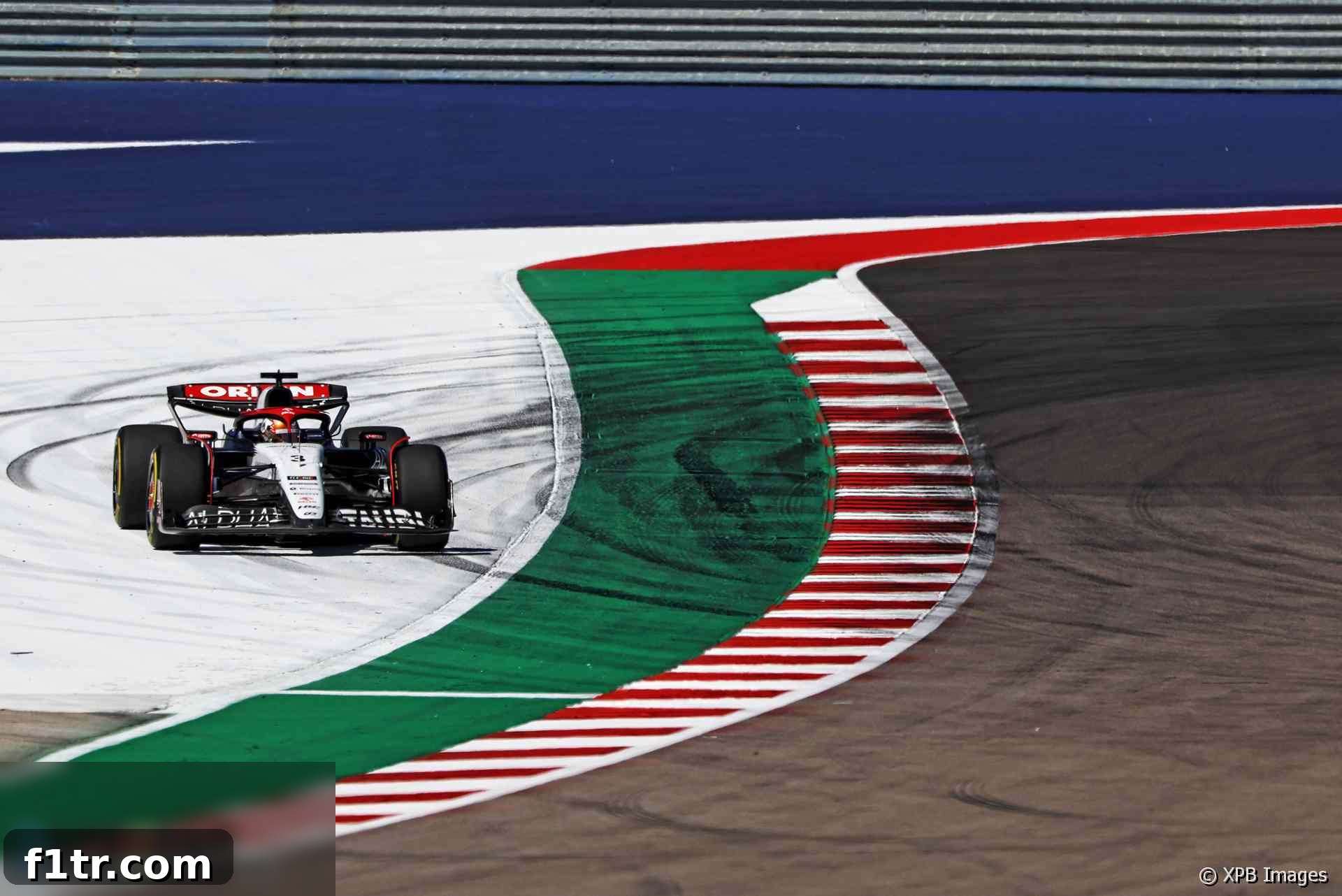
The intricate world of Formula 1 has recently been embroiled in a persistent and contentious debate surrounding track limits, a challenge that came to a head at the United States Grand Prix. Following the race in Austin, the stewards issued a significant statement, urging the sport’s governing body, the FIA, to devise and implement more robust mechanisms for enforcing these critical regulations. Their concern stemmed from the clear indication that numerous violations during the event went unnoticed and, consequently, unpunished, raising serious questions about the fairness and integrity of the competition.
Advert | Become a Supporter & go ad-free
The controversy intensified when the Haas F1 team formally requested a review of the United States Grand Prix results. Their protest was founded on the belief that several rival drivers had committed multiple track limits breaches, which had been overlooked by race officials. While the stewards ultimately rejected Haas’s plea, citing the team’s inability to present compelling new evidence to substantiate their claims, their decision was not without a crucial acknowledgment. They conceded that certain video footage submitted by Haas appeared to indeed illustrate track limits infringements that were not detected or penalized during the race itself. This acknowledgment underscored a fundamental flaw in the real-time enforcement process, particularly concerning an event that had taken place over two weeks prior, making retrospective enforcement practically impossible without clearer, immediate evidence.
The Unacceptable Reality of Enforcement Failures
The stewards’ frustration was palpable, articulated in a pointed statement within their official verdict. They remarked, “Notwithstanding the formal outcome of this decision, the stewards have seen individual pieces of evidence that show what appear to be potential track limit breaches at the apex of turn six.” More critically, they declared their inability to consistently and fairly apply the current standard for track limits across all competitors to be “completely unsatisfactory.” This stern critique was accompanied by an urgent call to action, strongly recommending that “all concerned that a solution to prevent further reoccurrences of this widespread problem be rapidly deployed.” This statement goes beyond a simple procedural note; it highlights a systemic issue threatening the credibility of race outcomes and the perception of fair play within Formula 1.
The problem of track limits is far from isolated to the US Grand Prix. While some races throughout the season have unfolded without significant disputes, others have become hotspots for infringements. The Austin event, for instance, saw a total of 35 lap times deleted due to track limits violations. However, this figure pales in comparison to the sheer volume recorded at other Grands Prix. The Qatar Grand Prix witnessed an astonishing 51 deleted lap times, while the Austrian Grand Prix topped the list with a staggering 84 infringements. These statistics underscore the pervasive nature of the issue, demonstrating that it is not merely an occasional oversight but a recurring challenge impacting multiple circuits and demanding a universal, robust solution.
Exploring Viable Solutions: Technology, Track, and Regulations
Recognizing the multifaceted nature of the problem, the stewards have suggested that a range of comprehensive options must be explored to implement an effective and lasting solution. They wisely refrained from prescribing a single remedy, instead deferring to the expertise of those better positioned to make such technical and practical assessments. Their guidance emphasizes three primary avenues for improvement: enhanced technology, strategic track modifications, and refined regulatory frameworks alongside stricter enforcement standards.
Technological Advancements for Precision
One of the most promising routes lies in leveraging cutting-edge technology. Current systems, often relying on inductive loops, pressure sensors, and manual review of camera footage, clearly fall short in providing the real-time, unerring accuracy required in high-stakes motorsport. Future solutions could incorporate advanced AI-powered vision systems capable of instantly detecting the precise location of a car relative to the track edge, even at blistering speeds. High-definition, multi-angle camera networks, integrated with sophisticated image recognition software, could provide incontrovertible evidence, eliminating ambiguity and the need for subjective human interpretation. Furthermore, highly accurate GPS or ultra-wideband (UWB) tracking systems, combined with digital track boundaries, could offer unparalleled precision, automatically flagging violations with minimal delay. The challenge lies in integrating these systems seamlessly into race control operations, ensuring they are robust, reliable, and resistant to false positives, thereby preventing unnecessary penalties and maintaining race flow.
Strategic Track Modifications for Natural Deterrence
Beyond technology, physical alterations to circuits offer a more traditional yet highly effective deterrent. The current fashion for vast asphalt run-off areas, while promoting driver safety, inadvertently encourages drivers to exceed track limits without immediate penalty, as there is no natural consequence for doing so. Reintroducing elements such as gravel traps, particularly at critical corners where violations are frequent, would instantly provide a natural and undeniable deterrent. Deeper, more aggressive kerbing could also make exceeding the track limits a physically uncomfortable or even damaging experience for the car, discouraging drivers from exploiting the very edge. Artificial grass, placed immediately beyond the white lines, can also serve as a visual and tactile warning, although its effectiveness in deterring serious infringements is limited compared to gravel. The goal here is to engineer circuits in a way that naturally punishes track limit abuses, making it inherently faster to stay within the designated racing lines rather than risking a time penalty or, worse, car damage.
Refining Regulations and Enforcement Standards
Finally, the regulatory framework and the standards of enforcement themselves require careful re-evaluation. Clarity in the rules is paramount; any ambiguity in what constitutes a track limit violation must be eradicated. This could involve defining the track edge with greater specificity or even exploring adaptive rules for different corner types. Crucially, consistency in applying penalties is non-negotiable. Drivers and teams need to know exactly where the line is drawn, not only literally but also in terms of the consequences of crossing it. Stricter, more immediate penalties for repeated infringements, or even a cumulative penalty system across a race weekend, could instill greater discipline. The role of race control versus individual stewards, and the communication protocols for flagging potential violations, also need to be optimized to ensure that every breach is identified and addressed in real-time or as close to it as possible.
An Urgent Call to Action for the 2024 Season
The stewards made it unequivocally clear that while a complete and perfect solution might not be achievable within the remainder of the current season due to practical constraints and development timelines, the urgency of the matter cannot be overstated. “Based on the timing of this decision, it is clear that a complete solution cannot, as a matter of practicality, happen this year,” they stated. However, given the alarmingly high number of circuits where significant track limit issues arose throughout the 2023 season, the imperative is to find and deploy further comprehensive solutions well before the commencement of the 2024 season. While acknowledging the commendable strides already made by the FIA in collaboration with various circuits to address these challenges, the stewards emphasized that these efforts must be accelerated and expanded. The integrity of the championship, the fairness of competition, and the clarity for both participants and fans hinge on a definitive resolution. The ongoing debate, often leading to post-race protests and confusion, detracts from the pure spectacle of Formula 1 racing.
The gravity of the situation was previously highlighted after the Austrian Grand Prix, where the result itself became subject to a protest by Aston Martin directly related to track limits infringements. Following that incident, the stewards issued a similarly emphatic recommendation, stating they “very strongly recommend that a solution be found to the track limits situation at this circuit.” This consistent messaging from the stewards across different races underscores the deep-seated nature of the problem and their collective determination to see it resolved permanently. The call for action is not merely a suggestion but a critical plea for the future health and reputation of Formula 1.
Advert | Become a RaceFans supporter andgo ad-free
2023 F1 season
- FIA president cleared of alleged interference in two 2023 races
- First week viewing figures for new Drive to Survive season fall again
- Max who? Drive to Survive season six prefers its favourite faces
- RaceFans’ complete 2023 season review
- The F1 drivers who pulled off the 10 biggest charges through the field in 2023
Browse all 2023 F1 season articles