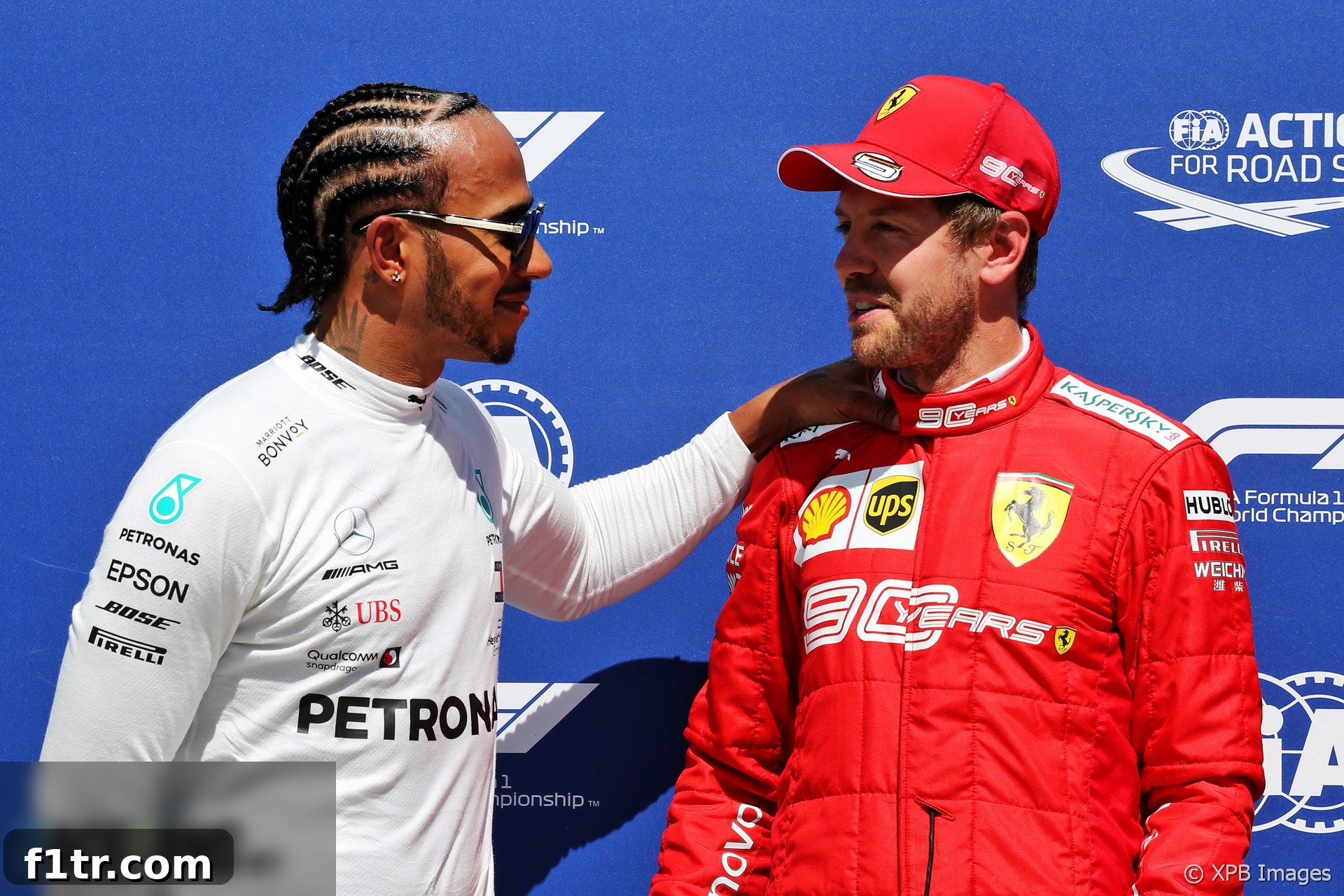
In a thrilling qualifying session that set the stage for the 2019 Canadian Grand Prix, Sebastian Vettel delivered a masterful performance, snatching pole position from Lewis Hamilton with a sensational final lap. The Ferrari driver’s incredible effort denied Lewis Hamilton what would have been a record-breaking seventh pole at the iconic Circuit Gilles Villeneuve, leaving the Mercedes star to settle for second place on the grid.
The Montreal circuit, renowned for its high-speed straights, demanding chicanes, and the infamous ‘Wall of Champions,’ consistently produces dramatic qualifying sessions, and 2019 was no exception. From the outset, the session was charged with anticipation, pitting the sport’s titans against emerging talents in a high-stakes battle against the clock. Beyond the top two, the session was punctuated by significant incidents and standout drives, including a heavy crash involving Kevin Magnussen that dramatically impacted the Q2 proceedings, and a truly stunning lap from Daniel Ricciardo that saw his Renault outperform both Red Bulls and a Mercedes, hinting at a fiercely contested race day.
The unique characteristics of the Circuit Gilles Villeneuve — a semi-permanent track combining street circuit precision with traditional racetrack speeds — place a premium on engine power, braking stability, and driver confidence in navigating the unforgiving concrete barriers. Teams arrived in Canada with specific car setups tailored for the track’s demands, and qualifying would test both their engineering prowess and their drivers’ ability to extract every ounce of performance.
Q1: The Initial Scramble for Survival
Advert | Become a Supporter & go ad-free
The opening phase of qualifying, Q1, immediately ignited with intense competition, particularly at the front. The Ferrari and Mercedes drivers — Vettel, Charles Leclerc, Hamilton, and Valtteri Bottas — engaged in a thrilling scrap for the fastest overall time. Each of the four championship contenders took turns at the top of the leaderboard, demonstrating the fine margins that define modern Formula 1 qualifying. By the completion of their initial runs on the soft compound tyres, the top three were separated by an incredibly tight margin of less than three hundredths of a second, with Vettel holding a slender advantage over Leclerc and Bottas.
Further down the field, the pressure was immense. Drivers battled not just for lap time, but for track position and clear air. Romain Grosjean, who had endured a challenging final practice session after clipping the wall and losing valuable track time, found himself perilously close to the elimination zone. However, showcasing his experience and resilience, Grosjean dug deep on his final run. He managed to extract enough pace from his Haas to climb safely into the top 10, securing his passage into Q2. Following his impressive turnaround, Alexander Albon in the Toro Rosso also put in a strong final lap to ensure his progression, illustrating the razor-thin margins and the constant shifting of positions.
This upward movement inevitably pushed others into jeopardy. Lance Stroll, representing his home crowd, faced a particularly uphill battle. His Racing Point team had been forced to switch to an older specification Mercedes power unit after suffering an engine failure during the final practice session, a significant disadvantage on a power-sensitive track like Montreal. Despite this setback, Stroll showcased his car control, exiting the final corner in an elegant drift, a testament to his determination. He briefly secured a Q2 spot, much to the delight of the local fans, but his time proved fleeting. Within moments, four of his rivals improved their lap times, relegating him back into the drop zone and ending his qualifying effort in Q1.
The blow for Racing Point was compounded as Stroll’s teammate, Sergio Perez, also failed to advance. Perez’s final run left him agonizingly short, by just seven-hundredths of a second, of securing a place in Q2. It was a double disappointment for the Silverstone-based squad. The final spot in Q2 went to Antonio Giovinazzi, whose impressive last-gasp lap not only secured his progression but also inadvertently pushed his Alfa Romeo teammate, Kimi Raikkonen, into the elimination zone. As often seen during the 2019 season, the two Williams drivers, George Russell and Robert Kubica, completed the list of those eliminated in Q1, highlighting their team’s ongoing struggles.
Drivers eliminated in Q1
| 16 | Sergio Perez | Racing Point-Mercedes | 1’12.197 |
| 17 | Kimi Raikkonen | Alfa Romeo-Ferrari | 1’12.230 |
| 18 | Lance Stroll | Racing Point-Mercedes | 1’12.266 |
| 19 | George Russell | Williams-Mercedes | 1’13.617 |
| 20 | Robert Kubica | Williams-Mercedes | 1’14.393 |
Advert | Become a RaceFans supporter andgo ad-free
Q2: Strategy, Traffic, and a Red Flag
Q2 introduced a crucial strategic element regarding tyre choices for the start of the race. With the soft compound tyres showing signs of rapid degradation on the abrasive Montreal track, the tactical advantage of starting the Grand Prix on the more durable medium compound was abundantly clear. Teams aiming for a top-10 grid slot knew that if they could set a competitive enough time on mediums to reach Q3, they would gain a strategic edge for Sunday’s race by being able to run a longer first stint.
Ferrari successfully navigated this challenge with relative ease. Both Vettel and Leclerc managed to set sufficiently competitive times on the medium rubber during their initial runs, comfortably securing their places in Q3. Mercedes, too, opted for the medium tyre strategy, but found it slightly more challenging than their Italian rivals. While Hamilton eventually made it through, both he and Bottas had to complete two runs on the medium compound to ensure they had the pace to progress, underscoring the delicate balance between tyre choice and raw speed.
For Red Bull Racing, the tyre decision proved considerably trickier, especially for Max Verstappen. His teammate, Pierre Gasly, who had struggled to match Verstappen’s pace throughout the weekend’s practice sessions, opted for the soft tyres, a more straightforward but less strategically advantageous choice. Verstappen, however, chose to commit to the medium compound for his initial runs, aiming for that crucial race day benefit. Unfortunately, his early efforts were heavily compromised by traffic on the circuit, a recurring frustration on tight tracks. This left him languishing in 11th position, just outside the Q3 cut-off, with time rapidly running out.
Recognizing the severity of his predicament, the Red Bull team made a late call to abandon the medium tyre strategy for Verstappen. They decided the risk of not making Q3 was too great, and switched him to the faster soft tyres for a final, desperate attempt to climb into the top 10. As Verstappen prepared for his critical flying lap, fate intervened in the most dramatic fashion. Just as he was exiting the notorious final corner, known for its proximity to the ‘Wall of Champions,’ Kevin Magnussen, who was on his own fast lap, glanced the barrier. The contact sent his Haas into a violent spin, smashing the right-hand side of the car hard into the pit wall. The severity of the impact, and the debris scattered across the track, immediately brought out the red flags, halting the session.
The timing of Magnussen’s spectacular crash was devastating for Verstappen. With insufficient time remaining on the clock to restart the session, the red flags spelled the end of his hopes for reaching Q3. Despite the crash, Magnussen’s earlier lap was just quick enough to secure him a place in Q3, a bittersweet outcome. However, the incident profoundly impacted his teammate, Romain Grosjean, who was running directly behind Magnussen and unable to complete his own flying lap before the session was stopped. This unfortunate turn of events ensured Grosjean’s elimination from Q2. They were joined by the two Toro Rosso drivers, Daniil Kvyat and Alexander Albon, and Antonio Giovinazzi, who had performed admirably in Q1 but couldn’t find the necessary pace in this highly competitive segment.
Drivers eliminated in Q2
| 11 | Max Verstappen | Red Bull-Honda | 1’11.800 |
| 12 | Daniil Kvyat | Toro Rosso-Honda | 1’11.921 |
| 13 | Antonio Giovinazzi | Alfa Romeo-Ferrari | 1’12.136 |
| 14 | Alexander Albon | Toro Rosso-Honda | 1’12.193 |
| 15 | Romain Grosjean | Haas-Ferrari |
Advert | Become a RaceFans supporter andgo ad-free
Q3: The Duel for Pole Position
The final qualifying segment, Q3, commenced with an electrifying atmosphere, promising a direct showdown between the sport’s heavyweights. Lewis Hamilton appeared to be firmly on course to deny Ferrari the coveted pole position after he delivered a superb first run, immediately topping the timesheets with a blistering lap. His performance ignited hopes within the Mercedes garage that a seventh Canadian pole was within his grasp, a testament to his exceptional skill around the demanding Montreal track. However, his teammate, Valtteri Bottas, endured a significantly less fortunate start to Q3. An uncharacteristic error saw him spin at the exit of turn two, an early and costly mistake that completely wrecked his first flying run and left him with considerable ground to make up.
As the final runs unfolded, the tension was palpable. Hamilton returned to the track, determined to consolidate his position. He chipped away at his previous lap time with his ultimate effort, managing a small but critical improvement, lowering the benchmark to a 1’10.446. This looked formidable, and for a moment, it seemed enough to secure pole. Yet, Sebastian Vettel had something special reserved for his final attempt. The Ferrari, with its formidable straight-line speed advantage on the long straights of Circuit Gilles Villeneuve, was perfectly suited for a last-gasp attack. Vettel produced a phenomenal lap, pushing the car to its absolute limit, and ultimately beat Hamilton by a significant two-tenths of a second at the finish line. His 1’10.240 lap time was a masterclass in qualifying performance, securing a crucial pole position for Ferrari and silencing the Mercedes challenge.
The final runs also highlighted a clear performance gap between the top two drivers and their respective teammates. Charles Leclerc, despite his best efforts, was over two-thirds of a second adrift of Vettel’s phenomenal pace, underscoring just how exceptional Vettel’s pole lap truly was. Valtteri Bottas continued what had been a mystifying and frustrating Q3 performance. After his earlier spin, he couldn’t recover sufficiently, managing only the sixth-fastest time. This placed him behind both Pierre Gasly’s Red Bull and, remarkably, an inspired lap from Daniel Ricciardo.
Ricciardo’s performance was undoubtedly one of the highlights of Q3. The Australian driver produced a stunning lap, showcasing the improving pace of his Renault by placing it an excellent fourth on the grid. This was a remarkable achievement, slotting his car ahead of both Red Bulls (with Verstappen out, Gasly was still behind him) and a Mercedes, proving the potential of the Enstone outfit. His teammate, Nico Hulkenberg, added to Renault’s strong showing by taking seventh place, reinforcing the team’s strong progress. The two Renaults were followed by the McLaren pair of Lando Norris and Carlos Sainz Jnr, who consistently demonstrated their improved form throughout the season. Kevin Magnussen, despite his heavy Q2 crash, still secured tenth place on the grid due to his earlier time, though he was unable to set a Q3 lap, making his grid slot largely symbolic.
Sebastian Vettel’s pole position for the 2019 Canadian Grand Prix was not just a testament to his individual brilliance but also a significant morale booster for Ferrari. It set up a tantalizing prospect for race day, with the championship rivals starting side-by-side on the front row, ready to do battle on one of Formula 1’s most demanding circuits. The blend of high-speed sections, hard braking zones, and strategic tyre management promised an unforgettable Sunday, fueled by the drama of Saturday’s qualifying.
Top ten in Q3
| 1 | Sebastian Vettel | Ferrari | 1’10.240 |
| 2 | Lewis Hamilton | Mercedes | 1’10.446 |
| 3 | Charles Leclerc | Ferrari | 1’10.920 |
| 4 | Daniel Ricciardo | Renault | 1’11.071 |
| 5 | Pierre Gasly | Red Bull-Honda | 1’11.079 |
| 6 | Valtteri Bottas | Mercedes | 1’11.101 |
| 7 | Nico Hulkenberg | Renault | 1’11.324 |
| 8 | Lando Norris | McLaren-Renault | 1’11.863 |
| 9 | Carlos Sainz Jnr | McLaren-Renault | 1’13.981 |
| 10 | Kevin Magnussen | Haas-Ferrari |
Go ad-free for just £1 per month>> Find out more and sign up
2019 Canadian Grand Prix Related Articles
For more insights and updates from the thrilling 2019 Canadian Grand Prix, explore these related articles:
- Ferrari Lose Bid to Have Vettel’s Canadian GP Penalty Reviewed
- Ferrari Confirm No Appeal on Vettel Penalty
- 2019 Canadian Grand Prix Star Performers
- “I Believe in the Project”: Verstappen Responds to Marko’s Fears He Could Leave
- Top Ten Pictures from the 2019 Canadian Grand Prix
Browse all 2019 Canadian Grand Prix articles