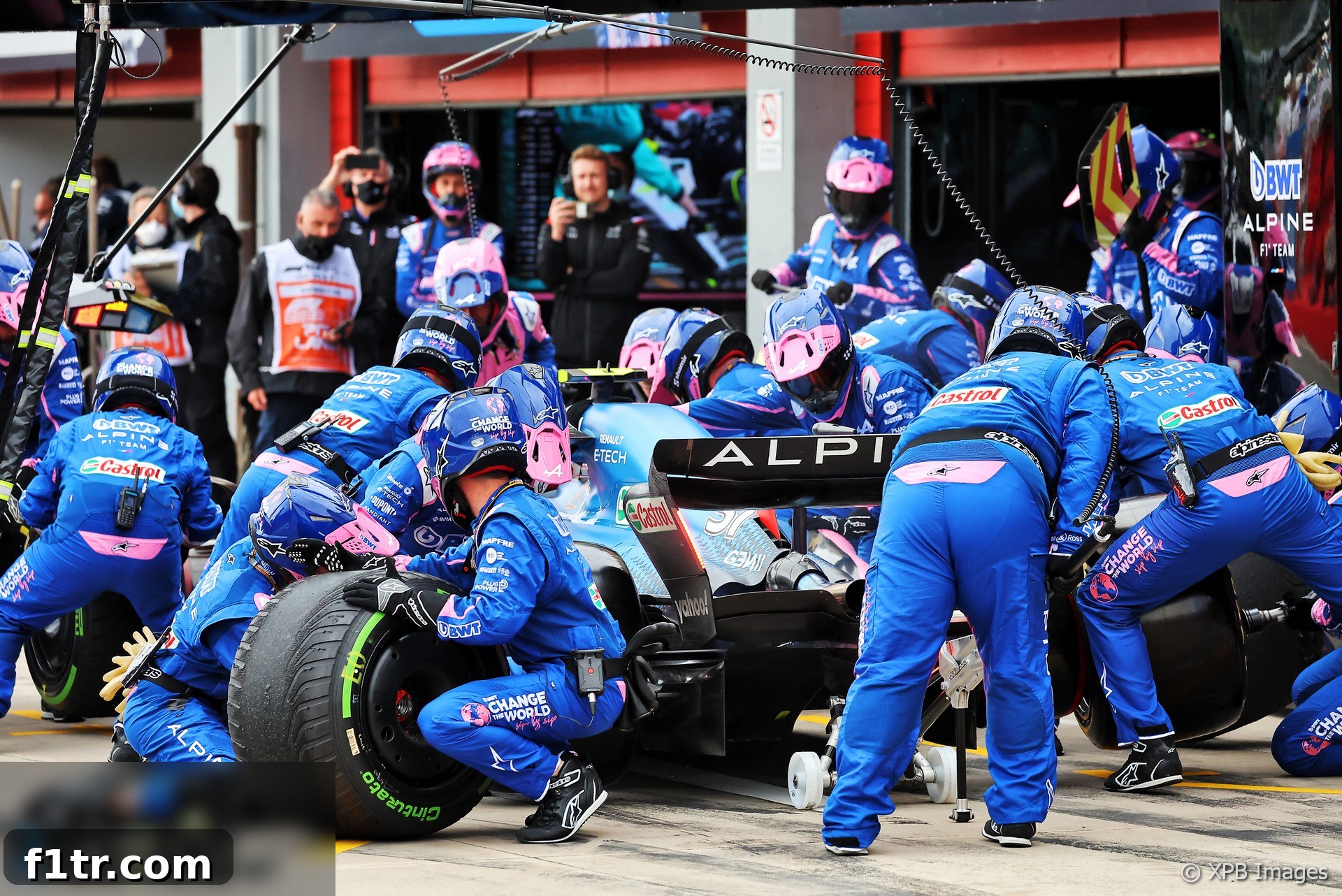
Alpine driver Esteban Ocon found himself embroiled in controversy at the Emilia-Romagna Grand Prix, vehemently disputing a five-second time penalty issued for what stewards deemed an unsafe release during a crucial pit stop. The incident, which saw Ocon’s car released directly into the path of Mercedes’ Lewis Hamilton, ignited a debate about pit lane safety protocols and the intense pressure of Formula 1 operations. Ocon firmly laid the blame on a piece of competitor pit equipment, specifically a hose, that he claimed was left obstructing his exit path, forcing him to take evasive action that inadvertently compromised Hamilton’s trajectory.
Advert | Become a Supporter & go ad-free
The contentious moment unfolded on lap 19 of the race when both Ocon and Hamilton peeled into the pit lane for their respective tire changes. As Ocon’s Alpine was cleared for release, he merged from his pit box simultaneously with Hamilton’s Mercedes, leading to a near-collision. Race stewards, after reviewing the evidence, concluded that Hamilton “had to take evasive action to prevent a collision,” a clear violation of the regulations designed to ensure the safety of drivers and pit personnel alike. This immediate ruling set the stage for Ocon’s post-race protestations.
Speaking to his race engineer, Josh Peckett, over the team radio immediately after the chequered flag, Ocon expressed his strong disagreement with the penalty. “I disagree with the penalty there,” he asserted, clarifying his perspective. “It was the tube that made me go left, the tube from the team in front.” This statement highlighted Ocon’s belief that an external factor, rather than a misjudgment on his or his team’s part, was the root cause of the incident. He was convinced that without the obstruction, the situation would have unfolded very differently, perhaps without any penalty or unsafe manoeuvre.
The consequences of the five-second time penalty were significant for Ocon. Despite crossing the finish line in a respectable 11th position, just outside the points, the added time relegated him to 14th place in the final classification. This outcome underscored the fine margins in Formula 1, where even a seemingly minor procedural infringement can drastically alter a driver’s race result and deny them crucial championship points. The frustration was palpable for the Alpine driver, who had pushed hard throughout the challenging conditions of the Emilia-Romagna Grand Prix.
“It’s a little bit frustrating, for sure,” Ocon reiterated after the race, elaborating on his disappointment. “We’re P11 and of course with that unsafe release, five seconds, that hurts our position.” He then returned to his core argument regarding the obstruction. “But I think what hurt that is really the tube that was left quite in the middle, almost at the fast lane. I had to squeeze Lewis because of that tube that was hanging.” His detailed account painted a picture of a driver reacting instinctually to an unforeseen obstacle in a high-pressure environment, rather than deliberately endangering another competitor or making a careless mistake during the pit stop procedure.
Ocon’s conviction was unwavering; he firmly believed that if the AlphaTauri team’s hose had not been in his path, “there would have been space for both of us” to safely exit their respective pit boxes. He affirmed his awareness of Hamilton’s position as he pulled away from his pit stall, indicating that he was not oblivious to his surroundings. “I was aware when I had to avoid the tube and then I saw he was there. It’s tight but of course it’s not safe to be that close to another car, that’s clear.” This nuanced explanation revealed the split-second decision-making required in the pit lane, where drivers must constantly balance caution with the imperative of a swift return to the track.
The stewards’ decision included a crucial detail: Ocon was not assessed any penalty points on his Super Licence for the incident. This particular aspect of the ruling underscored their understanding that “the infringement was caused by the unsafe release by the team,” rather than a direct error or dangerous driving by Ocon himself. In Formula 1, unsafe release penalties are typically directed at the team responsible for managing the pit stop, as they are ultimately accountable for ensuring that a car is released safely into the pit lane. This distinction is vital, as penalty points accumulate on a driver’s licence and can lead to race bans if a certain threshold is crossed, a consequence Ocon was spared.
Advert | Become a RaceFans supporter andgo ad-free
Understanding the nuances of unsafe releases in Formula 1 requires an appreciation for the incredibly complex and high-stakes environment of the pit lane. Pit stops are choreographed ballets of precision and speed, where fractions of a second can dictate race outcomes. Teams invest heavily in training their pit crews to execute flawless tire changes and repairs, often within two to three seconds. However, this pursuit of speed must always be balanced with an unyielding commitment to safety. Regulations stipulate that a car must not be released if doing so would impede another competitor or create a dangerous situation for personnel in the pit lane. Infrared sensors, traffic lights, and meticulous human oversight are all employed to minimize risks, yet human error or unforeseen external factors, like the stray pit equipment in Ocon’s case, can still lead to incidents. Penalties for unsafe releases are thus stringent, ranging from five-second time penalties to more severe twenty-second penalties or even drive-through penalties, depending on the severity and impact of the infringement. These rules are non-negotiable, acting as a critical safeguard for everyone operating in one of motorsport’s most perilous zones.
The 2022 Emilia-Romagna Grand Prix itself was a challenging event, marked by variable weather conditions and intense racing. Held at the iconic Imola circuit, it presented drivers with a formidable test of skill and nerve. For Mercedes, it was a particularly difficult weekend, with both Lewis Hamilton and George Russell struggling for pace compared to their rivals. Hamilton’s encounter with Ocon in the pit lane was just one of several moments that highlighted the pressure cooker environment of the race. Against this backdrop, Ocon’s fight for points, and his subsequent penalty, added another layer of drama to an already eventful Grand Prix. The incident served as a stark reminder that in the relentless pursuit of victory, every detail, from the position of a pit lane hose to the precise timing of a car’s release, can have profound implications on the race and the championship standings.
Ultimately, Esteban Ocon’s five-second time penalty for an unsafe release at the Emilia-Romagna Grand Prix sparked a significant discussion. While the stewards deemed an infringement had occurred and Lewis Hamilton was forced to react, Ocon’s explanation regarding the obstructing pit equipment offered a compelling counter-narrative. It highlighted the razor-thin margins and instantaneous decisions made under immense pressure in Formula 1’s pit lane, where external factors can sometimes complicate even the most practiced procedures. Despite the frustration of losing positions, the stewards’ decision to absolve Ocon of penalty points on his license acknowledged the team’s ultimate responsibility for the release, providing a measure of vindication for the driver. This incident remains a potent illustration of the constant vigilance required in F1, where the quest for speed must always yield to the paramount importance of safety.
2022 Emilia-Romagna Grand Prix Insights
- Aston Martin’s dedication pays off with first points after challenging Melbourne crashes
- Verstappen joins elite club as 14th driver to achieve multiple ‘grand slams’ in F1 history
- Transcript: “I need more power” – A look at Hamilton and Russell’s differing fortunes at Imola
- Ferrari supports expansion to six sprint races as F1 Commission convenes in London
- Ocon attributes penalty for near-miss with Hamilton in pits to misplaced equipment
Explore more articles from the 2022 Emilia-Romagna Grand Prix