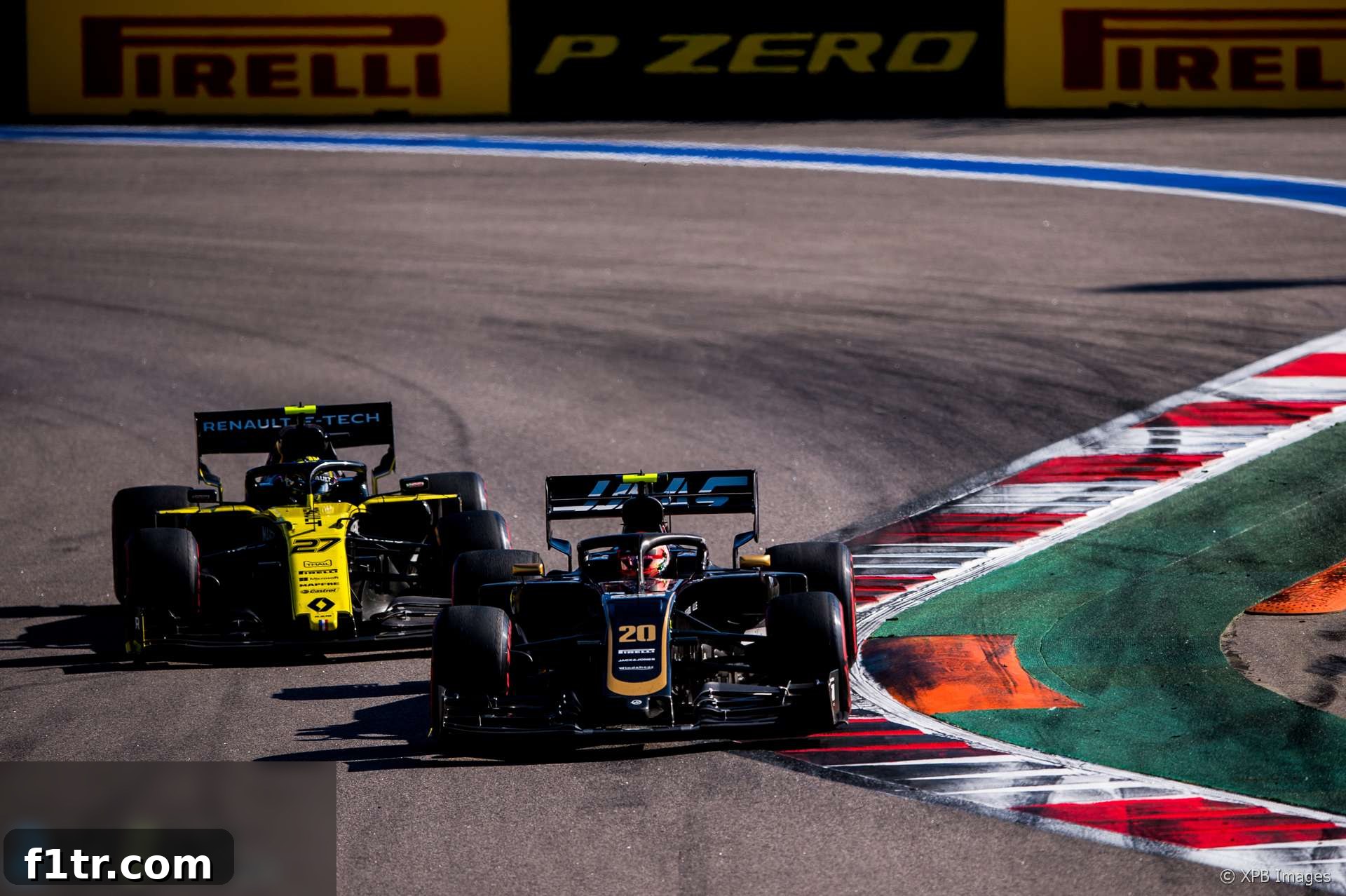
The aftermath of the Russian Grand Prix saw a fierce debate ignite around track limits, driver conduct, and the consistency of Formula 1 stewarding. At the heart of this controversy was Haas driver Kevin Magnussen and his fiery team principal, Guenther Steiner, both of whom expressed outrage over a five-second time penalty that ultimately cost Magnussen a well-deserved eighth-place finish. This incident, while specific to Magnussen, quickly became a focal point for a broader discussion concerning the application of rules across all racing series and the often-strained relationship between drivers, teams, and race officials.
Advert | Become a Supporter & go ad-free
Speaking with palpable frustration over the team radio immediately following the race, Magnussen vehemently dismissed his penalty for exceeding track limits at Turn 2 and failing to rejoin correctly, labeling it “bullshit.” His indignation didn’t subside after the checkered flag; he reiterated his criticism to the media, expressing a firm belief that the FIA would, upon review, acknowledge and correct what he perceived as an erroneous decision. This strong reaction from a driver, while not uncommon in the heat of the moment, set the stage for an even more dramatic confrontation.
Haas team principal Guenther Steiner escalated the rhetoric significantly, directly implicating the officials. His sharp words, describing the decision-making steward as “stupid, idiotic,” resonated with previous outbursts. Notably, this echoed a similar incident from May, where frustrations over another penalty led him to remark that “some of the stewards are just not up to being stewards.” Such direct and personal attacks on officials are rare and often carry serious implications within the tightly regulated world of motorsport, raising questions about decorum, respect, and the boundaries of criticism.
The Pervasive Problem of Turn 2: A Track Limits Saga
However, Magnussen’s penalty, and the subsequent uproar, was far from an isolated event. The critical Turn 2 at the Sochi Autodrom proved to be a consistent challenge for drivers across all categories competing that weekend. Ahead of the races on Saturday, F1, F2, and F3 drivers received explicit and detailed instructions from the race director regarding the proper procedure for navigating the run-off area at this problematic corner. These directives were clear: “Any driver who fails to negotiate turn two by using the track, and who passes completely to the left of the first orange kerb element prior to the apex, must re-join the track by driving to the left of the white blocks and remaining to the left of the orange block in the run off.”
This stringent instruction aimed to prevent drivers from gaining an unfair advantage by cutting the corner or compromising safety. Despite the clarity of these rules, the weekend’s racing saw a significant number of infractions. Over a mere 48 hours, an alarming total of nine different drivers—including Magnussen—fell afoul of this specific regulation. The stewards, to their credit, applied the rules with unwavering consistency, issuing identical five-second time penalties and one penalty point for each transgression. This consistent application, while frustrating for those penalized, underscores the impartiality of the officials in upholding the established guidelines.
A Clear Pattern: Penalties Across the Board
The following table illustrates the widespread nature of the issue, demonstrating that Magnussen’s incident was part of a larger pattern, not an isolated target of official scrutiny:
| Series | Event | Driver | Infraction | Penalty |
|---|---|---|---|---|
| F2 | Race one | Guanyu Zhou | Went off track at turn two and did not follow the instructions given by the race director in the driver briefing notes. | Five-second time penalty and one penalty point |
| F2 | Race one | Giuliano Alesi | Went off track at turn two, gained advantage and did not follow the instructions given by the race director in the driver briefing notes. | Five-second time penalty and one penalty point |
| F2 | Race one | Jordan King | Went off track at turn two and did not follow the instructions given by the race director in the driver briefing notes. | Five-second time penalty and one penalty point |
| F3 | Race two | Jehan Daruvala | Went off track at turn two and did not follow the instructions given by the race director in the driver briefing notes. | Five-second time penalty and one penalty point |
| F3 | Race two | Bent Viscaal | Went off track at turn two and did not follow the instructions given by the race director in the driver briefing notes. | Five-second time penalty and one penalty point |
| F2 | Race two | Sergio Sette Camara | Went off track at turn two and did not follow the instructions given by the race director in the driver briefing notes. | Five-second time penalty and one penalty point |
| F2 | Race two | Ralph Boschung | Went off track at turn two and did not follow the instructions given by the race director in the driver briefing notes. | Five-second time penalty and one penalty point |
| F2 | Race two | Mahaveer Raghunathan | Went off track at turn two and did not follow the instructions given by the race director in the driver briefing notes. | Five-second time penalty and one penalty point |
| F1 | Russian Grand Prix | Kevin Magnussen | Went off track at turn two and did not follow the instructions given by the race director in the driver briefing notes. | Five-second time penalty and one penalty point |
Advert | Become a RaceFans supporter andgo ad-free
The Quest for Consistency: A Double-Edged Sword
The key takeaway from the multitude of penalties handed out over the weekend is the unquestionable consistency demonstrated by the stewards. While Magnussen argued that his particular rejoin at Turn 2 did not confer any tangible advantage, it’s crucial to note that the majority of other penalized drivers were similarly not deemed to have gained an advantage in terms of lap time. The penalty was not for gaining an advantage, but for failing to follow the prescribed rejoining procedure after leaving the track. This distinction is vital for understanding the stewards’ application of the rules.
Time and again, drivers and teams alike publicly demand consistency from race stewards. They argue that clear, predictable application of rules is paramount for fair competition. In this specific instance, the stewards delivered precisely that. Had Magnussen, or the Haas team, been more attentive to the eight identical penalties issued in the F1 support races that preceded the Grand Prix, they might have anticipated the enforcement of the rule and perhaps even altered Magnussen’s approach to Turn 2. The fact that he became the sole F1 driver to receive such a penalty suggests a potential oversight on their part, rather than an arbitrary targeting by officials.
Steiner’s Vehement Criticism and the FIA’s Measured Response
Steiner’s pointed criticism, particularly his personal attack on a steward, naturally raised questions about potential repercussions from the governing body. Such public disparagement of officials is typically not tolerated lightly. A precedent exists from three years prior, when Sebastian Vettel was compelled to issue a formal apology after heatedly disputing a penalty call with the then-Race Director, Charlie Whiting, over the radio. This incident underscored the importance of maintaining professional conduct, even in moments of high tension.
On Sunday evening in Sochi, Whiting’s successor, Michael Masi, addressed the situation with a measured and diplomatic tone. While stating he hadn’t directly heard Steiner’s comments, Masi carefully outlined the various established judicial processes within the FIA that could be invoked to investigate such remarks and take appropriate action. “The FIA’s got its various judicial processes, be it at the circuit [with] the stewards, there’s various other processes and avenues that exists within the judicial and disciplinary rules that the FIA has,” he explained.
Masi further emphasized the need for mutual respect within the sport: “I’ve heard about the comments that were made on the radio, I haven’t seen them directly so I’m not going to comment on what those are. At the end of the day, we’re all here to do a job be it officials, the teams, everyone. So I think there has to be a level of mutual respect.” He reiterated his stance on not commenting directly without full knowledge of the remarks, but left little doubt about the FIA’s capacity to act if inappropriate language was used. “But with regard to the specific comments I haven’t seen them so I prefer not to comment on them until I have. If something’s been said that’s inappropriate there’s those that are in charge of the judicial elements away from the event that can look at it.” This response highlighted the FIA’s structured approach to handling disciplinary matters, ensuring that any actions taken would be based on due process rather than immediate reaction.
Beyond the Outrage: A Call for Objectivity
While Haas had experienced previous decisions that might have been considered “borderline,” the penalty for Magnussen at Turn 2 clearly did not fall into that category. The instructions were explicit, the infraction was evident, and the penalty was applied with undisputed consistency across multiple racing series and drivers. In light of this, the team’s strong, emotional reaction, particularly Steiner’s inflammatory remarks, may ultimately prove to be regrettable. Objectively, the situation was a clear violation of a well-defined and consistently enforced rule. This incident serves as a crucial reminder that while emotions run high in competitive motorsport, adherence to regulations and respect for the officiating process remain fundamental pillars of the sport.
Quotes: Dieter Rencken
Advert | Become a RaceFans supporter andgo ad-free
2019 F1 season
- Crying in the Melbourne car park at 2019 grand prix was my career low – Ocon
- McLaren Racing reports reduced £71 million loss in 2019
- Kvyat: Hockenheim podium last year was “my biggest achievement” so far
- How the FIA’s new encrypted fuel flow meter targets Ferrari’s new ‘aliasing’ trick
- “He smashed my office door”: 23 must-see moments from ‘Drive to Survive’ season two
Browse all 2019 F1 season articles