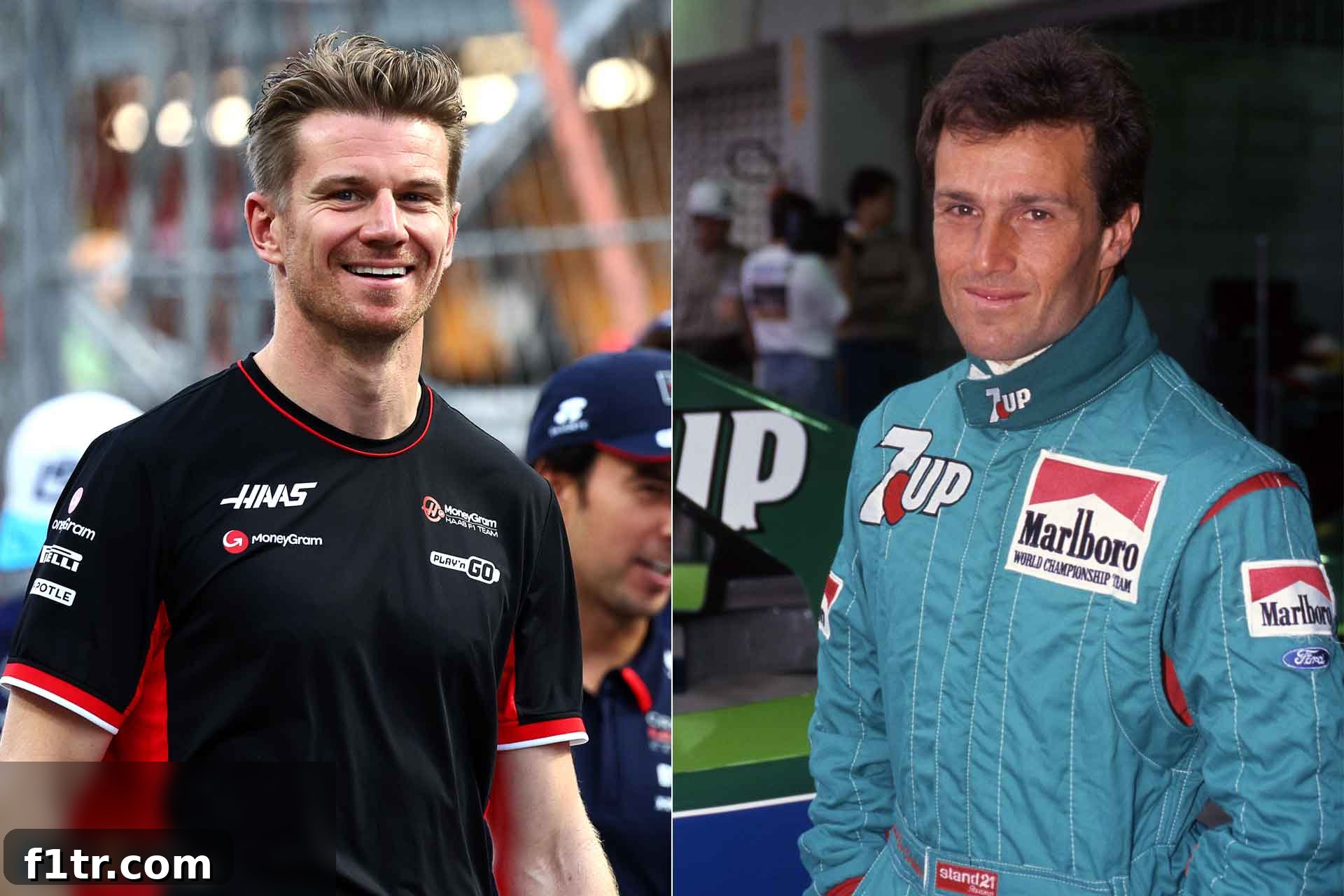
In the high-octane world of Formula 1, where legends are forged in victory and records are meticulously documented, a unique, almost melancholic milestone was reached at the recent Chinese Grand Prix. German driver Nico Hulkenberg, a veteran of the sport known for his immense talent and consistent performance, officially equalled the record for starting the most Grands Prix without ever clinching a win. His 208th start drew him level with the enigmatic Italian racer Andrea de Cesaris, a record that has stood unchallenged for three decades.
This achievement, or rather, the lack thereof, casts a spotlight on the fine margins between F1 success and a distinguished, yet unrewarded, career. For Hulkenberg, this record carries an additional layer of distinction: he already holds the unenviable title for the most Grand Prix starts without ever appearing on the podium. De Cesaris, despite his own lengthy winless streak, at least managed to visit the rostrum twice during his illustrious career. This dual record makes Hulkenberg’s journey in Formula 1 particularly poignant, highlighting a career brimming with potential and strong performances, yet perpetually missing that ultimate breakthrough moment.
The Parallel Paths: Nico Hulkenberg and Andrea de Cesaris
Both drivers’ careers spanned an impressive 14 years, a testament to their enduring presence and dedication to the pinnacle of motorsport. However, their paths, personalities, and the eras they raced in present a fascinating contrast.
Andrea de Cesaris: The Enigmatic Italian Daredevil
Andrea de Cesaris made his Formula 1 debut in 1980 with Alfa Romeo, the first of ten different teams he would represent before his retirement in late 1994. Throughout his career, de Cesaris cultivated a reputation that earned him the moniker “Andrea de Crasheris” due to his frequent incidents and the substantial toll he took on his machinery. Despite his raw speed and aggressive driving style, consistency often eluded him, leading to spectacular crashes that became a hallmark of his time in F1. Indeed, his tenure with Ligier was cut short in 1985 following a particularly costly string of accidents.
Yet, to dismiss de Cesaris purely as a crash magnet would be an injustice. He possessed undeniable flashes of brilliance that hinted at extraordinary, albeit unfulfilled, potential. He famously secured pole position at the 1982 Long Beach Grand Prix with Alfa Romeo, demonstrating blistering one-lap pace. The 1983 season saw him achieve two second-place finishes, further solidifying his capability to run at the front. Perhaps his most memorable, near-victory performance came at the 1991 Belgian Grand Prix for the nascent Jordan team, where he ran strongly in second place for much of the race, tantalizingly close to a maiden win, only for his car to expire within sight of the finish line. His lengthy career, spanning over a decade and a half, was often sustained by the unwavering support of key sponsors like Marlboro, a common lifeline for many drivers in that era, demonstrating that even with a wild reputation, inherent speed and commercial backing could prolong an F1 journey.
Nico Hulkenberg: The Highly-Rated Prodigy
In stark contrast to de Cesaris’s tumultuous entry, Nico Hulkenberg arrived in Formula 1 in 2010 with a sky-high reputation, having systematically dominated junior categories. His prowess was evident early on: he led Germany to victory in A1 Grand Prix, clinched the Formula 3 Euroseries title, and, impressively, won the GP2 (now Formula 2) championship on his debut, mirroring the feat achieved by none other than Lewis Hamilton three years prior. This exceptional junior record marked him as a future F1 star, widely expected to ascend rapidly through the ranks.
His promising debut season with Williams culminated in a truly stunning pole position at the 2010 Brazilian Grand Prix, showcasing his raw speed and ability to perform under pressure. This performance was a clear indicator of his potential to become a front-runner. However, the harsh financial realities of Formula 1 intervened. Despite his talent, the cash-strapped Williams team had already decided to replace Hulkenberg with Pastor Maldonado, whose Venezuelan sponsors brought a significant financial injection, highlighting the perennial struggle between pure talent and economic necessity in securing an F1 seat.
Advert | Become a RaceFans supporter andgo ad-free
After a year on the sidelines as a test driver, Hulkenberg made an impressive return to the grid in 2012 with Force India (now Aston Martin). That very year, he came agonizingly close to victory at Interlagos, leading a remarkable 30 laps before a collision with Lewis Hamilton ended his hopes. It was a cruel twist of fate that encapsulated much of his career – near-misses and unfortunate circumstances. He then made what many considered an ill-advised switch to Sauber for 2013, only to rejoin his former team, Force India, where he remained for three more seasons. During this second stint, while consistently performing at a high level, he was unable to replicate his teammate Sergio Perez’s occasional breakthroughs into the top three. A blend of strategic missteps, reliability issues, and sheer bad luck seemed to conspire against him whenever a genuine podium opportunity arose.
His move to the factory Renault team in 2017 was widely seen as his definitive chance to lead a manufacturer-backed operation to the front of the grid and finally secure that elusive podium. The anticipation was palpable, yet further podium opportunities continued to elude him. Perhaps the most painful near-miss came at his home Grand Prix in Germany in 2019, where he was running strongly in contention before a crash in challenging wet conditions dashed his hopes. He was subsequently dropped by Renault at the end of that year, a decision that deeply disappointed many fans and pundits who believed he deserved a stronger outcome.
Following a period of acting as a “super-sub” for teams like Racing Point and Aston Martin, impressing with his ability to jump into a car and perform immediately, Hulkenberg made a full-time return to Formula 1 with Haas. Here, he has once again showcased his formidable one-lap pace and race craft. However, the equipment at his disposal has not yet allowed him to genuinely challenge for the podium finish that is now long overdue, let alone a victory. His continued presence and strong showings, even in less competitive machinery, speak volumes about his enduring talent and determination, keeping alive the hope that one day, he might just break his remarkable duck.
Career Summaries: de Cesaris and Hulkenberg – A Statistical Glance
While statistics never tell the full story, they offer a stark comparison between these two drivers who share a unique place in F1 history.
| Nico Hulkenberg | Andrea de Cesaris | |
|---|---|---|
| Starts | 208 | 208 |
| Participations | 225 | 214 |
| Best race finish | 4th (x3) | 2nd (x2) |
| Best championship finish | 7th (2018) | 8th (1983) |
| Best grid position | 1st (1) | 1st (1) |
| Teams | Williams (2010) Force India (2012, 2014-16) Sauber (2013) Renault (2017-19) Racing Point (2020) Aston Martin (2022) Haas (2023-24) |
Alfa Romeo (1980, 1982-83) McLaren (1981) Ligier (1984-85) Minardi (1986) Brabham (1987) Rial (1988) Scuderia Italia (1989-90) Jordan (1991, 1994) Tyrrell (1992-93) Sauber (1994) |
Advert | Become a RaceFans supporter andgo ad-free
The Enduring Quest for Victory
The shared record of Nico Hulkenberg and Andrea de Cesaris speaks volumes about the brutal realities of Formula 1. It underscores that talent, raw speed, and even sustained presence in the sport are not always enough to secure the ultimate prize. The confluence of car performance, team strategy, reliability, and sheer luck often dictates a driver’s fate more than individual brilliance alone.
De Cesaris’s career, defined by breathtaking speed and equally breathtaking accidents, symbolizes a bygone era of F1 where daring and often uncontrolled aggression were more common. His podiums, despite the crashes, showcased his genuine ability to challenge the established order when his car held together. Hulkenberg, on the other hand, represents the modern F1 driver: precise, consistent, technically adept, yet seemingly cursed by circumstances. His dominance in junior categories and multiple near-misses in F1 paint a picture of a driver who has consistently maximised his machinery, often outperforming expectations, but never quite being in the right place at the right time with the right car.
The psychological toll of such a long career without a victory or even a podium must be immense. Every race start is a renewed hope, a fresh opportunity to rewrite the narrative. For Hulkenberg, particularly, the pursuit of that maiden podium, let alone a victory, has become a defining aspect of his Formula 1 story. It’s a testament to his resilience, passion, and belief in his abilities that he continues to compete at the highest level, year after year, refusing to let the weight of these records define his entire legacy. While 208 winless starts marks a historical moment, it also fuels the collective hope of fans that “The Hulk” will one day stand atop the podium, proving that perseverance can indeed conquer even the most stubborn of records.
De Cesaris and Hulkenberg’s Careers in Pictures
Advert | Become a RaceFans supporter andgo ad-free
2024 Chinese Grand Prix Related News
- Alonso and Sainz incidents prompt changes to Formula 1’s rules
- Aston Martin fail in bid to have Alonso’s Shanghai penalty reviewed
- Mercedes cleared over Hamilton pit stop infraction as ‘nearly all teams in breach’
- Aston Martin petitions FIA to review Alonso’s penalty for Sainz collision
- “You need to be more on it”: 12 unheard radio exchanges from the Chinese GP
Browse all 2024 Chinese Grand Prix articles