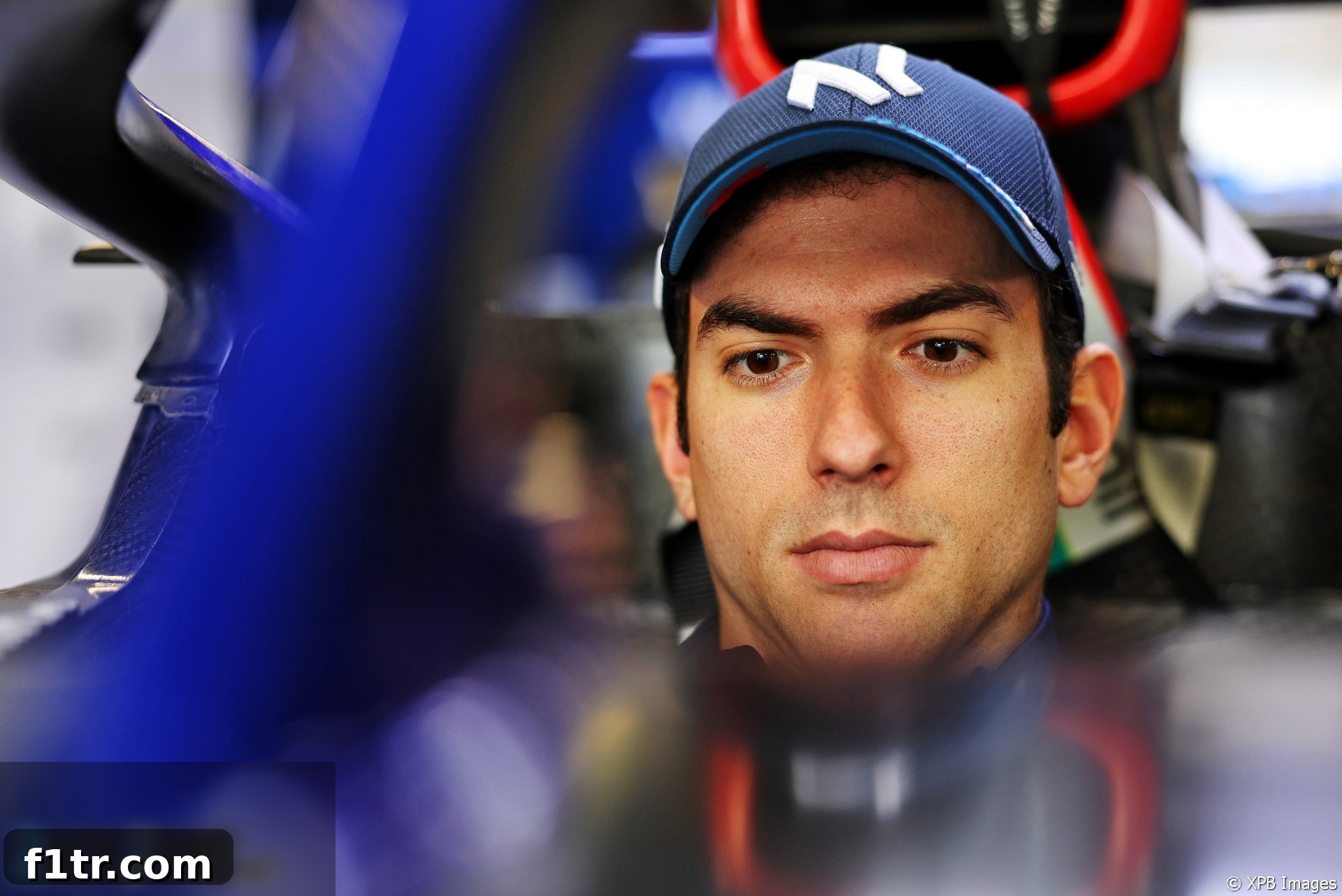
Nicholas Latifi’s 2022 F1 Season: A Candid Look at a Challenging Farewell
Stepping into carbon-fibre rocketships to do battle at over 320kph across 22 gruelling weekends solidifies Formula 1 drivers’ status as some of the planet’s bravest athletes. The sheer skill, courage, and mental fortitude required to compete at this elite level are immense, making it a dream for many but a reality for only a select few. Yet, amidst the high-octane drama and incredible feats of speed, the 2022 F1 season presented a stark reality for one driver: Nicholas Latifi. It would be a disservice to the sport’s high standards to suggest anything but that his performance during this campaign positioned him as the season’s most underperforming driver.
Latifi’s journey at motorsport’s pinnacle appeared to reach its poignant conclusion at the end of his third F1 campaign with Williams Racing. For observers and analysts alike, the reasons for his departure were painfully clear, underscored by a series of events and a persistent struggle for pace that defined his year.
A Season Defined by Struggle: Navigating the Williams FW44
Throughout the 2022 season, Nicholas Latifi consistently found himself at the rear of the field, often qualifying and finishing as the slowest driver among his peers. While it is crucial to acknowledge that he was typically behind the wheel of what was widely regarded as the slowest and most challenging car on the grid – the Williams FW44 – the performance gap to his teammates and competitors was undeniable and often significant. The FW44, with its inherent handling characteristics and lack of outright speed, proved a formidable beast for any driver to tame, but Latifi seemed to extract less from it than others.
His struggles were frequently punctuated by what many described as bewildering blunders, incidents that seemed to compound his difficult season and draw unwelcome attention. One notable example occurred in Singapore, where, under challenging conditions, he inexplicably drove into Zhou Guanyu’s Alfa Romeo as the latter pulled alongside him, ending both their races prematurely and raising questions about his spatial awareness. Another unfortunate incident took place during a wet Monaco Grand Prix. On the formation lap, a crucial stage for tyre temperature and focus, Latifi crashed, necessitating a pit stop for a new front wing before the race had even officially begun. To add to his woes, he then ran off the track at Sainte Devote shortly after, falling even further adrift of the main pack. Perhaps the most memorable, and certainly the most publicised, mishap occurred at Suzuka. During Friday practice, he mistook a shortcut designed for a shorter track variant before the final chicane, generating millions of video views and becoming the subject of widespread, if ruthless, mockery across social media platforms.
These exploits, regrettably, solidified his status as an ironic joke character among the fervent online F1 fandom. This perception grew throughout the season, creating a narrative that often overshadowed any potential competency he might have possessed behind the wheel – a competency that, in fairness, might have been superior to many other drivers recalled from the long and storied history of Formula 1. The pressure of this public image, combined with the on-track difficulties, created a challenging environment for Latifi, one where every mistake was amplified and every struggle scrutinised.
In truth, Latifi’s struggles began right from the very start of the 2022 season. The opening round in Bahrain provided an immediate and stark comparison with his new teammate, Alex Albon. Albon, returning to F1 after a year out, immediately impressed by qualifying his Williams car in a respectable 14th position. Latifi, by contrast, qualified 20th and last. Just a week later, at Jeddah, the situation worsened. Crashing out in Q1 was certainly not ideal, but it wasn’t a complete disaster. However, his unforced, race-ending error the very next day, a solo spin into the wall, was undoubtedly one of the more embarrassing and defining moments of his early season, setting a concerning tone for the remainder of his campaign.
The Unyielding Benchmark: Alex Albon’s Return and Impact
As the season progressed, it became increasingly clear that Nicholas Latifi simply could not match the performance level Alex Albon was consistently extracting from the Williams car. Albon’s return to Formula 1 was marked by an immediate adaptability and a string of impressive performances that highlighted the performance gap between the two drivers. Despite driving the same machinery, Albon managed to snipe crucial points in several races, demonstrating a nuanced understanding of the car and an ability to capitalise on opportunities when they arose.
Albon’s ability to extract points from the notoriously difficult FW44 was a testament to his skill and experience. He secured a valuable point in Melbourne, followed by another in Miami, and then a remarkable performance at Spa-Francorchamps. These results were achieved in a car that rarely threatened the top ten, illustrating Albon’s capacity to push the limits and deliver when it mattered most. Over this same span of races, Latifi only managed to finish inside the top 15 once, further accentuating the performance disparity and increasing the pressure on him to deliver.
Monza: The Race That Sealed a Fate
The Italian Grand Prix at Monza, with its high-speed straights and minimal downforce requirements, was always considered to be Williams’s best chance for points. The slippery nature of the FW44, which exhibited a comparatively high top speed, presented a genuine opportunity for Latifi to potentially fight for an outside chance of a championship point. This was his big moment, a chance to demonstrate his capabilities on a circuit that theoretically suited the car’s strengths.
However, fate intervened in the most dramatic fashion. Alex Albon fell ill on Saturday morning and was suddenly replaced by reserve driver Nyck de Vries, making his last-minute F1 debut. What transpired next was nothing short of a pivotal moment in Latifi’s career. The F1 debutant immediately out-qualified the team’s regular driver, Latifi, sending shockwaves through the paddock and beyond. Not only did De Vries impress in qualifying, but he also put together an incredibly composed race performance. He held his position on the opening lap while his vastly more experienced teammate dropped four places, and then went on to finish an astounding ninth, securing points on his very first F1 outing. Latifi, meanwhile, crossed the line in 15th place. If there was any doubt remaining about Latifi’s future with Williams, or indeed in Formula 1, the events of Monza irrevocably sealed his fate. It was a stark and undeniable comparison that highlighted the urgent need for Williams to re-evaluate their driver line-up.
Glimmers of Promise: Moments of Resilience and Skill
While the 2022 season was largely defined by struggle, it would not be entirely accurate to suggest that Latifi’s campaign was devoid of any highlights. There were fleeting moments where his inherent skill and determination shone through, offering glimpses of what he was truly capable of under specific conditions. One such moment came at the British Grand Prix at Silverstone. Latifi arrived at the circuit without the shiny new upgrades that had been fitted to his teammate’s car, placing him at an immediate disadvantage. However, in a rain-affected qualifying session, where driver skill often transcends car performance, he not only managed to squeeze through into Q2 at the expense of Albon, but he took it one step further by reaching Q3 for the very first time in his career. Yes, he may have spun off into the gravel during Q3, which ultimately ensured he would start tenth, but it was still a genuine achievement, a moment to be immensely proud of, demonstrating his capability in tricky, changeable conditions.
Another notable highlight arrived at the Japanese Grand Prix, once again held in challenging wet conditions. Latifi, showing commendable strategic thinking and bravery, took a decisive gamble on an early switch to intermediate tyres. This bold move paid off handsomely, allowing him to gain track position. He then displayed remarkable composure and car control, keeping his Williams on the track over the final 20 demanding laps to cling onto a superb ninth place. This performance secured his first and, as it turned out, only points finish of the season, a truly hard-fought result in treacherous circumstances. Yet, even this accomplishment couldn’t entirely escape the shadow of his season-long narrative. After getting memorably lost and taking the Suzuka shortcut in Friday practice, he could not even fully enjoy his best result of 2022 without once again becoming the butt of jokes online. This recurring theme highlighted how deeply embedded the perception of him as a struggling driver had become.
The Farewell: A Legacy Beyond Results
By this point in the season, his impending departure from Williams and, by extension, likely from Formula 1, was already public knowledge. The series of events throughout the year, culminating in the Monza performance, solidified the team’s decision to seek a change. The mishaps and the consistent performance gap to his teammates seemed to sum up the overarching perception of Latifi as a driver that had steadily built up over his three years in F1. Facing the stark reality of being out of a drive for the following year and, quite possibly, for the remainder of his professional racing career at the highest level, Latifi himself admitted with candour that his third season had probably been his worst, precisely when he needed to produce his best performances to secure his future.
However, despite having likely raced his last Grand Prix and concluding a Formula 1 career that didn’t yield the results he or his supporters had hoped for, Nicholas Latifi leaves the sport knowing that he does so with the profound respect of his former team, Williams Racing, and his peers on the grid. While his on-track performance was a consistent talking point, his character, professionalism, and positive attitude in the face of immense pressure and criticism never faltered. He remained a well-liked and respected figure within the paddock, demonstrating sportsmanship and grace even when grappling with significant personal and professional challenges. This legacy of character, often overlooked in the cutthroat world of F1, is a testament to the man behind the helmet and offers a different kind of achievement as he closes this chapter of his racing life.
2022 F1 season
- Mercedes told me “you’re wrong” about 2022 car’s problems – Hamilton
- FIA confirms all 10 F1 teams complied with 2022 cost cap
- Steiner “not ashamed” of panning “slow” Schumacher in Drive to Survive
- Albon believes year out of F1 improved him as a driver
- Hamilton sees diversity gains in F1 years on from his ‘traumatising’ experience of racism
Browse all 2022 F1 season articles