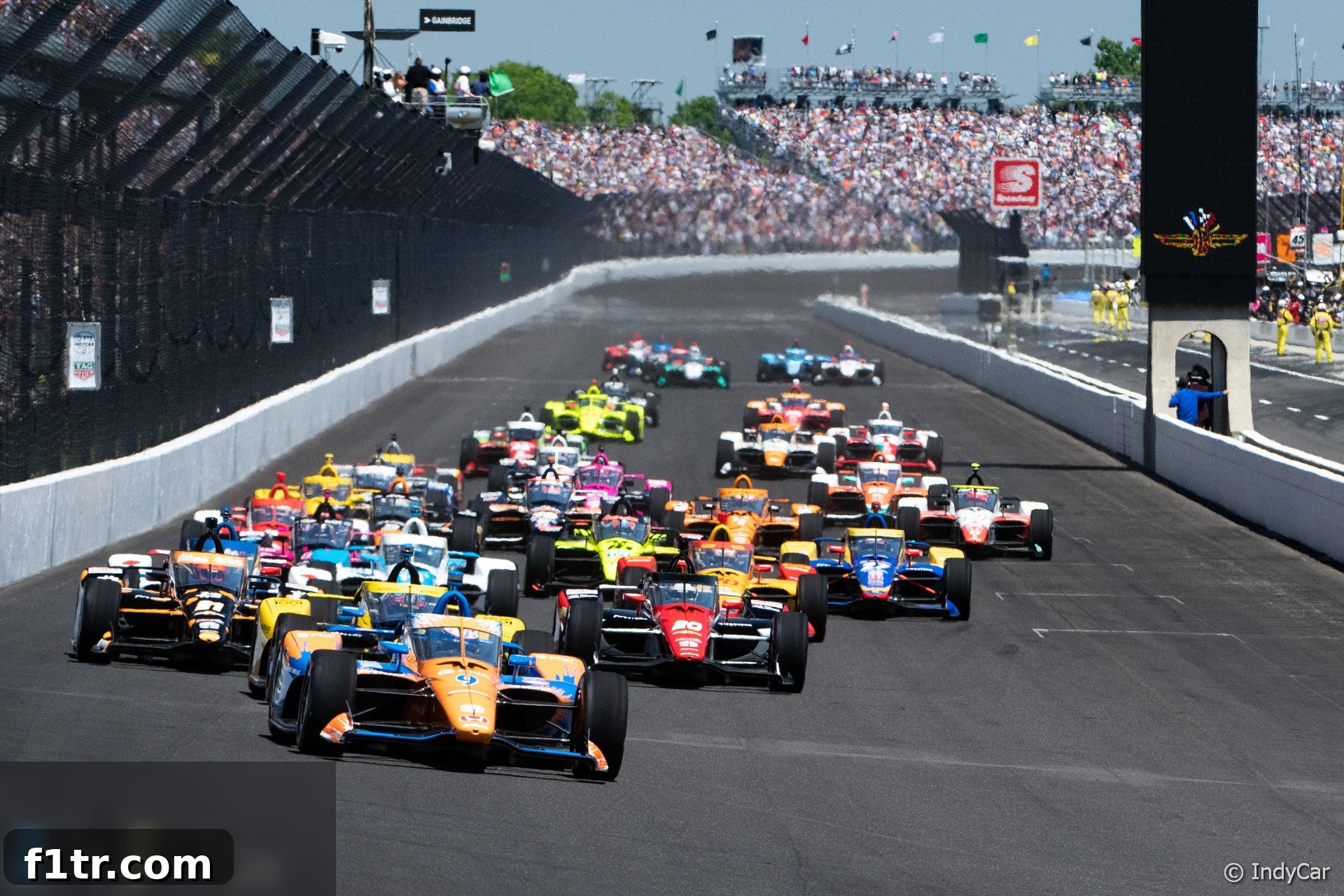
Two-time IndyCar champion Josef Newgarden has openly shared his evolving perspective on Formula 1, indicating that its allure has significantly diminished compared to his earlier career aspirations. While once a captivating prospect, the global pinnacle of motorsport no longer holds the same profound appeal for the seasoned American driver, who now predominantly prioritizes the pure competitive spirit and balanced racing environment found within the NTT IndyCar Series.
Newgarden’s Illustrious Journey: From Europe to IndyCar Stardom
Newgarden’s distinguished career in motorsport commenced with developmental stints on European racing circuits, a formative period that laid the groundwork for his future successes. However, his definitive path led him back to the United States in 2011. This pivotal year proved transformative as he secured the Indy Lights championship, a crucial stepping stone that propelled him directly into the fiercely competitive world of the IndyCar Series. Since his graduation, Newgarden has etched his name into the annals of IndyCar history, amassing an impressive tally of 20 race victories and clinching two coveted championship titles. His consistent excellence was further highlighted in the most recent season, where he secured the runner-up position for the second consecutive year, showcasing his enduring capability at the very top of the sport. Despite his unwavering dedication and success in IndyCar, the 31-year-old maintains a profound respect for Formula 1’s engineering marvels and its vast global footprint, yet he finds himself increasingly drawn to the unparalleled level of competition and driver-centric focus that defines IndyCar racing today.
The Shifting Appeal: F1’s “Gravity of the Cars” vs. IndyCar’s Driver Focus
Delving into the reasons behind his shifting perspective, Newgarden articulated the initial magnetic pull of Formula 1 during his formative years. “For me, the allure of F1 is the gravity of the cars,” he explained. “When I think of F1, I think about a manufacturer’s championship and trying to build the quickest cars that you can within a reasonable – or I should say an unreasonable – budget. That’s what was exciting about it.” This statement vividly captures his early admiration for F1’s relentless pursuit of technological frontiers, where groundbreaking innovation and monumental financial investments coalesce to create the fastest and most aerodynamically sophisticated machines on the planet. The high-stakes quest for ultimate speed, predominantly driven by the vast resources of global manufacturers, once presented an overwhelmingly compelling vision for an ambitious young racer.
However, as Newgarden’s career matured and his understanding of professional motorsport deepened through years of intense competition, his perception of Formula 1 underwent a significant evolution. “But the older I’ve gotten, the more I’ve been in racing and watched Formula 1, I don’t know that it’s somewhere I really want to race. It doesn’t look as much of a driver’s championship to me,” he candidly stated. This profound shift in outlook underscores a fundamental divergence in philosophy between the two premier open-wheel series. While F1 undeniably stands as a showcase for cutting-edge automotive technology and engineering prowess, Newgarden now increasingly perceives it as a contest primarily influenced and often decided in the design offices and vast factories of the competing teams, rather than solely by the raw skill and dexterity of the driver behind the wheel. The sustained dominance of a select few top-tier teams, frequently dictated by their superior financial backing and developmental capabilities, can often overshadow individual driving talent, making the path to consistent victory appear significantly more constrained for many.
IndyCar: The “Most Competitive Product” for Drivers
Newgarden, ever the pragmatist, acknowledges Formula 1’s enduring global prestige: “It’s a very impressive championship, it always has been. It’s something I would certainly like to do, I’d like to drive everything that I could do to have the experience and then I’d have more first-hand knowledge to really speak on it.” This comment indicates that, given a legitimate opportunity, he would still embrace the unique experience of piloting an F1 car, if only to gain a complete, firsthand understanding of its capabilities. Yet, his ultimate conviction and passion lie firmly with IndyCar: “But I think IndyCar is really where you’re going to get the most competitive product as a racing driver.” This powerful assertion encapsulates his deeply held belief that IndyCar offers a truer, more authentic test of a driver’s raw talent and adaptability, where the equipment is more closely matched across the grid, and individual performance plays a far more decisive role in determining race outcomes and championship glory. This competitive parity creates an environment where more drivers and teams have a genuine shot at victory on any given weekend.
The Influx of F1 and F2 Talent: A Testament to IndyCar’s Appeal
Newgarden’s insights are further validated by a noticeable and growing trend within the global motorsport community: IndyCar has become an increasingly attractive destination for high-profile drivers transitioning from both Formula 1 and Formula 2. Over the past couple of seasons, a significant influx of established talents has made the transatlantic move, with notable names such as Romain Grosjean, Callum Ilott, and Christian Lundgaard all committing to full-time campaigns in the series. These drivers, having competed at the very highest echelons of European single-seater racing, are choosing IndyCar because it offers compelling opportunities for competitive racing and genuine championship contention, which may be increasingly scarce in F1’s limited and highly coveted top-tier seats. Beyond full-time commitments, former F1 driver Kevin Magnussen also made a memorable one-off appearance in the series as a substitute, demonstrating its appeal even for temporary stints, and Nico Hulkenberg participated in a comprehensive test session with McLaren SP in 2021, further underscoring the interest from seasoned F1 veterans. This ongoing influx of accomplished European racing talent not only significantly raises IndyCar’s international profile but also powerfully validates Newgarden’s assertion about its inherently competitive and rewarding nature for drivers.
Competitive Balance: The Key to Driver Opportunity
A pivotal factor contributing to IndyCar’s undeniable appeal, as highlighted by Newgarden, is the significantly greater opportunity for individual success it affords its drivers. He points to the impressive statistics from last year’s IndyCar season, where a remarkable nine different drivers celebrated victories across just 16 intensely contested races. This striking diversity in winners stands in stark contrast to Formula 1’s 22-round calendar, which, despite being substantially longer, yielded only six different winners – a figure that was widely considered the most diverse in F1 since 2012. This notable disparity emphatically underscores the competitive balance inherent within IndyCar, where a much wider array of teams and drivers genuinely contend for wins on merit, fostering a more unpredictable, exhilarating, and ultimately more satisfying championship battle for both participants and fans alike.
“When you’re a driver at the top level, you want to have an opportunity to compete, to win the championship and to win big races regardless of your situation,” Newgarden emphasized, articulating a fundamental desire for any elite athlete. “And I think unfortunately, that’s not present in Formula 1. So from that standpoint, it’s not as appealing.” This articulation cuts directly to the core of his current disillusionment with F1. For many professional racing drivers, the ultimate aspiration is not merely to participate at the sport’s highest level, but to genuinely compete for victories and ultimately, championships. If the fundamental structure of a racing series inherently limits this opportunity to only a select few teams blessed with astronomical budgets and superior development resources, it inevitably diminishes its appeal to drivers who prioritize genuine on-track competition and the chance to consistently prove their individual worth against the best.
American Talent in F1 and Newgarden’s IndyCar Dedication
The conversation surrounding American drivers in Formula 1 is a perennial one, and it remains particularly pertinent. The series has notably lacked a consistent American presence since Alexander Rossi’s relatively brief stint in 2015 – a driver who, interestingly, subsequently found a highly successful and enduring home in the IndyCar Series. While Newgarden, ever the pragmatist, would never categorically rule out an F1 opportunity – acknowledging the unpredictable and dynamic nature of racing careers – his primary focus and unwavering dedication lie firmly with IndyCar, a series he has championed and helped elevate.
“I’d never say never on anything, you just never know how this stuff shifts,” he remarked, maintaining an open mind about any unforeseen future possibilities in his distinguished career. However, his profound connection and commitment to IndyCar are undeniable and deeply personal: “But for me, IndyCar is my life. It’s a championship I care about more than any in the world. And I want to see it flourish because it really deserves a lot of recognition, I think, for the incredible championship it is.” Newgarden’s commitment extends far beyond his personal career aspirations; he is a passionate and vocal advocate for the continued growth, increased visibility, and broader recognition of IndyCar. He genuinely believes that the series, with its hallmark close racing, diverse roster of winners, and unwavering emphasis on pure driver skill, offers a compelling and authentic spectacle that richly deserves a wider global audience and greater appreciation from motorsport enthusiasts worldwide.
The Evolving Landscape of Motorsport: A Driver’s Perspective
The evolving landscape of top-tier motorsport suggests a fascinating divergence in priorities for elite racing drivers across the globe. While Formula 1 continues to undoubtedly represent the absolute pinnacle of automotive engineering, technological innovation, and grand global spectacle, IndyCar is progressively carving out a distinct and highly valued niche as the ultimate “driver’s championship.” It consistently offers genuine, accessible opportunities for a broader and more diverse field of competitors to vie for victory on any given race weekend. Josef Newgarden’s insightful journey, coupled with his articulate and honest reflections, serves as a powerful testament to this significant shift in perception. His perspective highlights the increasing appeal of a series where raw talent, strategic prowess, and an unyielding competitive spirit can truly shine and dictate outcomes. His unwavering dedication and vocal advocacy for IndyCar not only reinforces its growing stature within the international motorsport community but also signals a promising and vibrant future for North American open-wheel racing, continually driven by a profound desire for pure, unadulterated, and fiercely competitive motorsport.
More on IndyCar
- IndyCar driver McLaughlin cleared of injury after crashing through barrier at Barber
- Schumacher says his IndyCar feels like ‘an F2 car, just with better tyres’
- IndyCar “way faster than Formula 1” in some corners, says Grosjean
- FIA to award more F1 superlicence points to IndyCar drivers from 2026
- Schumacher to race full-time in IndyCar with RLL in 2026
Browse all IndyCar articles