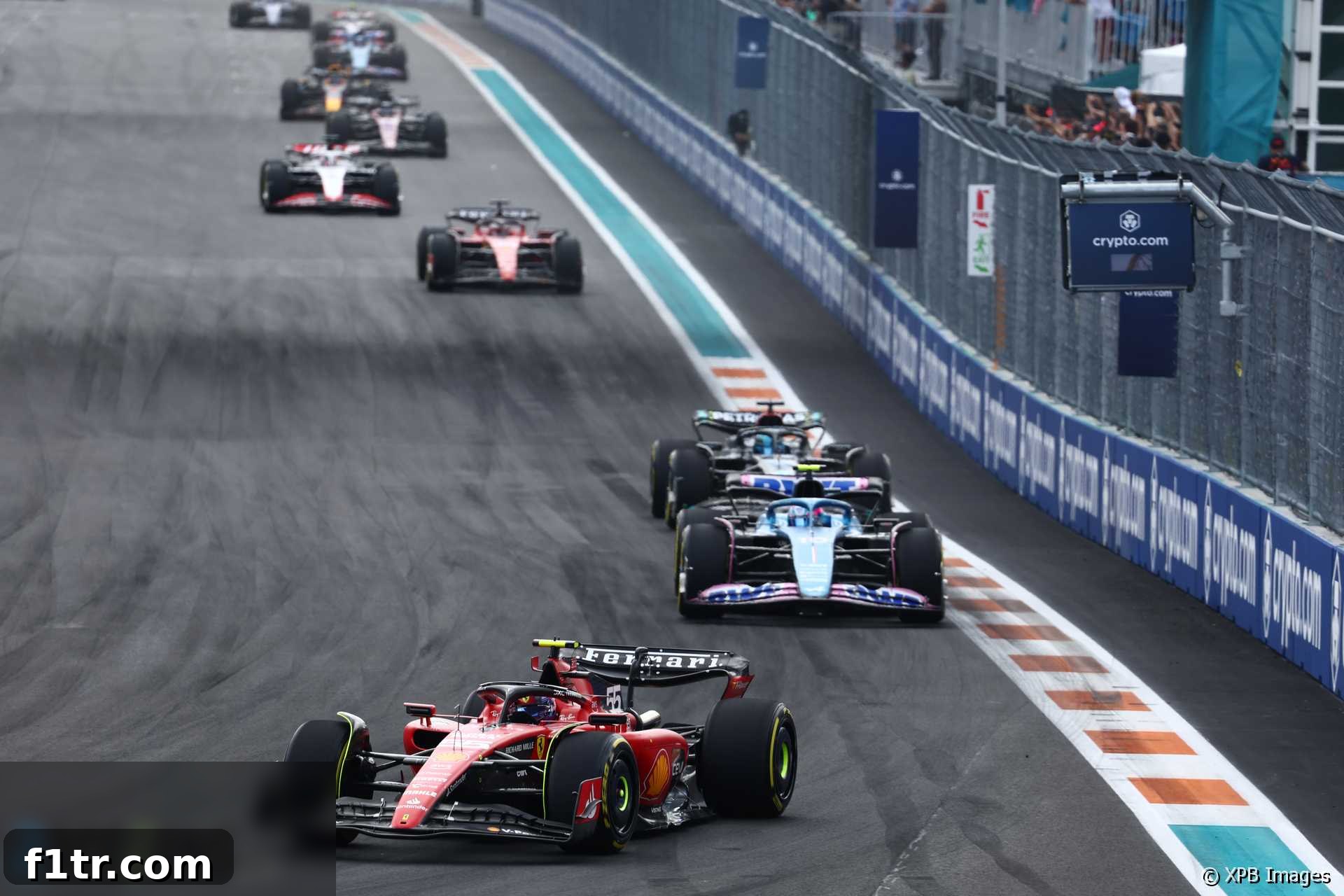
The Miami Grand Prix proved to be a weekend of immense frustration for Carlos Sainz Jnr, who candidly described his race as “tough.” Despite a promising qualifying performance that saw him line up third on the grid, the Spanish driver ultimately crossed the finish line in fifth place, conceding positions to rivals Max Verstappen and George Russell. At the heart of his struggles lay a critical inability to fully extract the performance from his Ferrari SF-23 without inflicting excessive degradation on his tyres – a recurring challenge for the Scuderia in the 2023 season.
Sainz’s weekend had started with a glimmer of hope. Securing P3 on the grid was a strong statement, hinting at the potential of the Ferrari package over a single lap. The team and fans alike harboured aspirations for a podium finish, perhaps even challenging for a victory if circumstances aligned. However, the unforgiving nature of race day, combined with the unique characteristics of the Miami International Autodrome and Ferrari’s ongoing tyre management woes, quickly turned optimism into a battle for survival.
The early stages of the race saw Sainz attempting to consolidate his position, but the strategic chess match began swiftly. In a bid to gain an advantage over Fernando Alonso, who was running ahead in second place, Ferrari opted for an aggressive undercut strategy. This involved bringing Sainz into the pits earlier than anticipated to switch from the medium compound tyres to the hard compound. The goal was to capitalise on the fresh rubber and the clear air to post quick lap times, thereby emerging ahead of Alonso once the Aston Martin driver made his own pit stop. Initially, the tactic appeared to pay dividends, allowing Sainz to leapfrog his compatriot.
However, the brief moment of success was quickly overshadowed by a stark reality. Sainz soon found his new set of hard tyres struggling significantly, a phenomenon he admitted caught him off guard. “I was a bit surprised with how much we struggled on the hard tyres after our very strong stint on the medium,” he recounted after the race. The initial push required to make the undercut effective – “pushing the tyres for three or four laps” – proved to be a critical tipping point for the delicate balance of the SF-23.
This aggressive expenditure of tyre life early in the stint left Sainz in an unenviable position. He explained the core limitation of his car: “For some reason with our car right now we have zero flexibility with how much we can push. I had to stay under the limit for the rest of the race if I wanted to make it to the end.” This ‘zero flexibility’ highlights a fundamental characteristic of the SF-23, which appears to have a very narrow operating window for its tyres. Once pushed beyond this invisible boundary, the degradation accelerates dramatically, making sustained performance impossible.
The conditions in Miami, particularly the prevalent wind, further complicated matters for Ferrari. Wind can significantly affect aerodynamic balance and downforce, placing additional stress on the tyres, especially through high-speed corners. “With the wind conditions, how tough we are on tyres, that hard stint just became too long for us,” Sainz elaborated. This confluence of car characteristics and environmental factors meant that what should have been a durable compound for a long stint quickly became a liability. The inability to lean on the tyres when needed, and the subsequent drop in pace, was a significant handicap.
Ferrari’s Tyre Management Conundrum: A Deeper Look
The issue of tyre degradation is not new for Ferrari. Throughout recent seasons, and particularly in 2023, the Scuderia has grappled with inconsistent tyre performance, especially on Sundays. While the SF-23 has often demonstrated blistering one-lap pace, making it a formidable contender in qualifying, translating that speed into sustained race performance has been a persistent challenge. Rivals like Red Bull, and increasingly Aston Martin, have showcased superior tyre preservation, allowing their drivers to push harder for longer and execute more flexible strategies.
Sainz’s comments underline this disparity. “At the moment I cannot push, especially in the race,” he stated, revealing the profound impact this limitation has on his driving style and strategic options. “As soon as you push one lap, you do a good first lap, the next lap you are three-tenths slower.” This immediate fall-off in performance means that even attempting to defend or attack for a single lap comes at a steep cost, effectively forcing the driver into a conservative approach for the remainder of the stint. It’s a strategic straitjacket that restricts their ability to react to race developments and capitalise on opportunities.
While the undercut on Alonso initially “worked” in terms of gaining track position, it was an unsustainable advantage given the car’s inherent limitations. Despite the strategy being deemed “the right call at the right time” by Sainz, hindsight revealed the true extent of Ferrari’s predicament. “It’s just that with hindsight, the car that we have right now, we have very little flexibility to try undercuts or overcuts. So it’s just more how limited we are,” he reflected. This statement is a stark admission of the strategic handcuffs Ferrari currently wears, unable to diversify their approach in the same way their competitors can. Ultimately, Alonso, managing his tyres more effectively, was able to reclaim his position, leaving Sainz to battle for minor points.
Implications for Ferrari’s Development Path
The Miami Grand Prix served as a critical reminder for Ferrari that despite efforts to improve, fundamental issues persist with the SF-23. Sainz admitted he was “surprised” by the problems, “because I thought we were making it better.” This sentiment highlights the ongoing development struggle within the Maranello camp. The race “kind of showed us that we still have some work to do,” a candid assessment of the journey ahead.
For Ferrari, addressing this ‘zero flexibility’ with tyre management must be a top priority. This could involve significant aerodynamic revisions, changes to suspension geometry, or even a deeper understanding of tyre compounds and their interaction with the car’s setup. The ability to push tyres for several laps without catastrophic degradation is not just a performance advantage; it’s a strategic necessity in modern Formula 1. Without it, even the most aggressive and well-timed strategies will ultimately fall short.
The team’s performance throughout the 2023 season has been a rollercoaster, often marked by flashes of brilliance in qualifying followed by disappointing race pace. While Charles Leclerc has also experienced similar challenges, Sainz’s detailed feedback from Miami provides invaluable insight into the specific areas requiring attention. The championship aspirations for Ferrari, both in the drivers’ and constructors’ standings, hinge on their capacity to unlock consistent race pace and robust tyre management across varying track conditions.
Looking Ahead: The Road to Recovery
The lessons from Miami will undoubtedly inform Ferrari’s development direction for the remainder of the season. The technical team will be dissecting data to understand why the hard compound tyres behaved so differently from the mediums and what specific aspects of the car’s setup contributed to the rapid degradation. The objective will be to widen that operating window, allowing both Sainz and Leclerc to extract maximum performance without punishing their tyres.
For Carlos Sainz, personally, the Miami Grand Prix was a challenging test of resilience. Despite the setbacks, his openness in discussing the car’s limitations offers clarity and a clear path for improvement. His continued feedback will be crucial as Ferrari strives to develop a more versatile and race-worthy machine. The Formula 1 season is a relentless campaign of innovation and adaptation, and Ferrari’s ability to respond to these challenges will define their success in the coming races.
The ultimate goal is to reach a point where strategic calls, like an undercut, can be executed with confidence, knowing that the car possesses the inherent ability to sustain the pace. Until then, races like Miami will serve as painful reminders of the work that remains for the Scuderia to truly compete at the very front on Sundays.
Bringing the F1 news from the source
RaceFans strives to bring its readers news directly from the key players in Formula 1. We are able to do this thanks in part to the generous backing of our RaceFans Supporters.
By contributing £1 per month or £12 per year (or the equivalent in other currencies) you can help cover the costs involved in producing original journalism: Travelling, writing, creating, hosting, contacting and developing.
We have been proudly supported by our readers for over 10 years. If you enjoy our independent coverage, please consider becoming a RaceFans Supporter today. As a bonus, all our Supporters can also browse the site ad-free. Sign up or find out more via the links below:
- Become a RaceFans Supporter
- RaceFans Supporter FAQ
2023 Miami Grand Prix Related Articles
- Verstappen picks Miami Grand Prix as his best drive of 2023 so far
- Albon “maximised most races this year” despite single point scored to date
- A sign the upgrades worked? Ferrari see an upside to Leclerc’s Miami crashes
- Red Bull ‘surprised other teams under-delivered’ with their 2023 cars
- F1’s driver intros are right for US market but wouldn’t work at Silverstone – Horner
Browse all 2023 Miami Grand Prix articles