Paul Stoddart’s Minardi: The Unyielding F1 Underdog Who Fought Until the End
The saga of Minardi, a quintessential underdog in the high-stakes world of Formula 1, is inextricably linked with its final, fiery owner, Paul Stoddart. His recollections of the team’s twilight days, before its acquisition by Red Bull at the close of 2005 and subsequent rebranding as Toro Rosso, offer a poignant summary of an era defined by relentless struggle: “Did I have enough money? No. Did we get through? Yes. But we had to fight for things. The fighting, the fighting…” These words perfectly encapsulate the spirit of a man who transformed Minardi into a symbol of unwavering perseverance against overwhelming odds.
Advert | Become a Supporter & go ad-free
In 2001, the spirited, chain-smoking Australian entrepreneur stepped in to rescue the beleaguered Minardi team from the precipice of bankruptcy. What followed were five tumultuous seasons during which Stoddart not only kept the financially struggling outfit afloat but, astonishingly, guided them to outscore the formidable Toyota team in 2002. While it’s true that 2002 marked Toyota’s inaugural season in Formula 1, the contrast in resources was staggering. Toyota poured an estimated billion dollars, or more, into its ambitious entry into motorsport’s elite category. Stoddart, by comparison, secured Minardi for a mere $10 million – a sum partly paid through creative bartering, highlighting his resourcefulness and unconventional approach to F1 ownership.
The immense satisfaction derived from seeing Minardi finish 10th in the Constructors’ Championship, ahead of the world’s largest motor company, and even securing a fifth-place finish in the season’s opening round against Toyota’s sixth, was deeply rooted in a fascinating backstory. As part of his purchase of Minardi, Stoddart had inherited the services of Gustav Brunner, a highly respected technical director and former Ferrari talent. Brunner’s innovative contributions included pioneering work on the first female-mould carbon fibre chassis and advanced magnesium gearbox casings, making him a crucial asset for any F1 team.
Imagine Stoddart’s profound surprise and dismay one Saturday in May 2001, when he discovered a fax in the Minardi machine bearing an unexpected message: “Paul, Gustav here. I’m sorry to tell you, but I’ve joined Toyota.” This swift and unannounced defection was a significant blow, underlining the cut-throat nature of Formula 1 talent acquisition.
At the subsequent Grand Prix in Austria, Stoddart wasted no time in confronting Toyota team principal Ove Andersson. Stoddart vividly recounts “frogmarching” Andersson into the Minardi motorhome, unleashing a torrent of classic Australian indignation. “He got the whole Australian ‘What-the-fuck-have-you-just-done?’” Stoddart recalls, describing how he verbally lambasted Andersson and Toyota for a full half-hour, employing every “Aussie word” he knew. It’s worth noting that Toyota wasn’t even officially racing in F1 at this juncture; the team was conducting extensive testing with a development car and observing race weekend proceedings from a motorhome parked just outside the paddock, which explained Andersson’s presence before their formal entry into the championship.
In a crucial moment, Formula 1 supremo Bernie Ecclestone intervened to assist Minardi. Stoddart was on the verge of issuing a damning press release when Ecclestone summoned him. “Stoddart,” Ecclestone reportedly declared, “you’ve lost the fucking guy, how much money do you want?” This direct approach led to a swift resolution. “We agreed on a figure,” Stoddart explains, “so I turned a technical director who was as useless as tits on a bull into a sponsor for a year and got on with life.” The settlement, a substantial $2.5 million, was a remarkable victory for Minardi, equalling a quarter of Stoddart’s original purchase price for the team and amounting to 10% of Minardi’s 2001 operating budget. This incident exemplified Stoddart’s uncanny ability to navigate the complex political landscape of F1 and turn adversity into advantage.
Advert | Become a RaceFans supporter andgo ad-free
Another significant battle, which saw Stoddart emerge victorious and even briefly resulted in Ecclestone becoming a 50% shareholder in Minardi on paper, reached its dramatic climax during the Canadian Grand Prix in June 2003. This particular dispute had been simmering since the beginning of the season. The major, manufacturer-backed teams were pushing for short-term regulatory changes, ostensibly to improve the sport, but which Stoddart (and fellow independent team owner Eddie Jordan) adamantly refused to support, citing prohibitive cost implications for the smaller teams.
The independent teams, outnumbered seven to three by their manufacturer-backed rivals, had been promised a crucial “fighting fund” and access to cheaper engines, with contributions from the major teams. However, once the desired regulatory changes were agreed upon, the fighting fund was conveniently forgotten, leaving Minardi and Jordan in a precarious financial position. The larger teams, however, severely underestimated Stoddart’s tenacity and, crucially, his encyclopaedic knowledge of the Concorde Agreement – Formula 1’s foundational commercial and sporting contract. With a wry chuckle, he once remarked, “None of them was as sad a fucker as I was to read it from cover to cover,” admitting he could recite F1’s constitution verbatim and famously kept a copy by his bedside.
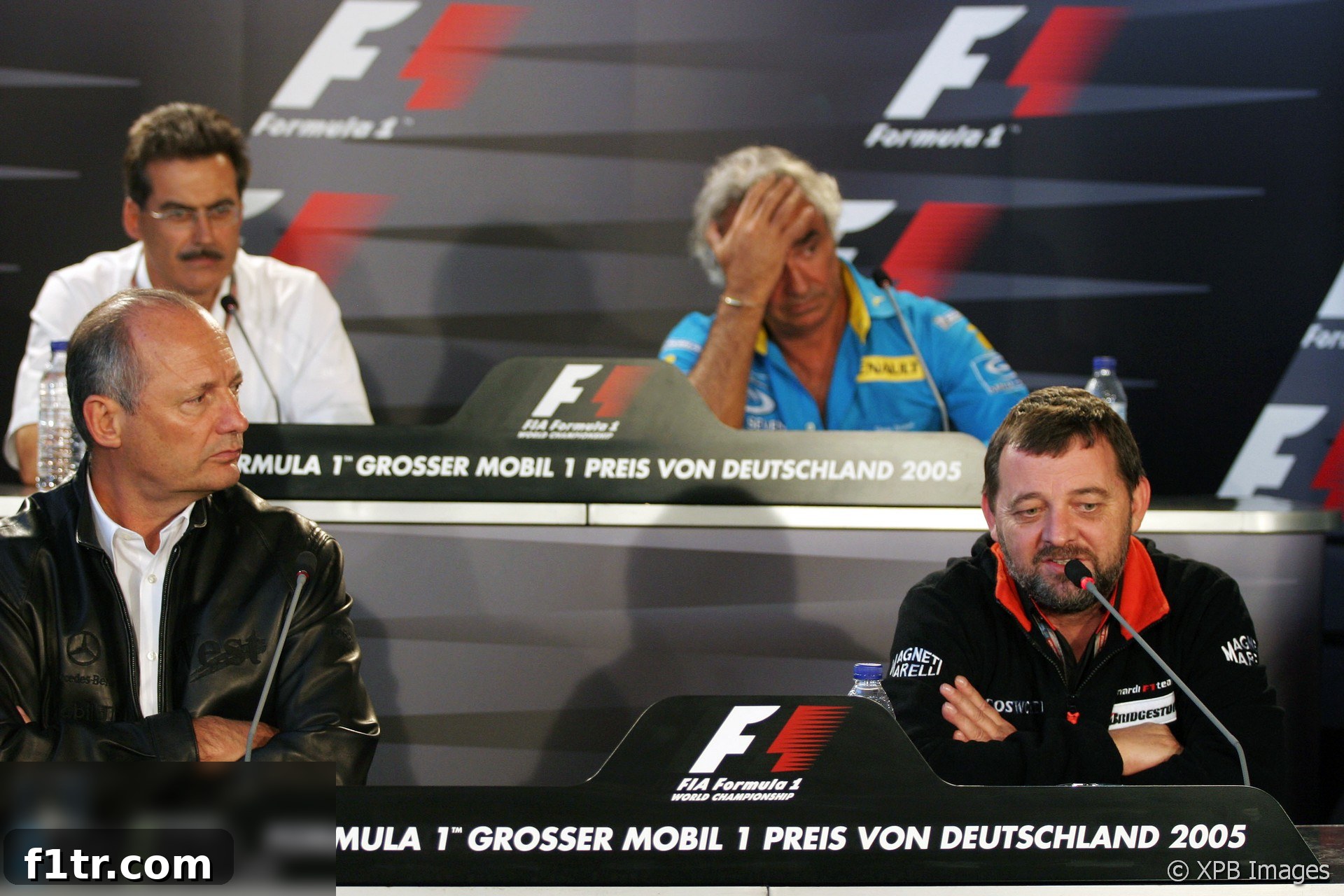
Thus, the stage was set for a dramatic showdown at Montreal’s Friday FIA press conference. Stoddart arrived armed with a comprehensive dossier containing the Concorde Agreement itself, alongside meticulously prepared notes detailing various issues pertaining to every team. “I was ready to pull the [grenade] pin on Minardi,” he recalls, explaining the depth of his frustration. “We’d been fucked around from pillar to post from January to June, and nobody had given us the money they promised us.” His preparation was meticulous: “I printed 50 copies of a 200-page Concorde Agreement in the hotel, we’d taken over their office, we had 50 T-shirts made, and I made 50 press packs. Why we were pulling the pin they would be able to figure out themselves when they read the Concorde.”
Stoddart’s dossier was not merely a collection of rules; it contained explosive revelations. “I had gathered some information, some of which was given to me by very prominent people: various things about Ferrari’s secret payments – not quite so secret anymore – and Ron Dennis had few issues here, Frank [Williams] a few issues there…” Even more damaging was the evidence against Eddie Jordan. “Eddie [Jordan] had given me a copy of a fax he had got from [title sponsor] Benson and Hedges to say if the fighting fund was not forthcoming, they believed Jordan Grand Prix would be trading insolvent and they didn’t want to be associated with it. So, I had a file that was very damaging to anybody who wanted to be an asshole.”
Before the press conference, Ron Dennis’s personal assistant invited Stoddart to McLaren’s hospitality unit. There, Dennis, known for his corporate professionalism, delivered a stark warning: “Paul, you know, if it gets too hot, get out of the kitchen, you can’t be in Formula 1.” Stoddart, never one to back down, reminded Dennis of McLaren’s own tumultuous financial history, including its three liquidations (which led to McLaren being known as Project 4 during one particularly fraught period). Dennis conceded, “Yeah, I know, but if you haven’t got the money, get out.” Stoddart found this admonition particularly galling, considering McLaren, like all other major teams, had agreed to pay a certain amount to the independents in exchange for their consent to regulatory changes in April. His response was unequivocal: “If I go, I’m not going quietly.”
Advert | Become a RaceFans supporter andgo ad-free
Stoddart arrived at the press conference precisely on time and fully prepared. His fellow team principals, however, were conspicuously delayed, caught in an emergency meeting convened by Ecclestone to defuse the escalating situation. Seizing the moment, Stoddart unpacked his materials for the assembled press corps, commanding their rapt attention during his seven-minute solo performance, effectively setting the narrative before his adversaries even arrived.
Finally, everyone “traipsed in,” as Stoddart described it – not just the five team principals scheduled, but a full contingent including Bernie Ecclestone himself. As they settled, Ron Dennis, seated to Stoddart’s right, began to speak, reiterating his earlier stance about F1 being a professional business and that, while he sympathised with owners like Stoddart, there was simply no place for them if they couldn’t fund their operations. He repeated his ‘heat/kitchen’ mantra.
Stoddart, with his folder of incriminating evidence sitting before him, then chose his moment. “So I open this folder which has some very interesting [undisclosed] information which Ron caught out of the corner of his left eye.” The tension in the room was palpable. Outside, it was pouring rain, yet Dennis, in his customary white shirt and black leather jacket, was “sweating like a pig,” eventually shedding his jacket. His candid reaction was telling: “His actual words were, ‘I know I shouldn’t do this, but I can’t help myself.'”
Eddie Jordan, seated behind Stoddart to his left, then attempted to distance himself from Minardi’s plight, declaring, “I feel for Paul, I feel for Minardi, but you have to understand Jordan is not in this situation, Jordan doesn’t need any money, we’re fine…” It was at this point that Stoddart famously christened him ‘Judas Jordan’. Opening his file to the specific section on Jordan, he repeatedly thumped his fist on the damning fax to ensure Jordan noticed it. Seeing the “absolutely devastating fax,” Jordan’s composure crumbled. Stoddart recounts “17 ‘um ahhs…’” from Jordan, before he finally stated, “I’ve got nothing more to say.” The immediate aftermath saw Ecclestone offer to purchase 50% of the team the very next day, a move that allowed Minardi to continue fighting, though the sale was never ultimately completed.
The next major challenge for Minardi involved Stoddart asserting that all competitor cars entered in the upcoming French Grand Prix were technically illegal under the current regulations. He pointed out, however, that Minardi’s two PS01s in their race truck were fully compliant. “To say there was uproar would be a gross understatement,” Stoddart recalls. A remarkable photograph captures Ron Dennis with his arm around Stoddart, walking down the hill after the press conference in Magny-Cours. Dennis, impressed by Stoddart’s courage, conceded: “You’ve got fucking balls. I will sort out this fighting fund, you have my word.” True to his word, Dennis facilitated the payment of Minardi’s due funds. Stoddart remarks, “I’ve been a friend and admirer of Ron since, and we’ve become fantastic friends,” highlighting an unlikely bond forged in the heat of conflict.
Minardi’s next significant battle unfolded on Stoddart’s home turf, Melbourne, revolving around FIA president Max Mosley’s plans for technical regulation changes for the 2005 season. “At the end of 2004 Max wanted to slow [the cars] down, but it was too close to the end of the season to be able to do it legally,” Stoddart explains. “So, he brought in [the revised regulations] under ‘safety’, which was total and utter bullshit and everyone knew it was bullshit.” All teams, with the exception of Ferrari, were aware that Minardi intended to compete with their 2004 specification cars at the 2005 Australian Grand Prix. In a bold move, Minardi planned to protest the race result, arguing that their cars were technically the only two legal vehicles on the grid.
Stoddart had meticulously prepared a legal challenge, with lawyers on standby. He informed F1 Race Director Charlie Whiting of his intentions, only to be told that Mosley had instructed Whiting not to pass Minardi’s cars at scrutineering. Undeterred, Stoddart escalated the matter: “We went straight to the High Court in Victoria, Melbourne and presented our case, which had been well prepared on every argument on the [regulatory process] and the way Max tried to change them.”
The High Court granted Stoddart an injunction, mandating that all parties – the ten team principals, along with representatives from the FIA and the promoter – appear in the High Court in Melbourne at 1 pm on Saturday, precisely when qualifying was scheduled. Stoddart’s lawyers faced the challenge of serving subpoenas to everyone, a task easily accomplished for all except Ferrari team boss Jean Todt, who proved elusive. “But he was at the grand prix ball that night, and there were fans,” Stoddart recounts, describing Todt signing autographs. “I said to our lawyer, ‘Line up with those fans.’ Jean signs two autographs, my lawyer is third in line, and he signs [the subpoena]. My lawyer says, ‘Mr. Todt, you’re served…'”
Around midnight, promoter Ron Walker called Stoddart, urgently pleading with him to withdraw the action at his “home grand prix.” Stoddart, understanding the broader implications for the event, agreed. His crew immediately returned to the circuit, working through the night to integrate upgraded parts and perform some ‘cut-and-shut’ modifications. By 8 am, the cars were legal enough to pass scrutineering, “although they ran like dogs and were uncompetitive,” he conceded.
The legal drama was not quite over. You cannot simply have a High Court hearing scheduled and fail to appear. Consequently, both sets of lawyers attended the 1 pm hearing to announce that the parties had reached an agreement. The judge was far from pleased, demanding to see all parties at 10 am on Monday to understand how the resolution was reached. This is where the matter should have concluded, except for Max Mosley’s insistence on issuing a press release at 9 am on Sunday. It provocatively stated that if any Australian judge believed they could impose judgments on the FIA, they needed to reconsider, as the FIA would withdraw all Australian motorsport worldwide.
The FIA’s statement read: “Apparently, the judge thought it right to interfere with the running of a major sporting event, overrule the duly appointed international officials and compel the governing body to allow cars to participate in breach of the international regulations, all this without first hearing both sides of the case. If Australian laws and procedures do indeed allow a judge to act in this way, it will be for the World Motor Sport Council to decide is a world championship motor sport event of any kind can ever again be held in Australia.” When the parties returned to court on Monday, one of the first questions posed by Justice David Habersberger was: “Is Mr Mosley present?” Upon receiving a negative reply, the judge famously remarked, “Pity, he would have needed his toothbrush,” a thinly veiled suggestion that Mosley might have faced imprisonment for contempt of court, adding another layer of intrigue to Stoddart’s legendary battles.
The final major controversy Minardi found itself embroiled in was the chaotic 2005 United States Grand Prix at Indianapolis. This infamous event saw Michelin’s tyres prove catastrophically unable to withstand the immense stresses of the circuit’s banked sections, leading to a profound crisis for the sport. Stoddart’s recent recollections of this fiasco have been widely published, offering a unique perspective on one of F1’s darkest hours.
Stoddart remains resolute in his claim that he planned to withdraw Minardi after the formation lap, despite their Bridgestone tyres having no such problems. This principled stance was agreed upon in solidarity with the Michelin-shod runners, a gesture of unity in the face of an unprecedented safety issue. Ferrari, however, intended to start the race on their Bridgestones. The final Bridgestone user, Jordan (by this point owned by Midland), was allied with the other eight teams. The ‘rebel’ team bosses were assembled in Ecclestone’s office, locked in last-ditch negotiations when they heard two Ferraris fire up, preparing for the start.
What no one had realised was that Jordan boss Colin Kolles was missing from the crucial meeting. “Lo and behold, we hear a third [car] start up and go out, which we’d not planned to do,” Stoddart recalls with a mixture of disbelief and frustration. “And I’m like, ‘Who the hell’s that?’ We look around, there’s nothing in the room that’s got yellow on it. ‘Oh, where’s that…’ – I won’t say what we called him, but anyway – ‘Where is he?’ Of course, he’s gone and put his cars out against the agreement.” At that pivotal moment, other team bosses urged Stoddart: “Paul, you’ve got to go out because you’ve got to race to take points.”
Minardi finished fifth and sixth, effectively last out of the six starters, yet it was a result that usually would have been celebrated as equalling the team’s best-ever two-car finish. However, Stoddart felt no satisfaction from this hollow victory. A television interview he gave during the race, which rawly captured the fraught emotions of the situation, quickly became notorious. “I walked alone out the back of the garage and was leaning up against a wall smoking a cigarette. Jack [Plooij] from RTL came to me. I said, ‘Jack, don’t even ask because you wouldn’t [televise] a word of what I’d say. It’s not a race, it’s a fucking farce.’ He said, ‘No, Paul, you can swear, I don’t care. We say it all the time.’ Like a fucking idiot I gave him an interview from hell, which is still on YouTube to this day and cost me multiple sponsors.” He laughs, the incident now a part of his colourful legend.
That, in essence, is Paul Gerard Stoddart – a man who wore his heart on his sleeve, often with a cigarette in hand, navigating the choppy waters of Formula 1 with a fierce passion. He took the rough with the smooth, seemingly enjoying every minute of the sport he continues to deeply love, despite the formidable forces stacked against Minardi throughout his five-year tenure as an F1 team boss. His legacy is one of fighting for the underdog, challenging the establishment, and showcasing an indomitable spirit that resonated deeply with fans.
Could Paul Stoddart ever make a return to Formula 1 in some capacity? Don’t bet against it; his passion and fighting spirit remain as strong as ever, and the sport could always use a character like him.
Join the RaceFans Supporters Drive!
If you’ve enjoyed RaceFans’ motor sport coverage during 2020, please take a moment to find out more about our Supporter Drive.
We’re aiming to welcome 3,000 new Supporters to help fund RaceFans so we can continue to produce quality, original, independent motorsport coverage. Here’s what we’re asking for and why – and how you can sign up:
- Join the RaceFans Supporters Drive!
RacingLines
- The year of sprints, ‘the show’ – and rising stock: A political review of the 2021 F1 season
- The problems of perception the FIA must address after the Abu Dhabi row
- Why the budget cap could be F1’s next battleground between Mercedes and Red Bull
- Todt defied expectations as president – now he plans to “disappear” from FIA
- Sir Frank Williams: A personal appreciation of a true racer
Browse all RacingLines columns