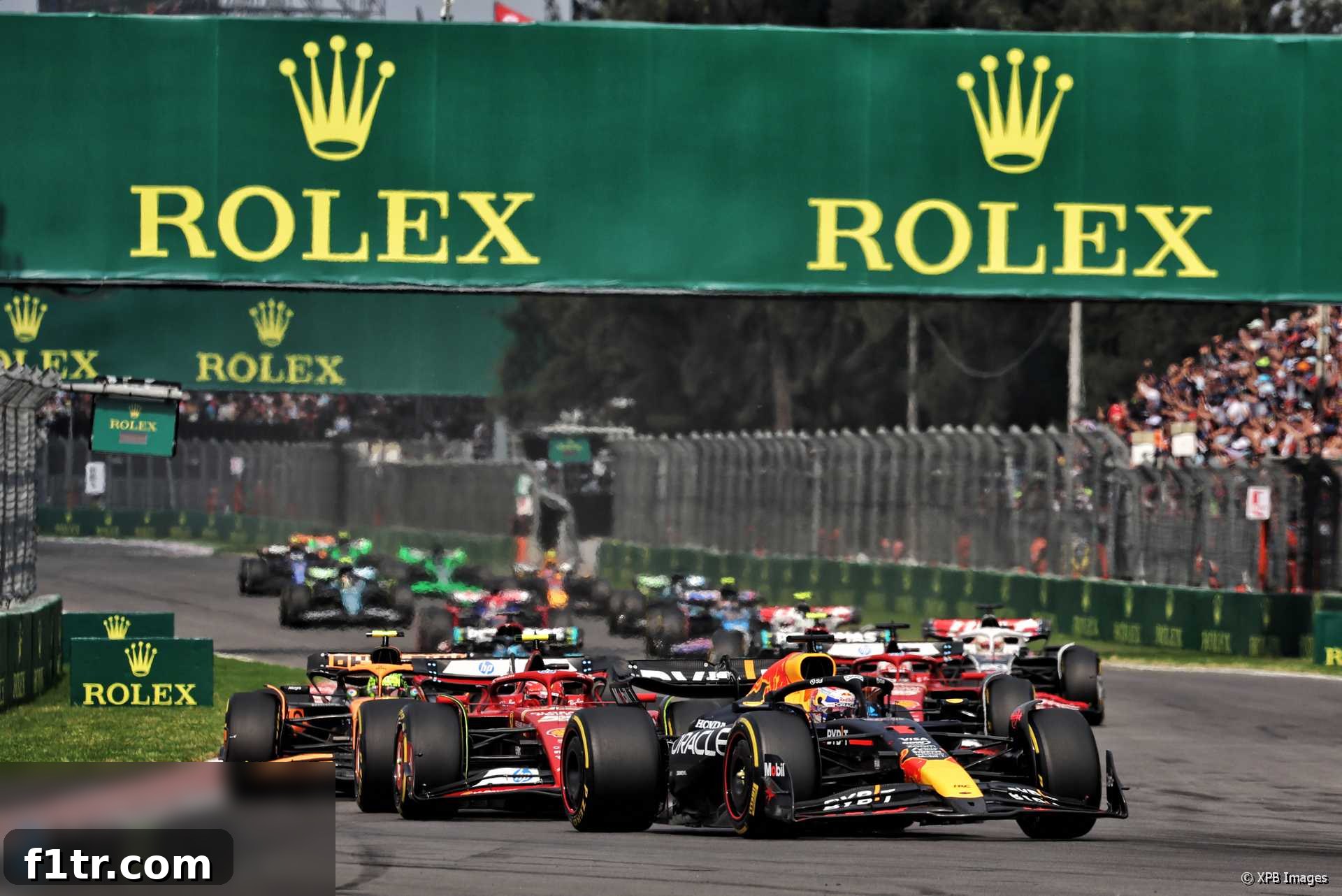
The 2024 Formula 1 Mexican Grand Prix at the iconic Autódromo Hermanos Rodríguez delivered a spectacle of strategic prowess, controversial penalties, and relentless on-track battles, ultimately culminating in a masterful victory for Carlos Sainz Jr. of Ferrari. This race, held in the vibrant atmosphere of Mexico City, was a pivotal moment in the season, impacting championship narratives and showcasing the raw intensity of F1 racing under high-altitude conditions.
From the moment cars hit the track, it was clear that tyre strategy and driver discipline would be paramount. The unique demands of the circuit – high altitude reducing aerodynamic downforce and stressing power units, combined with a challenging mix of high-speed straights and technical sections – put every team and driver to the ultimate test. As the grid lined up, the air was thick with anticipation, setting the stage for one of the most talked-about races of the year.
One of the early narratives emerged even before the green flag. Alpine’s Esteban Ocon faced a significant setback, being forced to start from the pit lane. This penalty was incurred after his team fitted new control electronics and an energy store to his car, breaching strict parc fermé regulations. Having originally qualified in 19th position, this decision meant an even tougher challenge for the French driver, highlighting the stringent technical rules that govern Formula 1.
The strategic landscape was further defined by the diverse tyre choices across the grid. The following table illustrates the tyre compounds available to each driver for the race, offering a glimpse into their planned strategies. Teams carefully weighed the trade-offs between the soft, medium, and hard compounds, considering their durability, grip levels, and performance windows in the demanding Mexican heat.
| Tyres available for the race | Hard | Medium | Soft | |||
|---|---|---|---|---|---|---|
| Driver | New | Used | New | Used | New | Used |
| Max Verstappen | 1 | 0 | 2 | 0 | 0 | 3 |
| Sergio Perez | 1 | 0 | 2 | 0 | 2 | 2 |
| Lewis Hamilton | 1 | 0 | 1 | 1 | 0 | 3 |
| George Russell | 1 | 0 | 1 | 1 | 0 | 3 |
| Charles Leclerc | 1 | 0 | 1 | 1 | 0 | 3 |
| Carlos Sainz Jnr | 1 | 0 | 1 | 1 | 0 | 3 |
| Lando Norris | 1 | 0 | 1 | 1 | 0 | 3 |
| Oscar Piastri | 1 | 0 | 1 | 1 | 3 | 1 |
| Lance Stroll | 0 | 1 | 1 | 1 | 1 | 3 |
| Fernando Alonso | 0 | 1 | 1 | 1 | 1 | 3 |
| Esteban Ocon | 1 | 0 | 1 | 0 | 2 | 3 |
| Pierre Gasly | 1 | 0 | 1 | 0 | 0 | 4 |
| Alexander Albon | 1 | 0 | 1 | 0 | 0 | 4 |
| Franco Colapinto | 1 | 0 | 1 | 0 | 3 | 2 |
| Liam Lawson | 1 | 0 | 1 | 0 | 1 | 4 |
| Yuki Tsunoda | 1 | 0 | 1 | 0 | 1 | 4 |
| Valtteri Bottas | 0 | 1 | 0 | 1 | 1 | 4 |
| Zhou Guanyu | 0 | 1 | 0 | 1 | 2 | 3 |
| Kevin Magnussen | 1 | 0 | 1 | 0 | 0 | 4 |
| Nico Hulkenberg | 1 | 0 | 1 | 0 | 0 | 4 |
As the drivers completed their reconnaissance laps, an early incident offered a hint of the drama to come: Liam Lawson clattered the kerbs at Turn 2, prompting his team to immediately check for potential damage to his car’s floor. This minor mishap underscored the unforgiving nature of the circuit. The majority of the field opted to start on the medium compound tyres, recognized for their balance of grip and durability. However, a select group of drivers, including Lawson, Valtteri Bottas, Franco Colapinto, home hero Sergio Perez, Zhou Guanyu, and the pit-lane starting Esteban Ocon, chose alternative strategies, setting themselves apart from the outset.
Oscar Piastri, starting on mediums, found himself surrounded by competitors on hard tyres. This strategic divergence was immediately highlighted by Pirelli, who noted the medium tyre’s significant acceleration advantage over the hard compound in the initial stages. Piastri was clearly identified as a driver to watch in the frantic opening moments. Similarly, Sergio Perez, also not on mediums, inquired about the leading hard-tyre runner, indicating a keen awareness of how rival strategies could unfold. As the formation laps commenced, the tension was palpable, with Ocon being the sole driver heading to the pit lane for his start.
Chaos at the Start: Collisions, Penalties, and Shifting Leads
The 2024 Mexican Grand Prix exploded into action with a series of dramatic events. Yuki Tsunoda was the first casualty, crashing out at Turn 1 in a chaotic melee. Amidst the pandemonium, Max Verstappen initially seized the lead, but not without incident, forcing Carlos Sainz off track at the exit. The Ferrari briefly moved ahead before Verstappen regained control, asserting his position at the front. The chaos continued as Alexander Albon was forced to stop on the straight after Turn 3, his race prematurely ended due to contact with Tsunoda.
Further down the field, troubles brewed. Charles Leclerc radioed his team, questioning if Lando Norris was reporting an engine problem, adding another layer of concern to the unfolding race. Meanwhile, Sergio Perez, who had made an impressive charge up to 13th by the end of Lap 1, found himself under investigation for a false start. Perez vehemently denied the accusation, exclaiming, “Why?” and asserting, “No, it was a great start.” However, onboard replays and race control messages suggested he might have been positioned too far forward in his grid box, a minor infringement with major consequences in F1. This incident led to a five-second time penalty for Perez, a bitter pill for the local favourite.
As the Safety Car was deployed to clear the debris from Tsunoda and Albon’s incidents, effectively neutralizing the race, Leclerc reported an unusual issue: his drinks bottle was spilling into his mouth. While seemingly minor, such distractions can be critical in the high-pressure environment of F1. The Safety Car eventually prepared to come in on Lap 6, signaling a restart on Lap 7, but not before the stewards confirmed Perez’s penalty and decided against further action regarding the Tsunoda/Albon collision.
The restart was immediately contentious. Max Verstappen strategically slowed the field to an absolute crawl, aiming to maximize his lead over the chasing pack. When the green flag waved, both Ferraris showed exceptional pace, with Sainz closing in on Verstappen and Leclerc challenging Norris. Liam Lawson, meanwhile, proved the wisdom of his hard tyre choice, emerging as the highest-placed driver on that compound, a strategy that had also paid dividends in Austin.
Verstappen vs. Norris: A Rivalry Erupts
Lap 9 saw further escalation of on-track drama. Carlos Sainz, having set the fastest lap on the previous tour and deploying his DRS, appeared to be in a strong position. Verstappen initially allowed him through, but Sainz stumbled over the kerbs, inadvertently slowing the Red Bull driver and bringing Lando Norris squarely into contention. This set the stage for a fiery encounter that would define much of the race.
The tension between Verstappen and Norris boiled over in spectacular fashion. Norris lined up Verstappen on the outside of Turn 3, but was predictably forced off track in an aggressive maneuver by the Dutchman. Norris, visibly frustrated, allowed Sainz to pass. However, the skirmish was far from over. Verstappen then dived at Norris at Turn 8, resulting in both cars going off track. These back-to-back incidents immediately caught the attention of the stewards, placing Verstappen under two separate investigations.
Norris’s radio communications vividly conveyed his anger and frustration: “This guy is dangerous. I just had to avoid a crash. It’s the same as last time.” He further elaborated, “He overtook me off the track and pushed me off.” While Norris was indeed forced off track twice, typically such instances do not automatically count as “strikes” under the strict interpretation of racing rules unless direct contact or a clear advantage is gained illegally. Nevertheless, the stewards deemed Verstappen’s actions to be over the limit.
The repercussions were swift. On Lap 14, Verstappen was handed a 10-second time penalty for forcing another driver off the track. Initially, the stewards did not specify which incident this was for, leaving room for speculation. Later, it was confirmed that this first penalty was for the Turn 4 incident. The question then remained what action, if any, would be taken for the Turn 8 collision. The answer arrived on Lap 20: Verstappen received a second 10-second time penalty for forcing Norris off the track at Turn 8. This effectively meant a cumulative 20-second penalty for the championship leader, a rare and significant punishment in Formula 1.
This sequence of events sparked considerable debate within the paddock and among fans, highlighting the fine line between aggressive racing and dangerous driving. Norris’s team mate, Oscar Piastri’s race engineer, Dudley, summed up the collective surprise, stating to Piastri, “So Verstappen now has a 20-second penalty,” to which Piastri simply replied, “Wow.”
Mid-Race Dynamics and Strategic Unfoldings
Away from the Verstappen-Norris drama, other battles intensified. On Lap 15, Lewis Hamilton made a late defensive move on George Russell but ultimately lost fifth place to his Mercedes teammate. Fernando Alonso, celebrating his 400th race weekend, endured a sad end to his milestone event, pitting and retiring on Lap 16, a disappointing conclusion for the veteran.
Ferrari’s internal battle for supremacy was also heating up, with Charles Leclerc closing on Carlos Sainz. Their engineer, Bozzi, had to intervene, reminding Leclerc to “Keep it clean,” underscoring the tight competition within the Scuderia. Further down the order, the young guns provided their own fireworks. On Lap 18, Liam Lawson attempted an audacious move down the inside of Sergio Perez at Turns 3 and 4, but was firmly rebuffed by the experienced Mexican. Perez’s frustration was evident on the radio: “What the f*** is this idiot doing? Is he okay?” The stewards, however, decided to take no action over the Lawson/Perez incident, indicating it was deemed a racing incident.
The substantial penalties significantly hampered Verstappen’s race. On Lap 25, Norris was rapidly closing on the Red Bull driver, who began complaining about his tyres losing performance. Verstappen pitted on Lap 27, but his stop was anything but routine. The mechanics stood motionless for a full 20 seconds as he was forced to turn his engine off and restart it, a costly delay that dropped him down to 15th position. This technical glitch, combined with his penalties, effectively took him out of contention for a podium finish.
As the race progressed, tyre strategy continued to play a crucial role. Norris eventually pitted from third place on Lap 31. The Ferrari duo of Sainz and Leclerc followed suit, executing well-timed stops that allowed them to maintain their lead, with Sainz holding an 8.7-second advantage over Leclerc. Meanwhile, George Russell continued his strong performance, passing both Liam Lawson and Oscar Piastri. Piastri, however, expressed his frustration with his team’s strategy, telling his engineer, Stallard, “Mate think about pulling me out of this s***” when faced with heavy traffic on track. He eventually made a move on Lawson at Turn 4, with Hamilton following suit at Turn 6 before swiftly passing Piastri himself on Lap 35.
Even the race leader wasn’t immune to issues. On Lap 37, Sainz reported a “big misfire out of Turn 3,” prompting his team to investigate. Colapinto also raised concerns about his car’s steering on Lap 39. Piastri finally pitted on Lap 40, a decision his engineer, Bozzi, seemed critical of, commenting to Leclerc that it was “a poor 13/14,” likely referring to the performance of a previous stint or a strategic call. Lawson’s pit stop on Lap 41 saw him emerge behind Perez, only to immediately pass the Red Bull driver on the main straight using DRS. Perez, struggling with significant floor damage and a reported “60 points of downforce” loss from his earlier skirmish with Lawson, was left vulnerable.
Towards the latter stages of the race, weather conditions briefly became a point of discussion, with Verstappen reporting darkening clouds and Lawson noting a drop of rain on his visor on Lap 43. However, the rain did not materialize into a race-altering downpour. The battle for positions continued unabated, with Piastri closing in on Colapinto for ninth place on Lap 48. Colapinto eventually pitted, but a slow 4.4-second stop further complicated his race. At the front, Sainz voiced his opinion that Ferrari might be pushing “too hard,” emphasizing “absolutely no need, for the team,” suggesting a cautious approach to manage his lead and ensure reliability.
The Grandstand Finish: Norris’s Charge and Sainz’s Triumph
As the race entered its final phase, the intensity reached a fever pitch. Norris, having successfully lapped Colapinto on Lap 59, unleashed a phenomenal pace, flying around the circuit and rapidly closing the gap to Leclerc, positioning himself just over a second behind the Ferrari. Bozzi’s message to Leclerc was direct: “We need your best driving now. Let’s go,” acknowledging the mounting pressure from the McLaren behind.
On Lap 62, Norris had DRS open in his pursuit of Leclerc, although he wasn’t quite close enough for an attack on that lap. However, a slight error from Leclerc, who went deep at Turn 4, offered Norris a critical advantage. The opportunity presented itself, and on Lap 63, in a dramatic turn of events, Leclerc went off track, allowing Norris to surge straight past him and seize second position as they began the lap. This crucial mistake by Leclerc solidified Norris’s podium aspirations and added a thrilling twist to the closing moments.
Further down the order, the fierce intra-team battle between the Mercedes drivers continued relentlessly. Russell, holding onto fourth place by a thread, fought valiantly against his more experienced teammate. On Lap 66, Hamilton finally executed a decisive pass on the outside heading into Turn 1, reclaiming fourth position in a hard-fought move. The late stages also saw another incident involving the young drivers: Colapinto and Lawson collided at Turn 2 on Lap 67 after the Williams driver ran wide at Turn 1, prompting another investigation from the stewards.
With victory seemingly in hand for Sainz, Leclerc was called into the pits on Lap 69 for a fresh set of soft tyres, aiming to snatch the bonus point for the fastest lap, which was currently held by Lawson. The strategy paid off on the final tour as Charles Leclerc successfully recorded the fastest lap, securing an additional point for Ferrari. Sergio Perez also attempted to claim the fastest lap but was half a second too slow in the first sector, falling short of the mark.
And so, under the Mexican sun, Carlos Sainz Jr. crossed the finish line to claim a sensational victory at the 2024 Mexican Grand Prix! It was a race defined by strategic brilliance, driver skill, and a healthy dose of controversy. Christian Horner, Red Bull Team Principal, later commented on Max Verstappen’s penalties, calling them “definitely on the harsher side,” while Sergio Perez remained visibly fuming at “that idiot,” presumably referring to Liam Lawson and their earlier skirmish.
The 2024 Mexican Grand Prix will long be remembered for its intensity, the thrilling battles, and the stewards’ decisive actions. It reshaped aspects of the championship narrative and left fans eagerly anticipating the remainder of the season. The race truly embodied the unpredictable and exhilarating nature of Formula 1.
2024 Mexican Grand Prix Related Articles
- McLaren have no regrets over pitting Norris shortly before red flag came out
- Leclerc fined, avoids same penalty as Verstappen after apologising for swearing
- Leclerc not in the clear over swearing as verstappen claims he went unpunished
- Majority of drivers wanted racing rules to change “straight away” – Russell
- Verstappen was “over the limit” with Norris but others would do same – Leclerc
Browse all 2024 Mexican Grand Prix articles