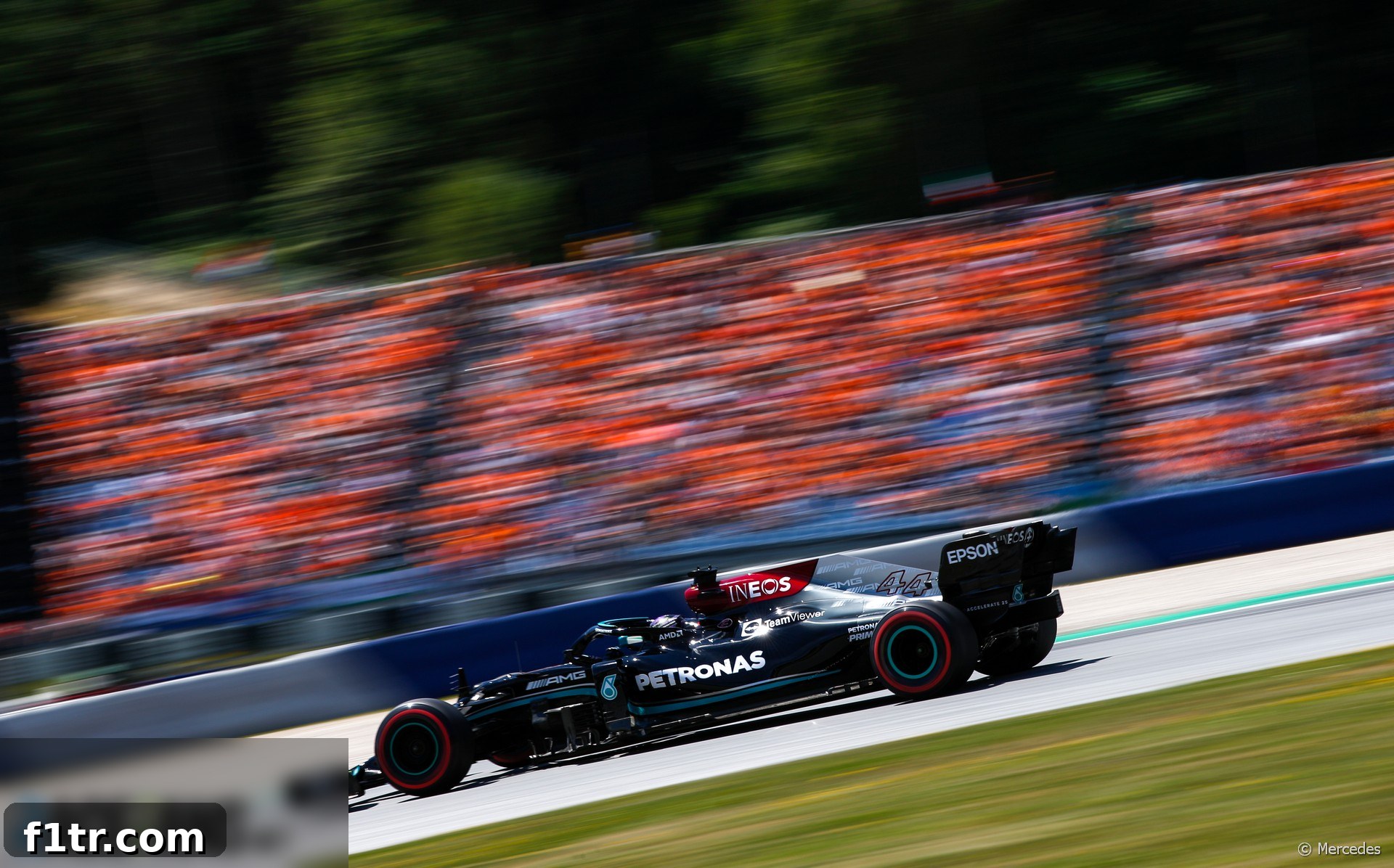
Mercedes’ Austrian GP Qualifying Struggles: Toto Wolff Points to Pirelli C5 Tyre Challenge and Overall Performance Deficit
Mercedes-AMG Petronas F1 Team Principal Toto Wolff provided a candid assessment of his team’s performance during the Austrian Grand Prix qualifying session, attributing their deficit to Red Bull Racing and the impressive pace of McLaren primarily to difficulties in extracting optimal performance from Pirelli’s softest C5 compound tyre. The weekend at the Red Bull Ring presented a critical juncture in the intense 2021 Formula 1 championship battle, and Mercedes found themselves unexpectedly outmanoeuvred in the crucial Saturday shootout.
Advert | Become a Supporter & go ad-free
The qualifying session saw Lewis Hamilton qualify in fourth position, closely followed by his teammate Valtteri Bottas in fifth. Both Mercedes drivers found themselves trailing not only the pole-sitting Red Bull of Max Verstappen but also the formidable McLaren of Lando Norris, who put in an exceptional lap to secure second place. This outcome underscored a growing challenge for the reigning champions, particularly on a circuit where Red Bull had consistently demonstrated superior form.
The inherent pace advantage enjoyed by both Mercedes and Red Bull over the midfield pack typically allows them some strategic flexibility in qualifying. Indeed, both teams could have comfortably navigated through the second segment (Q2) of qualifying using the slightly harder C4 tyre. However, the final, decisive segment (Q3), where pole position is determined, mandated the exclusive use of the ultra-soft C5 compound. It was on this specific tyre that Mercedes encountered significant hurdles, a factor Wolff highlighted as central to their subdued performance.
Max Verstappen’s initial run in Q3 proved sufficient to secure pole position, his blistering lap being a mere 0.048 seconds faster than Lando Norris. In stark contrast, Lewis Hamilton was 0.270 seconds adrift of Verstappen’s pole time, with Valtteri Bottas a further 0.024 seconds behind Hamilton, placing them fourth and fifth respectively. The margins, though seemingly small in F1, represented a significant performance gap that Wolff promptly attributed to their struggles with the C5 tyres.
The Pirelli C5 Conundrum: A Key Factor in Mercedes’ Qualifying Deficit
“I think that it’s the C5 tyre that is [seemingly] where we struggle on performance,” Wolff stated, pinpointing the specific compound as a critical area of weakness for the Silver Arrows. His observation suggested a deeper issue than simple setup adjustments, indicating a fundamental difficulty in optimising their W12 chassis to work effectively with the softest Pirelli rubber available.
The C5 compound, designed for maximum grip and ultimate single-lap performance, is also the most challenging to manage, often requiring a delicate balance between extracting pace and preventing overheating or excessive degradation over the course of a lap. For Mercedes, it appeared this delicate balance eluded them in Austria. Wolff’s comments hinted that while other teams, particularly McLaren, seemed to unlock the full potential of the C5, Mercedes struggled to find the necessary window for optimal grip and consistency throughout the lap.
“You can see that McLaren and Lando seem to be going really well on that specific compound and we struggled, and we felt we were underperforming on the C5 in qualifying, too,” Wolff added, acknowledging the impressive pace shown by McLaren. Lando Norris’s brilliant P2 demonstrated that the Mercedes-powered McLaren chassis was highly adept at utilizing the C5 compound, an intriguing dynamic given both teams share the same power unit supplier. This suggests that the issue for Mercedes was more deeply rooted in aerodynamics, chassis setup, or how their car interacted with the tyre surface, rather than pure engine power.
During the earlier Friday practice sessions, both Hamilton and Bottas had expressed concerns, predicting that Verstappen would likely hold a pace advantage of a few tenths over Mercedes. Their predictions were unfortunately borne out, not only by Verstappen’s pole but also by the performance of his teammate. Sergio Perez, who qualified third, was a narrow 0.024 seconds faster than Hamilton in Q3, underscoring Red Bull’s comprehensive advantage over the Silver Arrows throughout the crucial qualifying segments.
Beyond a Single ‘Silver Bullet’: Mercedes’ Holistic Performance Challenge
Wolff’s analysis extended beyond the specific tyre compound, indicating a broader performance gap that couldn’t be resolved by a simple fix. “It’s just that over the whole lap we struggle to somehow find lap time,” he explained, painting a picture of a car that wasn’t performing at its peak across the entire circuit. This holistic struggle suggests that the team isn’t losing time in one obvious place, but rather bleeding tenths in various corners and sections.
“And so there isn’t a silver bullet that we would have as an answer, but simply that overall we need up our performance in every single area, and that is not only chassis but it’s PU, everywhere,” Wolff asserted, highlighting the multifaceted nature of their challenge. This admission from the Mercedes team principal is significant, suggesting that the team needs to scrutinize every aspect of their operation – from the aerodynamic efficiency of the chassis to the power unit’s delivery and overall integration – to bridge the gap to their rivals.
Red Bull, for instance, has been consistently strong in the final sector of many circuits, a trait often attributed to their superior tyre management over a full lap, which allows them to maintain grip and traction where others might start to struggle. McLaren, on the other hand, has managed to optimise their Mercedes power unit to match Red Bull’s speed in the sector one speed traps, and even set some of the fastest sector times. This diverse set of strengths from their rivals underscores the comprehensive nature of the performance benchmarks Mercedes must now meet.
However, Wolff was quick to dismiss the notion that Mercedes was losing out in any single, identifiable part of the track. “We are losing time in turn one, turn three, turn four… you couldn’t even pinpoint one corner, or two corners that are responsible for most of the time loss, it’s tiny bits everywhere,” he elaborated. This ‘death by a thousand cuts’ scenario indicates a pervasive performance deficit, where marginal losses in multiple areas cumulatively add up to a significant disadvantage over a full lap. Such an issue is often more challenging to resolve than a specific, isolated problem, requiring a deep dive into every aspect of the car’s design and setup.
The Broader Context: Mercedes’ 2021 Season Challenges and Implications
Advert | Become a RaceFans supporter andgo ad-free
The struggles in Austrian Grand Prix qualifying fit into a broader narrative of the 2021 Formula 1 season, where Mercedes has faced an unprecedented challenge to their long-standing dominance. The regulation changes, particularly those affecting the floor of the cars, appear to have impacted Mercedes more significantly than Red Bull, shifting the competitive landscape. While Mercedes has fought hard to adapt and recover, the Austrian Grand Prix highlighted that the battle is far from over, and areas of vulnerability persist.
A qualifying performance like this has significant implications for the race. Starting from the second row, behind both Red Bulls and a McLaren, means Mercedes drivers face a challenging task to gain track position. Tyre degradation, pit stop strategies, and the ever-present threat of safety cars will all play a crucial role. Overtaking at the Red Bull Ring, while possible, is not always straightforward, particularly against cars of similar or superior pace. Mercedes will need a flawless execution and perhaps a touch of fortune to convert their starting positions into a strong points haul.
Looking ahead, Toto Wolff’s frank assessment indicates a clear roadmap for the Mercedes engineering team. The focus will undoubtedly intensify on understanding the C5 tyre behaviour, not just in isolation but in conjunction with the W12’s aerodynamic characteristics and suspension setup. Furthermore, the commitment to improving “every single area” suggests a relentless pursuit of marginal gains across the chassis and power unit. The championship fight against Red Bull is a tight one, and every tenth of a second counts. Mercedes’ ability to quickly diagnose and rectify these performance gaps will be critical in their quest to retain both the Drivers’ and Constructors’ titles in what promises to be one of the most exciting F1 seasons in recent memory.
2021 Austrian Grand Prix Related Articles
- Vasseur on Alfa’s “huge step forward” and why he’s vexed by technical directives
- How Ricciardo “got some enjoyment back” after “really low” first race in Austria
- F1’s penalty points are not “harsh” and won’t be reviewed this year – Masi
- Austrian double showed Sainz found his feet faster than 2021’s other big-name moves
- 2021 Austrian Grand Prix Star Performers
Browse all 2021 Austrian Grand Prix articles