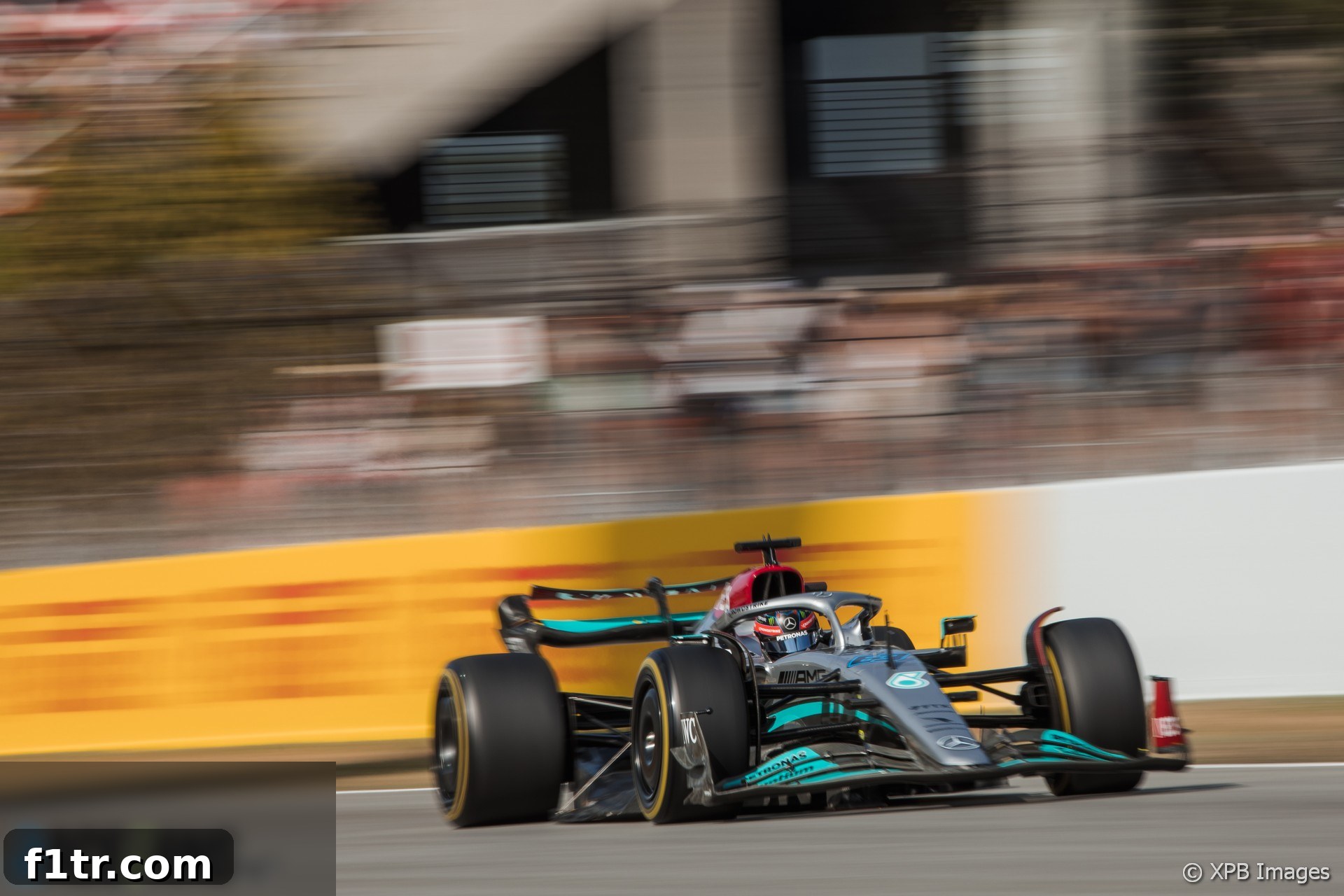
Mercedes’ Porpoising Dilemma: Has the W13 Finally Found Its Footing?
The highly anticipated 2022 Formula 1 season introduced a radical new era of technical regulations, bringing with it the return of a phenomenon known as “porpoising.” This aerodynamic bouncing, which became a significant challenge for many teams, disproportionately affected Mercedes-AMG Petronas F1 Team, hindering the performance of their W13 challenger. While the team showcased a remarkable improvement at the Spanish Grand Prix, sparking optimism among fans and within the paddock, Mercedes’ motorsport strategy director, James Vowles, remains cautiously optimistic, suggesting that the team’s porpoising problems may not be a permanent fixture of the past.
The early rounds of the 2022 season were a stark reminder of the unpredictable nature of new regulations. Mercedes, the dominant force of the turbo-hybrid era, found themselves grappling with an unfamiliar foe: an aggressive, high-frequency bouncing that severely compromised driver comfort, car balance, and ultimately, lap time. The issue was so pronounced that at the Emilia Romagna Grand Prix in Imola, star driver George Russell voiced serious concerns, stating that the extreme porpoising was not sustainable for driver well-being or performance. This candid admission highlighted the severity of the challenge facing the reigning constructors’ champions.
Understanding the Porpoising Phenomenon in F1 2022
To fully appreciate the scope of Mercedes’ struggle, it’s essential to understand what porpoising entails. This aerodynamic instability occurs when a car’s downforce repeatedly increases and decreases at high speed, causing it to rapidly bounce up and down. With the 2022 regulations reintroducing ground effect aerodynamics, teams aimed to generate significant downforce from the car’s floor. However, when the car lowers close to the track surface, the airflow beneath the floor can “stall,” leading to a sudden loss of downforce. This causes the car to rise, the airflow reattaches, downforce returns, and the car is pushed back down, restarting the cycle. The result is a violent, uncontrolled oscillation that makes the car incredibly difficult to drive at the limit, especially through high-speed corners and over bumps. Mercedes’ W13 appeared particularly susceptible to this issue, with its unique sidepod design and aerodynamic philosophy seemingly exacerbating the problem, leading to a noticeable performance deficit compared to rivals like Red Bull and Ferrari.
The Long Road to Recovery: Mercedes’ Early Season Struggles
Mercedes’ engineers worked tirelessly to understand and mitigate the porpoising from the very first pre-season tests. Initial attempts to solve the problem often yielded mixed results, or even introduced new challenges. The team observed moments of reduced bouncing during Friday practice sessions in places like Miami, only for the issue to inexplicably resurface with full force on qualifying day and during the race. This inconsistency made it incredibly difficult to gather reliable data and implement effective solutions. Drivers George Russell and Lewis Hamilton frequently reported discomfort, reduced visibility, and a lack of confidence in a car that was once the benchmark for stability and predictability. Their inability to push the W13 to its aerodynamic limits meant that Mercedes was consistently off the pace of the front-running teams, leading to a period of unprecedented struggle and introspection for the Silver Arrows.
Barcelona Breakthrough: A Glimmer of Hope for the W13
The Spanish Grand Prix at the Circuit de Barcelona-Catalunya marked a pivotal moment in Mercedes’ 2022 campaign. The team arrived with a significant upgrade package, reportedly featuring revisions to the floor, wing components, and potentially suspension elements, all aimed at tackling the porpoising head-on. The impact was immediate and substantial. The W13 displayed a vastly improved demeanor, with the dreaded bouncing largely brought under control. This newfound stability allowed the engineers to finally tune the car effectively and for the drivers to extract more of its inherent performance. Both Russell and Hamilton delivered their most competitive performances of the season, with Russell securing a strong podium finish and Hamilton staging an impressive recovery drive after an early collision, demonstrating the true potential of the W13 once its aerodynamic maladies were tamed. The Spanish GP offered a tangible demonstration that Mercedes had made a definitive step forward in their understanding and deployment of solutions to their persistent bouncing issues.
James Vowles’ Measured Optimism: Tempering Expectations
Despite the encouraging results in Barcelona, James Vowles, Mercedes’ motorsport strategy director, urged caution, emphasizing that it might be premature to declare the porpoising problem entirely solved. In a video released by the team, Vowles explained, “We’ve had one race out of six where the car has been well-behaved. It was a car that, really, was a proper racing car for once. We could set it up, we could tune it, we could play around with the settings and it would respond in a way that was predictable and the same couldn’t be said for the car that we had for the first five races of the season.”
Vowles’ reservations stem from several factors. Firstly, the Circuit de Barcelona-Catalunya is a well-known benchmark track, characterized by smooth asphalt and a familiar layout that has often suited Mercedes’ car concepts over the years. This raises questions about how the W13 will perform on more challenging, bumpier, or high-speed tracks. “However, we have to temper our expectations,” he continued. “It’s one track and a track that has suited our car for many years prior to this one. There is a lot for us to understand and learn. I think it would be wrong to say that the porpoising issue has disappeared.”
He further pointed out that other teams on the grid have experienced the ebb and flow of porpoising throughout the season. “You still see it on our competitors and I am sure there will be elements of it coming back again as we build on our understanding and the foundations that we laid down in Barcelona. What I can say is we made a definitive step, a step in our understanding and the deployment of what we put on track and we can build on that, and the same could not be said about the first five races, with the car that we had there.” This highlights that while a significant improvement has been made, the complex nature of aerodynamics and varying track conditions mean that the team must remain vigilant and continue their development efforts.
Upcoming Tests: Monaco and Baku’s Unique Challenges
The true test of Mercedes’ progress will come at the subsequent rounds of the championship, particularly on the demanding street circuits of Monaco and Baku. Vowles specifically singled out these venues as crucial barometers for the W13’s stability and overall performance. “We’ve got difficult tracks coming up, we’ve got Monaco and Baku which will throw up their own challenges and surprises,” he stated. Street tracks are notoriously bumpy, feature tight corners, and require a very different car setup compared to permanent racing circuits. The low-speed nature of Monaco, combined with its undulating surface, could potentially trigger porpoising, especially if the team struggles to find the optimal ride height. Similarly, the long straights and fast sections of Baku, juxtaposed with slow, technical corners, will push the W13’s newfound stability to its absolute limits, demanding a robust and consistent aerodynamic platform. Success on these tracks would provide strong validation that Mercedes has indeed found a more universal solution to their porpoising woes. The stakes are high, as strong performances here could cement their return to contention, whereas a resurgence of the problem could once again derail their championship aspirations.
“The difference now, though, is we have a car that is within touching distance of the front and a car that we can fight for a championship with,” Vowles concluded, indicating a renewed sense of purpose and belief within the team. The immediate goal is to consolidate the gains from Spain and consistently challenge at the sharp end of the grid.
Overheating Power Units: Another Spanish Grand Prix Challenge
Beyond the porpoising saga, the Spanish Grand Prix presented Mercedes with another significant hurdle: severe power unit overheating. Both George Russell and Lewis Hamilton were instructed to manage their engines and slow down in the final laps of Sunday’s race to prevent potential failures. James Vowles detailed the extreme conditions encountered, explaining, “We were very, very hot on our power unit side. To give some context, the ambient temperature was up to 37 degrees Celsius in the race, started round about 36 and actually went up later in the afternoon. That is incredibly warm, that’s an outlier relative to nearly every circuit on the calendar.”
Such extreme temperatures push the power unit components, especially the engine, turbocharger, and MGU-H/K, to their absolute limits. Maintaining optimal operating temperatures is crucial for both performance and reliability. In response, the drivers had to adopt specific strategies to mitigate the heat build-up. Vowles explained, “The drivers had to respond and the way you do this is by looking after the power unit, making sure your nose is in clear air, making sure you are doing lots of lift and coast.” Lifting off the throttle early before a corner (“lift and coast”) reduces engine workload and fuel flow, thereby lowering temperatures. Staying in “clear air” away from the turbulent wake of other cars also helps with cooling efficiency. Vowles commended the drivers, stating they “did a really good job to get those cars home to the finish” under the challenging circumstances. This incident underscores that even as Mercedes tackles porpoising, other reliability and performance factors constantly demand their attention, especially under varying climate conditions.
Conclusion: Mercedes’ Path Forward in a Challenging Season
The 2022 Formula 1 season has been a rollercoaster for Mercedes, marked by an unprecedented struggle with porpoising that threatened to derail their championship ambitions. The significant step forward at the Spanish Grand Prix provided a much-needed boost of confidence and tangible evidence that the W13 has the potential to be a competitive machine. However, the cautious stance taken by James Vowles is a pragmatic one, acknowledging that one race does not define a season. The true measure of their success in overcoming the porpoising problem will be demonstrated over the coming races, particularly on the unique layouts of Monaco and Baku. With a car now “within touching distance of the front,” Mercedes is back in the fight, but the journey to fully unlock the W13’s potential and consistently challenge for victories and the championship title remains an intricate and demanding one. The team’s ability to adapt, learn, and refine their solutions will be key to their success in this fascinating new era of Formula 1.
2022 Spanish Grand Prix
- Q&A: Kubica ‘shocked’ by ‘completely different’ Alfa Romeo in Spain
- How heat and traffic trouble left F1 fans fuming after the Spanish Grand Prix
- Mercedes not yet certain their porpoising problem has “disappeared”
- Sticking to budget cap “pretty much impossible” due to rising costs – McLaren
- Ricciardo hoping to find an explanation for Spanish GP pace deficit to Norris
Browse all 2022 Spanish Grand Prix articles