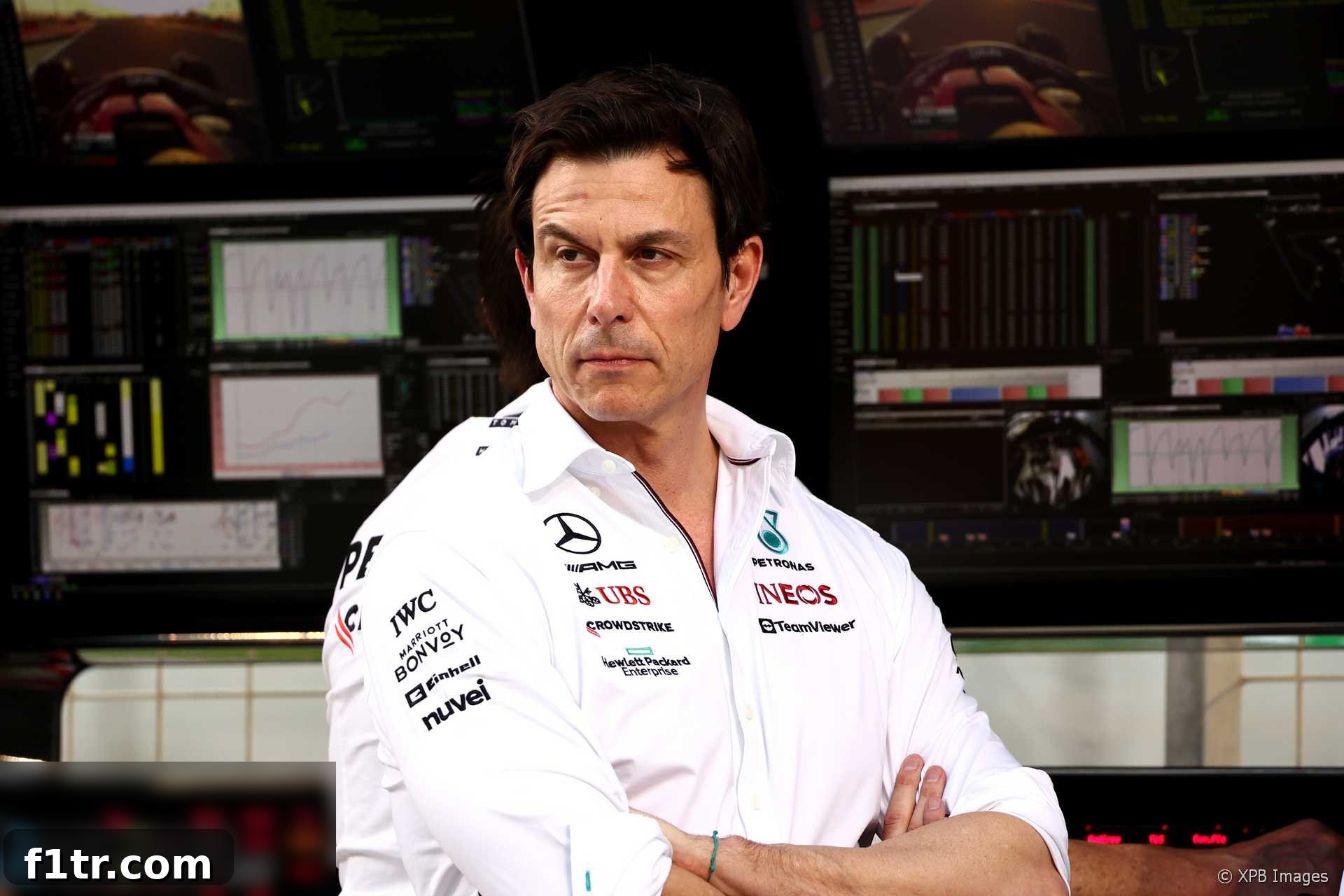
Mercedes-AMG Petronas F1 Team Principal Toto Wolff has confirmed that the Silver Arrows are set to introduce a “consistent” stream of upgrades for their W14 challenger over the upcoming races. This strategic move is aimed squarely at significantly reducing the performance gap to championship leaders Red Bull Racing, as the team continues its relentless pursuit of competitiveness in the 2023 Formula 1 season.
The 2023 season has presented a formidable challenge for Mercedes, who began the year with aspirations of closing the deficit to the dominant world champions. However, the initial rounds saw them not only lagging behind Red Bull but also out-scored by their power unit customer, Aston Martin. This unexpected turn of events has placed Mercedes third in the Constructors’ Championship standings, trailing Aston Martin by nine points and a substantial 67 points behind the Red Bull juggernaut as the season headed into its fourth round in Azerbaijan.
Mercedes’ Evolving Upgrade Strategy
Initially, during the Australian Grand Prix weekend, Toto Wolff had indicated that major performance upgrades for the W14 would not arrive until the Emilia-Romagna Grand Prix at Imola in May. His comments then focused on optimizing the existing package:
“The next three races, we won’t be adding any performance,” Wolff stated after Friday practice in Australia. “It’s now about finding the best set-up solutions and getting the tyres in the right window.” This initial stance underscored a period of deep analysis, aiming to extract maximum potential from the current car specification while comprehensive developmental work continued behind the scenes.
However, the competitive landscape and the urgent need for progress have prompted an updated strategy. Wolff has since confirmed a more continuous approach to car development. In a Q&A session published on Mercedes’ official website, he elaborated: “We will consistently be bringing upgrades to the car over the next few races, which is something to look forward to. But there is no such thing as a magic bullet that transforms the car, and it’s about being realistic with your expectations. Hopefully, we will see a steady improvement.”
This statement highlights the complex nature of Formula 1 development. Rather than a single, revolutionary update, Mercedes is committed to an iterative process, introducing a series of smaller, yet impactful, improvements designed to cumulatively boost the W14’s performance. This pragmatic approach acknowledges that in the fiercely competitive world of F1, substantial gains are often achieved through methodical, sustained development rather than isolated breakthroughs.
Addressing Driver Feedback and Technical Challenges
A crucial aspect of Mercedes’ development focus has been addressing driver feedback, particularly from seven-time world champion Lewis Hamilton. Hamilton has openly expressed a lack of confidence in the W14’s handling characteristics in recent races, attributing some of this to his seating position within the cockpit. Driver confidence is paramount in Formula 1, directly influencing their ability to push the car to its absolute limits and extract peak performance.
Mercedes Chief Technical Officer James Allison, a highly respected figure within the team, has indicated that modifications to the car’s suspension system are part of the planned upgrades. These changes are critical, as the suspension plays a pivotal role in how the car interacts with the track, influencing everything from aerodynamic stability to tyre management and, crucially, the driver’s ‘feel’ for the car. By refining the suspension, the team aims to provide Hamilton—and teammate George Russell—with a more predictable and confidence-inspiring platform, allowing them to better exploit the W14’s potential.
The seating position issue, though seemingly minor, can have profound implications. If a driver is not optimally integrated with the car, their perception of grip, balance, and responsiveness can be compromised, leading to hesitation and a reduced ability to deliver consistent lap times. Mercedes’ willingness to address such nuanced feedback underscores their commitment to optimizing every aspect of the car-driver interface.
The Powerhouse Behind the Performance: Brackley and Brixworth
Toto Wolff continues to express unwavering confidence in the capabilities of Mercedes’ two world-class facilities: the chassis factory in Brackley and the power unit factory in Brixworth. These twin hubs of innovation are the lifeblood of the Mercedes-AMG F1 team, where cutting-edge research, design, development, and manufacturing take place daily.
“The machine is continuing to run in Brixworth and Brackley at a fast pace,” Wolff affirmed. “What you see on track is only the tip of the iceberg, but the performance of the car and power unit is made in these two factories.” This metaphor vividly illustrates the sheer scale and intensity of operations that underpin a modern Formula 1 team. The visible performance on race weekends is merely the culmination of countless hours of intricate engineering, simulations, testing, and production carried out by hundreds of dedicated professionals.
The synergy between Brackley, responsible for the car’s aerodynamics, chassis, and overall vehicle dynamics, and Brixworth, which develops the championship-winning hybrid power units, is crucial. Their combined expertise is essential for designing, building, and continuously evolving a competitive F1 car. Wolff’s remarks highlight the deep trust he places in the engineers, designers, and technicians who tirelessly work behind the scenes, far from the glare of the race track.
A Long-Term Vision and Unyielding Mindset
Beyond the immediate challenge of the 2023 season, Mercedes maintains a broader, long-term strategic outlook. Wolff emphasized the robust mindset and spirit within the team, which he describes as “great” and full of “buzz.” This organizational resilience is a hallmark of Mercedes’ prolonged success in Formula 1.
“I believe 100 percent in our organisation, because our perspective is not always on a single race weekend, not even a single season. It’s on trying to build our capability so we are successful over multiple years, while recognising the fact you are never going to win every single season, because no sports team has ever done it,” Wolff stated. This philosophy acknowledges the cyclical nature of sporting dominance. While Mercedes enjoyed an unprecedented period of eight consecutive Constructors’ Championships, the team understands that sustained success requires continuous adaptation, learning, and investment in its core capabilities.
This perspective allows the team to weather periods of underperformance without losing sight of its overarching goals. It fosters a culture of innovation, self-assessment, and improvement, rather than panic. The focus remains on building fundamental strengths and ensuring that the organization is robust enough to contend for championships year after year, even if not every year yields the ultimate prize.
The Battle for Supremacy: Out-Developing Red Bull
With Red Bull having established a significant points advantage early in the 2023 season, the target for Mercedes is clear: they must accelerate their development pace faster than Red Bull can continue to refine their already dominant RB19. This creates an intense engineering arms race throughout the season.
“We understand the knowledge that we need to recover. We need to have a steeper development curve than Red Bull and fundamentally, we want to compete for race wins,” Wolff asserted. “They are setting the benchmark now.” The challenge is immense. Red Bull’s RB19 has proven to be an exceptionally well-balanced and aerodynamically efficient car, particularly in race trim. To not only catch but surpass such a benchmark requires not just innovative ideas, but also flawless execution and rapid implementation of upgrades.
Mercedes’ ambition to compete for race wins is not merely a statement of intent but a reflection of their engineering heritage and competitive drive. The team is confident in its internal processes and its personnel to achieve this. While setbacks are inevitable in the unforgiving world of Formula 1, the overarching goal is an upward trajectory in performance. The determination to close the gap and once again challenge for victories underscores Mercedes’ enduring commitment to excellence in the pinnacle of motorsport.
The coming races will be a critical test of Mercedes’ development capabilities and resilience. As the consistent upgrades begin to appear on the W14, the Formula 1 world will watch closely to see if the Silver Arrows can indeed recover the knowledge they need, achieve a steeper development curve, and ultimately return to the sharp end of the grid, challenging Red Bull for supremacy.
2023 F1 Season Related Content
- FIA president cleared of alleged interference in two 2023 races
- First week viewing figures for new Drive to Survive season fall again
- Max who? Drive to Survive season six prefers its favourite faces
- RaceFans’ complete 2023 season review
- The F1 drivers who pulled off the 10 biggest charges through the field in 2023
Browse all 2023 F1 season articles