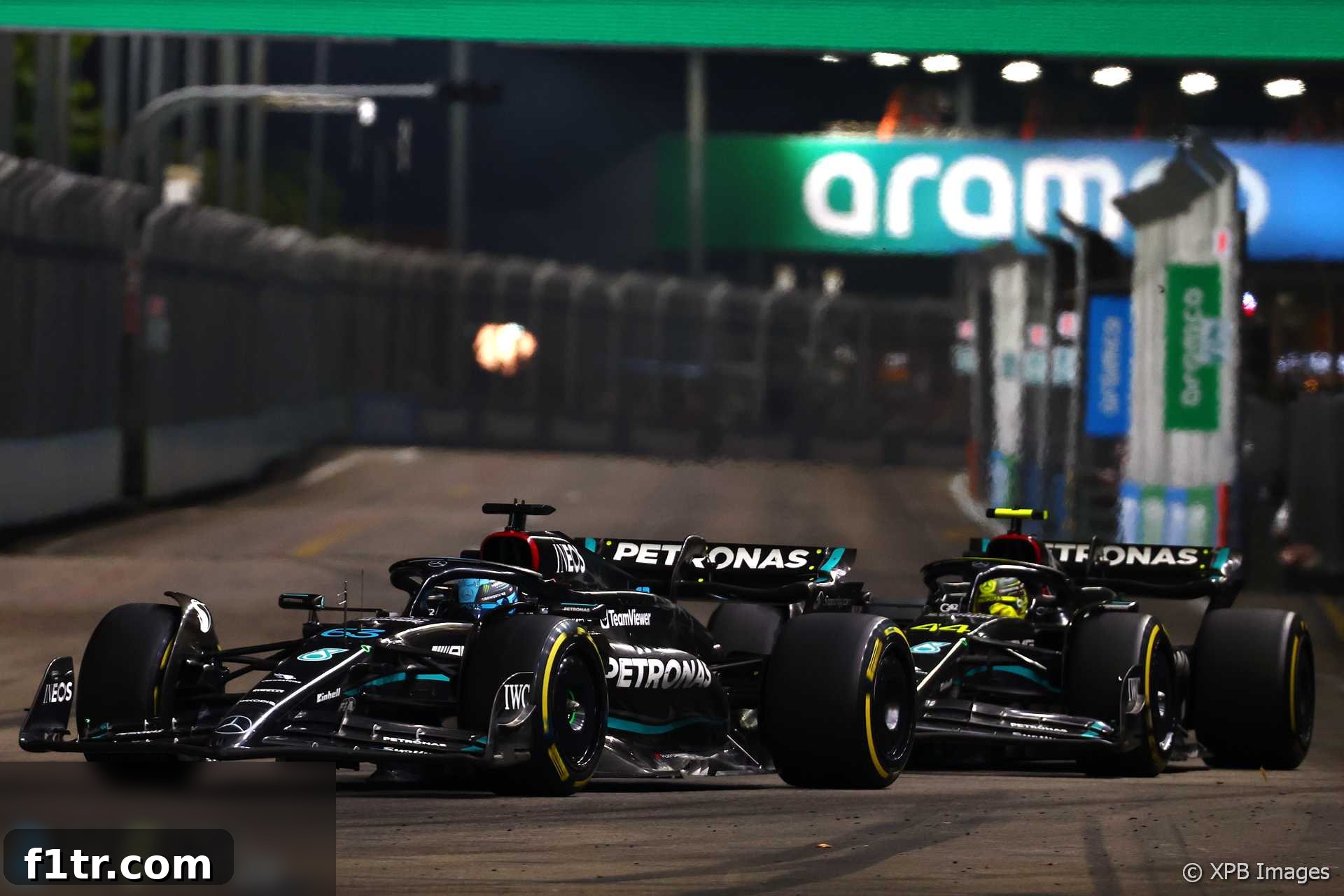
In the high-stakes world of Formula 1, every strategic decision carries immense weight, capable of altering the outcome of a race and impacting championship aspirations. The 2023 Singapore Grand Prix provided a compelling illustration of such a moment, as the Mercedes-AMG Petronas F1 Team faced a critical strategic crossroads. Amidst the challenging Marina Bay Street Circuit, known for its demanding conditions and unforgiving walls, Mercedes opted for a bold, unified strategy for both George Russell and Lewis Hamilton, a choice that stirred considerable debate but was ultimately defended by the team’s technical director, James Allison. The decision to not split their drivers’ strategies, even when presented with a seemingly opportune moment, was heavily influenced by Russell’s fierce desire to contend for victory, a desire Mercedes felt compelled to honor.
The Singapore Grand Prix: A Crucible of Strategy
The Singapore Grand Prix is renowned as one of the most physically demanding and strategically intricate races on the Formula 1 calendar. Its unique night race format, high humidity, and extensive number of corners put immense strain on drivers and machinery alike. For Mercedes, the 2023 season presented a continuous battle to close the gap to front-runners, making every race an opportunity to maximize points and prove their competitive edge. Heading into the crucial stages of the Singapore GP, both George Russell and Lewis Hamilton found themselves in strong positions, Russell running second and Hamilton fifth. Their performance up to that point suggested a potential for a significant points haul, possibly even a double podium.
The race had been relatively stable until a pivotal moment arrived in the form of a Virtual Safety Car (VSC) period. A VSC deployment offers a unique strategic window in Formula 1. During a VSC, all cars must reduce speed to a delta time, effectively neutralizing the gaps between competitors without fully stopping the race. This period significantly minimizes the time lost in a pit stop, as drivers can pit without losing as much track position as they would under green flag conditions. For teams eyeing a strategic advantage, a VSC pit stop on fresh tires can be a game-changer, allowing them to jump rivals or gain crucial pace in the latter stages of a race. It was this precise scenario that Mercedes confronted, presenting them with a golden opportunity to alter the complexion of their race.
The Unified Pit Stop: A Gamble on Glory
As the VSC was deployed, the Mercedes pit wall was abuzz with rapid calculations and discussions. With Russell in second place and Hamilton in fifth, the prospect of a double pit stop became a real possibility. Russell, ever the ambitious competitor, was quick to lobby his team on the radio, expressing his strong conviction that a pit stop for fresh tires was the correct call and would provide him with the best chance to challenge for the win. His determination was a significant factor in the team’s ultimate decision. Rather than splitting strategies – perhaps pitting Hamilton while keeping Russell out to maintain track position – Mercedes opted to bring both cars in for new tires. This bold move reflected a collective belief in the potential for a spectacular result, a belief fueled by Russell’s unwavering confidence.
Technical Director James Allison later elaborated on the rationale behind this unified approach. He explained that the team was “pretty confident” they could use the fresh rubber to propel their drivers past their immediate rivals. The immediate target after the pit stops was Charles Leclerc’s Ferrari. The potential upside of this strategy was immense: a coveted one-two finish for Mercedes, a result that would have been a significant statement in their season. Allison acknowledged the potential downside, a “two-point loss compared with doing nothing,” but emphasized that the calculated risk felt like “a really good bet, a really good hand to play.” The allure of a dominant performance outweighed the more conservative option of splitting strategies, particularly given the perceived high probability of success.
George Russell’s Unwavering Ambition
A crucial element in Mercedes’ decision-making process was George Russell himself. Allison highlighted Russell’s fierce competitive spirit, stating, “George was massively up for this. George felt he could get the job done. George would have been absolutely furious not to be given that chance.” This insight underscores the delicate balance teams must strike between optimizing numerical probabilities and managing driver morale and ambition. Denying a driver of Russell’s caliber and mindset the opportunity to fight for a win, especially when he believes strongly in the strategy, could have profound psychological repercussions, potentially affecting his trust in the team and future performance.
From the team’s perspective, the data supported Russell’s conviction. With new tires, the engineers calculated a very good chance for him to execute overtakes. The “downside was very small,” Allison asserted, while the “upside was absolutely enormous.” This belief in the potential for a high reward with a relatively low risk underpinned the strategic gamble. Mercedes saw an opportunity not just to secure points, but to achieve a potentially race-winning outcome through aggressive, calculated play. It was a testament to the team’s courage and their confidence in their drivers’ abilities to deliver when it mattered most.
The Battle on Track: Navigating the DRS Train
After the synchronized pit stops, both Russell and Hamilton rejoined the track on fresh tires, aiming to exploit their new rubber advantage. Russell successfully led Hamilton past Charles Leclerc, a testament to the immediate pace benefit they gained. However, the path to the front was not as clear-cut as initially hoped. They soon encountered Carlos Sainz Jnr and Lando Norris, who were strategically positioned ahead and, crucially, benefiting from a “DRS train.”
A DRS (Drag Reduction System) train occurs when multiple cars are closely following each other, allowing each trailing car to activate its DRS due to being within one second of the car ahead. This creates a cascading effect where cars can defend their positions more effectively, as the advantage gained by a following car through DRS is often negated by the car ahead also having DRS enabled. In the tight confines of Singapore, where overtaking is already notoriously difficult, the DRS train proved to be a formidable barrier. Despite Russell’s and Hamilton’s fresher tires and aggressive driving, breaking this defensive chain became an immense challenge. The initial projected advantage began to diminish as the laps ticked by, turning a promising strategic move into a tense battle for track position.
The Climax and Heartbreak: A Valiant Effort Ends in Drama
The final laps of the Singapore Grand Prix were a spectacle of high-octane drama. With the strategic gamble yet to fully pay off, George Russell pushed relentlessly, determined to make the unified strategy work and secure a podium, if not a victory. His pursuit of Lando Norris was fierce, a testament to his fighting spirit. On the very final lap, in a desperate attempt to pass Norris, Russell carried too much speed into Turn 10, lost control of his Mercedes, and crashed into the barrier. It was a heartbreaking moment for the young Briton, a devastating end to a race where he had shown immense pace and ambition.
Russell’s unfortunate incident had a direct impact on his teammate. Lewis Hamilton, who had been following closely, inherited third place due to Russell’s retirement. While Hamilton securing a podium finish salvaged some points for Mercedes, Russell’s crash was a stark reminder of the fine margins in Formula 1 and the often brutal consequences of pushing to the absolute limit. It was a dramatic conclusion that left many questioning whether the aggressive, unified strategy had been the right call, especially given the eventual outcome.
Post-Race Reflection: Courage and Conviction
Despite the bittersweet conclusion, James Allison remained steadfast in his defense of Mercedes’ strategic decision. He reiterated his pride in the team’s “courage to do it with both cars.” Allison emphasized that neither driver, nor anyone on the engineering and strategy side, doubted that it was the right call at the time. He acknowledged that “playing poker is very similar to playing race strategy – sometimes the hand does not go your way,” but stressed the importance of calculating the best odds and playing them accordingly. This perspective highlights that success in F1 strategy isn’t solely judged by the outcome, but by the soundness of the decision-making process given the information available at the time.
The incident underscored several key aspects of modern Formula 1: the critical role of real-time data analysis, the psychological influence of driver ambition on strategic calls, and the inherent risks of aggressive tactics. While the Singapore gamble did not yield the desired one-two finish, Mercedes viewed it as a necessary display of intent and a commitment to fighting for wins rather than settling for conservative points. Allison expressed hope that the team would “have the courage to do the same thing again in the future,” believing that with a bit of luck, such bold moves would eventually “tilt our way.” This philosophy suggests a continued willingness to take calculated risks in pursuit of ultimate victory, an ethos that defines top-tier motorsport.
Lessons Learned and Future Implications
The 2023 Singapore Grand Prix will be remembered not just for its dramatic finish, but for the bold strategic play made by Mercedes. It serves as a compelling case study in the complexities of Formula 1 strategy, where the optimal decision is often a blend of data-driven analysis, psychological insight, and a healthy dose of courage. The incident reinforced the understanding that while data provides the framework, the human element—the driver’s ambition, the strategist’s nerve—plays an equally crucial role in defining the path taken.
For Mercedes, the experience likely contributed to their ongoing evolution as a team. It demonstrated their readiness to push boundaries and take calculated risks, a mindset essential for challenging for championships. While the immediate result was not a fairy tale ending, the strategic clarity and conviction shown by the team and its drivers were undeniable. It sets a precedent for how Mercedes approaches future race weekends, indicating a preference for aggressive, high-reward strategies when the odds, however slim, favor a spectacular outcome. The delicate dance between caution and aggression will continue to define their pursuit of Formula 1 supremacy.
2023 Singapore Grand Prix Related Articles
- Sainz’s Singapore win made Leclerc focus on improving his race pace – Clear
- Singapore and Austin retirements cost me top 10 championship place – Ocon
- How Ocon’s “extreme” height for an F1 driver is helping other tall racers
- Steward’s admission Verstappen should have had penalty frustrates his rivals
- Drivers back Singapore qualifying tweak as rule changes again for Japanese GP
Browse all 2023 Singapore Grand Prix articles