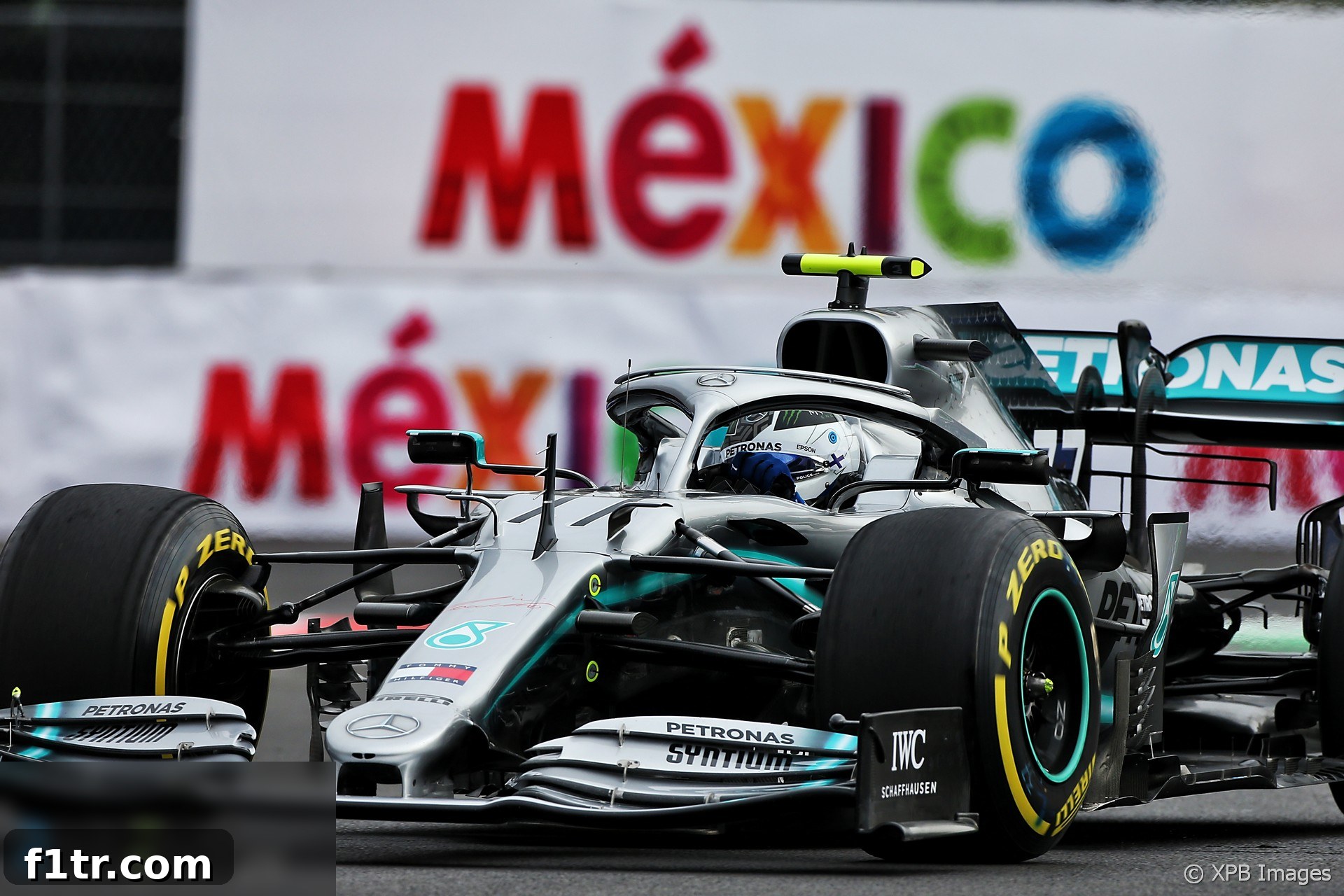
The Autodromo Hermanos Rodriguez circuit in Mexico City has carved out a reputation as one of the most challenging and unpredictable venues on the Formula 1 calendar, particularly for top teams like Mercedes. While once it was the tight, technical turns of Singapore that exposed their weaknesses, in recent times, it’s been the unique atmospheric conditions and track characteristics of Mexico that have consistently undermined their performance.
Advert | Become a Supporter & go ad-free
Located over two kilometers (approximately 7,200 feet) above sea level, the Autodromo Hermanos Rodriguez presents a formidable challenge that goes beyond typical circuit design. Despite featuring a couple of impressively long straights, which would ordinarily tempt teams to opt for low-downforce Monza-level wing settings, the thin air at this altitude dramatically alters aerodynamic dynamics. The reduced air density means that even running the largest available wing configurations, teams struggle to generate the equivalent downforce seen at sea-level tracks with medium-to-low wing settings. This forces cars to run maximum angle of attack on their wings just to achieve grip levels comparable to a circuit like Monza, which is renowned for its high-speed, low-downforce setup.
Beyond the aerodynamic hurdles, the track surface itself contributes significantly to the unique difficulties. It offers exceptionally low grip, a characteristic partly attributable to the dust and debris that naturally accumulates on a circuit nestled within a bustling metropolis home to millions. This combination of low air density – leading to less aerodynamic grip – and a slippery track surface creates a vicious cycle. It makes energizing the Pirelli tyres to their optimal operating window incredibly difficult, as cars struggle to generate enough friction and heat. Furthermore, the thinner air presents substantial cooling challenges for the cars’ engines, brakes, and other vital components, pushing them closer to their thermal limits and potentially impacting reliability and performance over a race distance.
Mercedes, in particular, has consistently found this circuit to be more problematic relative to their main rivals than almost any other venue on the calendar. This weekend was no exception, as they arrived expecting to play catch-up to the formidable pace of Ferrari and Red Bull. Following Friday’s practice sessions, Valtteri Bottas candidly admitted that their performance deficit was “bigger than we expected at this point the weekend,” highlighting the severity of their struggles and the difficulty in unlocking the car’s full potential under Mexico’s unique conditions.
A persistent thorn in Mercedes’ side at the Autodromo Hermanos Rodriguez has been tyre graining. While most teams grapple with this phenomenon, Mercedes appears to be particularly afflicted. Graining occurs when the tyre surface peels off in small bits, rather than wearing down smoothly, significantly reducing grip and performance. This issue compounds the already low-grip nature of the track and the challenges in tyre temperature management. Team Principal Toto Wolff articulated concerns that Ferrari, in particular, would extend their advantage even further on Saturday during qualifying.
“You can see that the Ferrari on the Saturday is almost unbeatable,” Wolff stated, acknowledging the Scuderia’s potent qualifying pace. “They’re able to up their game from Friday to Saturday. Once all the power kicks in that they have available it’s very difficult to compensate for the loss of straight line [speed].” Ferrari’s power unit advantage, especially when deployed in maximum engine modes during qualifying, gives them a significant edge on the long straights of Mexico, a characteristic that Mercedes struggles to counter given their car’s specific aerodynamic and engine performance profiles at altitude.
Despite the Friday struggles and the perceived qualifying advantage of Ferrari, Wolff maintained a degree of hope that the race day scenario might present a different picture. “They seem to have the strongest car on Saturday. Then when it comes to racing on Sunday, the Red Bull and the Mercedes are maybe a tiny bit more competitive at some of the races. Not the high speed tracks that we’ve seen, but all the others we seem to be crawling back a little bit.” This sentiment underscores the team’s belief that their car’s race pace and tyre management, while challenging in Mexico, might still offer a fighting chance compared to Ferrari’s Saturday dominance.
Looking ahead to qualifying, a clear pecking order was anticipated among the top three teams. On the face of it, the expectation was a two-by-two grid lineup: Ferrari leading the charge, potentially followed by Red Bull (assuming Alexander Albon could recover strongly from his second practice crash), and then Mercedes. However, the relatively short lap time at this particular track, combined with its unique characteristics, often introduces an element of variability and unpredictability. This setup can sometimes tighten the gaps between cars, making small errors or gains more impactful. Furthermore, there was a strong possibility of seeing a repeat of the Q3 towing tactics that became prominent at high-speed tracks like Spa and Monza. Drivers would strategically vie for a slipstream down the enormous start/finish straight, seeking to shave precious tenths off their lap times in a bid to gain a crucial grid position.
Adding another layer of complexity to the weekend, temperatures were forecast to rise over Saturday and Sunday. This meant that teams would face critical decisions regarding their cooling packages. Striking the right balance between aerodynamic efficiency and adequate cooling is always a delicate act, but it becomes even more pronounced in the thin, hot air of Mexico City. For Mercedes, this was a particularly concerning area, as their cooling solutions had shown weaknesses compared to their key rivals throughout the season, exacerbating their inherent challenges at this high-altitude venue.
The midfield battle, often a hotbed of intense competition, threw up some surprising results on Friday. Toro Rosso emerged as a standout performer, looking incredibly strong and competitive. Their Honda power unit seemed to handle the altitude challenges commendably, and their chassis appeared well-balanced for the track’s demands. McLaren continued their impressive run of form, appearing quick and poised to challenge for strong points. This strong showing from their rivals meant that Renault, despite their season-long efforts, might find it particularly tricky to advance into the coveted Q3 session, highlighting the fierce competition in the middle of the pack.
Another team that, much like Mercedes, has consistently identified this venue as a “bogey track” is Haas. Their struggles in Mexico have been well-documented, often defying their performance at other circuits. Romain Grosjean offered a stark and somewhat humorous assessment of their prospects on Friday: “Last year we came with the fourth of fifth fastest card [and] we were 17th and 18th on the grid. This year we come with the ninth fastest car – if you make the calculation, we’ll start 26th and 27th or something like that.” His pessimistic outlook, albeit exaggerated, was sadly reflective of the team’s genuine difficulties. Indeed, Friday’s sessions largely bore out his assessment, with Haas proving to be the ninth-quickest team overall. While they managed to stay ahead of the struggling Williams pair, their pace was not far off that of Alfa Romeo, indicating a tight but challenging battle at the rear of the midfield.
Longest Stint Comparison – Second Practice: Analyzing Race Pace
Understanding a team’s long-run performance is crucial for predicting race outcomes, and the longest stint comparison chart provides valuable insights into potential race pace and tyre degradation. This chart visually represents all drivers’ lap times (in seconds) during their most extended unbroken stint in second practice. Extremely slow laps, often due to traffic or pit stop simulations, have been omitted to provide a clearer picture of consistent performance. Race fans can zoom, pan, and reset the view to meticulously analyze the data, identifying which drivers and teams demonstrated the strongest consistency and tyre management over a longer duration, offering clues as to who might excel come Sunday’s Grand Prix.
Advert | Become a RaceFans supporter andgo ad-free
Combined Practice Times: A Snapshot of Speed
The combined practice times from Friday’s sessions offer a comprehensive snapshot of outright speed across the field, setting the stage for qualifying. Sebastian Vettel topped the charts for Ferrari, underscoring their strong performance potential, particularly on a single lap. Red Bull’s Max Verstappen was hot on his heels, confirming their status as a front-running contender, especially given their historically strong form in Mexico. The Mercedes drivers, Charles Leclerc and Valtteri Bottas, found themselves slightly adrift, highlighting the challenges the Silver Arrows faced even in the early stages of the weekend. Further down, the impressive showing of Toro Rosso with Daniil Kvyat and Pierre Gasly was evident, while Haas’s Romain Grosjean and Kevin Magnussen languished near the back, validating their concerns about this particular circuit. These timings provide a crucial benchmark for all teams heading into the competitive qualifying session.
| Pos | Driver | Car | FP1 | FP2 | Total laps |
|---|---|---|---|---|---|
| 1 | Sebastian Vettel | Ferrari | 1’18.218 | 1’16.607 | 55 |
| 2 | Max Verstappen | Red Bull-Honda | 1’17.461 | 1’16.722 | 54 |
| 3 | Charles Leclerc | Ferrari | 1’17.446 | 1’17.072 | 57 |
| 4 | Valtteri Bottas | Mercedes | 1’18.005 | 1’17.221 | 64 |
| 5 | Lewis Hamilton | Mercedes | 1’17.327 | 1’17.570 | 60 |
| 6 | Daniil Kvyat | Toro Rosso-Honda | 1’18.835 | 1’17.747 | 67 |
| 7 | Alexander Albon | Red Bull-Honda | 1’17.949 | 1’21.665 | 26 |
| 8 | Pierre Gasly | Toro Rosso-Honda | 1’18.593 | 1’18.003 | 62 |
| 9 | Carlos Sainz Jnr | McLaren-Renault | 1’18.401 | 1’18.079 | 59 |
| 10 | Nico Hulkenberg | Renault | 1’19.011 | 1’18.261 | 45 |
| 11 | Lando Norris | McLaren-Renault | 1’19.299 | 1’18.349 | 59 |
| 12 | Lance Stroll | Racing Point-Mercedes | 1’19.679 | 1’18.362 | 59 |
| 13 | Sergio Perez | Racing Point-Mercedes | 1’19.717 | 1’18.366 | 57 |
| 14 | Daniel Ricciardo | Renault | 1’19.499 | 1’18.380 | 57 |
| 15 | Kimi Raikkonen | Alfa Romeo-Ferrari | 1’19.205 | 1’18.681 | 59 |
| 16 | Romain Grosjean | Haas-Ferrari | 1’19.850 | 1’18.766 | 59 |
| 17 | Antonio Giovinazzi | Alfa Romeo-Ferrari | 1’18.959 | 1’18.889 | 68 |
| 18 | Kevin Magnussen | Haas-Ferrari | 1’19.013 | 1’19.306 | 59 |
| 19 | George Russell | Williams-Mercedes | 1’20.548 | 1’19.968 | 62 |
| 20 | Robert Kubica | Williams-Mercedes | 1’20.180 | 37 | |
| 21 | Nicholas Latifi | Williams-Mercedes | 1’21.566 | 30 |
Advert | Become a RaceFans supporter andgo ad-free
Teams’ Progress vs 2018: Gauging Evolution
Analyzing the ‘Teams’ Progress vs 2018’ chart provides a critical perspective on how each team’s performance has evolved year-on-year at the Autodromo Hermanos Rodriguez. This metric is invaluable for understanding which teams have successfully adapted their car concepts to the unique challenges of the high-altitude circuit, and which have perhaps regressed or plateaued. Such comparisons highlight the effectiveness of development cycles and give insights into the strengths and weaknesses of different chassis and power unit combinations in specific conditions. Observing these trends helps to paint a broader picture of the competitive landscape and the ongoing technological arms race in Formula 1.
Go ad-free for just £1 per month>> Find out more and sign up
Quotes: Dieter Rencken
2019 Mexican Grand Prix: Related Content
- Why Leclerc’s penalty decision took four hours longer than Kvyat’s
- Ferrari must start converting pole positions into wins – Binotto
- 2019 Mexican Grand Prix Star Performers
- Mercedes: Lost ‘wouvre panel’ cost Hamilton seven seconds
- Horner defends Verstappen’s driving after Hamilton’s “torpedo” criticism
Browse all 2019 Mexican Grand Prix articles