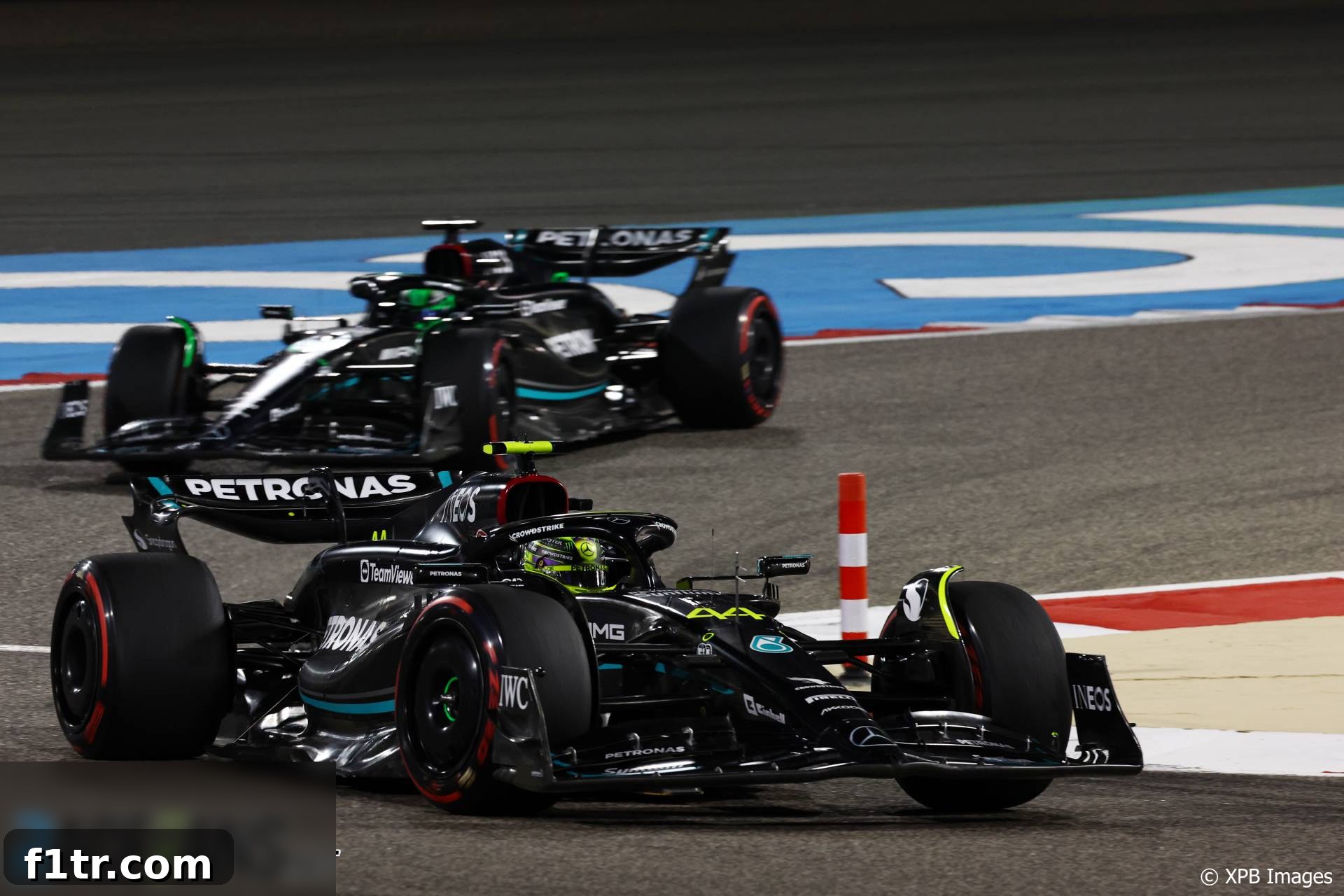
Mercedes Plots “Radical” Overhaul for W14 After Bahrain Setback
Following a profoundly disappointing start to the 2023 Formula 1 season at the Bahrain Grand Prix, Mercedes-AMG Petronas’ trackside engineering director, Andrew Shovlin, has confirmed the team is poised to implement “radical” modifications to its W14 challenger. Shovlin’s candid admission underscores the Silver Arrows’ urgent need for improvement, as their performance in the season opener was unequivocally deemed “not good enough.”
The Bahrain Grand Prix saw Mercedes drivers Lewis Hamilton and George Russell finish a distant fifth and seventh, respectively. Their W14 cars trailed the dominant Red Bull of race-winner Max Verstappen by a staggering 50 seconds, a gap that sent shockwaves through the paddock and reignited concerns about the team’s direction after a challenging 2022 season.
In a direct and honest assessment shared on the team’s inaugural race debrief video of the season, Shovlin did not mince words regarding Mercedes’ lack of pace. He highlighted the significant performance deficit that plagued the team throughout the weekend, indicating a fundamental issue with the car’s core capabilities.
The Stark Reality: A Performance Deficit and Tyre Degradation Woes
“Ultimately, we’ve got a lot of work to do,” Shovlin stated, laying bare the task ahead for the Brackley-based outfit. “The gap in qualifying was quite large; we were over half a second to the front. In the race, that was even bigger.” This significant disparity from the outset indicated that the W14 simply lacked the raw speed required to compete with the front-runners, particularly Red Bull.
Beyond the outright pace, Mercedes grappled with severe tyre degradation, a problem that amplified their struggles on race day. Shovlin explained, “That was compounded by the fact that when you get the tyre degradation, you get a bit more sliding, the tyres run hotter and you end up finding it very difficult to keep them under any kind of control.” This issue proved particularly vexing, as managing tyre wear and overheating not only compromised performance but also made the car incredibly challenging for Hamilton and Russell to drive consistently at the limit. Paradoxically, tyre management was a notable strength for Mercedes during the latter half of the 2022 season, making its sudden regression a major point of concern and a key area for urgent understanding.
The engineering director stressed that understanding this long-run degradation is paramount. “There is a lot that we need to understand but the key things are really getting on top of that long run degradation, which last year was a strong point for us,” he reiterated. This suggests a fundamental disconnect between the car’s current setup or aerodynamic characteristics and its interaction with the Pirelli tyres, a problem that demands a comprehensive solution. Moreover, the underlying issue of insufficient raw pace remains a critical hurdle. “Clearly, we’ve got something that’s not in the right place that we need to work on but ultimately the other thing is that performance gap to the front. The raw pace of the car is not good enough,” Shovlin affirmed, highlighting the dual challenge of improving both endurance and outright speed. The team is now working intensely on both short-term fixes and mid-term strategic developments to elevate their position on the grid.
Beyond the “Zero Sidepod”: The Quest for a New Concept
Mercedes’ struggles under the current technical regulations, introduced in 2022, have been intrinsically linked to their bold “zero sidepod” concept. This distinctive aerodynamic philosophy, first unveiled on the W13, was carried over to the W14 for the 2023 season, albeit with various refinements. However, the consistent performance deficit has prompted team principal Toto Wolff to declare that there would be “no sacred cows” in the quest to return to championship-contending form. This potent statement signalled a willingness to abandon even the most defining aspects of their car’s design if necessary.
Shovlin elaborated on this, clarifying the common misconception surrounding the term “concept” within F1 circles. “People have tended to use the word ‘concept’ when they mean ‘the sidepod design’ and Toto had said recently that we are looking at a revision that is going to come along in the next few races anyway,” he explained. While the sidepods are the most visually striking element of a car’s aerodynamic package, a true “concept” encompasses a far broader range of design choices, including floor geometry, suspension kinematics, and overall airflow management.
Given the significant performance gap to the front, Shovlin confirmed that the team’s revisions would extend far beyond superficial changes. “Given the gap to the front, of course we are going to look at bigger departures and more radical changes,” he stated. These “radical changes” suggest a fundamental re-evaluation of the W14’s aerodynamic philosophy and potentially even its mechanical underpinnings. Such significant shifts, however, are not instantaneous. “But those changes take time to turn into a faster solution in the wind tunnel – you can’t do them overnight,” Shovlin cautioned. The complex interplay of aerodynamics, mechanical grip, and tyre performance requires meticulous development and validation, a process that can span weeks, if not months. This often involves extensive CFD (Computational Fluid Dynamics) simulations, followed by rigorous testing in the wind tunnel to ensure new designs deliver the intended performance gains without introducing unforeseen issues.
Implementing such substantial changes demands a deep understanding of the car’s intricate systems. “There is quite a lot of development that you’ve got to do around any sort of big change in geometry in that area,” Shovlin noted. This includes ensuring structural integrity, cooling efficiency, and integration with existing components. The goal is clear: “Of course, we are looking at where we can improve the car, we are looking for potential to develop and you will see visible changes coming on the car over the next few races.” These visible changes will likely begin to appear on the W14 within the upcoming Grand Prix events, as Mercedes races against time to unlock its true potential.
Aerodynamic Testing in Practice: The Rear Wing Experiment
During the Bahrain Grand Prix weekend, Mercedes employed a strategic approach to gather crucial data on its car’s performance characteristics. Shovlin revealed that both Lewis Hamilton and George Russell were equipped with different specification rear wings during practice sessions. This side-by-side testing methodology, previously utilized by the team in 2022 (notably during the Canadian Grand Prix), allows for direct comparison and efficient data collection.
“We did look at a bigger rear wing on George’s car on Saturday morning, so he went to one that we were running in the test,” Shovlin explained. Conversely, “Lewis stayed with our update wing, the lighter downforce wing.” This experiment aimed to evaluate the optimal balance between aerodynamic downforce and drag, a critical trade-off in Formula 1 car design. A larger rear wing generates more downforce, enhancing cornering grip, but also increases drag, which reduces straight-line speed. Conversely, a lighter downforce wing offers higher top speeds but potentially compromises stability in corners.
The conclusion from this Saturday running was insightful: “the wing that Lewis had, the one that was faster in a straight line, was overall quicker.” This finding suggested that, despite potentially sacrificing some cornering performance, the benefits of reduced drag and higher straight-line speed outweighed the additional downforce provided by the larger wing on the Bahrain International Circuit. This data directly informed the race setup, as Shovlin confirmed: “Come the race, both cars were on the same rear wing,” indicating the team had converged on the optimal aerodynamic configuration based on their empirical testing.
A Tough Journey Ahead: Commitment to Improvement
Shovlin openly acknowledged the formidable challenges confronting Mercedes throughout the remainder of the 2023 season, describing the path ahead as a “tough journey.” Despite the magnitude of the task, he unequivocally stated the team’s steadfast commitment to enhancing the W14 and clawing their way back to the front of the grid.
“It’s a very difficult start to the year and after the season we had in 2022 we certainly didn’t wish for this sort of challenging start,” Shovlin admitted, reflecting on the collective disappointment within the team. The previous season, though ending with a victory for Russell, saw Mercedes surrender its constructors’ championship dominance. To begin 2023 with similar, if not greater, struggles was a stark reminder of the monumental task at hand. However, the response from within the team has been swift and unified: “everyone’s been very quick to acknowledge that problem.” This collective acknowledgement fosters a culture of honesty and shared responsibility, crucial for overcoming significant technical hurdles.
The integral role of the drivers, Lewis Hamilton and George Russell, in this development process cannot be overstated. “The drivers are very much on board with that, and they have been working very well together to try and help us develop and improve the car,” Shovlin highlighted. Their experience, nuanced feedback, and collaborative spirit are invaluable in pinpointing the car’s deficiencies and guiding the engineering team towards effective solutions. This unified approach from both the technical staff and the drivers underlines the team’s dedication to turning their fortunes around.
Shovlin concluded by emphasizing the team’s professional humility and relentless drive. “It’s nice just to see how everyone is very honest about the challenge that is ahead of us, very humble about where we are and what we need to do to move forward and committed to finding solutions because we are not happy with our current performance,” he said. The Mercedes-AMG Petronas team, accustomed to perennial success, fully understands that their current standing is simply “not good enough.” With a determined mindset, they are resolved to leave no stone unturned in their pursuit of performance. “We know that’s not good enough, but we will be doing everything we can to improve it.” The message from Brackley is clear: while the road ahead is arduous, Mercedes will meet the challenge head-on, leveraging every ounce of its formidable engineering prowess to climb back to the pinnacle of Formula 1.
2023 F1 Season Related Articles
- FIA president cleared of alleged interference in two 2023 races
- First week viewing figures for new Drive to Survive season fall again
- Max who? Drive to Survive season six prefers its favourite faces
- RaceFans’ complete 2023 season review
- The F1 drivers who pulled off the 10 biggest charges through the field in 2023
Browse all 2023 F1 season articles