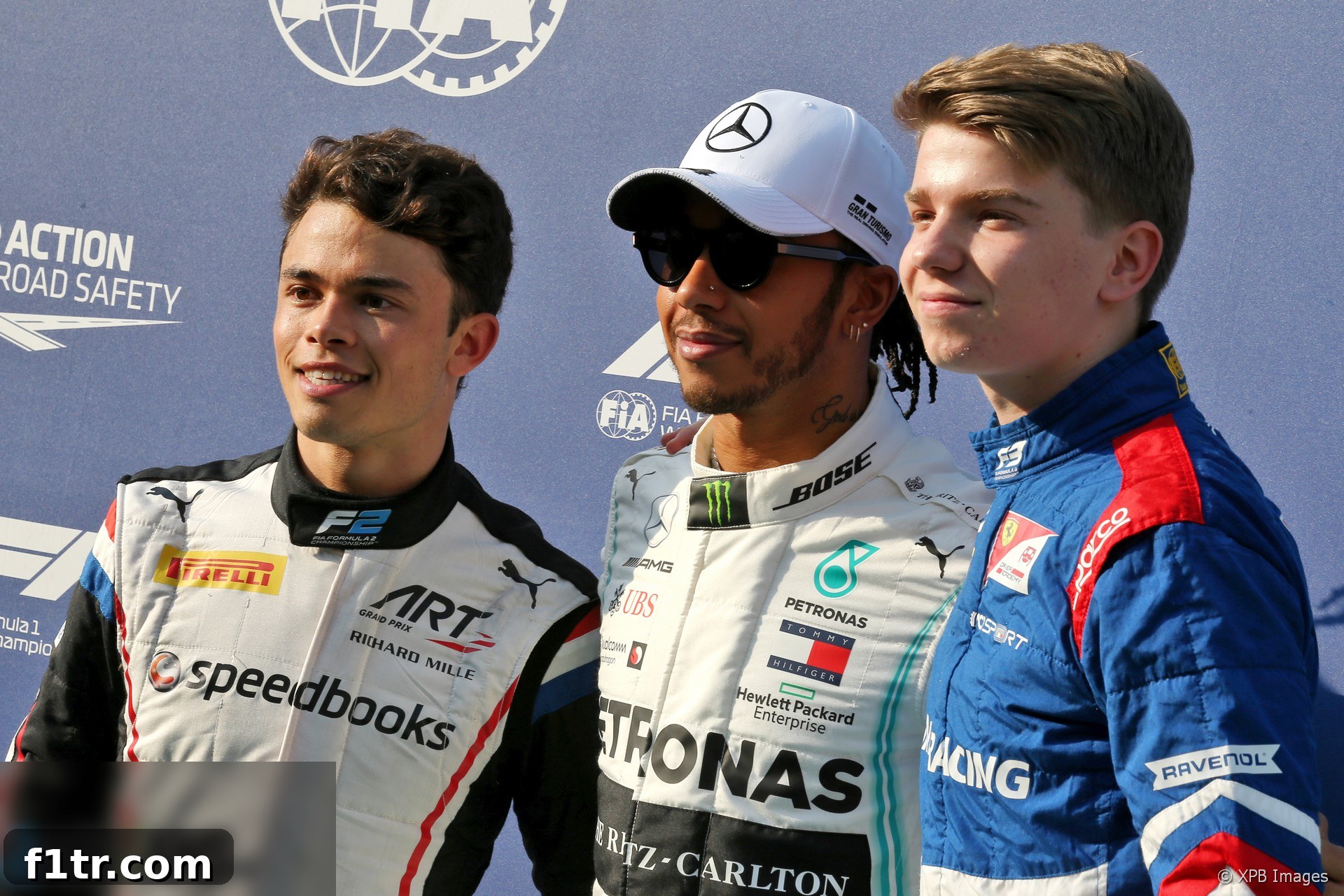
The story of Lewis Hamilton in Formula 1 is inextricably linked with McLaren. The unparalleled support and meticulous development he received from the team during his junior career didn’t just launch a legend; it fundamentally reshaped how driver development programs were conceived and operated across motorsport for years to come. Hamilton’s meteoric rise set an almost impossibly high bar, creating a blueprint for success that many aspiring talents, and indeed McLaren themselves, would strive to replicate.
Following Hamilton’s groundbreaking journey to F1, McLaren embarked on a quest to find their next superstar. Their sights turned to Nyck de Vries, a prodigious talent who, on paper, embodied many of the qualities that made Hamilton so special. Yet, despite being groomed for greatness within the McLaren system for nearly a decade, De Vries would eventually make his full-time Formula 1 debut with a completely different team, long after his ties with the Woking-based outfit had been severed. This raises a compelling question: What transpired between McLaren and their highly promising young protégé that led to such an unexpected parting of ways, and how did a seemingly perfect partnership unravel?
The Hamilton Blueprint: A Legacy of Meticulous Development
Before De Vries, McLaren’s young driver development programme – which at the time was run jointly with Mercedes – focused its attention primarily on a select few. After Hamilton’s stunning graduation to F1, the roster of junior single-seater talents was remarkably sparse, featuring only Giedo van der Garde. He joined the scheme in 2006, coinciding with his move to the highly-regarded ASM team in the Formula 3 Euro Series, directly inheriting the seat Hamilton had vacated just the year prior. This immediate connection inevitably invited comparisons to the burgeoning F1 star.
The parallels didn’t stop there. McLaren’s subsequent signing, British karter Oliver Rowland, also found himself under the immense shadow of Hamilton. Rowland was brought into the program in May 2007 at the age of 14, just one year older than Hamilton had been when he first joined McLaren’s ranks nearly a decade earlier. Both had clinched Super 1 national titles at the junior level in the preceding year, further fueling the narrative of a ‘next Hamilton’ in the making.
Aware of the overwhelming pressure these comparisons could create, McLaren was quick to temper expectations. A spokesperson for the team famously stated at the time, “No driver is the next Lewis Hamilton. Each driver is individual and we have certainly not brought Oliver into the programme with the aim of him following Lewis’s exact career path.” Rowland himself echoed this sentiment, adding, “it is not for me to draw comparisons with Lewis.” And he was right to do so. Because as events would unfold, it would be another exceptional talent, a Dutchman rather than a Brit, who would truly experience the weight and complexities of being the ‘chosen one’ in the post-Hamilton era.
A New Era, A Familiar Vision: Nyck de Vries Enters the Fold
Ron Dennis, during his tenure as team principal, oversaw every facet of McLaren with meticulous attention to detail. This fastidiousness extended to the support of young drivers, with McLaren exerting influence over nearly every aspect of Hamilton’s junior career. However, by 2009, Dennis had stepped back from direct control of the F1 team, handing the reins to his long-time right-hand man, Martin Whitmarsh. Whitmarsh’s approach, while distinct, remained heavily influenced by the robust structures and systems Dennis had established, and crucially, by the undeniable success of Hamilton’s trajectory.
A significant expansion of McLaren’s young driver programme was unveiled in March 2010. Notably, this announcement came in the same week that McLaren repurchased 29% of Mercedes’ 40% share in the team, signaling a period of strategic recalibration. The revamped program featured an impressive eight members. Rowland and Van der Garde remained, joined by four new single-seater racers and two long-term karting prospects. Among these promising newcomers were Alexander Albon and Nyck de Vries.
However, fate intervened when Albon secured sponsorship from Red Bull for his karting exploits, diverting his path. This left Nyck de Vries as the undisputed ‘Hamilton’ of the Whitmarsh era: a driver slated for complete immersion into the team from his karting days, with the clear intention of being guided directly into a coveted F1 race seat by McLaren. To further underscore these similarities, Hamilton’s own father, Anthony Hamilton, was even recruited as De Vries’ manager. Anthony’s proven success in navigating his son’s career under McLaren’s strict guidance made him a logical, albeit ultimately complex, choice. While this arrangement provided increased control and a direct link to the Hamilton legacy, it came at the cost of De Vries and his father’s autonomy in making crucial career decisions.
Prodigy Under Pressure: De Vries’ Early Racing Career
De Vries was widely regarded as a prodigious talent, a reputation he solidified by winning the World Karting Championship in both 2010 and 2011. When he transitioned to car racing in 2012, he mirrored Hamilton’s path by jumping straight into Formula Renault 2.0. To cement McLaren’s commitment, team sponsor Lucozade came on board as his primary backer, providing significant financial and marketing muscle.
As a highly sought-after talent, De Vries theoretically had his pick of top junior teams. Yet, McLaren orchestrated tests with three specific teams, ultimately selecting the one with the closest historical ties, based on Hamilton’s own junior career. De Vries joined the R-ace GP team in 2012, a squad directly connected to ART GP – formerly known as ASM, the very team with which Hamilton had famously won his Formula 3 and GP2 titles. This strategic choice was designed to replicate a winning formula, embedding De Vries in an environment proven to nurture McLaren’s top talent.
Much like Hamilton, De Vries finished fifth in the Eurocup standings during his rookie single-seater season. However, unlike Hamilton’s dominant F3 and GP2 years, R-ace GP found itself outmatched by several rivals, including a team that De Vries had initially preferred to join. This early setback hinted at cracks in the meticulously planned development path.
De Vries eventually got his way, moving to the more competitive Koiranen GP squad for the 2013 season. But a new car introduction that year negated Koiranen’s previous advantage, and De Vries once again finished fifth. To add to the complexity, McLaren had also brought 2012 Eurocup champion Stoffel Vandoorne into their program, creating internal competition for future F1 opportunities.
This confluence of circumstances meant De Vries had to endure a third season in Formula Renault. He responded emphatically, comfortably winning both the Eurocup and Alps series in 2014. While the original plan would have seen him progress to F3 for his third year in cars, mirroring Hamilton’s path, the double title success was, at the very least, an encouraging sign of significant progress and resilience.
McLaren’s Shifting Fortunes and De Vries’ Diminishing Influence
Despite his on-track success, the reality behind the scenes was stark: De Vries’ position within the McLaren empire was steadily shrinking. He had once been so integral to the team that he even appeared in their short-lived animated series, ‘Tooned,’ in 2012, alongside F1 champions Hamilton and Jenson Button, and numerous team legends. By 2014, however, McLaren was no longer a race-winning team, and Ron Dennis had retaken control from Martin Whitmarsh, signaling a period of significant internal upheaval.
The situation became increasingly straightforward, if brutal. McLaren primarily funded De Vries’ career, but their own sponsors supported McLaren based on a return on investment. As McLaren slid down the F1 pecking order, their ability to provide value to these crucial sponsors diminished. The highly anticipated switch from Mercedes to Honda as engine supplier in 2015, while guaranteeing more funding for the team, paradoxically reduced McLaren’s on-track competitiveness even further. This strategic shift inevitably triggered changes in the young driver program, with fresh Honda investment bringing in Honda juniors, much like the Mercedes partnership had enabled McLaren to support talents like Hamilton in the 2000s.
By the time the Honda deal was finalized, Lewis Hamilton had already departed McLaren, making a monumental move to Mercedes’ factory F1 team. This move would famously propel him to unprecedented, record-breaking heights in the World Championship, further underscoring McLaren’s declining relevance as a breeding ground for F1’s elite.
Lost in Transition: The Political Chessboard and Lack of Opportunity
Once the support of young drivers became a pawn in McLaren’s evolving internal political landscape, Nyck de Vries was left without a clear direction or champion within the team. During Hamilton’s junior years, he was regularly involved in F1 straight-line testing duties and various other team activities. This constant engagement allowed him to reinforce his value to Ron Dennis, even if his results occasionally faltered (as they did during his challenging first year in F3).
For De Vries, the closest he came to such high-level integration were demonstration runs in old F1 cars at events like the Goodwood Festival of Speed. He also served as a simulator driver – a role that, notably, didn’t even exist during Hamilton’s youth. Over his remarkable nine-year tenure at McLaren, De Vries never once drove a contemporary Formula 1 car. This critical lack of genuine F1 seat time meant he missed invaluable opportunities to impress senior figures within the team and showcase his exceptional talent in the ultimate proving ground.
This absence of direct F1 exposure created a two-fold problem for De Vries. While Hamilton had competed alongside numerous Mercedes juniors, he was essentially the sole talent officially backed and championed by McLaren. By the time De Vries reached FR3.5 in 2015, his McLaren stablemate, Stoffel Vandoorne, had already firmly established himself in GP2. Despite facing some of the same internal McLaren challenges as De Vries, Vandoorne was widely considered to be on a direct path to an F1 seat, further intensifying the competition.
The second part of the problem manifested as yet another pivotal management change. By the end of 2016, Ron Dennis was out, and Zak Brown had stepped in to lead McLaren. Brown arrived with his own vision and, crucially, his own favored driver to back, further altering the landscape for De Vries.
The Fork in the Road: De Vries’ Post-McLaren Journey
While Hamilton, Vandoorne, and later Lando Norris would receive financial support all the way up to Formula 1, McLaren made the decision to stop funding Nyck de Vries’ racing activities after 2016, though he was technically retained as a junior driver. This critical decision undoubtedly added several years to De Vries’ arduous route to F1, and it prompted a follow-up decision from the Dutchman himself that further prolonged his wait to reach the pinnacle of motorsport.
Despite McLaren’s unwillingness to fund his Formula 2 campaign, they still wanted De Vries to undertake paid simulator work at their Woking headquarters. However, De Vries, acutely aware that on-track results were now more vital than ever for his F1 aspirations, chose to make F2 his sole focus instead. This was a brave and strategic move, asserting his independence and prioritizing competitive racing above all else.
He had underperformed with ART GP in GP3 in 2016, a season where dwindling McLaren funding prevented him from making a direct jump from FR3.5 to GP2. Consequently, when he became reliant on his own budget in 2017, he faced an uphill battle. Securing an F2 seat with a top team, and delivering a stunning rookie season akin to Hamilton or Vandoorne, became an impossibility.
Instead, De Vries found a way onto the grid with the underfunded Rapax team. Mid-season, he had to switch to Racing Engineering, ultimately finishing seventh in the standings with a single sprint race win. By this point, his McLaren story was effectively over, particularly with Zak Brown’s protégé, Lando Norris, arriving in F2 for the 2018 season, taking the spotlight and potential F1 pathway.
Fellow driver Sean Gelael’s father played a crucial role in keeping De Vries in the series for a second season, making him Gelael’s teammate at the back-to-back champion team Prema for 2018. However, the introduction of a troublesome new car that year meant De Vries was largely alone in leading Prema’s charge. Despite coming close to being championship runner-up and winning three races, he ultimately finished behind Norris in the standings. While noted for his maturity upon entering FR2.0, by the time he and his rivals reached F2, it was no longer a standout trait, and his public persona remained shaped by McLaren’s rather corporate past approach.
Redemption and a Deserved F1 Debut
In May 2019, Nyck de Vries officially left McLaren. This departure, much like Hamilton’s move from McLaren, seemed to unlock his character, both on and off-track, allowing him to truly flourish. In an alternate timeline, he might well have been the driver to ignite the feverish Dutch passion for Formula 1, had Max Verstappen not explosively arrived on the scene in 2015.
Reuniting with ART GP for the 2019 season, De Vries delivered a masterful performance, winning the Formula 2 championship. His campaign was marked by exemplary drives in both wet and dry conditions, coupled with consistent speed in qualifying and races. Just days after a sensational charge from 17th to third at Monza, De Vries was announced as Mercedes’ first driver for their Formula E program. Yet, in the eyes of many F1 observers, his high standard that season was somewhat devalued by the perception that he had “failed” to win the F2 title earlier in his career. No matter how dominant his 2019 campaign proved to be, the ship, it seemed, had already sailed on it directly translating into an F1 opportunity.
Perhaps it’s no surprise, then, that much like Hamilton, De Vries was able to become a world champion with Mercedes, albeit in a different category. His Formula E crown was followed by a more erratic title defense. However, his impressive F1 test performances since 2020, culminating in his starring race debut at the recent Italian Grand Prix, have finally convinced multiple teams of his undeniable calibre. This breakthrough moment at Monza, where he scored points on debut as a substitute driver, was the culmination of years of perseverance and talent.
The Broader Lesson: Talent vs. System in F1 Development
Nyck de Vries’ journey serves as a compelling case study, highlighting the often-unforeseen pitfalls that can arise when Formula 1 teams meticulously plot out paths for prodigious young talents from a very early age. Such highly structured programs, while well-intentioned, can sometimes do more harm than good, leading to a significantly longer and more arduous route to F1 rather than the rapid rise seen with Hamilton (which itself was revolutionary for its time) or even more extreme examples since.
De Vries isn’t alone in this experience. Other young drivers have also been unfairly hampered by the inherent instability of F1 team management changes. Ferrari’s extremely exciting protégé, Raffaele Marciello, suffered a similar fate in 2015, but like De Vries, he ultimately fulfilled early career expectations of conquering global motorsport by joining Mercedes’ sportscar programme. This shuffling backwards due to new arrivals or shifting priorities is a regularly occurring phenomenon, especially observed for many years within the Red Bull Junior Team. However, De Vries’s story, spanning nearly a decade within one of F1’s most prestigious academies, perfectly encapsulates the delicate balance between nurturing talent and navigating the unpredictable currents of elite motorsport politics and strategy. In the end, despite all the twists, turns, and setbacks, Nyck de Vries did get his F1 chance, and he made it count.
2022 F1 season
- Mercedes told me “you’re wrong” about 2022 car’s problems – Hamilton
- FIA confirms all 10 F1 teams complied with 2022 cost cap
- Steiner “not ashamed” of panning “slow” Schumacher in Drive to Survive
- Albon believes year out of F1 improved him as a driver
- Hamilton sees diversity gains in F1 years on from his ‘traumatising’ experience of racism
Browse all 2022 F1 season articles