McLaren Ends Juncos Hollinger Partnership Following Social Media Abuse Controversy in IndyCar
In a significant and immediate development within the fiercely competitive world of IndyCar racing, McLaren has officially terminated its commercial alliance with Juncos Hollinger Racing (JHR). This abrupt decision, announced with immediate effect, stems directly from a heated social media dispute involving the two teams’ drivers, Theo Pourchaire of McLaren and Agustin Canapino of JHR, following a contentious on-track incident at the recent Chevrolet Detroit Grand Prix. The termination underscores the increasing intolerance of top-tier motorsport organizations towards online harassment and the critical importance of maintaining a respectful environment within the sport.
The Incident That Sparked Controversy
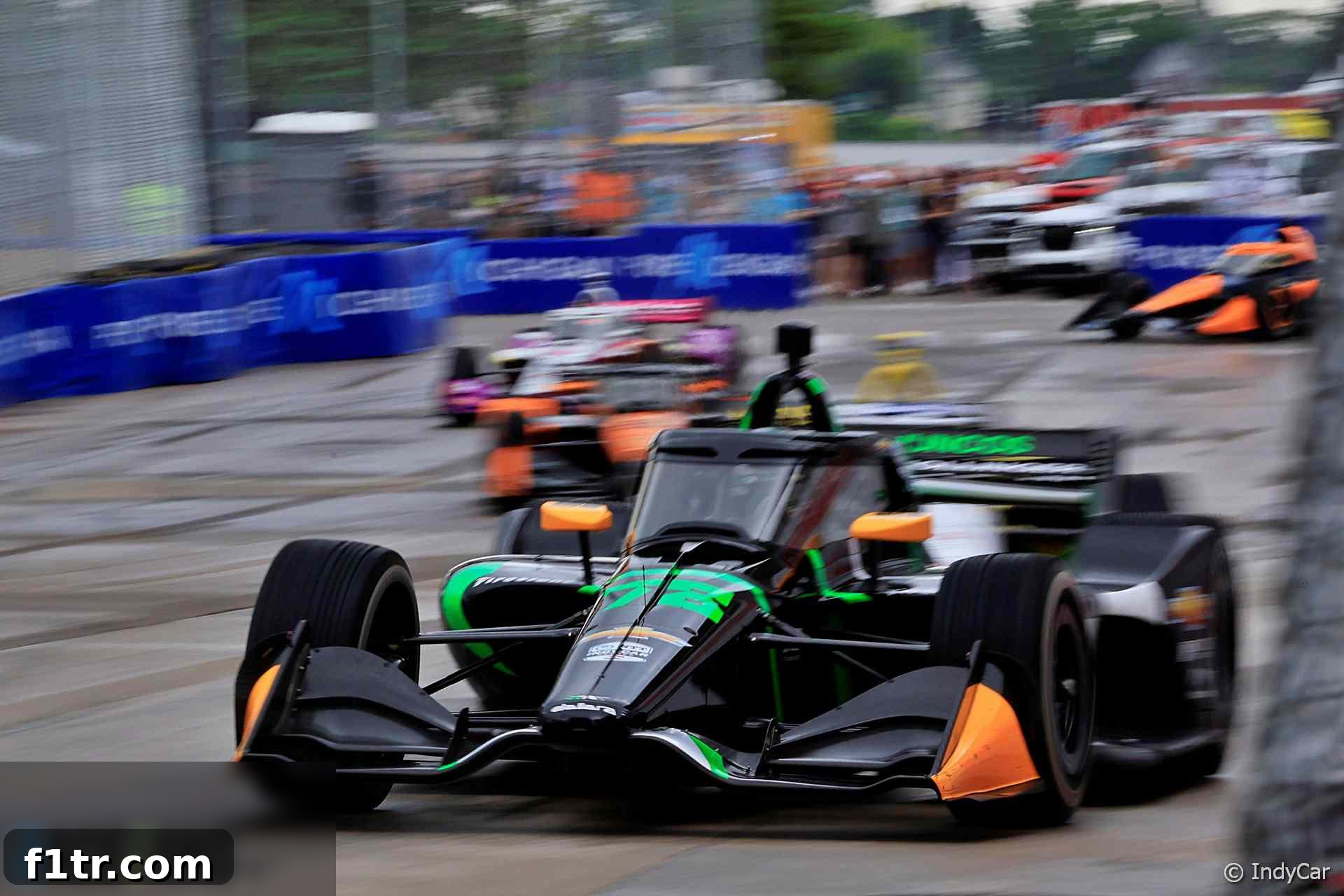
The genesis of this dramatic split traces back to Sunday’s Detroit Grand Prix, where a collision occurred between McLaren’s rookie driver, Theo Pourchaire, and Juncos Hollinger’s Agustin Canapino. The incident unfolded during a restart, with Canapino running in a promising sixth position. While on-track altercations are a common feature of high-stakes racing, the aftermath of this particular collision quickly escalated into a wider controversy that transcended the racetrack.
In the wake of the Detroit race, Theo Pourchaire publicly disclosed that he had become the target of a torrent of online abuse. The Frenchman claimed that he received “so much hate and death threats in the last 24 hours for such a small incident,” highlighting the severe and often disturbing nature of online harassment that athletes can face. This was not an isolated incident concerning Canapino’s fanbase; his supporters had previously been accused of directing abusive comments towards other drivers on social media platforms, creating a pre-existing tension around their online conduct.
Canapino’s Controversial Response Fuels the Fire
The situation was further exacerbated by Agustin Canapino’s public response to Pourchaire’s allegations. Two days after the race and Pourchaire’s claims, Canapino took to social media, casting significant doubt on the veracity of the death threats and general abuse Pourchaire reported. His statement, intended perhaps as a defense of his passionate Argentine fanbase, instead drew widespread criticism for appearing to dismiss Pourchaire’s experience of harassment.
Canapino wrote, “We Argentines are passionate and euphoric, but that doesn’t mean we should be accused of something we are not. Therefore, I strongly reject being generalised and placed in a category we don’t deserve.” He continued, challenging the very existence of the threats: “I have not seen a single death threat directed at those who claim to have received them. From last year to today, no one in their right mind would do such a thing. It’s outrageous to be accused of this so lightly, and I won’t allow it anymore. If anyone did this, they are not part of us, and we don’t deserve to be consider this way because of some misfit we strongly reject.”
While Canapino also added that he “constantly receives abuse and hate” and had “learned to live with it as many people do, choosing to ignore it,” his primary message was perceived as a denial and a counter-accusation. This stance was seen by many as highly insensitive, especially coming from a fellow driver, and did little to de-escalate the increasingly toxic online environment. Furthermore, some observers accused Canapino of implicitly endorsing posts by others that attacked Pourchaire, further complicating his position and the public’s perception.
McLaren’s Firm Stance and Zak Brown’s Condemnation
McLaren Racing, a global motorsport powerhouse known for its strong brand values and commitment to a positive sporting environment, swiftly condemned the events. Zak Brown, CEO of McLaren Racing and the figurehead overseeing their IndyCar operations, voiced his unequivocal disapproval of the online reaction. In a public post, Brown labeled the behavior as “sad and pathetic,” sending a clear signal of McLaren’s zero-tolerance policy towards such conduct. His statement underscored the seriousness with which McLaren views instances of online harassment, particularly when directed at its drivers.
For McLaren, this incident likely represented a breach of trust and a direct contradiction of the values they strive to uphold, both on and off the track. The decision to terminate the alliance was a definitive statement that the team prioritizes the well-being and safety of its personnel over commercial partnerships, especially when online behavior descends into threats and abuse.
The Broader Impact of Social Media on Motorsport
This incident between McLaren and Juncos Hollinger Racing serves as a stark reminder of the growing challenges posed by social media in professional sports. While platforms like X (formerly Twitter), Instagram, and Facebook allow for unprecedented fan engagement, they also create breeding grounds for anonymity-fueled toxicity. Drivers, like all public figures, are increasingly exposed to a relentless barrage of hate speech, personal attacks, and even death threats, which can profoundly impact their mental health and overall well-being.
The blurred lines between passionate support and outright abuse are a persistent problem. What begins as fervent loyalty can sometimes devolve into targeted harassment, with individuals feeling emboldened by the perceived anonymity of the internet. This creates an unhealthy environment that undermines the spirit of sportsmanship and fair competition. Motorsport organizations, teams, and drivers are now grappling with the responsibility to not only address such behavior but also to educate fans on respectful online conduct.
This McLaren-JHR split highlights a critical shift in how teams are choosing to respond to such issues. Historically, teams might have issued generic statements. However, McLaren’s decisive action suggests a new precedent: a willingness to sever strategic alliances if a partner’s conduct, or the conduct of their affiliated personnel and their fanbases, deviates too far from acceptable standards of respect and decency. This could encourage other teams to adopt stronger policies regarding social media ethics for their drivers and staff.
The Fallout: Official Statements and Future Implications
The termination of the commercial alliance was confirmed by both teams through simultaneous official statements. McLaren’s announcement was direct and unambiguous: “McLaren Racing has terminated its commercial alliance with Juncos Hollinger Racing, effective immediately. This decision follows actions that occurred earlier this week on social media in regards to an on-track incident at the Chevrolet Detroit Grand Prix.” Their statement left no room for interpretation regarding the catalyst for the separation.
Juncos Hollinger Racing, in turn, acknowledged the split with a more measured tone. “As of today, our strategic partnership with Arrow McLaren has come to a conclusion,” their statement read. They added, “We appreciate the time spent with McLaren over past months. They are a world-class organization which we enjoy competing against week in and week out. While the results of the partnership did not mature, we have the utmost respect for them and are confident in the future of Juncos Hollinger Racing.” The reference to “results of the partnership did not mature” in JHR’s statement stands in contrast to McLaren’s direct attribution to social media actions, yet it implicitly acknowledges that the alliance was not flourishing as intended, whether due to performance or other unforeseen complications like the recent controversy.
The immediate implications for Juncos Hollinger Racing are significant. Losing a commercial alliance with a titan like McLaren can affect resources, technical support, and sponsorship opportunities. For McLaren, this move reinforces their brand integrity and sends a powerful message across the IndyCar paddock about their expectations for professional conduct and their stance against online abuse. It also opens up possibilities for future partnerships that better align with their corporate ethos.
Setting a Precedent for Accountability
This incident could set an important precedent within IndyCar and potentially across other motorsport categories. It signals that teams are prepared to take concrete action against behavior that not only harms individual drivers but also tarnishes the sport’s image. It underscores the idea that a driver’s responsibility extends beyond the cockpit to their conduct and influence in the digital sphere, and that teams bear some responsibility for the environment fostered by their affiliated personnel and fanbases.
The McLaren-JHR split serves as a potent case study on the consequences of unchecked online behavior and the imperative for all stakeholders in professional sports—drivers, teams, and fans—to engage respectfully and constructively. As racing continues to embrace digital connectivity, ensuring a safe and inclusive environment for everyone involved will remain a paramount challenge and a defining characteristic of modern motorsport.
For fans who wish to support independent motorsport journalism and enjoy an ad-free browsing experience, consider becoming a RaceFans Supporter. Your contributions help cover the costs of creating, hosting, and developing high-quality racing content today and in the future.
- Become a RaceFans Supporter
- RaceFans Supporter FAQ
Explore More IndyCar News
- IndyCar driver McLaughlin cleared of injury after crashing through barrier at Barber
- Schumacher says his IndyCar feels like ‘an F2 car, just with better tyres’
- IndyCar “way faster than Formula 1” in some corners, says Grosjean
- FIA to award more F1 superlicence points to IndyCar drivers from 2026
- Schumacher to race full-time in IndyCar with RLL in 2026
Browse all IndyCar articles