Brazilian Grand Prix: A Race of Records, Redemption, and Unforgettable Podiums
The 2019 Brazilian Grand Prix at Interlagos delivered an absolutely extraordinary spectacle, etching itself into the annals of Formula 1 history as a race of unexpected outcomes, dramatic turns, and multiple groundbreaking records. While the previous McLaren-Honda partnership four years prior had been marred by struggles, this event saw Honda-powered teams celebrate unprecedented success, highlighting a remarkable resurgence for the Japanese manufacturer. This thrilling race served as a stark reminder of F1’s unpredictable nature, where every lap can rewrite destinies and create new heroes.
Verstappen’s Dominance and Honda’s Resurgence
Max Verstappen, the young Dutch prodigy, was undoubtedly the star of the show. He masterfully navigated the challenging Interlagos circuit, securing Red Bull’s third Honda-powered victory of the season. This triumph was particularly sweet for Honda, as it marked only their second win at this legendary track. The previous occasion dated back to 1991, when the legendary Ayrton Senna claimed an emotional home victory for McLaren, also powered by Honda. Verstappen’s win wasn’t just another notch on his belt; it underscored Honda’s significant progress and their renewed competitive edge in the sport, transforming their fortunes from a challenging return to a formidable force.
This victory was the eighth of Verstappen’s burgeoning career, propelling him into an elite group of drivers. With eight wins, he now stands alongside esteemed names like 1967 world champion Denny Hulme and the legendary Jacky Ickx. His consistent, aggressive, yet controlled driving style continues to make him a fan favourite and a constant threat for championship honours, solidifying his position as one of Formula 1’s brightest talents.
Drama, Penalties, and Unexpected Heroes Emerge
Albon’s Heartbreak and Hamilton’s Penalty
The race was not without its cruel twists of fate. Alexander Albon, Verstappen’s teammate at Red Bull, was poised for what would have been a sensational maiden podium finish, running comfortably in third place during the closing stages. However, his dreams were shattered on the penultimate lap when Lewis Hamilton, in an aggressive move, tipped him into a spin. This unfortunate incident not only cost Albon a well-deserved podium but also triggered a chain of events that would dramatically reshape the final standings. Hamilton, initially finishing third, was later handed a five-second time penalty for the collision, dropping him down to seventh place. This penalty added another layer of intrigue to an already chaotic race, demonstrating how fine the margins are in Formula 1 and how quickly fortunes can change.
Gasly’s Maiden Podium and Toro Rosso’s Triumph
With Albon out of the picture and Hamilton facing a penalty, the door swung wide open for others. Pierre Gasly seized this incredible opportunity, hanging on to second place by the narrowest of margins. In a thrilling drag race to the finish line, he held off Hamilton, crossing the line just ahead of the Mercedes driver. This remarkable achievement earned Gasly his first-ever Formula 1 podium, a moment of immense personal and team triumph. For Toro Rosso, this was their second-best result in their 14-year history, surpassed only by Sebastian Vettel’s unforgettable victory at the 2008 Italian Grand Prix. Gasly’s podium also marked a significant milestone for French motorsport, as he became the first French driver to reach the podium since Romain Grosjean at Spa four years prior. His performance was a testament to his resilience and talent, especially after a challenging season that saw him demoted from Red Bull earlier in the year.
A Historic Honda One-Two
The combination of Verstappen’s victory and Gasly’s second-place finish resulted in a historic moment for Honda: their first one-two finish since 1991. That year, Gerhard Berger led his McLaren team mate Senna home at Suzuka, also with Honda power. Even more remarkably, this was Honda’s first one-two formed by two different teams since 1987, when Nelson Piquet’s Williams led Senna’s Lotus home at Monza. This statistic truly underlines the incredible engineering achievement and competitiveness that Honda had reclaimed in the sport, making the Interlagos result a watershed moment for their F1 programme.
McLaren’s Long-Awaited Return to the Podium and a Youthful Trio
Sainz Jr.’s First Podium and Spanish History
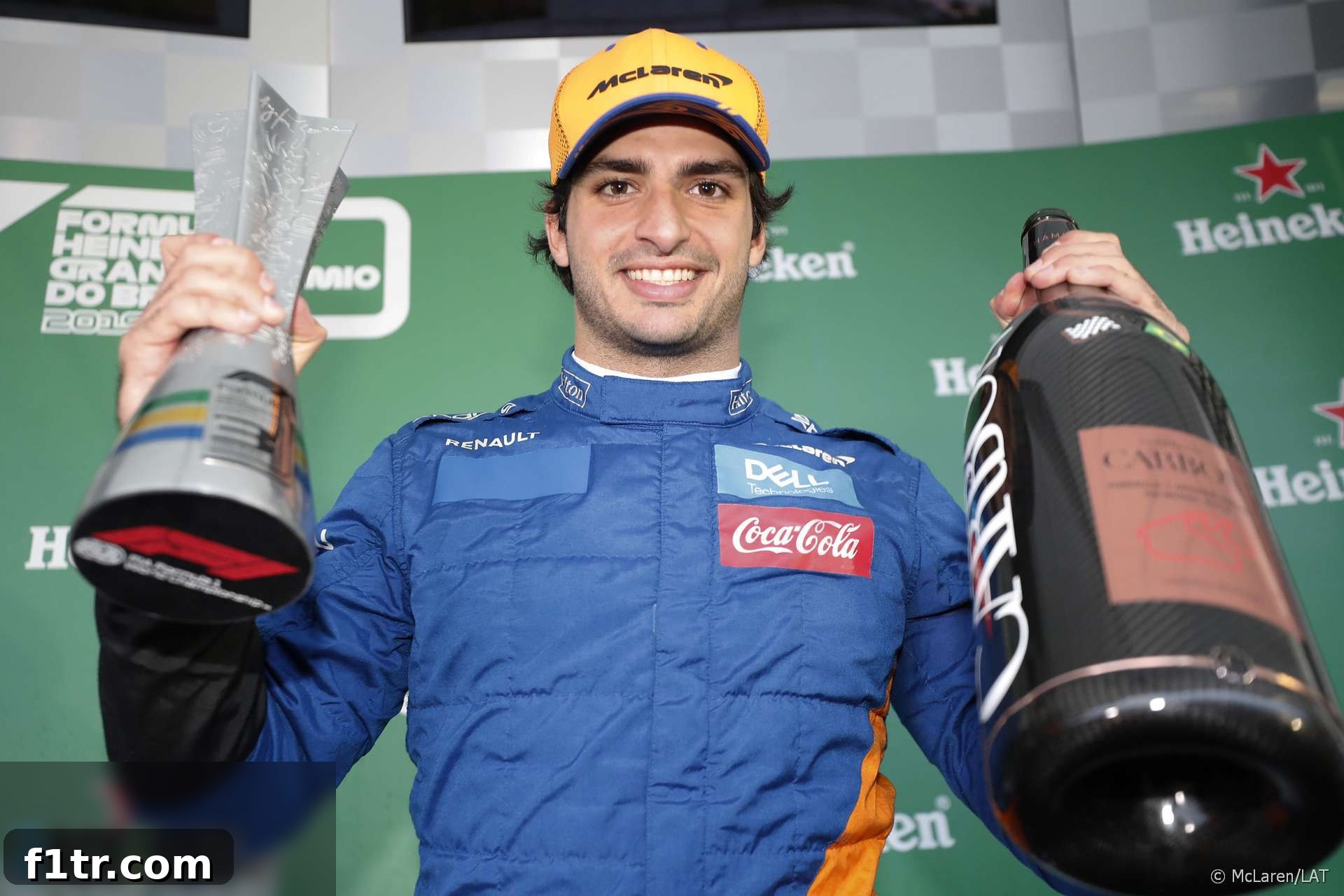
While not present on the initial podium ceremony, Carlos Sainz Jnr was later promoted to third place following Hamilton’s penalty. This marked the first podium finish of his career, a momentous occasion for the Spanish driver and his team, McLaren. Sainz became only the fourth Spanish driver in history to finish in the top three in a Grand Prix, scoring the 100th podium finish for his country. He joins the esteemed company of Alfonso de Portago (one podium), Pedro de la Rosa (one podium), and the legendary Fernando Alonso (97 podiums). This achievement was a huge morale booster for McLaren, signalling their strong progress and renewed competitiveness.
A Youthful Trio Rewriting History
The 2019 Brazilian Grand Prix podium was remarkable for another significant reason: it featured two first-time podium finishers in Pierre Gasly and Carlos Sainz Jr. Such an occurrence is incredibly rare in Formula 1, happening only four times in the last four decades. The last time more than one newcomer graced the top three was over 25 years ago, at the 1994 German Grand Prix, where Ligier teammates Olivier Panis and Eric Bernard finished second and third. This statistic highlights the exceptional circumstances and the emergence of fresh talent at the highest level of motorsport. Intriguingly, both Sainz and Gasly have strong ties to the Red Bull Junior Team and have previously been teammates with Max Verstappen, adding another layer to their shared journey to the podium.
Furthermore, this was the youngest podium trio in Formula 1 history. With a combined age of 71 years and 60 days, Verstappen, Gasly, and Sainz collectively beat a record that had stood since 2008. The previous record was set when Sebastian Vettel won at Monza, flanked by Heikki Kovalainen and Robert Kubica, whose combined age was 71 years and 338 days. This new record underscores the increasing youth movement in Formula 1, with talented young drivers making their mark earlier than ever before.
For McLaren, Sainz’s podium marked their first in over two thousand days, a staggering 2,072-day wait that began in the year preceding their ill-fated tie-up with Honda. The irony of achieving this significant milestone in a race where Honda celebrated a double podium was not lost on observers. Curiously, their last podium result also involved a driver not initially on the podium: Kevin Magnussen and Jenson Button finished third and fourth on the road in the 2014 Australian Grand Prix, but Button was promoted to third when Daniel Ricciardo was disqualified from second place. This long-awaited return to the top three was a clear signal that McLaren was firmly on the path to recovery and rediscovering its competitive spirit.
Adding to the sentiment, Honda’s F1 technical director Toyuharu Tanabe, graciously praised their former partner’s success. “Congratulations to McLaren, with whom we scored that last win in 1991, for finishing on the podium today,” he stated. He also added a poignant tribute: “We would like to dedicate this win to our founder, Soichiro Honda, whose birthday it would have been today.” Soichiro Honda was born on November 17th, 1906, making the timing of this remarkable success even more special for the Japanese manufacturer.
Alfa Romeo’s Remarkable Double Top-Five Finish
The drama of Hamilton’s penalty didn’t just elevate Sainz; it also propelled both Alfa Romeo drivers into stronger positions, giving the team its first double top-five finish since a remarkable achievement in 1951. It’s a statistic that highlights the historical depth of the Alfa Romeo name in Formula 1, a feat they never managed during their subsequent stints in the sport in the seventies and eighties. While today’s Alfa Romeo operates as a rebranding of the Sauber team, this result harkens back to the Sauber legacy, which last had two cars finish in the points at the 2009 Belgian Grand Prix as BMW Sauber, and prior to that in the 2004 Belgian Grand Prix as Sauber. This resurgence is a testament to the team’s continuous effort and development.
Thanks to their impressive performance, Alfa Romeo scored a significant 22 points in Brazil, the second-largest haul for any team that day after Red Bull. With only one race remaining in the season, this crucial points boost dramatically slashed Racing Point’s lead over them in the Constructors’ Championship from 30 points down to a mere 10. This set up an exciting final race battle for position in the standings, underscoring the importance of every point, especially in the competitive mid-field.
Diving Deeper into the Numbers: 2019 F1 Statistics
For those who love to delve into the data and truly understand the intricacies of the Formula 1 season, we invite you to review the year so far through comprehensive statistics:
- 2019 F1 Championship Points
- 2019 F1 Season Records
- 2019 F1 Race Data
- 2019 F1 Qualifying Data
- 2019 F1 Retirements and Penalties
- 2019 F1 Strategy and Pit Stops
Did you spot any other interesting stats, facts, or unique occurrences from the thrilling 2019 Brazilian Grand Prix? We encourage you to share your insights and observations in the comments section below. Let’s keep the discussion going!
Go ad-free for just £1 per month>> Find out more and sign up
More from the 2019 Brazilian Grand Prix
- Binotto held talks with Vettel and Leclerc over ‘unacceptable’ Brazil crash
- Bottas: Red Bull quicker than Mercedes on the straights now
- Russell will miss “funny, knowledgeable” Kubica
- 2019 Brazilian Grand Prix Star Performers
- Gasly thriving away from “pressure” of Red Bull – Horner
Browse all 2019 Brazilian Grand Prix articles