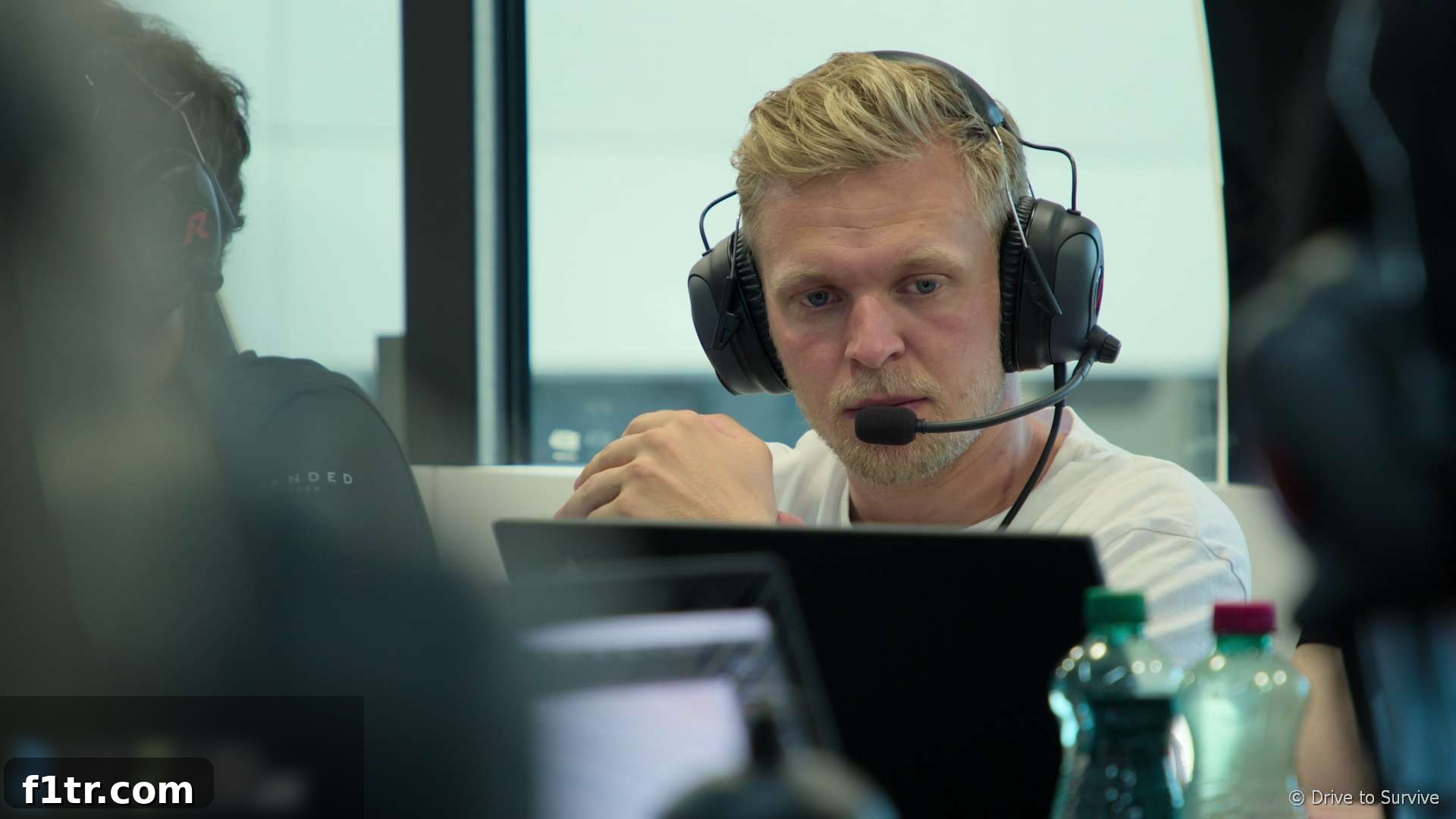
The latest season of Netflix’s critically acclaimed series, ‘Drive to Survive’, offered viewers a dramatic insight into Haas F1 Team’s tumultuous 2019 campaign, yet according to seasoned driver Kevin Magnussen, the show barely scratched the surface of the team’s disastrous year. The episode, which captured a furious team principal Guenther Steiner confronting Magnussen and teammate Romain Grosjean after a costly collision at the British Grand Prix, was just a fraction of the challenges faced by the American outfit.
Advert | Become a Supporter & go ad-free
The Silverstone Debacle: More Than Just a Race Incident
The incident at Silverstone was undeniably a low point, featuring raw, behind-the-scenes footage that captivated audiences worldwide. On the very first lap of their home race, both Haas drivers made contact at Turn 5, resulting in significant damage to both cars and ultimately, a double retirement for the team. This on-track mishap, however, was merely a symptom of a much deeper malaise plaguing the team throughout the season. Magnussen, reflecting on the Netflix portrayal, revealed, “I have seen that one that I’m in, and they didn’t even put the bad things in.” This statement alone suggests that the struggles depicted in ‘Drive to Survive’, while impactful, were a curated version of a far more complex and challenging reality.
The collision at Silverstone, which forced both cars out of the race prematurely, wasn’t just an isolated incident of driver error. It encapsulated the immense pressure, mounting frustrations, and a spiraling series of poor performances that had characterized Haas’s 2019 season. For a team striving to establish itself as a consistent midfield contender, such an outcome at a high-profile event was a devastating blow to morale and reputation. The immediate aftermath saw Steiner’s trademark fiery personality unleashed, underscoring the severity of the situation and the sheer disappointment felt within the garage. His berating of Magnussen and Grosjean, while difficult to watch, highlighted the high stakes and the emotional toll that such incidents take on everyone involved in Formula 1.
Unveiling the Hidden Struggles: What Netflix Didn’t Show
Magnussen’s candid admission that the “bad things” were omitted from the documentary raises intriguing questions about the full extent of the team’s predicament. While ‘Drive to Survive’ excels at delivering high-octane drama and personal narratives, it often focuses on specific storylines for maximum entertainment value. What Magnussen likely refers to are the relentless, day-to-day pressures, the technical frustrations with a temperamental car, the strained internal communications, and the profound psychological impact of a season that consistently failed to meet expectations. For a Formula 1 team, a disastrous season isn’t just about a few collisions or public arguments; it encompasses a pervasive sense of failure, questioning of capabilities, and a constant battle against demoralization.
The inherent challenges of F1 extend far beyond the racetrack. The development cycles, the political intricacies, the relentless travel schedule, and the cutthroat competitive environment all contribute to an ecosystem where pressure is constant. Magnussen’s words hint at the unseen grind, the countless hours spent trying to understand a difficult car, the endless debriefs, and the mounting tension that can fray even the strongest professional relationships. These elements, while less glamorous for television, are the true crucible in which F1 teams operate, and they undoubtedly formed a significant part of Haas’s “bad things” in 2019.
The Tumultuous Rich Energy Saga: A Public Fallout
Adding another layer of complexity to Haas’s calamitous 2019 season was the highly controversial and ultimately disastrous sponsorship deal with Rich Energy. Prior to the British Grand Prix weekend, the team’s title sponsor made headlines by announcing, via Twitter, their intent to terminate the partnership. This unconventional and public declaration led to a protracted and often acrimonious falling-out between the two parties, playing out very much in the public eye. The Rich Energy saga was a PR nightmare, overshadowing any potential on-track achievements and creating an atmosphere of uncertainty and instability within the team.
Rich Energy’s tenure as a sponsor was marked by eccentric social media activity, unsubstantiated claims, and a general air of chaotic unpredictability. The public termination of the deal, followed by a subsequent retraction and then a final separation, left Haas exposed and financially vulnerable. For a smaller team like Haas, securing stable and substantial sponsorship is paramount for survival and development. The Rich Energy debacle not only created significant financial headaches but also served as a constant distraction, further contributing to the “shit going on in the background” that Magnussen described. This highly public and messy affair undoubtedly amplified the stress on team management, drivers, and engineers alike, making an already difficult racing season even more arduous.
“I think it’s a very exciting story,” said Magnussen, acknowledging the dramatic arc of their season. “There was a very, very big episode for when it happened.” This sentiment underscores that the Rich Energy drama was not just a side note but a central, impactful storyline that deeply affected the team’s operations and morale, providing ample material for any behind-the-scenes documentary.
Navigating the Depths: Team Cohesion Under Pressure
Magnussen vividly described how the escalating tensions within the team culminated in the memorable confrontation between Guenther Steiner and his drivers. “We were in such a low point with everything. That’s where we really were getting depressed about the season not going right, and, you know, there was a lot of shit going on in the background with sponsors, et cetera.” This candid reflection paints a picture of a team under siege, where multiple external and internal pressures converged to create an almost unbearable atmosphere. The interplay of poor on-track performance, the volatile sponsorship situation, and the inherent competitiveness of two drivers pushing for results inevitably led to moments of intense frustration and emotional outbursts.
Yet, amidst this storm, Magnussen also found a silver lining, a testament to the resilience often found in high-pressure environments. “It all sort of just came together that weekend and we all lost it a little bit. But it truly made us stronger and it’s gotten us closer together. And you would all be surprised to see how it is in real life between us.” This powerful statement suggests that while the visible drama and disagreements were real, they ultimately served as a crucible, forging stronger bonds and a deeper understanding among team members. In the high-stakes world of Formula 1, shared adversity can often unify a team, creating a sense of camaraderie that transcends on-track rivalries and boardroom politics. The ability to overcome such a challenging period together can, paradoxically, become a foundational element for future success, reinforcing trust and collective purpose.
The Broader Struggle of the VF-19: A Technical Nightmare
Beyond driver incidents and sponsorship sagas, the fundamental issue plaguing Haas in 2019 was the car itself: the VF-19. While often quick in qualifying, the car possessed a critical flaw that manifested dramatically during races: extreme sensitivity to tires. This meant that while Magnussen and Grosjean could often extract a strong lap time over a single lap, the car struggled immensely with tire degradation and overheating in race conditions, leading to a significant drop-off in performance. This inconsistent behavior made race strategy a nightmare and left the drivers feeling helpless as they watched competitors pull away.
The technical challenges with the VF-19 contributed significantly to the “low point” Magnussen described. Engineers worked tirelessly, bringing multiple upgrades throughout the season, but none fully resolved the underlying issues. The team even famously reverted to an earlier specification of the car at one point, highlighting their desperation to find a solution. This technical quagmire was a constant source of frustration for both drivers, who felt they couldn’t unleash their full potential. It’s easy for external observers to attribute poor results to driver error or team mismanagement, but often, the unyielding physics of a temperamental racing machine is the most formidable opponent. The struggle with the VF-19 was a silent, persistent battle that fueled much of the visible tension and disappointment within the Haas garage.
‘Drive to Survive’ and the Narrative of Formula 1
Netflix’s ‘Drive to Survive’ has been instrumental in broadening Formula 1’s global appeal, attracting new audiences with its dramatic storytelling and behind-the-scenes access. However, as Magnussen’s comments highlight, the show, by its very nature, crafts a narrative. It focuses on compelling storylines, individual rivalries, and moments of high drama, sometimes necessarily condensing or omitting certain aspects of the complex reality of an F1 season. While it provides an invaluable window into the sport, it is ultimately a television production designed to entertain.
The show’s portrayal of Haas’s 2019 season perfectly illustrates this dynamic. It captured Steiner’s charismatic outbursts and the Silverstone crash, elements that are inherently dramatic and easily digestible for a mass audience. Yet, the deeper, more nuanced struggles – the relentless technical challenges, the intricate political maneuverings, the daily psychological toll on individuals – are often less visually engaging and thus may be downplayed or left out. Magnussen’s insight serves as a crucial reminder that while ‘Drive to Survive’ offers an authentic glimpse, the full, unvarnished truth of a Formula 1 season is often far more intricate and demanding than any single episode can convey. It’s a balance between revealing reality and creating an engaging, accessible story for millions.
- ‘Drive to Survive’ season two: Spoiler-free review and guide to all 10 episodes
- “He smashed my office door”: 23 must-see moments from ‘Drive to Survive’ season two
Advert | Become a RaceFans supporter andgo ad-free
The Enduring Legacy of a Challenging Season
The 2019 season, with its driver collisions, sponsorship controversies, and technical headaches, stands as one of Haas F1 Team’s most challenging years in Formula 1. Yet, as Kevin Magnussen suggests, even in the depths of despair, there were elements that ultimately strengthened the team’s resolve and fostered a closer bond among its members. While ‘Drive to Survive’ offered a compelling, albeit condensed, narrative of their struggles, the full story encompasses a myriad of unseen battles, both technical and emotional. The lessons learned from such a tumultuous period – about resilience, communication, and collective spirit – are invaluable, shaping the team’s approach to future challenges and reminding everyone that success in Formula 1 is as much about enduring hardship as it is about celebrating victories.
2019 F1 season
- Crying in the Melbourne car park at 2019 grand prix was my career low – Ocon
- McLaren Racing reports reduced £71 million loss in 2019
- Kvyat: Hockenheim podium last year was “my biggest achievement” so far
- How the FIA’s new encrypted fuel flow meter targets Ferrari’s suspected ‘aliasing’ trick
- “He smashed my office door”: 23 must-see moments from ‘Drive to Survive’ season two
Browse all 2019 F1 season articles