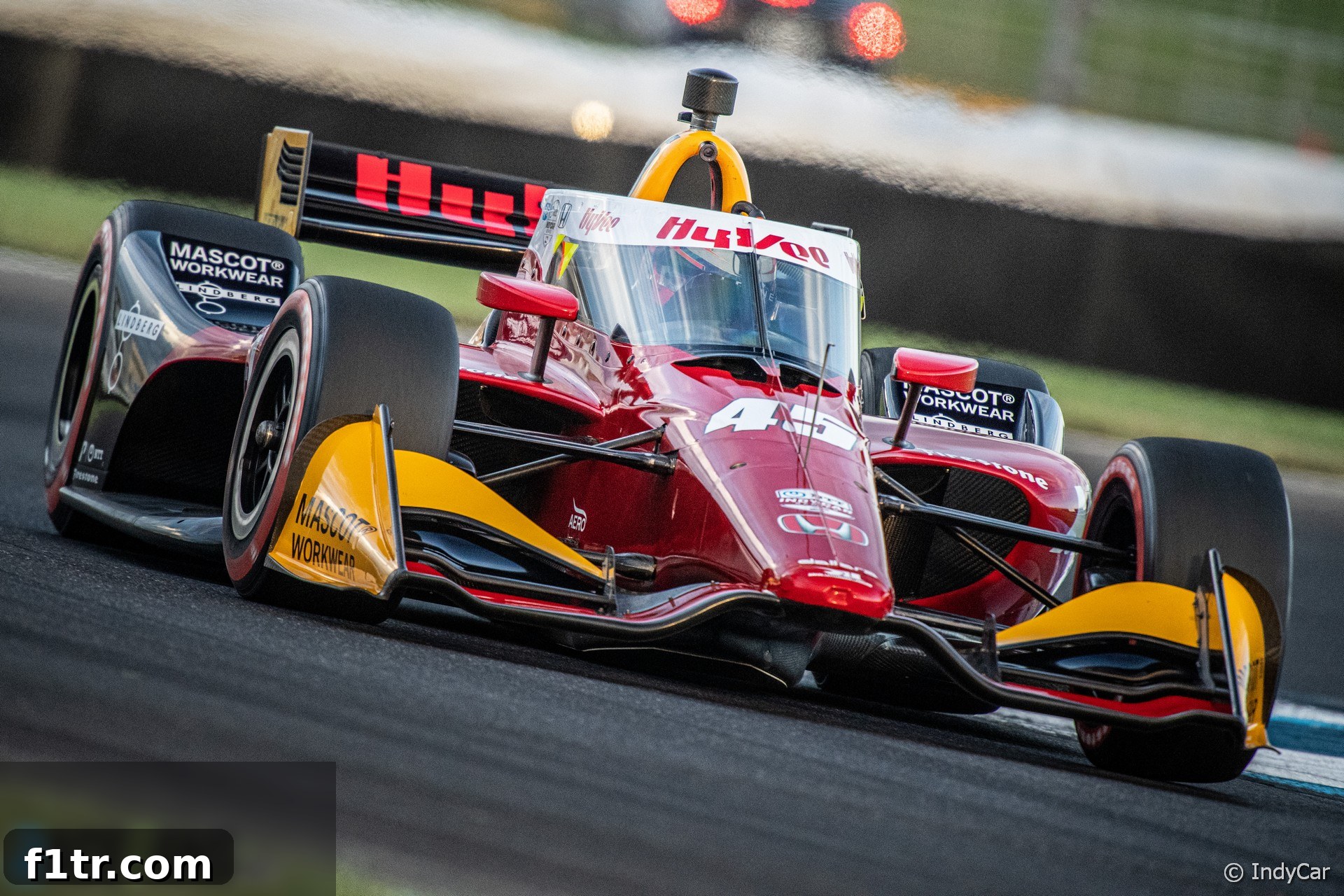
IndyCar’s newest sensation, Christian Lundgaard, is poised for a challenging yet exhilarating rookie season with Rahal Letterman Lanigan Racing. Hailing from the competitive ranks of Formula 2, the Danish driver acknowledges that adapting to the distinct and often brutal nature of IndyCar tracks will be paramount to his success. His transition marks a significant step in his burgeoning career, bringing with it the unique demands of American open-wheel racing, a world away from the smoother, purpose-built circuits of Europe.
The 20-year-old talent has joined Rahal Letterman Lanigan’s expanded three-car lineup, signaling a strong commitment from the team to nurture new talent. Lundgaard is not entirely a stranger to the IndyCar paddock, having made an impressive one-off appearance last year on the Indianapolis Motor Speedway road course. There, he turned heads by qualifying a remarkable fourth, ultimately finishing 12th in the race – a performance that undoubtedly paved the way for his full-time debut. However, as he embarks on a full championship campaign, the real test of his adaptability and skill truly begins.
The Steep Learning Curve: From Formula 2 Precision to IndyCar Grit
The leap from Formula 2 to IndyCar is more than just a change of scenery; it’s a fundamental shift in racing philosophy and demands. Formula 2, primarily contested on modern European circuits, emphasizes precision, high-downforce aerodynamics, and often, smoother track surfaces. IndyCar, on the other hand, presents a diverse calendar that includes traditional road courses, notoriously bumpy temporary street circuits, and the high-speed, high-stakes world of oval racing. This variety requires a different driving approach, a robust car setup, and a mental fortitude that European single-seater drivers often need time to cultivate.
Lundgaard himself acknowledged the relative comfort of his initial foray. “I’m happy that the Indy road course was the track that I drove,” he reflected. “I know I tested at Barber, but the track is very European, and I’m used to the European tracks. So for me to start there was a good benchmark.” This sentiment underscores the familiarity he found on those specific layouts, which somewhat mirror his F2 experiences. Yet, the vast majority of the IndyCar schedule offers stark contrasts, demanding a far more aggressive and adaptable driving style.
Conquering the Urban Jungle: The Challenge of IndyCar Street Circuits
One of the most significant adjustments for any driver transitioning to IndyCar, particularly from Europe, is mastering the series’ challenging street circuits. Unlike the manicured surfaces of permanent race tracks, these temporary venues are carved out of city streets, featuring uneven asphalt, manhole covers, painted lines, and sudden surface changes. They are unforgiving, physically demanding, and require an entirely different approach to car setup and driving technique. Lundgaard anticipates this shift will be a major hurdle early in his season.
“But once we get to Nashville, Detroit, those kind of circuits, I wouldn’t say I’m going to struggle more, but I’ll probably need more time compared to the others because they’ve been there,” Lundgaard candidly admitted. Tracks like Nashville, with its dramatic bridge section and rough downtown streets, or Detroit, known for its tight confines and challenging bumps, represent the quintessential IndyCar street course experience. Navigating these concrete canyons at blistering speeds, often with minimal runoff, demands an acute sensitivity to the car’s behavior over bumps, quick reflexes, and an unyielding commitment to pushing the limits.
To prepare for this specific challenge, Lundgaard has already gained valuable experience at the Sebring International Raceway road course. Sebring, famed for its incredibly bumpy and undulating surface, serves as an unofficial testing ground for IndyCar teams due to its ability to replicate the harsh conditions found on many street circuits and older road courses. “It was good to spend the time with the team and learn a bumpy track,” he explained. “I know that it’s not the worst, but it replicates as much as we can the real tracks. I think for me, just to get a feel of how it actually feels in the car, how the car handles on bumps was very beneficial. I was very satisfied and happy with the tests.” This early exposure is crucial, providing Lundgaard with a foundational understanding of how to manage the unique demands of an IndyCar machine over irregular surfaces, a skill that will be indispensable as the season unfolds.
The Enigma of the Oval: A True Test of Adaptability
Perhaps the most foreign and formidable challenge awaiting Christian Lundgaard is the world of oval racing. A cornerstone of IndyCar, oval racing is virtually non-existent in European single-seater ladders, making it a completely new discipline for drivers like Lundgaard. These high-speed, continuously turning tracks present unique physics, intricate aerodynamics, and a psychological test unlike any other form of motorsport. The sheer speeds, the constant G-forces, and the precision required to run inches apart from competitors for hundreds of miles demand a specialized skill set and immense bravery.
The second round of the championship often takes place at Texas Motor Speedway, a high-banked, 1.5-mile oval known for its incredible speeds and challenging nature. Lundgaard is wisely approaching this with a healthy dose of caution and curiosity. “I’ll have a test at Texas before which I think will come in quite handy,” he stated, highlighting the importance of pre-season preparation. “At the moment, I don’t know what to think of it.” This honesty is typical of rookies facing the unknown of oval racing; it’s a discipline that defies easy prediction based on prior experience.
His only prior “experience” came from a simulator session, which he found deceptively simple. “I drove my home sim at Indy the other day, and it felt a bit easy. But I might also have had a bit too much downforce.” This observation hints at the delicate balance between downforce and drag on an oval, where too much downforce can make a car feel secure but also slow it down significantly, while too little can lead to a “loose” or unstable car that is incredibly difficult to control at speeds exceeding 200 mph. “So I think once we go to Texas and I actually get a real go in the car, I’ll have a feel of how loose the car is and how stable it is as well. At the moment, it’s quite difficult to tell for me, but I’m looking forward to get out and race at high speeds.” The Texas test will undoubtedly provide a much-needed reality check and a crucial opportunity to learn the nuances of high-speed oval racing before competitive action begins.
Ambition Meets Reality: Lundgaard’s Rookie Season Expectations
Christian Lundgaard arrives in IndyCar with a clear vision: to learn, but not to spend an entire season doing so. He aims to quickly adapt and begin demonstrating his true potential. This mindset is common among top-tier talents, balancing the practicalities of a steep learning curve with an innate drive to win. “To be honest, in terms of expectations, it’s a little tricky one because everyone would say, ‘okay, he’s new, he needs to learn’,” Lundgaard acknowledged. “But at the same time, I have the same feeling. I still want to do well, but I don’t want to put too much pressure on myself.”
He understands that external pressures are a natural part of professional motorsport, especially when joining a reputable team like Rahal Letterman Lanigan Racing, co-owned by motorsport legend Bobby Rahal and television icon David Letterman. “Whatever pressure the team or sponsors or everyone behind the scenes put on me, I don’t really mind because pressure is a good thing. It means that someone knows you can do it, so they’re expecting you to.” This perspective highlights a mature approach to his rookie year, seeing pressure not as a burden, but as validation of his capabilities.
Lundgaard’s ultimate goal transcends mere participation. “I’m here to learn. I’m here to use the beginning of the season to prove myself and to learn. But I don’t want to spend the whole season trying to learn and then see where I’m at after that. Obviously, I compete to win, and that’s my goal.” This statement sets a high bar for himself, indicating that while he acknowledges the challenges, his competitive spirit remains unwavering. He aspires to move beyond the learning phase quickly, aiming for consistent strong performances, podium finishes, and ultimately, race wins. His ability to integrate with the RLL team, which also features experienced drivers like Graham Rahal and fellow new recruit Jack Harvey, will be key to accelerating his adaptation and achieving these ambitious goals.
A Promising Future in a Competitive Arena
Christian Lundgaard’s arrival injects fresh talent into an already fiercely competitive IndyCar series, which boasts a deep field of seasoned champions, former Formula 1 drivers, and rising stars. His journey from Formula 2 to the diverse world of IndyCar is a testament to his versatility and the allure of American open-wheel racing. The challenges of adapting to rough street circuits, mastering the high-speed ovals, and navigating a full season will be immense. Yet, with the support of Rahal Letterman Lanigan Racing and his own inherent talent and ambitious mindset, Lundgaard has every opportunity to make a significant impact. His rookie season will undoubtedly be a captivating storyline, watched closely by fans eager to see how this young Danish driver conquers the unique demands of IndyCar and stakes his claim among motorsport’s elite.
Further Reading: IndyCar News and Updates
- IndyCar driver McLaughlin cleared of injury after crashing through barrier at Barber
- Schumacher says his IndyCar feels like ‘an F2 car, just with better tyres’
- IndyCar “way faster than Formula 1” in some corners, says Grosjean
- FIA to award more F1 superlicence points to IndyCar drivers from 2026
- Schumacher to race full-time in IndyCar with RLL in 2026
Browse all IndyCar articles