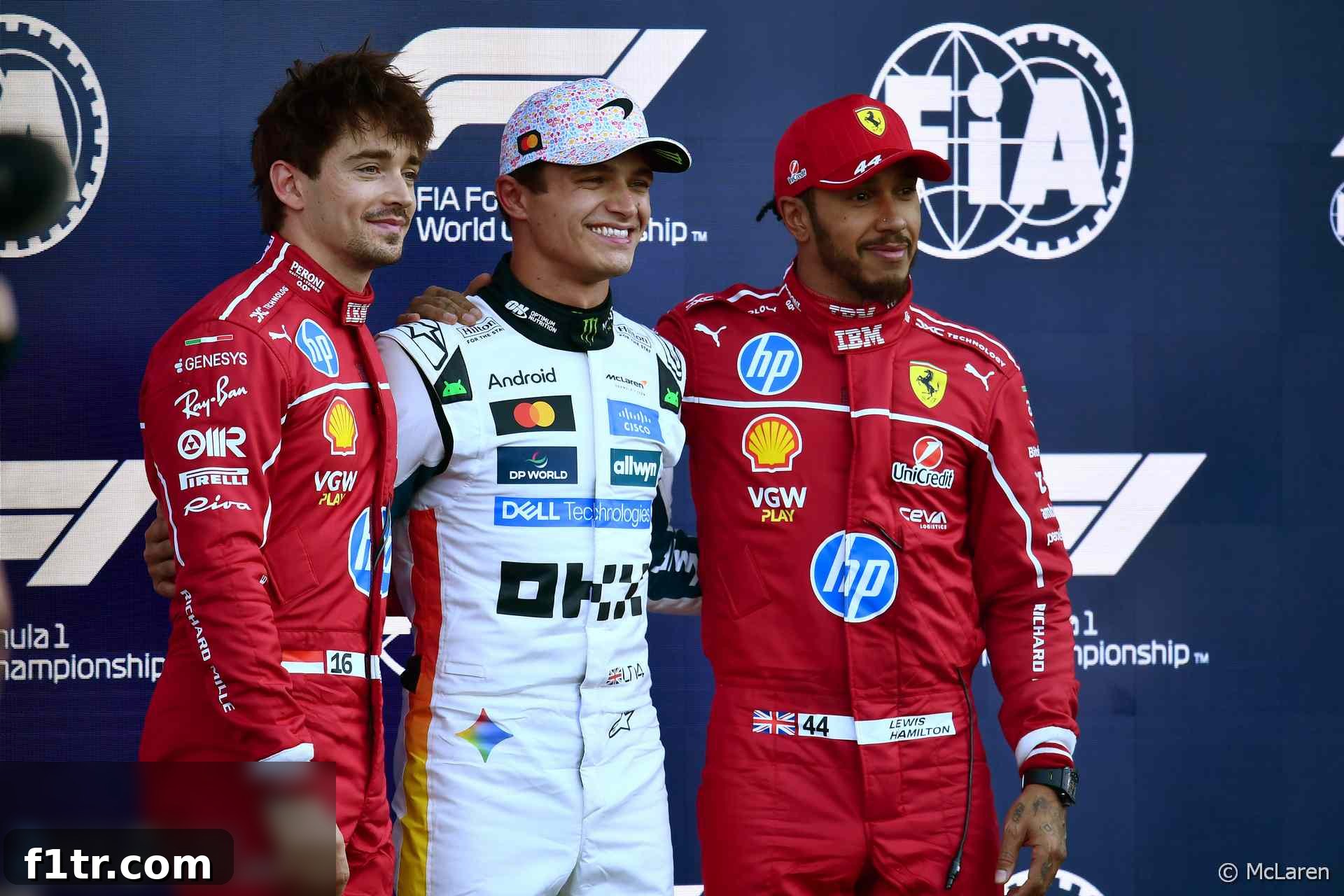
In a surprising twist following a thrilling qualifying session for the Mexican Grand Prix, Charles Leclerc of Ferrari found himself contemplating whether his second-place grid start might actually be a less advantageous position than third. The Monegasque driver, known for his blistering single-lap pace, secured his fifth front-row start of the season at the high-altitude Autódromo Hermanos Rodríguez, yet a distinct apprehension colored his post-qualifying remarks regarding the optimal launch point for the race.
Leclerc’s concern stems from a unique characteristic of the Mexico City track: its exceptionally long run from the starting grid to the challenging Turn 1. This stretch is the longest of any circuit on the Formula 1 calendar, creating an environment ripe for slipstream battles and significant position changes right off the line. Coupled with the disadvantage of starting on the “dirty” side of the track, Leclerc anticipates a challenging opening sequence where he could be vulnerable to rivals launching from behind who can benefit from the vacuum created by the cars ahead.
“The run to Turn 1 is incredibly long, and we know how crucial a strong start will be,” Leclerc stated during an interview with the official Formula 1 channel after qualifying. “Honestly, I almost wished I had qualified P3. From third, you often benefit from a significant slipstream behind the front row cars, which can propel you forward with tremendous momentum. Starting from P2, I’ll likely be deprived of that powerful slipstream effect, and to compound the challenge, I’ll be on the dirty side of the track, which typically offers less grip for the initial launch.”
The “dirty side” of the grid refers to the part of the track that is less used during practice and qualifying sessions. Tyre rubber, oil, and dust accumulate on this side, leading to reduced traction compared to the cleaner racing line. This subtle yet significant factor can mean the difference between a lightning start and a bogged-down launch, potentially costing crucial positions in the high-speed charge towards Turn 1. For a driver aiming to convert a front-row start into an early lead, this grip deficit is a genuine source of worry, especially when facing rivals with potentially better traction.
Despite these tactical reservations, Leclerc maintained a focus on his own performance and strategy, emphasizing his determination to overcome the perceived disadvantages. “My focus will be entirely on what I can control: executing the best possible start and managing the initial phase of the race with absolute precision,” he affirmed. “We will push to convert our starting position into an early lead, and hopefully, that will be enough to navigate the unique challenges of the first corner and establish ourselves at the front of the pack.”
The history of the Mexican Grand Prix race start further supports Leclerc’s cautious outlook. The long run to Turn 1 has often seen pole-sitters and front-row starters lose positions, while those further back, particularly in third, have frequently capitalized on the slipstream and braking zone dynamics. This phenomenon is amplified by Mexico City’s high altitude, which significantly reduces air density. This lower density impacts aerodynamic downforce, making cars harder to slow down and less stable under braking, while also affecting engine performance, adding another layer of complexity and unpredictability to the opening lap and early race strategy.
In the previous year’s race, Max Verstappen, despite starting second, managed to snatch the lead early on, showcasing the potential for aggressive moves even from what is traditionally considered the less preferred side of the grid. However, his early lead didn’t translate into victory on that specific occasion, underscoring the unpredictable nature of the race where maintaining a lead can be as challenging as gaining it. More strikingly, in three of the four races preceding the current season’s event where this discussion arose, the driver who started third ultimately triumphed. This statistical anomaly highlights the inherent strategic advantage that can be gained from the slipstream into Turn 1, often allowing a driver to slingshot past the front row.
Verstappen himself has twice converted a third-place grid start into an early lead, demonstrating his mastery of the chaotic opening at Mexico by leveraging the slipstream and late braking. Yet, the 2019 race saw a dramatic counter-example when Lewis Hamilton, starting third, dropped to fifth after an incident involving Verstappen in the opening corners, only to stage a remarkable recovery drive to win the race. This historical context provides a rich backdrop for the upcoming race, with Hamilton once again starting from the third grid slot, perfectly positioned to exploit the very advantage Leclerc fears missing – the clean side of the track and a prime slipstream opportunity.
Unpacking the Grid: Mexican Grand Prix Winners and Their Start Positions Since 2015
An in-depth examination of past Mexican Grand Prix results reveals compelling patterns regarding winning positions and the critical role of the opening lap. The challenging run to Turn 1 frequently reshuffles the pack, making grid position a less definitive predictor of victory compared to many other circuits. The data below illustrates how often the ultimate winner has started from pole, the front row, or even further back, alongside their position by the second lap – a critical indicator of early race performance and tactical success.
| Year | Winner | Grid position | Lap two position |
|---|---|---|---|
| 2015 | Nico Rosberg | 1 | 1 |
| 2016 | Lewis Hamilton | 1 | 1 |
| 2017 | Max Verstappen | 2 | 1 |
| 2018 | Max Verstappen | 2 | 1 |
| 2019 | Lewis Hamilton | 3 | 5 |
| 2021 | Max Verstappen | 3 | 1 |
| 2022 | Max Verstappen | 1 | 1 |
| 2023 | Max Verstappen | 3 | 1 |
| 2024 | Carlos Sainz Jnr | 1 | 2 |
Analyzing this comprehensive data, it’s abundantly clear that while pole position has indeed led to victory several times – notably by Nico Rosberg in 2015, Lewis Hamilton in 2016, Max Verstappen in 2022, and Carlos Sainz Jnr in 2024 – it is far from a guaranteed path to the top step of the podium. Indeed, pole-sitters like Lando Norris (who secured P1 in the current race context) must be acutely aware of the immediate threat from behind. The 2017 and 2018 races saw Max Verstappen clinch victories from second on the grid, each time by executing a phenomenal start and taking the lead on Lap 1. This highlights the potency of a strong initial launch combined with the advantages of the long run to Turn 1, even if not from the absolute front slot.
However, what stands out most strongly in the context of Charles Leclerc’s concerns are the victories achieved from third place on the grid. Max Verstappen’s dominant wins in 2021 and 2023, both starting from third and quickly moving into the lead by Lap 2, serve as prime examples of the slipstream’s immense power and the strategic benefits of that grid slot. Lewis Hamilton’s incredible victory in 2019, despite falling to fifth on Lap 2 from a third-place start, demonstrates that even an initial setback can be overcome at this highly dynamic circuit, but it also vividly illustrates the inherent volatility of the first corner. The statistics strongly suggest that starting third can often provide a strategic advantage, allowing drivers to draft powerfully behind the front row and then make their decisive move under braking into Turn 1. The clean side of the track for the P3 starter further enhances this potential, offering superior grip for a better initial acceleration.
With Lewis Hamilton once again starting from third in the upcoming race, the stage is set for a truly fascinating and potentially chaotic opening lap. His historical performance in Mexico, combined with the statistical advantage often seen from the third grid slot, positions him as a significant threat not only to Leclerc but also to pole-sitter Lando Norris. The strategic decision-making and execution in the first few seconds of the race will be paramount, potentially dictating the entire complexion of the Grand Prix, turning qualifying supremacy into an early race deficit for some, and an unexpected advantage for others.
For Charles Leclerc, the challenge is unequivocally clear: he must execute a flawless start, optimizing his launch from the comparatively less grippy “dirty side” of the track, and then defend aggressively and intelligently against drivers like Hamilton who will be looking to exploit the slipstream and cleaner racing line. Ferrari’s strategists will undoubtedly be working overtime to fine-tune every aspect of the launch control and initial race phase, understanding that the traditional advantage of a front-row start is considerably diluted, if not entirely reversed, at the unique Autódromo Hermanos Rodríguez. The margin for error will be minimal, and the rewards for perfection, immense.
The Mexico City Grand Prix promises an electrifying start, where qualifying heroics might quickly fade into the background as strategic positioning, raw nerve, and the unpredictable dynamics of slipstream and braking take center stage. The exceptionally long sprint to Turn 1, the challenging high altitude, and the historical unpredictability of this circuit all converge to make the opening moments of this race one of the most anticipated and critical on the F1 calendar. All eyes will be keenly fixed on Leclerc, Norris, and Hamilton as the lights go out, eager to see who truly benefits from their grid slot when the chaos and excitement of the Mexican Grand Prix begins to unfold.
2025 Mexican Grand Prix
- F1 fans shocked as ferry company screens “adult film” by mistake
- Russell: Lack of penalties over corner-cutting was ‘especially unfair for Lewis’
- Williams aim to give Albon more “consistent” car after consecutive Q1 exits
- Lawson “not at fault” for marshal incident says FIA following criticism from Mexico’s OMDAI
- Stats: Norris takes F1’s biggest win for two years as Ferrari go win-less for 12 months
Browse all 2025 Mexican Grand Prix articles