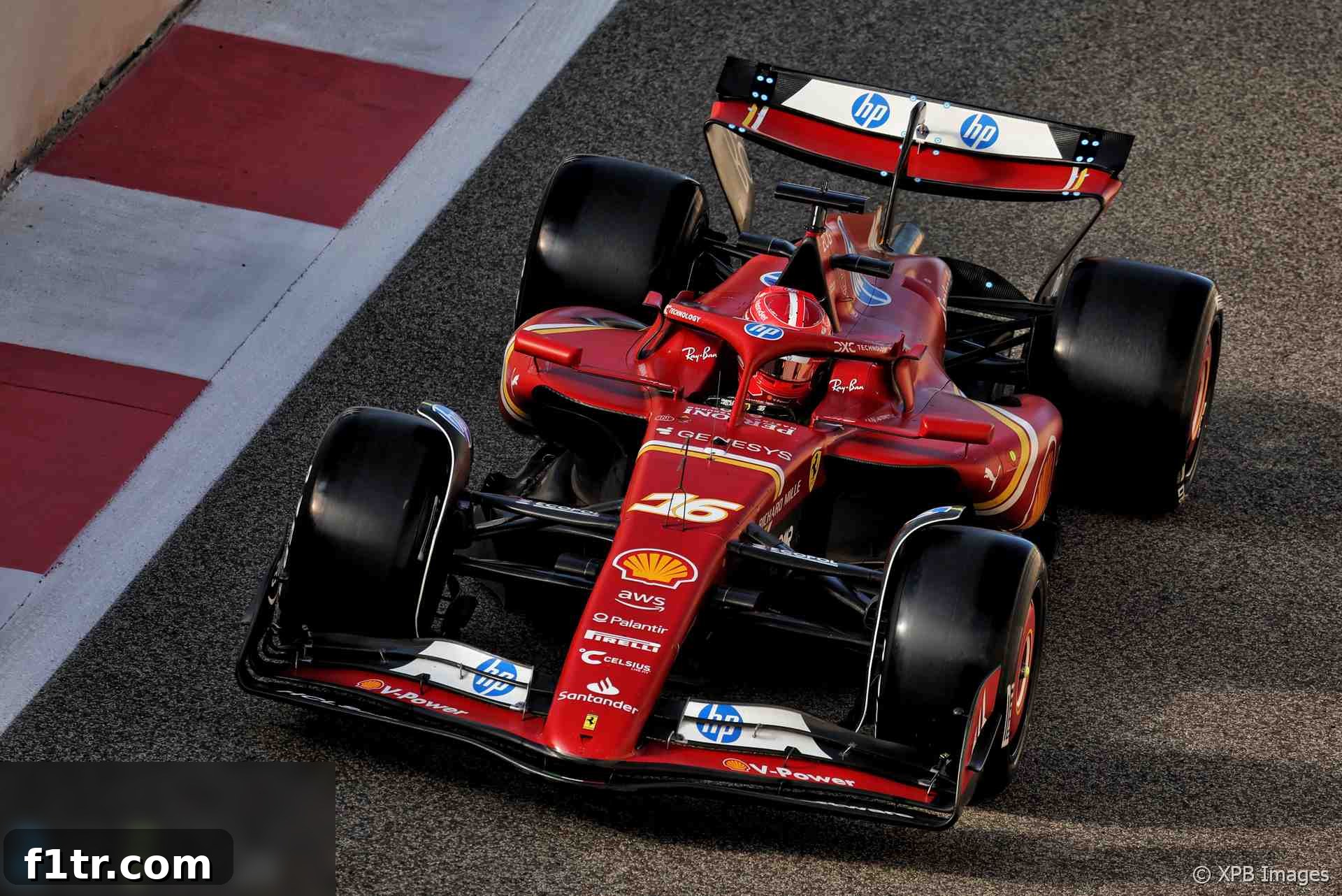
Charles Leclerc Leads the Charge in Thrilling F1 Post-Season Test at Abu Dhabi
The annual Formula 1 post-season test at the Yas Marina Circuit in Abu Dhabi wrapped up with Ferrari’s star driver, Charles Leclerc, demonstrating exceptional pace and topping the timings. This crucial single day of running provided teams with an invaluable opportunity to gather data, evaluate new components, and integrate fresh talent, setting the stage for the highly anticipated 2025 season. Leclerc, who concluded the world championship in a commendable third place, underlined his team’s aspirations by clocking the quickest time of 1’23.510. His comprehensive effort saw him complete an impressive 134 laps, showcasing both the resilience of the SF-24 and his own remarkable consistency.
Post-season testing is a cornerstone of Formula 1 development, serving as a vital bridge between the competitive pressures of one season and the ambitious preparations for the next. For teams, it’s an unparalleled chance to test aerodynamic updates, experiment with different car setups, and validate simulation data in real-world conditions. Beyond technical evaluations, these tests are instrumental in the development of young drivers. They offer aspiring F1 talents the rare and invaluable experience of handling current Grand Prix machinery, often a critical step on their journey to the pinnacle of motorsport. For seasoned drivers, it provides an early opportunity to familiarize themselves with new team environments, or to deepen their understanding of their existing cars and their evolving dynamics.
Rising Stars and Strategic Team Moves Steal the Spotlight
While Leclerc’s pace commanded attention, the Abu Dhabi test was equally significant for the emerging generation of F1 drivers and those embarking on new career chapters. Mercedes junior driver Andrea Kimi Antonelli, a talent widely tipped for a future F1 seat, was a focal point. Despite a schedule change that saw Frederik Vesti initially take the wheel, Antonelli quickly adapted, completing 62 laps and impressively posting a time within four-tenths of Leclerc’s best. This strong showing in the Mercedes W15 further solidifies his reputation as a formidable prospect and fuels anticipation for his eventual F1 debut.
The test also marked a significant transition for Carlos Sainz Jnr, who made his debut for Williams. This initial outing in the FW46 provided an early indicator of his adaptability and the team’s potential for the upcoming season. Sainz immediately impressed, securing the second fastest time, just 0.125 seconds shy of Leclerc. His swift integration and competitive pace offer a strong psychological boost for Williams and underscore Sainz’s capability to deliver immediate performance in a new environment. His technical feedback will be crucial for Williams’ development efforts over the winter break.
Mercedes’ front-line driver, George Russell, also contributed substantially, finishing third overall and matching Leclerc’s impressive lap count of 134. His extensive running in the W15 would have provided critical data for Mercedes as they continue their relentless pursuit of performance. Elsewhere, veteran driver Nico Hulkenberg made his first appearance for Sauber, the team slated to become Audi in 2026. Hulkenberg’s fourth-place finish in the C44 demonstrated his characteristic ability to quickly get up to speed with new machinery, offering an early positive sign for Sauber’s development path.
Yuki Tsunoda’s Red Bull Revelation: A Deep Dive into Championship-Winning Machinery
Perhaps one of the most talked-about moments of the test involved Yuki Tsunoda, who finally had his long-awaited opportunity to pilot the formidable Red Bull RB20. For Tsunoda, this was more than just another test day; it was a rare chance to experience the car that had dominated the recent world championship, offering a direct comparison to the RB machinery he typically drives. Sharing the Red Bull garage with Formula 2 runner-up Isack Hadjar, whose lap times were incredibly close, Tsunoda’s insights were particularly valuable.
Tsunoda was effusive in his praise and clearly thrilled by the experience in Max Verstappen’s championship-winning car. “It’s the first time in the past four years that I have driven a different car,” he stated, highlighting the significance of this opportunity in his career. He vividly described the transformative feeling of the RB20: “You can physically feel why the RB20 has been fighting for a championship this year, it feels like a very different car to drive. We have had a very productive day today so I am really happy with that.” This direct feedback from a competitive driver like Tsunoda is invaluable for Red Bull, not only in terms of data but also in assessing the talent within their driver development program.
What truly stood out was Tsunoda’s seamless adaptation to the RB20. He elaborated on his comfort with the car, saying, “I feel like the car suits my driving style and I haven’t struggled much at all to adapt. Even on the long runs, I have been able to run consistently today and was able to feel the limitations of the car which, if you don’t have confidence in the car, you are unable to test.” This statement speaks volumes about Tsunoda’s skill set and growing maturity. His ability to quickly find the car’s limits and maintain consistent pace over long runs underscores a crucial attribute for any top-tier F1 driver. It suggests that with the right machinery, Tsunoda possesses the innate ability to extract maximum performance, reinforcing his credentials for a potentially higher-tier F1 future.
Diverse Programs and Key Learnings from Other Teams
McLaren continued their program of integrating IndyCar talent, with Pato O’Ward completing another successful run in the MCL38. This ongoing engagement allows O’Ward to further acclimatize to F1 machinery and provides McLaren with a broader pool of talent for evaluation. The other McLaren car saw Lando Norris and Oscar Piastri splitting driving duties. While Norris had a minor, damage-free spin early on, both drivers contributed significantly to McLaren’s extensive data acquisition, focusing on optimizing their 2024 package and exploring new developments for the upcoming season.
Alpine also had a productive day, entrusting their A524 to academy drivers Jack Doohan and Paul Aron. Their consistent performances highlight Alpine’s continued investment in nurturing future F1 stars. Haas likewise ran a dual program, with Esteban Ocon taking to the track alongside Ryo Hirakawa in the VF-24, focusing on component testing and performance analysis. Aston Martin deployed Felipe Drugovich and Jak Crawford in their AMR24, focusing on long-term development and providing crucial seat time for their junior prospects. The varied participation, ranging from established Grand Prix winners to aspiring rookies, underscores the multi-faceted nature of this vital post-season event.
Track conditions were noted to be less favorable earlier in the day, potentially influencing the initial performances of some drivers, including Ferrari’s Antonio Fuoco and Mercedes’ Frederik Vesti, who completed their sessions during those periods. Regardless of the conditions, every lap completed and every piece of data gathered contributes to the comprehensive understanding that teams aim to build for their next seasonal campaigns. This collective effort, from every pit box to every engineering station, is the unseen engine that propels Formula 1 forward, fostering innovation and preparing for the intense competition that lies ahead.
Abu Dhabi Post-Season Test Times: A Comprehensive Table
The following table provides a detailed overview of the official timings and lap counts from the Abu Dhabi post-season test, offering a clear picture of driver performances and team activity throughout the day:
| Pos. | Driver | Team | Model | Best time | Gap | Laps |
|---|---|---|---|---|---|---|
| 1 | Charles Leclerc | Ferrari | SF-24 | 1’23.510 | 134 | |
| 2 | Carlos Sainz Jnr | Williams | FW46 | 1’23.635 | 0.125 | 146 |
| 3 | George Russell | Mercedes | W15 | 1’23.789 | 0.279 | 134 |
| 4 | Nico Hulkenberg | Sauber | C44 | 1’23.856 | 0.346 | 113 |
| 5 | Andrea Kimi Antonelli | Mercedes | W15 | 1’23.873 | 0.363 | 62 |
| 6 | Ayumu Iwasa | RB | RB01 | 1’24.100 | 0.590 | 110 |
| 7 | Pato O’Ward | McLaren | MCL38 | 1’24.222 | 0.712 | 116 |
| 8 | Jack Doohan | Alpine | A524 | 1’24.268 | 0.758 | 137 |
| 9 | Paul Aron | Alpine | A524 | 1’24.275 | 0.765 | 121 |
| 10 | Esteban Ocon | Haas | VF-24 | 1’24.305 | 0.795 | 119 |
| 11 | Luke Browning | Williams | FW46 | 1’24.375 | 0.865 | 105 |
| 12 | Ryo Hirakawa | Haas | VF-24 | 1’24.435 | 0.925 | 133 |
| 13 | Liam Lawson | RB | RB01 | 1’24.440 | 0.930 | 159 |
| 14 | Arthur Leclerc | Ferrari | SF-24 | 1’24.576 | 1.066 | 68 |
| 15 | Isack Hadjar | Red Bull | RB20 | 1’24.632 | 1.122 | 125 |
| 16 | Lando Norris | McLaren | MCL38 | 1’24.678 | 1.168 | 84 |
| 17 | Yuki Tsunoda | Red Bull | RB20 | 1’24.689 | 1.179 | 127 |
| 18 | Gabriel Bortoleto | Sauber | C44 | 1’24.738 | 1.228 | 130 |
| 19 | Oscar Piastri | McLaren | MCL38 | 1’24.838 | 1.328 | 72 |
| 20 | Jak Crawford | Aston Martin | AMR24 | 1’24.997 | 1.487 | 109 |
| 21 | Felipe Drugovich | Aston Martin | AMR24 | 1’25.014 | 1.504 | 146 |
| 22 | Frederik Vesti | Mercedes | W15 | 1’25.159 | 1.649 | 55 |
| 23 | Antonio Fuoco | Ferrari | SF-24 | 1’25.238 | 1.728 | 73 |
Anticipating 2025: Key Takeaways and Future Outlook
The Abu Dhabi post-season test serves as an indispensable prologue to the next Formula 1 season. While individual lap times must always be interpreted with caution, given the varied testing programs, fuel loads, and tire compounds used, the sheer volume of data collected is invaluable. For leading teams like Ferrari, Leclerc’s impressive pace and extensive running offer a solid affirmation of their current development trajectory, providing confidence as they finalize their 2025 challenger. Mercedes will meticulously analyze Antonelli’s promising debut alongside Russell’s consistent performance, factors that will undoubtedly influence their future driver strategies and technical directives.
The insights gleaned from drivers like Carlos Sainz’s seamless integration at Williams and Nico Hulkenberg’s immediate comfort with Sauber’s machinery will be pivotal for their respective teams’ intensive off-season development phases. For young talents such as Yuki Tsunoda, Pato O’Ward, Andrea Kimi Antonelli, and the numerous other promising drivers who gained critical F1 experience, this test could very well be a defining moment in their careers, laying crucial groundwork for future opportunities in the sport. The diverse range of cars put through their paces – from the championship-winning Red Bull RB20 to the developing machines of Williams, Haas, and Alpine – vividly illustrates the constant evolution and intense competition that defines the very essence of Formula 1.
As the final engines fall silent on the Yas Marina Circuit, the Formula 1 paddock transitions into a period of rigorous analysis and accelerated development. The data streams from Abu Dhabi will be meticulously processed, informing critical design decisions, engine calibrations, and aerodynamic refinements across all ten teams. The anticipation for the upcoming Formula 1 season is already palpable, with these post-season tests serving as the unofficial inauguration of the new competitive cycle, promising another thrilling year filled with high-speed drama, technological breakthroughs, and unforgettable racing moments.