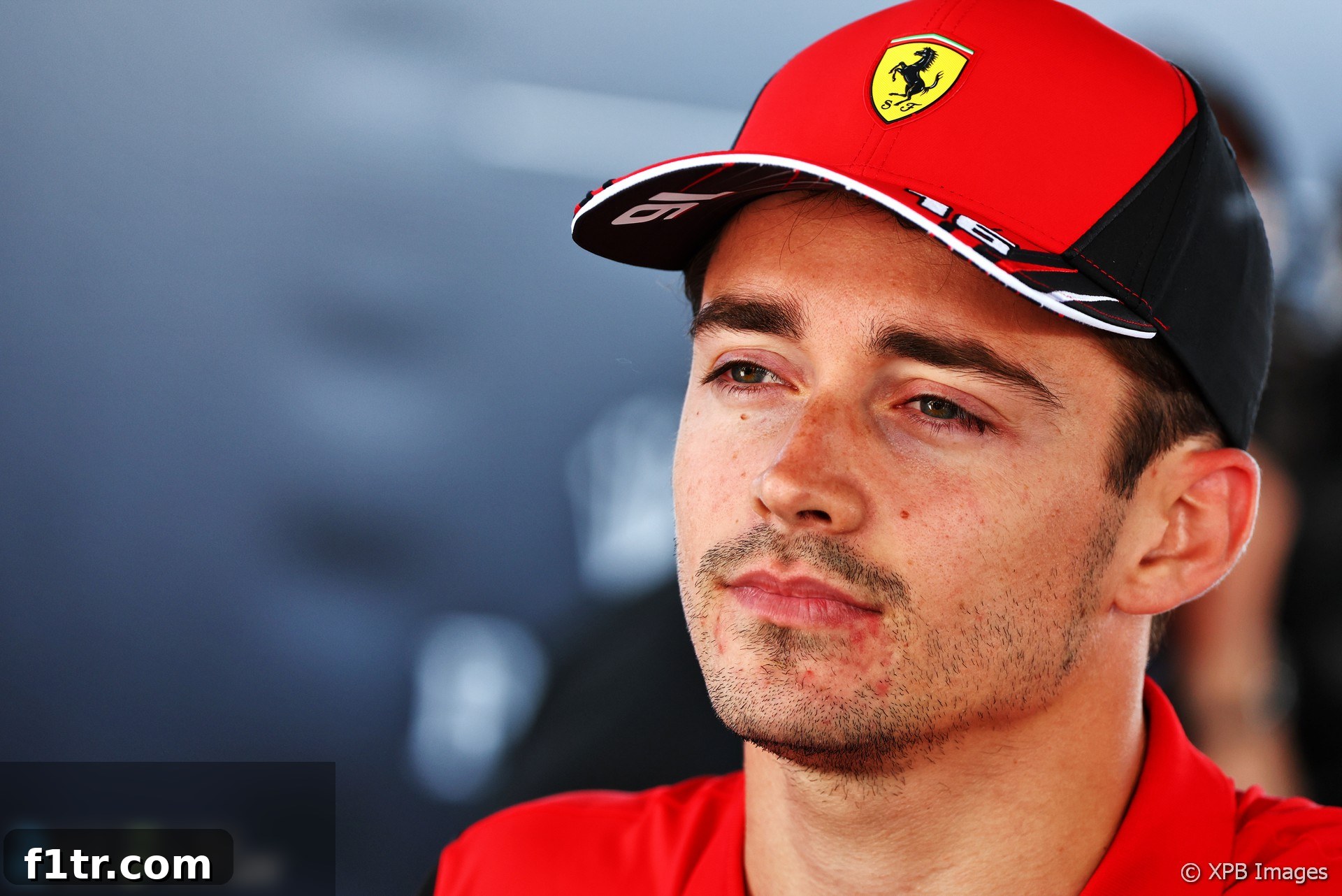
Charles Leclerc, the highly talented Ferrari driver, is set to face a monumental challenge at the Circuit Gilles Villeneuve. Starting today’s crucial race from a daunting 19th position on the grid, Leclerc is undeterred by the severe grid penalties incurred for multiple power unit component changes. Despite the significant setback, the Monegasque driver maintains an optimistic outlook, boldly asserting that a remarkable fourth-place finish is not only achievable but also his primary target for the race. This ambitious goal underscores his unwavering belief in the F1-75’s pace and Ferrari’s strategic capabilities, setting the stage for what promises to be an enthralling comeback drive.
Leclerc’s journey to the back of the grid stems from Ferrari’s strategic decision to replace several power unit elements, including the internal combustion engine (ICE), turbocharger, MGU-H, and MGU-K. This move, while incurring substantial penalties, is designed to ensure enhanced reliability and performance for the remainder of the demanding Formula 1 season. While the immediate consequence is a compromised starting position, the long-term benefit is a potentially more robust and competitive power unit. However, the path from 19th to the top four is fraught with challenges, particularly at a circuit known for its unique blend of high-speed straights and tight chicanes.
Reflecting on his experience during the qualifying sessions, Leclerc candidly admitted that the task of overtaking cars might prove more formidable than his initial expectations. “I don’t know whether it will work out or not,” Leclerc commented, acknowledging the unpredictability of race day. “It was a bit more difficult to overtake than what I initially thought yesterday.” This insight from a driver of his caliber suggests that while the Circuit Gilles Villeneuve is often perceived as a track conducive to overtaking, the reality for modern F1 cars, with their complex aerodynamics and reliance on clean air, can be quite different. The Canadian track, with its legendary Wall of Champions and demanding braking zones, requires precision and aggressive driving, making every overtaking maneuver a high-stakes gamble.
Despite these anticipated difficulties, Leclerc’s underlying confidence in his car’s performance remains high. He believes that the F1-75 possesses the inherent speed necessary to carve through the field. “But overall, I think we’ve got quite a good pace in the car,” he affirmed. The key, he stressed, lies in a meticulously executed race strategy. “If we play it smart in the strategy, having some clean air, we can come back to P4 or something. So that is the goal and yeah, I’ll give it everything.” The concept of ‘clean air’ is paramount for Formula 1 cars, as it allows them to operate at their aerodynamic peak without being hampered by the turbulent wake of a preceding car. Achieving this often involves precise timing of pit stops, strategic tire choices, and effective management of track position, all of which will be critical components of Ferrari’s approach for Leclerc’s comeback drive.
The strategic elements Ferrari will consider are multifaceted. They will need to analyze tire degradation patterns, anticipate potential Safety Car periods, and make shrewd decisions regarding tire compounds – whether to opt for aggressive soft stints, durable mediums, or a long haul on hard tires. An early Safety Car could present a golden opportunity for Leclerc to make up ground with a ‘free’ pit stop, while a late one could shake up the order entirely. Ferrari’s strategists will be working overtime, monitoring every lap and every rival’s move to guide Leclerc through the pack. The pressure on the pit wall will be immense, as every call could dictate the outcome of Leclerc’s ambitious charge.
While a fourth-place finish is the immediate objective, Leclerc acknowledges the sheer unlikelihood of a victory from 19th, describing such a prospect as “optimistic.” With humility and team spirit, he threw his full support behind his teammate, Carlos Sainz Jnr, who qualified P3 and is poised to battle with Max Verstappen for the race lead. “Obviously if I’m not able to do that, then the second person I want to win is Carlos. That would be great for him,” said Leclerc. “I think he’s been competitive this weekend and it’s going to be very close with Max.” Sainz has shown impressive form throughout the Canadian Grand Prix weekend, consistently matching or even exceeding the pace of championship rival Verstappen at times. A strong performance from Sainz would not only be a personal triumph but also vital for Ferrari in their ongoing Constructors’ Championship battle against Red Bull.
Leclerc also expressed a hopeful, albeit somewhat distant, wish to join the leading battle should circumstances align. “Hopefully with a late Safety Car and a little bit of luck, I can join the battle also. But obviously this is quite optimistic.” This statement highlights the unpredictable nature of Formula 1 races, where a sudden turn of events, such as a well-timed Safety Car or a fortuitous mechanical issue for a front-runner, can drastically alter the competitive landscape. For Leclerc, such a scenario would represent the perfect storm, allowing him to capitalize on the chaos and potentially elevate his position beyond his current P4 target. However, he remains realistic about the chances of such an outcome, focusing instead on the achievable goals.
Ferrari’s decision-making process during the Canadian Grand Prix weekend was highly strategic, especially concerning Leclerc’s car. The team utilized the qualifying session not to compete for pole position, but rather as a critical opportunity to run Leclerc’s car after the installation of the new power unit components. This allowed them to conduct vital system checks and ensure everything was functioning correctly under race conditions. Consequently, Leclerc did not participate in Q2, as advancing further would have offered no real advantage given his impending grid penalties. This pragmatic approach underscores Ferrari’s commitment to long-term reliability and performance, even at the cost of immediate grid glory.
Despite the disappointment of not being able to compete for a strong qualifying position, Leclerc firmly believes that Ferrari made the correct strategic choice by opting to take all the grid penalties in one fell swoop. “I don’t know if there will be any more penalties other than that but I think it’s the best we could have done, although it is not a good situation to be in,” he explained. “But I guess we took the right decision to put it all on one race instead of having multiple races with then grid places.” This decision is a calculated gamble, consolidating all the grid drops into a single event, thereby minimizing the overall impact on Leclerc’s championship campaign across several races. The alternative of staggered penalties would have meant starting from compromised positions in multiple Grand Prix events, potentially hindering his ability to score significant points more frequently.
The ultimate goal behind this strategic power unit change and penalty absorption is to put an end to the reliability issues that have plagued Leclerc and Ferrari in recent races. These mechanical failures have been a significant factor in Red Bull’s ascent in both the Drivers’ and Constructors’ championships. By introducing fresh, and hopefully more robust, components, Ferrari aims to eliminate these concerns, allowing Leclerc to focus purely on performance. “So we’ll try to make the most of it and hopefully we can have no reliability issues anymore and focus on ourselves and catch back up with the Red Bulls in the championship,” Leclerc articulated. The championship battle is intense, and every point counts. A reliable power unit is foundational to Ferrari’s ambition to challenge Red Bull consistently and reclaim their position at the top.
In conclusion, Charles Leclerc faces an uphill battle at the Canadian Grand Prix, starting from the rear of the grid due to strategic power unit penalties. His target of a P4 finish is ambitious but reflects his confidence in the Ferrari F1-75’s pace and the team’s strategic acumen. The race will be a true test of his overtaking prowess, tire management, and the effectiveness of Ferrari’s pit wall decisions. While a victory from 19th might be a distant dream, his support for teammate Carlos Sainz highlights the unified front Ferrari is presenting in their fight against Red Bull. This race is not just about points; it’s about resilience, strategic foresight, and a determined effort to overcome adversity, ultimately aiming for long-term reliability and a sustained championship challenge against their rivals. Leclerc’s charge through the field promises to be one of the most compelling narratives of the weekend.
2022 Canadian Grand Prix
- Alfa Romeo see “great future in F1” for Zhou after best result so far
- Ocon has “big hopes” for Alpine’s Silverstone upgrade package
- Hamilton’s Canada podium especially satisfying after run of “bad luck” – Wolff
- Verstappen urges Red Bull to find more pace after close win in Canada
- More confident Sainz is now a contender for wins – Binotto
Browse all 2022 Canadian Grand Prix articles