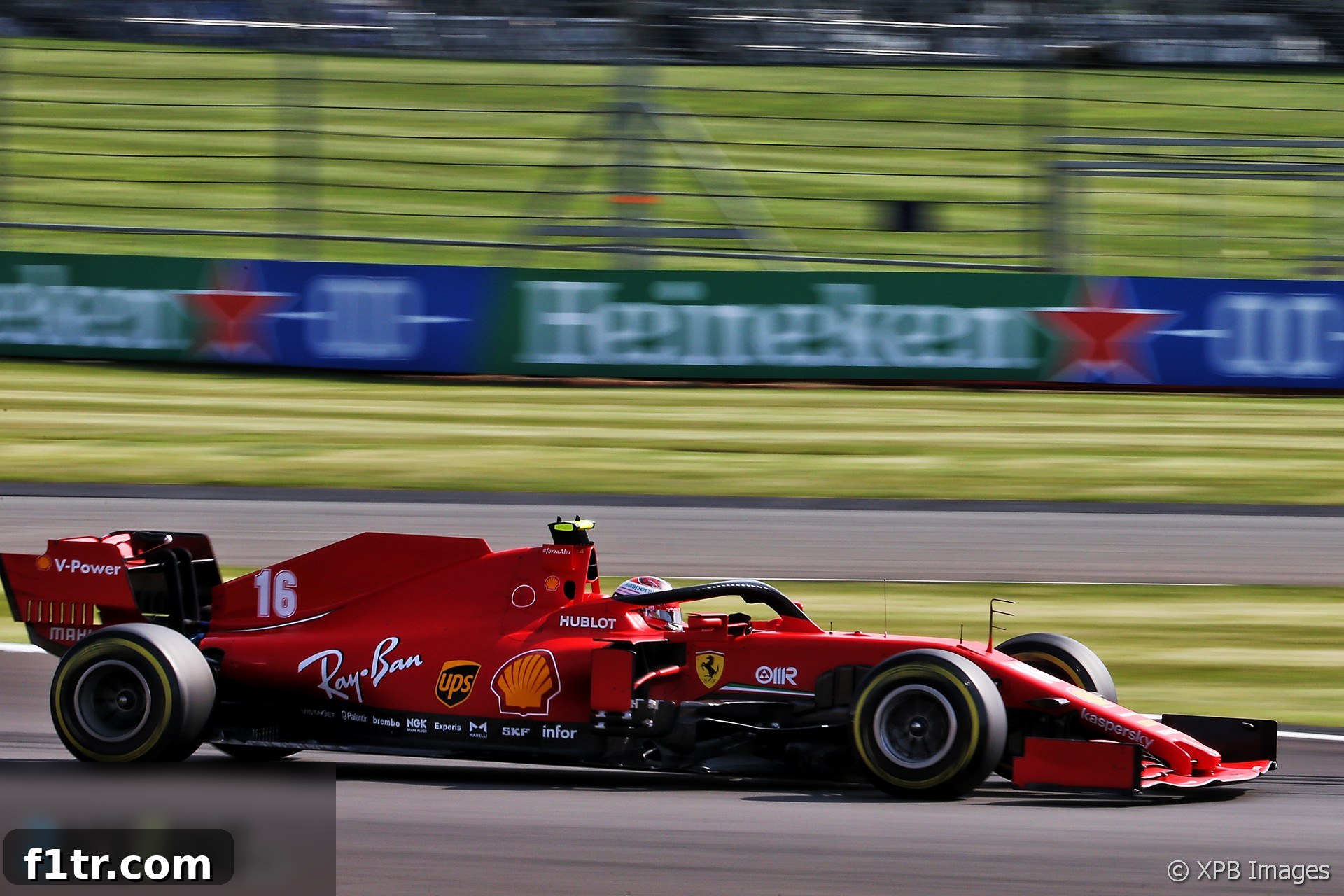
Leclerc’s Silverstone Masterclass: Ferrari’s Strategic Gamble Pays Off in Qualifying
The iconic Silverstone Circuit, a true temple of speed in Formula 1, once again delivered high drama during qualifying for the British Grand Prix. Amidst the high-stakes battle for grid positions, Charles Leclerc emerged as a standout performer, securing an impressive fourth place for Ferrari. This wasn’t just a strong single-lap effort; it was a strategically astute performance that could profoundly influence his race on Sunday.
Leclerc’s P4 represents Ferrari’s most competitive qualifying result of the 2020 season to date, a significant achievement given the team’s struggles throughout the year. But what truly set his performance apart was his daring choice to progress through Q2 on a set of medium compound tyres. This decision, fraught with risk, ultimately paid off, placing him in a significantly stronger tactical position for the upcoming race compared to many of his direct rivals, who will begin the Grand Prix on softer, less durable rubber.
A Delightful Surprise for Leclerc and Ferrari
Following his stellar qualifying session, Leclerc was understandably ecstatic. “I’m extremely happy about today,” he shared with a beaming smile, reflecting the relief and satisfaction of a job well done. “I did not expect to be fourth for tomorrow’s race and especially not starting with mediums.” This sentiment underscores the internal expectations within the Ferrari camp, which had been tempered by a challenging season where competitive qualifying performances were a rarity.
The decision to attempt Q2 on mediums was not one taken lightly. It required absolute confidence in the car and the driver’s ability to extract the necessary pace without pushing the tyres beyond their optimal window. Leclerc admitted the team harbored genuine doubts about their ability to pull off such a feat. “We tried it but we were not very confident about making it,” he confessed. “To make it work was very nice.” This demonstrates the fine margins at play and the successful execution under immense pressure.
The strategic implications of starting on the medium tyre are profound, particularly for Ferrari. Leclerc highlighted the team’s ongoing battle with tyre degradation. “It’s looking [better] for the race tomorrow because our race pace we are struggling. I think we have the pace, we are just destroying the tyres very quickly compared to the others, so starting on the medium will help us massively.” This insight reveals a critical weakness in Ferrari’s 2020 package – the car’s propensity to prematurely wear out its tyres. By starting on mediums, Leclerc gains the flexibility to run a longer first stint, potentially leapfrogging competitors on softs who will be forced into an earlier pit stop. This strategic advantage offers a lifeline for a team striving to maximize its limited performance.
The Strategic Nuance of Tire Compounds in F1
To fully appreciate Leclerc’s tactical advantage, it’s crucial to understand the role of tyre compounds in Formula 1. Pirelli supplies teams with three different dry-weather compounds for each race weekend: soft, medium, and hard. The softest compound offers the most grip and therefore the fastest lap times, but it degrades the quickest. Conversely, the hard compound provides the least grip but is the most durable, allowing for longer stints. The medium compound strikes a balance between performance and longevity.
According to F1 regulations, any driver who qualifies in Q3 must start the race on the tyre compound they used to set their fastest time in Q2. For those outside the top 10, there is a free choice of starting tyre. By clearing Q2 on mediums, Leclerc bypassed the requirement to start on the theoretically faster but strategically restrictive softs. This means he avoids the early pit stop window that will plague his soft-tyre rivals, giving him greater flexibility to react to safety cars, track conditions, and competitor strategies. A longer first stint allows him to push harder later in the race, or to make an undercut/overcut work more effectively.
On a high-energy circuit like Silverstone, known for its fast corners and demanding layout, tyre degradation is a significant factor. Teams often opt for multi-stop strategies, and managing tyre wear is paramount. Leclerc’s choice enables him to potentially run a single-stop race, or at least significantly delay his first stop, giving him fresher tyres for longer when it counts, or providing a buffer should he need to manage unforeseen circumstances.
Vettel’s Troubles: A Divergent Path for Ferrari’s Drivers
While Leclerc celebrated a strategic triumph, the mood in the other side of the Ferrari garage was markedly different. His teammate, Sebastian Vettel, endured a challenging qualifying session, ultimately securing only 10th place. Adding to his woes, Vettel was unable to replicate Leclerc’s medium-tyre gamble, meaning he will start the British Grand Prix on the less desirable soft compound.
“For sure starting on the soft tyre is not ideal,” admitted Vettel, a four-time world champion well aware of the strategic implications. “But it is what it is so we have to try and make the most of it.” His pragmatic acceptance reflects the often-unforgiving nature of F1, where qualifying performance directly translates into strategic dilemmas for race day.
Vettel’s struggles were not purely down to tyre choice but stemmed from a deeper issue of comfort and rhythm with his SF1000 car. “I struggled to find the rhythm,” he confessed. “The car was not too bad but it didn’t fit me today so [I was] struggling. Yesterday obviously I did very little laps and and this morning as I said [I couldn’t] get into the rhythm.” This highlights a familiar pattern for Vettel in recent seasons, where extracting the maximum potential from the car has proved challenging, especially when compared to Leclerc’s consistent ability to push the limits.
The lack of running on Friday due to technical issues (which often affects a driver’s ability to fine-tune the car and their own driving style) compounded his problems. In a sport where every tenth of a second counts and confidence in the machine is paramount, a disrupted practice schedule can be a critical disadvantage. Nevertheless, Vettel remained determined: “Nevertheless I will try everything I can tomorrow and we’ll see what we can get.” Despite the hurdles, the veteran racer will undoubtedly push hard to recover positions and salvage points for Ferrari.
Ferrari’s 2020 Conundrum: A Tale of Two Drivers
The divergent qualifying fortunes of Leclerc and Vettel at Silverstone encapsulate Ferrari’s challenging 2020 season. The Scuderia entered the year with high hopes, but a lacklustre power unit and an aerodynamically inconsistent chassis quickly dashed those aspirations. While Leclerc has often managed to extract more than the car’s inherent pace suggests, dragging it into surprising positions, Vettel has visibly struggled to adapt and find consistency.
Leclerc’s aggressive yet calculated approach, exemplified by his medium-tyre strategy, showcases his adaptability and ability to work with the team to identify and execute bold tactical plays. His P4 at Silverstone is not just a personal achievement but a morale booster for a team desperately seeking positive momentum.
For Vettel, the struggle continues. As his time at Ferrari draws to a close at the end of the season, these performances intensify the scrutiny. His inability to find rhythm and pace consistent with his teammate points to a broader disconnect that the team has been unable to resolve. Starting on softs from P10 puts him immediately on the back foot, facing the challenge of managing early tyre degradation while trying to make up ground in a competitive midfield.
The Race Day Outlook: High Stakes at Silverstone
Looking ahead to Sunday’s race, Charles Leclerc’s P4 and medium-tyre advantage position him as a potential dark horse. While challenging the dominant Mercedes duo of Lewis Hamilton and Valtteri Bottas might be a bridge too far, Leclerc could realistically aim to consolidate his position or even fight for a podium spot if circumstances play into his hands. His strategic flexibility could allow him to undercut rivals, extend his first stint under a safety car, or simply run a more optimal race distance on his chosen compounds.
For Sebastian Vettel, the path to points will be significantly tougher. Starting on the softs means an early pit stop is almost inevitable, potentially dropping him into traffic. He will need a combination of shrewd strategy from the pit wall, aggressive but clean driving, and perhaps a stroke of luck (like a well-timed safety car) to climb through the field. His experience will be invaluable, but the inherent performance deficit and tyre choice make it an uphill battle.
The British Grand Prix at Silverstone promises to be a fascinating strategic contest. Leclerc’s qualifying masterstroke has set the stage for an intriguing race, demonstrating that even when a team is not at the very front of the grid, intelligent strategy and exceptional driving can still create significant opportunities. Ferrari will be hoping that Leclerc’s gamble pays dividends and provides a much-needed shot in the arm for their challenging season.
2020 F1 Season
- Grosjean to make F1 test return tomorrow for first time since Bahrain horror crash
- Pictures: Wrecked chassis from Grosjean’s Bahrain fireball crash to go on display
- Bottas vs Rosberg: Hamilton’s Mercedes team mates compared after 78 races each
- F1 revenues fell by $877 million in Covid-struck 2020 season
- Hamilton and Mercedes finally announce new deal for 2021 season
Browse all 2020 F1 season articles