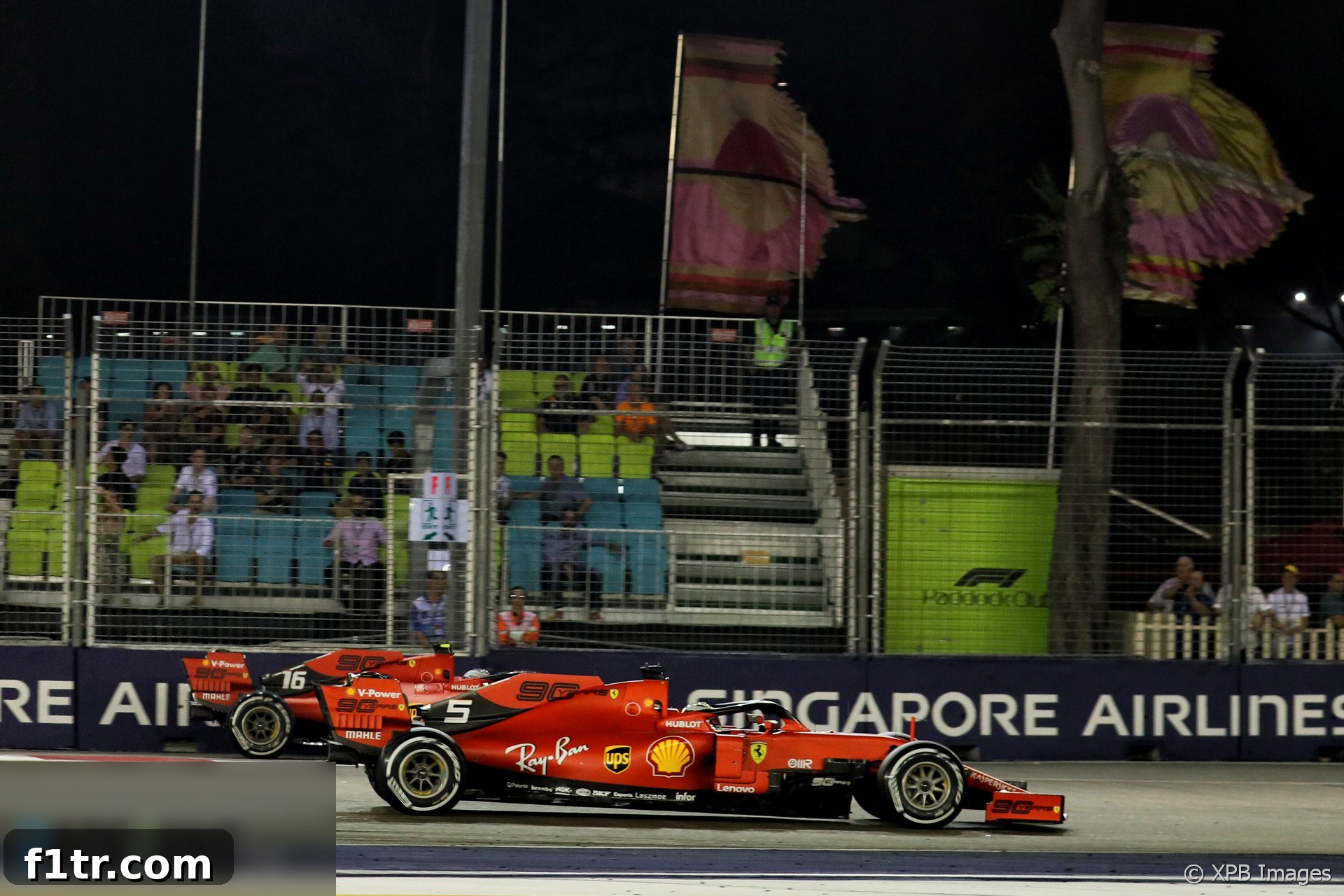
Charles Leclerc, a prodigious talent in Formula 1, found himself embroiled in a perplexing strategic situation during a pivotal Grand Prix in the 2019 season. Unbeknownst to him, a critical decision made by his Ferrari team regarding his teammate, Sebastian Vettel, placed his race lead in jeopardy. This incident not only highlighted the intense pressures of top-tier motorsport but also underscored the complex dynamics within a premier racing outfit, particularly when managing two championship-caliber drivers. The lack of transparent communication from the pit wall left Leclerc vulnerable, ultimately allowing Vettel to execute a crucial undercut and seize the lead, much to the young Monegasque’s visible frustration.
The intricate world of Formula 1 strategy often hinges on split-second decisions and precise execution. In this particular race, Leclerc had been meticulously managing his pace at the front of the field, adhering to Ferrari’s initial race plan. However, the revelation that Vettel had pitted earlier – a move unknown to Leclerc – completely altered the competitive landscape. This strategic maneuver, known as an undercut, involves a trailing car pitting for fresh tyres before the leading car, using the superior grip of the new rubber to put in rapid out-laps and gain track position. For a driver in Leclerc’s position, who was fully committed to the team’s instructions, this blindsiding tactic felt like a significant betrayal, eroding the trust essential for seamless team operations.
From the confines of the cockpit, a Formula 1 driver possesses an extremely limited view of the overall race picture. “You don’t see the full situation as a driver,” Leclerc articulated post-race, visibly dejected. “You only see your situation so it’s very difficult to know who has pitted behind.” This quote encapsulates the driver’s isolation in a high-stakes environment, relying entirely on the team for crucial information. Leclerc’s confirmation, “I was not aware Seb had pitted,” resonated deeply with fans and pundits, highlighting a glaring lapse in Ferrari’s communication protocols. He had driven his heart out, believing he was executing the optimal strategy. “Obviously for me I couldn’t have asked anything more than I did. I obviously did not expect Seb to pass me and it was frustrating from the car,” he added, his words painting a vivid picture of his on-track disappointment as his teammate swept past him on fresher tyres.
Advert | Become a Supporter & go ad-free
The sequence of events unfolded rapidly on lap 18. Sebastian Vettel received the critical instruction to pit at turn 20, just moments before the pit lane entry. Meanwhile, Leclerc, confidently leading the race, continued to adhere to the team’s directive to manage the pace and protect their tyre strategy. The crucial oversight was that Leclerc was not informed that Vettel had pitted, nor was he advised to immediately increase his pace to counter a potential undercut. This lack of communication proved costly. While Leclerc navigated the middle sector of the track in a controlled 42.7 seconds, Vettel, on his fresh tyres during a scorching out-lap, was over 1.7 seconds faster. This significant advantage allowed Vettel to gain precious time, laying the groundwork for his eventual leapfrog.
Ferrari’s communication with Leclerc regarding his own pit stop compounded the issue. It wasn’t until he was more than halfway around the subsequent lap that he received a vague instruction: “mode box.” This phrase, while indicating preparation for a pit stop, lacked the immediate clarity and urgency required for a leading driver in a critical phase of the race. Confused by the ambiguous message, Leclerc sought confirmation as he approached the pit entrance, asking, “Box this lap or not?” The hesitation and uncertainty emanating from the cockpit underscored the detrimental impact of the team’s unclear messaging. Had he been given a direct and timely instruction to pit earlier, or at least informed of Vettel’s stop, Leclerc could have potentially mitigated the damage or even prevented the undercut altogether.
The aftermath of the race saw Leclerc grappling with a mixture of personal frustration and professional understanding. “I also completely understand if that this decision had been taken it’s for sure for the good of the team,” he conceded, attempting to reconcile his feelings with the broader team objectives. This sentiment reflects the immense pressure on F1 drivers to prioritize team success, even when it comes at a personal cost. However, he quickly followed with, “But it’s hard to understand in the car. It’s frustrating.” This candid admission revealed the raw emotion beneath the composed exterior of a world-class athlete. He reflected on his performance, emphasizing his adherence to the strategy: “I’ve had a good qualifying yesterday, I’ve done everything, I stick to the plan at the beginning of the race.”
Leclerc further elaborated on the initial strategy, stating, “We had to slow down as much as we could for the pit window to not open for the others and then started to push.” This detailed insight into Ferrari’s pre-planned tyre management strategy makes the subsequent undercut even more perplexing from Leclerc’s perspective. He was executing a careful strategy designed to protect their lead, only to find himself a victim of an internal tactical shift. “I did not expect the undercut. But it’s life, sometimes it goes that way. I’m happy for the team anyway,” he concluded, showcasing his maturity despite the disappointment. This episode became a defining moment in the burgeoning rivalry between the two Ferrari drivers and fueled discussions about team orders and strategic transparency within the Scuderia.
Advert | Become a RaceFans supporter andgo ad-free
Team Radio Transcript: Unpacking the Critical Pit Stop Communications
The raw data from the team radio exchanges provides an invaluable, real-time chronicle of how the critical strategy call unfolded and where the communication gaps emerged. Analyzing these messages reveals the precise moments when the strategic advantage shifted and the clarity of instructions faltered.
| Lap | Exchange | Message |
|---|---|---|
| 19 | To Leclerc: | Pit stop gap 18 seconds. |
| 19 | Vettel: | Go down three clicks. |
| 19 | To Vettel: | Copy that. |
| 19 | To Vettel: | Charles lap time 9.0 |
| 19 | To Leclerc: | Hamilton behind at 1.2. Hamilton with DRS. |
| 19 | To Vettel: | Turn 20 Box Sebastian, box now. |
| 19 | To Leclerc: | Vettel pits And Hamilton with DRS. K1 plus available if you need it. |
| 20 | To Leclerc: | Hamilton with DRS. |
| 20 | To Vettel: | In pits Mode box, mode box. |
| 20 | To Vettel: | On the white line, racing Hulkenberg. |
| 20 | To Vettel: | Push on the out lap. You are in free air. |
| 20 | To Leclerc: | Turn 13 And mode box. Hamilton with DRS. |
| 20 | To Vettel: | You are racing Hamilton, and push. |
| 20 | Leclerc: | Box this lap or not? |
| 20 | To Leclerc: | Box now, box. Box now, box. |
| 20 | To Leclerc: | K2 on. |
| 21 | To Leclerc: | And reset brake balance, reset diff. Will be close on Sebastian on exit. |
| 21 | To Vettel: | SOC 2. |
| 21 | Vettel: | We cleared him already did we? |
| 21 | To Vettel: | Not yet. Push. Half a second. |
| 21 | To Leclerc: | Leclerc rejoins the track behind Vettel. And K2 off, K2 off. |
| 21 | To Vettel: | SOC 2 and push. |
| 21 | To Leclerc: | We need to push as much as you can. |
| 21 | Leclerc: | Yeah but what the hell? I mean… |
| 21 | To Leclerc: | We are tight with Hamilton. |
NB. Notes in italics are not messages
The transcript lays bare the critical sequence of events. On lap 19, Vettel receives a clear “Box Sebastian, box now” instruction at turn 20. Crucially, Leclerc is only told about Hamilton being behind him with DRS and available K1 plus, but no mention of his teammate’s pit stop. By lap 20, as Vettel is in the pits receiving “mode box” and told to “Push on the out lap,” Leclerc is only then advised “mode box” at Turn 13, and still focused on Hamilton. Leclerc’s desperate query, “Box this lap or not?” is a stark indicator of his lack of awareness and the team’s delayed communication. The instruction “Box now, box” arrives, but by then, the die is cast. As Leclerc rejoins behind Vettel on lap 21, his exasperated “Yeah but what the hell? I mean…” perfectly captures his confusion and frustration at having lost track position without prior warning or clear strategic explanation.
This incident transcended a simple pit stop error; it became a focal point in the intense narrative of Ferrari’s 2019 season. The dynamic between their two star drivers, Charles Leclerc and Sebastian Vettel, was already under scrutiny, and this event only amplified the discussions around potential team orders or favoritism. For a team like Ferrari, steeped in history and under immense pressure to deliver championship titles, managing driver rivalries while optimizing overall team performance is a perpetual tightrope walk. The undercut, a legitimate strategic weapon, was wielded with devastating effect, but its application without the knowledge of the leading driver raised questions about internal communication efficacy and fairness.
The psychological toll on Leclerc, a young driver striving to establish himself as a future champion, cannot be overstated. He had demonstrated exceptional pace and control throughout the early stages of the race, meticulously following the team’s plan to create a pit window and manage tyre degradation. To have his efforts undermined by an unforeseen internal strategy call, communicated poorly, was undoubtedly a blow to his confidence and trust in the team. While he publicly accepted the decision for the “good of the team,” the underlying frustration was palpable and spoke volumes about the complexities of modern F1 team management.
Ultimately, this strategic misstep (or deliberate tactical choice, depending on perspective) in the 2019 season served as a stark reminder of several critical aspects of Formula 1 racing: the pivotal role of real-time communication, the constant battle of wits on the pit wall, and the human element of driver ambition colliding with team objectives. For Ferrari, it highlighted areas where their operational efficiency and internal transparency needed significant improvement to prevent such costly misunderstandings from recurring and to ensure both drivers felt equally supported in their pursuit of victory. The incident remained a significant talking point, illustrating the delicate balance required to harness the talent of two elite drivers under one banner.
Advert | Become a RaceFans supporter andgo ad-free
2019 F1 Season: Related Articles & Insights
The 2019 Formula 1 season was a period filled with intense battles, memorable performances, and significant strategic challenges for all teams, especially those at the forefront like Ferrari. The dynamic between Charles Leclerc and Sebastian Vettel was a recurring theme, often overshadowed by Mercedes’ dominant performance but always a source of intrigue. This specific strategic moment between the two Ferrari drivers added another layer to the season’s rich tapestry, sparking debate among fans and analysts alike about the intricate world of F1 team management and driver dynamics. Explore more stories and analyses from this compelling year in motorsport.
- Crying in the Melbourne car park at 2019 grand prix was my career low – Ocon
- McLaren Racing reports reduced £71 million loss in 2019
- Kvyat: Hockenheim podium last year was “my biggest achievement” so far
- How the FIA’s new encrypted fuel flow meter targets Ferrari’s suspected ‘aliasing’ trick
- “He smashed my office door”: 23 must-see moments from ‘Drive to Survive’ season two
Browse all 2019 F1 season articles