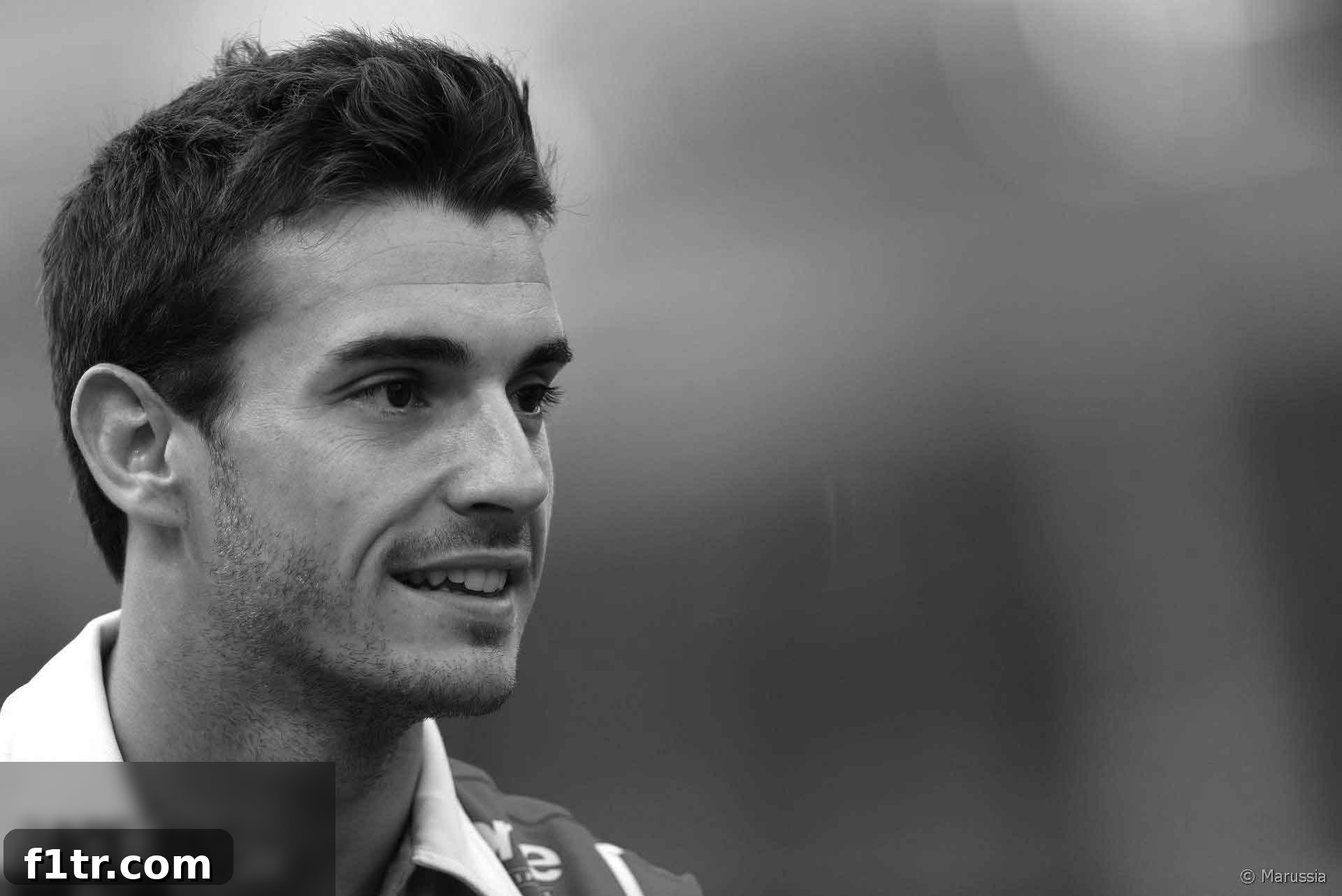
Jules Bianchi: A Legacy of Talent and Unfulfilled Promise in Formula 1
Jules Bianchi was a prodigious talent whose impressive rise through the motorsport ranks marked him as a future star, destined for the pinnacle of Formula 1. His spirited underdog triumphs with the Marussia team, combined with a consistent string of successes earlier in his career, had firmly placed him on Ferrari’s radar as a potential driver for the Scuderia. Tragically, a life that promised a journey to Maranello and beyond was cut short far too soon. Nine months after a devastating crash at the Japanese Grand Prix, Jules Bianchi passed away, leaving the world of motorsport in profound mourning for a talent lost.
A Promising Start: Early Life and Racing Roots
Born in Nice, France, Jules Bianchi carried a rich family legacy within motorsport. His family’s passion for racing ran deep; his great-grandfather, Mauro Bianchi, was a celebrated endurance racer, and his great-uncle, Lucien Bianchi, competed in Formula 1 in 1968 for Cooper. In the same year, Lucien achieved remarkable success, winning the prestigious Le Mans 24 Hours alongside Pedro Rodriguez in a iconic Ford GT40. However, fate dealt a cruel hand to Lucien as well, who was killed the following year during practice at La Sarthe when his car tragically struck a telegraph pole. This shared family history underscored the inherent risks and profound dedication within the Bianchi family’s relationship with racing.
Jules himself first got behind the wheel of a kart shortly after his fifth birthday, igniting a passion that would define his life. Success in karting followed swiftly, revealing a natural aptitude and fierce competitive spirit. By 2007, having just secured the highly respected WSK International Series crown, Bianchi was ready to transition into racing cars, a step he took with remarkable ease and immediate impact.
Ascending Through the Ranks: Dominance in Junior Formulas
French Formula 2.0: An Instant Impact
The transition from karting to single-seater racing was almost seamless for the young Frenchman. He opened his account in the competitive French Formula 2.0 championship with an impressive second-place finish, immediately signaling his intent. By the conclusion of the 13-round series, Bianchi had decisively clinched the championship crown, demonstrating his overwhelming talent with five dominant wins, eleven podium finishes, and a remarkable lowest finish of fifth place throughout the entire season. His command of the car and race craft were already evident, marking him as a talent far beyond his years.
F3 Euroseries: The Mark of a Future Star
Following his triumph, Bianchi was immediately snapped up by the formidable French outfit ART Grand Prix for promotion to the F3 Euroseries in 2008. This championship was a known proving ground for future F1 stars, and Bianchi wasted no time in making his mark. By the end of his rookie season, only his more experienced team-mate Nico Hülkenberg and Edoardo Mortara, both of whom had a year’s experience under their belts, were ahead of him in the standings. Bianchi further impressed the paddock by winning the prestigious annual Masters race at Zolder, a non-championship event that pitted the best F3 drivers against each other, solidifying his reputation as a rising force.
Returning for the 2009 season as the clear favorite, Bianchi delivered on all expectations, taking the F3 Euroseries title with undeniable authority. He secured nine victories, a feat that stood as the most by any driver in the series since Lewis Hamilton’s dominant 2005 campaign. This achievement was particularly impressive given the subsequent introduction of reverse-grid races, which added an extra layer of challenge. His comprehensive performance left no doubt about his potential, and it wasn’t long before the biggest name in Formula 1 came calling.
The Ferrari Connection and GP2 Challenge
Ferrari had been closely monitoring Bianchi’s burgeoning career, especially with his management handled by Nicolas Todt, the son of former Ferrari team principal and then-FIA President Jean Todt. Bianchi’s prodigious talent and strategic connections soon led him to join the esteemed Ferrari Driver Academy, a critical step for any young driver aspiring to reach Formula 1 with the legendary Italian team. His deep involvement with Ferrari saw him conducting his first test for the Scuderia at the end of 2010, marking a significant milestone in his journey.
While continuing his testing duties for Ferrari, Bianchi graduated to the GP2 Series, again partnering with ART Grand Prix. In a pattern reminiscent of his 2008 F3 season, he finished his debut GP2 season third in the championship, trailing only two more experienced drivers: Pastor Maldonado, who would go on to win the title, and Sergio Pérez. Bianchi’s one-lap pace was undeniably impressive, evidenced by him securing pole position for his very first race in the series and repeating the feat twice more throughout the year. However, despite consistently featuring among the points-scorers and demonstrating raw speed, Bianchi concluded the year without a single victory, a minor frustration in an otherwise strong rookie campaign.
The 2011 GP2 season brought significant changes to the single-make series, with a new chassis and tyre supplier introduced. This rendered much of Bianchi’s year-one experience somewhat irrelevant as he returned for a second season with ART. The result, on paper, was a near facsimile of the previous year: a third-place finish in the championship with 53 points, one more than he had managed the year before. However, the season was far from straightforward, beginning with a poor start that challenged his resilience.
Bianchi’s early undoing included a tangle with eventual champion Romain Grosjean in Turkey, losing pole position due to a yellow flag infringement in Spain, and a collision with Giedo van der Garde at the start of another race. Despite these setbacks, he showcased his fighting spirit by bouncing back with a stirring victory at Silverstone, following an intense scrap with his former F3 rival Christian Vietoris. From that point onwards, Bianchi consistently took points in every race, reaffirming his talent and determination in the face of adversity.
Near Misses and the Road to Formula 1
In 2012, Bianchi seized the opportunity to gain invaluable Formula 1 experience, making nine appearances in practice sessions with the Force India team throughout the year. Concurrently, he sought to secure his first championship title in three years by switching to Formula Renault 3.5, a series known for its fiercely competitive grid. He came agonisingly close to clinching the title, in what would prove to be another season defined by exhilarating performance intertwined with frustrating setbacks.
His year in Formula Renault 3.5 began with a vexing start. After finishing second on the road at Motorland Aragón, he was controversially disqualified due to a technical infringement involving his car’s limited-slip differential. The stewards ruled that the component did not comply with regulations, resulting in the loss of 18 precious points that would prove critical in the championship fight. Despite this early blow, Bianchi refused to be deterred.
A close second-place finish to Sam Bird at Monaco, followed by a repeat result at Spa, properly ignited his season. A breakthrough victory soon followed at the Nürburgring, showcasing his exceptional pace and control. Another win in a challenging wet/dry race at Silverstone further solidified his championship credentials, setting up an intense three-way title battle between himself, Sam Bird, and Robin Frijns as the season drew to a close.
The championship decider at the Barcelona finale was fraught with tension. On lap 20, Bianchi made a bold move, shocking his rival Frijns by diving for the inside at turn one and squeezing past. The championship pendulum momentarily swung in Bianchi’s favor. Now, Frijns found himself under attack from Kevin Magnussen, and if those positions changed hands, the title would have been Bianchi’s. However, in a controversial twist, Frijns attempted to re-pass Bianchi at turn four, leading to a collision between the two championship protagonists. The incident left Frijns as the champion, a bitter pill for Bianchi to swallow after such a relentless season.
Forging a Path in Formula 1 with Marussia
Despite the heartbreak of the Formula Renault 3.5 title decider, it was Bianchi who ultimately earned a graduation to Formula 1, albeit not without another layer of disappointment. Having originally been firmly in the frame for a highly coveted Force India drive, the team made a late decision to re-hire Adrian Sutil instead. This left Bianchi with limited options, leading him to team up with fellow rookie Max Chilton at the back-of-the-grid Marussia squad for the 2013 season. It was a challenging prospect, but one Bianchi approached with his characteristic determination.
The Marussia MR02 was far from an ideal vehicle with which to demonstrate his extraordinary potential, yet Bianchi’s talent shone through almost immediately. In only his second Formula 1 outing, at the Malaysian Grand Prix, he delivered a remarkable 13th place finish. While seemingly modest, this result proved absolutely vital for the team; it guaranteed Marussia tenth place in the Constructors’ Championship ahead of their direct rivals Caterham, providing crucial financial benefits and a significant morale boost for the small, independent team.
The following year, Bianchi and Marussia went one better, again thanks entirely to the Frenchman’s exceptional driving. At the iconic Monaco Grand Prix, a circuit where his great-uncle Lucien had achieved the only podium finish of his F1 career in 1968, Jules Bianchi produced a sensational performance. He masterfully dragged his Marussia into the top ten, crossing the finish line in ninth place. This historic achievement secured the team’s first-ever championship points in Formula 1 – a staggering feat for a team operating on such a restricted budget. Because of those two precious points, Marussia concluded the 2014 season with an incredible ninth place in the Constructors’ Championship, finishing ahead of established teams like Sauber and Caterham.
The significance of that ninth place at Monaco and the prize money it earned the team cannot be overstated. It was a lifeline, helping Marussia to survive the severe financial difficulties that ultimately prevented them from racing at the end of that very year. Tragically, Jules Bianchi would never truly know the full, life-saving implications of his extraordinary achievement for the team he drove for with such passion and skill. His performance was not just a personal highlight, but a monumental contribution to the survival of a struggling team.
The Tragic End at Suzuka
Marussia’s penultimate appearance in Formula 1 came at the 2014 Japanese Grand Prix, a race that unfolded in dire and deteriorating conditions. As torrential rain fell late in the race, visibility was severely compromised, and the track became increasingly treacherous. Bianchi was bravely holding off Adrian Sutil for 17th place when the Sauber driver aquaplaned off the circuit and into the barriers at the Dunlop Curve. The incident necessitated the deployment of a recovery vehicle to retrieve Sutil’s damaged car.
Devastatingly, on the very next lap, Bianchi’s car also lost control in the challenging conditions, veering off track and striking the recovery crane with tremendous force. The impact was horrific and immediate. Bianchi was critically injured and swiftly transported to the Mie General Medical Center in Yokkaichi, where it was confirmed he had suffered severe diffuse axonal brain injuries. The motorsport community held its breath, praying for a miracle as Bianchi fought for his life.
The following month, Bianchi was transferred back to France to continue his medical care, but as weeks turned into months, he continued to show little signs of improvement. The situation grew ever more grave, placing an unbearable burden on his family. His father, Philippe Bianchi, shared the profound anguish with the media, stating earlier that week, “It’s unbearable, it’s a daily torture. We sometimes feel like we’re going crazy, because for me, it certainly is more terrible than if he had died.” Jules Bianchi’s heroic struggle came to an end on July 17, 2015, less than a month before what would have been his 26th birthday. His passing sent shockwaves through the sporting world, marking one of the darkest days in recent Formula 1 history.
A Sporting World Mourns: Jules Bianchi’s Enduring Legacy
Jules Bianchi’s death was a profound loss not only for his family and friends but for the entire motorsport community. He was a driver of immense promise, an individual whose talent was evident from his earliest days in karting, through his dominant performances in junior categories, and into his courageous F1 career with Marussia. His potential for a future Ferrari seat was a widely accepted truth, and his passing left an indelible void, a poignant reminder of what could have been. He was a rising star, a fighter, and a true racer, whose spirit captivated fans and colleagues alike.
Beyond the personal tragedy, Bianchi’s accident served as a stark and painful catalyst for significant changes in Formula 1 safety regulations. His incident highlighted the need for enhanced safety measures around recovery operations during races in adverse conditions, directly leading to the introduction of the Virtual Safety Car (VSC) system. This system allows for race control to neutralize the race more effectively without deploying a full safety car, improving safety for both drivers and trackside personnel. Jules Bianchi’s legacy, therefore, lives on, not just in the hearts of those who remember his talent and courage, but also in the tangible safety improvements that now protect every driver on the grid. He will forever be remembered as a supremely gifted driver whose light was extinguished far too soon, but whose impact on the sport remains profound and enduring.
Related Articles: 2015 F1 Season Review
- How a secret Mercedes engine mode helped pressure Vettel into a race-ending puncture
- Over 100 driver penalties issued in record-breaking 2015
- Part-time racer? The facts of Hamilton’s ‘jet-set lifestyle’
- The Complete F1 Fanatic 2015 season review
- Your favourite – and least favourite – F1 races of 2015
Browse all 2015 F1 season articles