The roar of the engines, the passionate chant of the Tifosi, and the iconic red of Ferrari converged on September 9th, 1979, creating an indelible moment in Formula 1 history. Forty years before this recent reunion, South African racing sensation Jody Scheckter, with his distinctive woolly hair and fierce determination, achieved his lifelong ambition: winning the Formula 1 World Championship. This triumph, secured at the revered temple of speed, Monza, with Scuderia Ferrari, was more than just a personal victory; it was a legendary feat that resonated deeply with racing fans worldwide.
Scheckter’s championship was particularly significant for Ferrari, as it marked their last drivers’ title for a staggering 21 years. This extended drought, twice the length of McLaren’s current dry spell, wouldn’t be broken until the arrival of the legendary Michael Schumacher. The 1979 season truly stood as a testament to Scheckter’s skill, consistency, and the formidable partnership he forged with the Maranello squad, especially given the intense pressure of delivering a championship to Ferrari on home soil.
While some might point to Gilles Villeneuve’s adherence to team orders at Monza as crucial to Scheckter’s championship, such actions were widely accepted as a logical and strategic component of a team sport, particularly within the Ferrari philosophy. Villeneuve, a ferociously talented and equally popular driver, played his part in securing the constructors’ title for Ferrari, even if it meant sacrificing his own slim championship hopes. This reflected the era’s understanding of team dynamics, where loyalty and a shared goal often superseded individual ambition. Although Scheckter’s Monza win wasn’t his home victory, he had already tasted success at his true home round in Kyalami, South Africa, along with significant wins at iconic circuits such as Anderstorp (famously on both four and six wheels in the Tyrrell P34), Buenos Aires, Monaco, Silverstone, and Zolder. These triumphs underscored his versatility and raw talent across diverse tracks and conditions.
Over the course of his seven-season Formula 1 career, Jody Scheckter amassed an impressive ten Grand Prix victories, showcasing his prowess and adaptability in an incredibly competitive era. However, the subsequent 1980 season presented a stark contrast to his championship-winning year. Behind the wheel of Ferrari’s notoriously dire 312T5, Scheckter struggled immensely, managing to score just two points throughout the entire season. The nadir of this difficult year came with a painful non-qualification in Montreal, a harsh reminder of the fine margins and engineering challenges within F1. Following this frustrating season, Scheckter made the decisive choice to walk away from Formula 1. He opted to devote himself to a new chapter, leaving behind the sport that had been his singular driving force since he and his elder brother Ian first experienced the thrill of speed on the 50cc ‘buzzbikes’ sold by their father, Max.
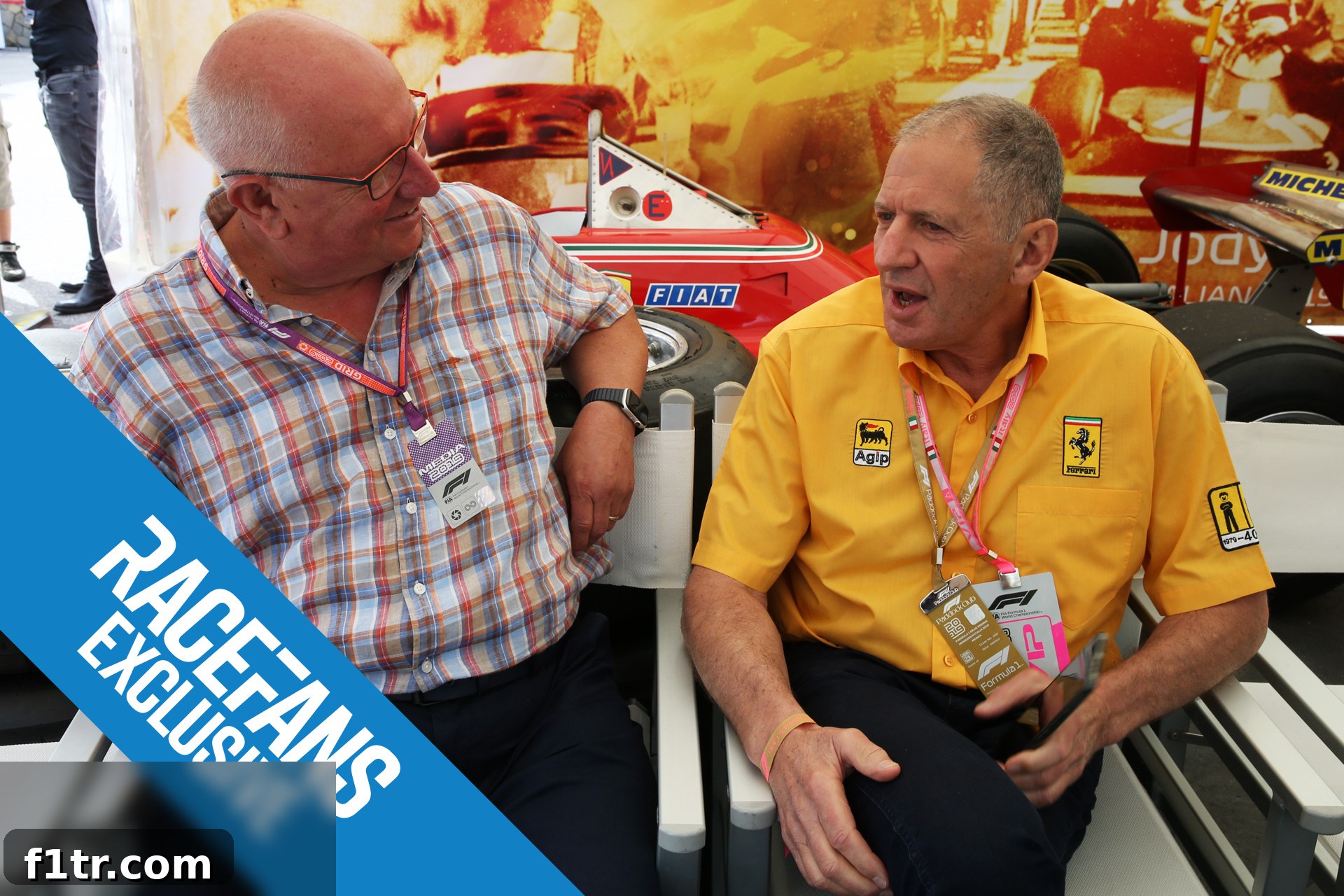
Fast forward to a day shy of 40 years since that glorious race in Monza, where the ecstatic Tifosi’s chants of “Shjodeeee, Shjodeeee, Shjodeeee” echoed for hours. We now find ourselves sitting in a marquee within the bustling Monza paddock. Scheckter had returned, graciously accepting an invitation from F1 and the circuit organizers to celebrate the enduring anniversary of his historic title. It was a moment of reflection, nostalgia, and renewed connection for a man who had intentionally distanced himself from the F1 world for decades.
At 69 years old, Scheckter appears remarkably fit and cheerful, a testament to a life dedicated to maintaining peak physical condition. He was consistently recognized as one of the strongest athletes among his contemporaries, famously winning the 1981 World Superstars decathlon contest, an event that combined various sporting disciplines. It seems he hasn’t gained an ounce in 40 years, later effortlessly slipping into a race suit of the exact same size he wore during his championship year. When asked if he was enjoying himself and if it felt good to be back in the F1 paddock, his response was immediate and heartfelt.
“I am, actually, it’s good to be back after 40 years,” he affirms, a slight crease forming around his ever-observant eyes, which constantly darted about, taking in the vibrant life of the paddock as we spoke. “This is a very special weekend for me. It’s a great way for me to come back. I don’t come back [to the paddock] often. And I really feel respected, and especially in Italy at this time, it’s a massive privilege for me this weekend.” His words conveyed a genuine appreciation for the recognition and the warmth he received, particularly from the passionate Italian fans who had never forgotten his championship success.
Scheckter had always maintained that once he achieved his ultimate objective of winning the world title, he would retire from the sport. As he previously told me, with characteristic bluntness, ‘I only wanted to go to the moon once.’ However, there was still an undeniable abruptness to his departure, leading many to believe he had entirely turned his back on the sport that had made him a very wealthy man by the age of 30. His decision was not merely an exit but a definitive statement, a complete redirection of his prodigious energy and focus towards new frontiers, rather than lingering in the past glory of his racing achievements.
Advert | Become a Supporter & go ad-free
“I wouldn’t put it that I turned my back on it. I got into something else,” he clarifies, referring to Firearms Technology Services (FATS), the arms training company he and his partners established in Florida, USA. This venture was a complete departure from the high-speed world of Formula 1, yet it demanded the same intensity and strategic thinking that defined his racing career. His entrepreneurial spirit quickly found a new outlet, proving that his drive for success extended far beyond the racetrack.
He elaborates on the remarkable success of FATS: “We created the market. We had 90% of the worldwide market. In 12 years we were in 35 different countries, 95% of the world market. The last three years were 29, 60, 100 million dollars; it went public two months after we sold it. I wasn’t the only shareholder.” The scale of this achievement speaks volumes about Scheckter’s business acumen and ability to identify and dominate a niche market, replicating the relentless pursuit of excellence that had propelled him to the pinnacle of motorsport.
Like his F1 career, the FATS venture demanded a full-time, all-consuming commitment. “It was weekends, days, everything,” he recalls. “Full-time, and that’s why I didn’t go to a grand prix. I didn’t turn my back on it, I was just [looking] forwards.” This unwavering focus on his current endeavor meant there was simply no mental or temporal space for looking back. His nature was to be fully immersed in the challenge at hand, a trait that served him well in both racing and business. He pauses thoughtfully as he seeks a link between the seemingly disparate worlds of F1 and FATS.
“We looked at other simulators. Formula 1 simulators are more difficult than aircraft simulators, because you’ve got so much ground stuff,” he explains, drawing an interesting parallel. “We looked at car simulators for police, but that was just right at the tip of it. We proved that we could train soldiers quicker on a simulator than on the range. And in America, when you could save money you could get money. We were very successful.” His anecdote highlights how Scheckter’s analytical mind sought efficiencies and innovative solutions, applying principles from one complex field to another, ultimately leading to significant advancements and financial success.
Given such a demanding schedule, was there any time for F1 at all during those years? “I did one commentary, in Long Beach (for CBS),” he recounts with a wry smile, clearly amused by the memory. “I was fantastic, because it was something like this: The guy was, ‘It’s so exciting, now over to you Jody, what do you see?’ And I said ‘Not a lot’. I never did another commentary for them again…” His blunt, unvarnished honesty, a hallmark of his personality, proved to be ill-suited for the polished world of television broadcasting, making for a memorable but short-lived foray into sports commentary.
While he was occasionally invited back into the commentary booth by other broadcasters, it became evident that the directness of a man who, at heart, remained a small-town South African, did not always align with the expectations of studio executives. Having left South Africa in 1971 to pursue his racing dreams, one might wonder if he ever missed his homeland. “It’s funny, I’ve only got a South African passport, I haven’t had anything else. And I feel very South African, I don’t feel English. I’ve got a house now in Cape Town, just bought another little place in Somerset West. I enjoy going back, I’m South African…” he states with pride, unequivocally asserting his national identity. He adds with a laugh, “I think you know when South Africa’s playing England who you want to win.” This sentiment clearly illustrates where his loyalties lie, an enduring connection to his roots.
When pressed on a quintessential cultural preference, steak or pasta, he replies, “As you get older, pasta is the thing!” This lighthearted remark offers a glimpse into his current lifestyle choices, perhaps influenced by his later career path. After selling FATS in the mid-nineties, Scheckter, by then divorced and remarried to Clare, embarked on yet another significant life change. He moved to the picturesque Hampshire Downs in England, where he acquired a modest farming operation. This seemingly tranquil pursuit quickly evolved, as Scheckter, true to his nature, successively and successfully expanded it into one of the largest and most respected organic and biodynamic farming operations in the UK. Laverstoke Park Farm now spans an impressive 2,500 acres, a testament to his ambition and dedication to sustainable agriculture.
Advert | Become a RaceFans supporter andgo ad-free
He explains the origins of this ambitious undertaking: “Then I came back to England – my wife’s English, she dragged me back. I wanted to produce the best-tasting, healthiest food for myself and my family and that’s how it all started, as a hobby. It should have stayed a hobby, but I grew it…” This candid admission reveals the deep personal motivation behind Laverstoke Park Farm, a desire to provide wholesome, nutritious food for his loved ones, which then spiraled into a much larger enterprise due to his innate drive and vision. However, the path was not without its significant challenges.
“I spent a massive amount of money because I thought I was really smart; I had 120 products. Completely stupid, I didn’t know anything about food. I lost money for, I don’t know, 16 years, big money,” he confesses with remarkable honesty. This period of substantial financial loss highlights the steep learning curve involved in transitioning from high-tech simulations to complex agricultural management. It demonstrates Scheckter’s resilience and willingness to learn from mistakes, eventually leading to a dramatic turnaround. “Then, three years ago, we just changed it around. We just simplified it. Last year was the first year we didn’t put money in. And now it’s sort of running.” This hard-won stability allowed the farm to flourish, focusing on core products that have gained significant recognition.
Today, Laverstoke Park Farm is renowned for its premium produce. “Our main products are mozzarella – we have about a thousand buffalo now, water buffalo – so we do ice cream, we do sparkling wine and beer,” he proudly states. The farm’s commitment to quality and sustainability, particularly with its large herd of water buffalo producing authentic mozzarella, has positioned it as a leader in organic and biodynamic agriculture, a far cry from the roar of Formula 1 engines, yet equally demanding in its own way.
Beyond its agricultural pursuits, the farm features a private circuit, designed, he tells me, by Apex, the same experts who undertook much of the work at Silverstone. This circuit serves as the venue for the highly successful CarFest, an annual event staged jointly with renowned DJ Chris Evans. CarFest can be best described as a compact, family-oriented version of the iconic Goodwood Festival of Speed, blending automotive spectacle with family entertainment and a strong charitable focus. Scheckter beams with pride as he describes the event’s unique appeal.
“Our CarFest is the best family event in the world,” he declares confidently. “I’m not exaggerating: 28,000 people, 45% of them children, there are cars [of all sorts], We put together grand prix cars of the ages. We’ve had from 1904 to 1993.” He then shows me highlights of this year’s event. “I got the shivers when I saw that, because some of those cars, when I first saw them…” I interrupt him mid-flow, recalling my previous interactions with him when working with his son Tomas during his F3 days. The Jody Scheckter I knew then had always struck me as a hard-nosed businessman, not a sentimental enthusiast. “You were never really a classic car type of guy, I venture,” I suggest, challenging his current sentimentality.
“I think you always love the cars you first see as a child, and I love some of those cars, front-engined going on to rear engines,” he responds, revealing a softer, more reflective side. This appreciation for the historical evolution of racing cars, from the thunderous front-engined machines to the sophisticated rear-engined marvels, showcases a deeper connection to motorsport’s heritage than his pragmatic persona might initially suggest. CarFest is not just an entertainment spectacle; it’s a powerful force for good, raising substantial funds for various charities. Scheckter proudly shares that they raise in excess of a million pounds per year for noble causes: “When [the crowd] was 19,000, we were getting about a million. And now it’s gone to 28,000, we’re giving a million-and-a-half each year.” This charitable impact underscores the profound positive influence of his post-F1 ventures.
Despite his swift exit from the competitive arena of Formula 1, Jody Scheckter has certainly not taken his eye off the sport. He remains a keen observer, though his views on modern F1 are characteristically trenchant and delivered with his usual bluntness. “I watch it all the time. What do I think of it? I think some of the rules, I cannot see the logic. They seem to me the most illogical… I can’t understand it, spoiling the sport. Otherwise it’s been quite exciting, some of the last races.” His criticism often targets the layers of complex and sometimes arbitrary regulations that he feels detract from the purity and excitement of racing, a perspective common among many drivers from his era.
Inevitably, he finds it challenging to envision himself racing in the current Formula 1 era. “I would’ve hated it,” he shoots back without hesitation. “I don’t like regulations. You crash and your gearbox breaks and you go back [on the grid]. How can that have any logic at all?” He refers to the strict penalties for component changes, a feature of modern F1 designed to control costs and encourage reliability, but which he sees as artificial interference with genuine racing. The driver once famously referred to as ‘Sideways Scheckter’ also has strong opinions on another bete noire of many fans and former drivers alike: track limits. “Aaargh, the track limits,” he exclaims when the subject is brought up, his disdain palpable. “It’s another thing that’s artificial.”
Advert | Become a RaceFans supporter andgo ad-free
He elaborates on how modern cars have fundamentally changed the driving experience. “But also, the cars today you can’t drive sideways. You can’t slide a car today. I think you lose all your aerodynamics. In my day, just at the end of my career, you shouldn’t slide. In the beginning it was actually an advantage because the tyres were tough and that was a way of heating them up.” This highlights the stark contrast in driving styles and car characteristics between his era and today. The art of sliding, once a strategic maneuver and a spectacle for fans, is now detrimental to performance due to highly sensitive aerodynamics, fundamentally altering the visual appeal and demands on drivers.
Scheckter was once known for being totally uncompromising in battle, earning him the moniker of a ‘madman’ from none other than Emerson Fittipaldi. However, he matured significantly throughout his career, evolving into the definition of a ‘percentage’ driver by the time he became world champion. He attributes this crucial transition to “common sense.” This shift from an aggressive, risk-taking style to a more measured, consistent approach was key to his championship success, emphasizing reliability and strategic point-scoring over individual race wins at all costs.
He draws a parallel to contemporary Formula 1 to illustrate his point: “It’s how you win a championship. You win a championship by not making mistakes. Just look at today. Look at Ferrari and look at Mercedes. Mercedes are solid, they don’t make many bad decisions. Ferrari’s quick, but all those little things cost them a championship.” This observation remains as true today as it was in his racing days, underscoring the timeless importance of consistency and operational excellence in winning championships. Yet, the scale of F1 operations has changed dramatically. Today, F1’s two biggest teams employ in excess of one-and-a-half thousand staff. Each.
How does that compare to manning levels during his era? “When I went to Wolf I had 20 people in the team,” he recounts, highlighting the stark contrast. His time with the tiny Walter Wolf Racing team in 1977, where he won on their debut, was a remarkable underdog story. “That’s the one year we should have or could have – I know that’s always a whim – won the championship. And Ferrari had 200 at that time.” This comparison vividly illustrates the exponential growth in resources and personnel required in modern F1, making his achievements with smaller outfits even more impressive in hindsight.
Our conversation took place before Charles Leclerc joined him in that privileged roster of Ferrari drivers to have won the Italian Grand Prix for the team. It is abundantly clear that Ferrari’s new hero has earned the blessing and admiration of their 1979 champion. “It’s funny,” he begins thoughtfully. “I’ve never really looked at drivers and thought ‘Wow!’ Before I raced and after I raced, [but] Leclerc is the first one.” This is high praise indeed, considering Scheckter’s typically reserved and critical assessment of other drivers, making his admiration for Leclerc all the more significant. He further explains his genuine affection for the young Monegasque.
“I really have, and I hate to say, I nearly have an affection for the guy. I always say he’s calm, he seems a really nice guy, he’s massively talented. He’s got to get it together a little bit, you know. But what’s the curious thing is how does a person like that come from Monaco?” he muses, perhaps finding Leclerc’s humble and grounded demeanor unusual for someone from the glitzy principality. “He’s a wonderful, a really nice guy. I look at him as the [Roger] Federer of Formula 1. Hopefully he can get the results. He just seems a really nice guy…” The comparison to tennis legend Roger Federer speaks volumes, implying a blend of elegance, talent, and composure that sets Leclerc apart in Scheckter’s eyes.
Go ad-free for just £1 per month>> Find out more and sign up
I playfully point out that Roger Federer has a South African mother. “Yeah, that’s probably a disadvantage in Formula One…” Scheckter quips, maintaining his dry wit. This exchange, though lighthearted, underscores the unique character and perspective Scheckter brings to discussions about the sport.
Leclerc had dedicated his breakthrough victory in Spa a week earlier to Anthoine Hubert, the Formula 2 driver who tragically died in a shocking crash the day before. Such devastating tragedies were, regrettably, much more commonplace during Scheckter’s time in Formula 1, giving him a stark perspective on safety in motorsport. “Two drivers out of 25 were killed each year,” he states grimly when I broach the sensitive subject, highlighting the incredibly high-risk environment of his racing era. “Bad odds.” He views last week’s fatality at Spa from the deeply experienced perspective of a driver who intimately knew much darker times in the sport, where loss was an ever-present shadow.
“Listen, there’s accidents in everything, but it was once, twice a year that people died,” he reflects. “It’s once every 10, 15 years [now]. The odds, I don’t know, if you take mileage, are very low at the moment.” His words underscore the immense progress made in F1 safety over the decades, a development he undoubtedly appreciates, particularly as a father. His sons, Toby and Tomas, both followed him into motorsport, with Tomas even reaching the cusp of Formula 1 before ultimately switching to IndyCars. Despite offering them paternal and financial support, Scheckter candidly admits he “hated” their decision to pursue racing, acutely aware of the dangers involved, a testament to the conflicting emotions of a former racer as a parent.
“I said to both of them, ‘If you’re going to get to Formula 1, I’ll support you. If you’re not, I’m going to cut you off.’ Toby I cut off. One holiday I said, ‘Listen, that’s it,’” he reveals, demonstrating his tough love approach and unwavering commitment to his children’s long-term well-being over fleeting racing dreams. “Tomas looked like he could get there. But, you know, it’s horrible when you can’t do anything about it. When you’re in the car you can fight, but when you’re there you can’t fight.” This poignant reflection highlights the unique helplessness a parent feels watching their child in a dangerous sport, a feeling alien to a man who always sought to control his own destiny on track. He vividly recalls one year when Tomas crashed out of the Indianapolis 500.
“It’s Sunday night, I’m trying to relax to go to work, the next thing, ‘Tomas is past Scott!’ and crashed. And so I didn’t enjoy it at all. And it was dangerous; Indy was dangerous.” The visceral memory of that moment underscores the profound parental anxiety that overshadowed any enjoyment of their racing careers. Tomas eventually left IndyCar racing in 2011, bringing an end to the family’s direct involvement in top-tier open-wheel motorsport. Scheckter’s own departure from F1, some three decades earlier, was often accompanied by claims of a falling out between him and Ferrari’s mercurial founder, Enzo Ferrari.
Following their double championship triumph in 1979 (Drivers’ and Constructors’ titles), Enzo Ferrari famously presented a statue of the iconic Cavallino Rampante to senior members of the team. However, Scheckter’s personal statue had a broken leg, sparking rumors: was this a subtle, yet powerful, sign of his much-rumored fractious relationship with the legendary Commendatore? “No,” he insists, firmly debunking the popular myth. “That is a massive advantage. I have a unique one. I’m the only one with a welded leg on the horse. So there is a positive.” He explains that far from being a negative sign, it made his trophy unique. “I really didn’t have a bad relationship with him at all. He loved Gilles and he respected me, and that’s the way it worked.” This pragmatic assessment illustrates the professional dynamics at play, where mutual respect underpinned their working relationship, even if affection was reserved for Villeneuve.
So, in his case, it was purely a professional relationship? “Yeah, absolutely,” he confirms. Nevertheless, as the Grand Prix Drivers’ Association president and newly-crowned world champion, Scheckter had pushed back against racing at the non-championship 1979 Imola Grand Prix. This particular race was held at the circuit later named after Enzo Ferrari’s beloved deceased son, Dino, a deeply personal venue for the Commendatore.
Scheckter insists this opposition was not because the GPDA considered the track itself to be dangerous. Instead, his rationale was far more personal: “I had just won the world championship, and I had been trying for seven years, and the last thing I wanted to do the next weekend was go racing. And I fought him and fought him, and I lost.” This highlights the clash of wills between the newly crowned champion, eager for a moment of respite, and the formidable Enzo Ferrari, determined to showcase his team. “That’s why I always say my Formula 1 world championship lasted a week, because Villeneuve blew me off the next race! That’s how I sum it up. I really didn’t want to race there at all,” he says flatly, a hint of lingering frustration in his voice, but ultimately an acceptance of a battle he couldn’t win.
Rumors that then-Brabham boss Bernie Ecclestone came seeking his services after his retirement were wide of the mark, he maintains. However, other significant offers did come his way. “But Penske tried to hire me once. And after I retired when I went to Canada, Renault came to me and said ‘Whatever you want financially…’ and I said, ‘No, I’ve made my mind up.’” This showcases Scheckter’s resolute character and his unwavering commitment once a decision was made. Typical Scheckter. But did he truly not hanker for F1 after walking away, especially after such a successful and impactful career?
“When I watched it on TV [sometime later] I remember thinking, ‘Boy, I’d love to go back to Monaco and do one race there.’ But that sort of faded over the years,” he admits, acknowledging a brief moment of longing for one of F1’s most iconic races. “Now, especially with these cars, I don’t have any desire to drive the modern cars. The 10-cylinder, yes, but I’ve sort of gone off these. I’m old-fashioned, probably.” His preference for the visceral, less regulated machines of yesteryear, particularly the powerful V10 era, solidifies his identity as a driver from a different time, a true legend whose legacy continues to inspire and provoke thought about the evolution of Formula 1. His candid reflections offer invaluable insights into the mind of a world champion who, after reaching the pinnacle of motorsport, found new and equally challenging mountains to climb.
RacingLines
- The year of sprints, ‘the show’ – and rising stock: A political review of the 2021 F1 season
- The problems of perception the FIA must address after the Abu Dhabi row
- Why the budget cap could be F1’s next battleground between Mercedes and Red Bull
- Todt defied expectations as president – now he plans to “disappear” from FIA
- Sir Frank Williams: A personal appreciation of a true racer
Browse all RacingLines columns