Japan has long been a powerhouse in the world of Formula 1, renowned for its engineering prowess and innovative spirit. Japanese manufacturers have left an indelible mark on the sport’s history, securing numerous victories and championships. Honda engines, for instance, have powered cars to an impressive 72 Grand Prix wins over more than two decades of competition. Similarly, Bridgestone tyres, which made their official debut in 1997, boast an astounding 138 victories, underpinning many championship successes.
Despite this formidable track record of Japanese excellence in F1 technology, a persistent question lingers for many motorsport enthusiasts: When will a Japanese driver finally stand atop the podium in a Formula 1 Grand Prix? While the dream of a Japanese F1 race winner continues, many talented individuals have paved the way, overcoming immense challenges and demonstrating remarkable skill. In this two-part series, guest writer Andrew Tsvyk delves into the compelling stories of the pioneering Japanese drivers who valiantly pursued this ultimate goal, charting their journeys and contributions to the pinnacle of motorsport.
Early Pioneers: Charting the Course for Japanese Talent in Formula 1
The 1960s saw the groundbreaking entry of Japanese cars and engines into the fiercely competitive world of Formula 1. However, it took another decade for the sport’s ultimate challenge to truly beckon drivers from the Land of the Rising Sun. The first intrepid racer from Japan to venture into the high-stakes arena of Grand Prix racing was Hiroshi Fushida, setting a precedent for all who would follow.
Hiroshi Fushida: The Inaugural Japanese Formula 1 Aspirant
Born on March 10, 1946, into the prominent family of Japan’s leading kimono producer, Hiroshi Fushida possessed the financial means to fuel his motorsport ambitions. Yet, unlike many “pay drivers” who rely solely on their funding, Fushida meticulously cultivated his racing skills, evolving into a highly accomplished and well-rounded competitor before contemplating the leap to Formula 1. His journey exemplified a deep-seated passion and commitment to racing, distinguishing him from many of his contemporaries.
Fushida’s Formula 1 aspirations, however, were plagued by misfortune. His first-ever F1 race, the 1975 Dutch Grand Prix, ended before it even began, as a catastrophic engine failure on his Maki car prevented him from starting. His second attempt, at the British Grand Prix, saw him fail to qualify, marking a swift and disheartening end to his F1 career. This British Grand Prix entry would, unfortunately, be the last time Hiroshi Fushida’s name appeared on a Formula 1 entry list, leaving his potential largely unfulfilled on the international stage.
Despite these setbacks and his inability to participate in a single event, Hiroshi Fushida holds an undeniable and revered place in the annals of Formula 1 history. He is rightfully recognized as the very first driver from Japan to formally attempt to race in Formula 1, a pivotal moment that courageously paved the way for a generation of his compatriots who would soon follow in his pioneering footsteps, forever changing the landscape of Japanese motorsport.
Masahiro Hasemi: A National Hero’s Moment at Fuji
Masahiro Hasemi is celebrated in Japanese motorsport folklore for a unique achievement: being the last driver from Japan to win his home Grand Prix. This momentous victory occurred in 1975, a year before the Japanese Grand Prix was elevated to world championship status. Nevertheless, this triumph solidified Hasemi’s reputation as one of Japan’s most formidable and respected racing drivers, a legend in his own right.
As a result of his acclaimed status, Masahiro Hasemi was a natural choice for Japan’s inaugural Formula 1 World Championship event, held at the challenging Fuji Speedway. Driving the innovative Kojima KE007, an indigenous Japanese constructor’s entry, Hasemi immediately impressed. He set the fourth-fastest time in the very first session, an outstanding result for a rookie piloting an unproven car. Although he experienced a crash during qualifying, the remarkable time he had already set was sufficient to secure an impressive tenth spot on the grid, a truly stellar debut for a new driver and a new team.
The 1976 Japanese Grand Prix itself unfolded under truly appalling weather conditions, with torrential rain leading to numerous retirements and challenging the best drivers on the grid. Only 11 drivers were ultimately classified, and Hasemi was among them. A poor start hampered Masahiro’s early progress, causing him to drop out of the top ten and relegating him to battling amongst the less prominent competitors. His race regrettably concluded seven laps from the finish due to a blown Cosworth engine. However, this mechanical failure could not overshadow one of his most remarkable achievements of the day: Masahiro Hasemi recorded the fastest lap of the race, a testament to his sheer speed and exceptional car control in treacherous conditions.
Despite his undeniable talent and memorable performance, Masahiro Hasemi would never again participate in another Formula 1 Grand Prix. Instead, he dedicated his career to local championships, where he continued to dominate and accumulate an impressive collection of victories across various categories, from Formula 2 to the highly competitive JGTC (Japanese Grand Touring Championship), until his retirement from racing in 2001. Today, the Hasemi legacy endures within the world of auto racing, as Masahiro continues to run his successful JGTC Nissan team, Hasemi Sport, perpetuating his family’s profound connection to motorsport.
For a deeper dive into one of Formula 1’s most iconic and controversial races, read more about the 1976 Japanese Grand Prix: 1976 Japanese Grand Prix flashback
Noritake Takahara: European Forays and Home Grand Prix Appearances
Noritake Takahara, then 25 years old, was one of three local Japanese racers who had the distinct honor of participating in the inaugural Japanese Grand Prix in 1976, marking a significant moment for national motorsport. A couple of years prior, in 1973, Takahara had already made an earnest attempt to break into Formula 1 by competing in various junior categories across Europe. However, his racing program was unfortunately very limited in scope, preventing the talented Japanese driver from consistently showcasing his abilities and ultimately failing to sufficiently impress the established Formula 1 hierarchy at the time.
Despite these early hurdles, Noritake Takahara’s talent did not go entirely unnoticed. He was extended an invitation to take part in the prestigious 1974 International Trophy at Silverstone, an important non-championship Formula 1 event. Driving a March, the Japanese racer delivered a solid and commendable performance, finishing eleventh, just a lap behind the eventual winner, the legendary James Hunt. This result hinted at his underlying speed and potential.
In 1976, team owner John Surtees recognized Takahara’s capabilities and recruited him to drive one of his TS19 cars at the highly anticipated Japanese Grand Prix. Qualifying proved challenging for the local star, as he could only manage a 24th fastest time on the grid. However, in the chaotic and rain-soaked race, Noritake Takahara demonstrated remarkable composure and steady progress, skillfully navigating the treacherous conditions to climb through the field and ultimately finish in a respectable ninth spot, a commendable effort for his home event.
Takahara returned to Fuji Speedway the following year for the 1977 Japanese Grand Prix, this time at the wheel of an older Kojima KE007. Qualifying again yielded an unremarkable result, and the race itself proved to be even more unfortunate. Noritake Takahara’s participation was cut short in a frustrating first-lap incident, ending his second and final Formula 1 Grand Prix appearance prematurely.
Kazuyoshi Hoshino: “The Fastest Guy in Japan” Takes on F1
A native of Shizuoka, Kazuyoshi Hoshino initially carved out a highly successful career in motorcycle racing, securing several national championships before the influential Nissan corporation persuaded him to transition to four wheels. Hoshino seamlessly adapted to car racing, immediately establishing himself among the frontrunners and swiftly earning the revered nickname “the fastest guy in Japan” for his electrifying speed and natural talent.
His esteemed status made his entry into the inaugural Japanese Grand Prix at Fuji Speedway a matter of national expectation. Driving for Heros Racing, Kazuyoshi piloted an older Tyrrell 007, a classic chassis. Crucially, the team also utilized Bridgestone tyres for the Grand Prix, marking the Japanese company’s historic debut in Formula 1 – a full two decades before their products would become a regular fixture and dominant force in the championship.
Despite his local celebrity and formidable reputation, Hoshino’s qualifying pace placed him just 21st on the grid, a somewhat disappointing outcome for “the fastest guy in Japan,” especially as some of his compatriots had managed to qualify ahead of him. Unfortunately for Kazuyoshi, this trend of challenging circumstances continued into the race. The Japanese star was forced to retire on lap 27 due to persistent tyre problems, a frustrating end to what had been a promising run.
Nevertheless, Hoshino’s raw pace and fighting spirit were undeniably strong in the early stages of the race. The Japanese racer displayed incredible prowess, storming through the field with remarkable speed. Starting from 21st, Kazuyoshi rapidly climbed positions, running as high as an astonishing third place before his unfortunate retirement. This dazzling display offered a tantalizing glimpse of his true potential.
“The fastest guy in Japan” made a return to Fuji in 1977, competing again with Heros Racing, this time driving a Kojima KE009. He successfully made it to the chequered flag, securing an 11th-place finish, a testament to his enduring skill and determination.
It remains a great shame and a subject of much speculation that Kazuyoshi Hoshino never secured a full-time drive in Grand Prix racing. Given the extraordinary amount of success and championships Kozuyoshi enjoyed in his homeland, one can only imagine what “the fastest guy in Japan” might have achieved had he been afforded the opportunity to compete consistently in the demanding and competitive environment of the Formula 1 World Championship.
The Modern Era: Renewed Ambition and Global Impact
With the regrettable demise of Fuji Speedway from the world championship calendar, Japanese interest in Formula 1 appeared to wane significantly for a period. However, a decade after the last Grand Prix had graced Japanese soil, a new era dawned with the sensational Formula 1 debut of Satoru Nakajima in Brazil, driving for Team Lotus, igniting a fresh wave of national excitement.
Satoru Nakajima: Honda’s Protégé and a Trailblazer
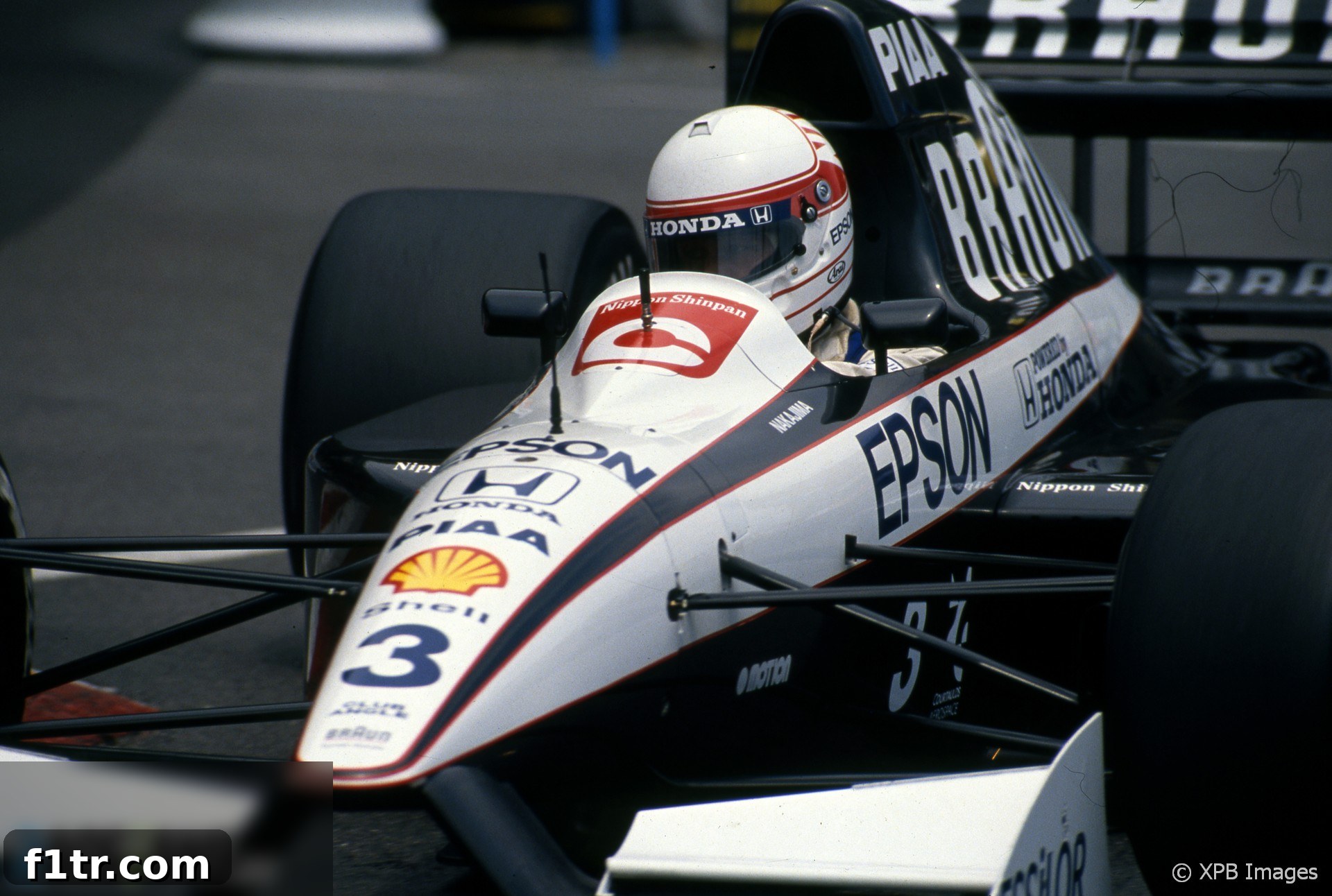
By the mid-1980s, Honda had firmly established itself as a major, influential player in Grand Prix racing, providing dominant engines to top teams. Their influence was particularly evident when Team Lotus was considering a partner for the legendary Ayrton Senna for the 1987 season. Satoru Nakajima, then 24 years old and a native of Okazaki, was undeniably not on the same level of raw speed as Senna – a benchmark against which few could compete – but crucially, no one expected him to be. His inclusion was largely facilitated by Honda’s desire to have a Japanese driver in one of their engine-supplied teams, a strategic move to promote Japanese talent.
Nakajima quickly made his mark, scoring a valuable point in just his second F1 race, the San Marino Grand Prix, where he finished sixth. This impressive start was followed by an excellent fifth-place finish at Spa-Francorchamps and a strong fourth at Silverstone, showcasing his adaptability and skill on diverse circuits. Another crucial point score came at Suzuka, his eagerly anticipated home race, where he delighted local fans. As a result of these consistent performances, Satoru finished his debut year with seven points, a respectable haul for a rookie, although it paled in comparison to Senna’s astonishing 50-point tally, underscoring the formidable challenge of competing against a generational talent.
Honda, ever keen to foster a Japanese presence in their F1 endeavors, was more than interested in retaining a driver from Japan within one of their teams. Consequently, Satoru Nakajima was retained by Lotus for the 1988 season. This decision had significant ramifications; Frank Williams, head of the eponymous team, famously refused to accommodate a “pay driver,” even one effectively sponsored by Honda, in his outfit. This principled stance ultimately led to Williams losing their coveted Honda engine deal, highlighting the power dynamics and influence of manufacturers in F1 at the time.
Nakajima commenced the 1988 season with a promising start, securing a sixth-place finish at Rio de Janeiro. However, this would tragically prove to be his sole points-scoring result of an otherwise challenging season. His seasoned teammate, Nelson Piquet, despite not having his best year, still managed to outscore Nakajima significantly, with 22 points to Satoru’s single point, illustrating the difficulties of adapting to the demands of F1 and the competitive landscape.
Nakajima remained with Lotus for yet another season in 1989. However, this proved to be an exceptionally difficult year for the Hethel-based team. The Lotus 101 chassis was far from a world-beater, and with Honda discontinuing their engine supply, the team’s horsepower was notably insufficient. Even in the hands of the triple world champion Nelson Piquet, the 101 remained largely uncompetitive. Piquet could only muster 12 points throughout the season. Satoru Nakajima’s contribution, however, included a memorable fourth-place finish at the season finale in Adelaide. More impressively, he set the fastest lap during the Adelaide race in truly terrible wet conditions, a stunning display of car control and bravery that garnered widespread admiration and showcased his exceptional talent in challenging circumstances.
While this stellar result in Adelaide did not earn Nakajima a new contract with Lotus, his strong connections with Honda ensured he was not left without a drive in Formula 1. Tyrrell became Nakajima’s new home for the 1990 season, as the Ockham-based team was actively seeking to secure Honda engines for their future campaigns, making Nakajima an attractive package.
Satoru scored a point in Phoenix on his debut for the Tyrrell team and admirably repeated that result at Suzuka at the end of the season, once again performing well at his home race. His highly talented teammate, Jean Alesi, managed to secure two impressive podium finishes for the team that year, underscoring the Tyrrell’s potential, while Satoru contributed two points to the team’s tally, demonstrating his consistent efforts.
The following season, 1991, marked Nakajima’s last in Formula 1. The Japanese driver once again started the season strongly, bringing his car home in a commendable fifth place at Phoenix, adding valuable points to his career total. Unfortunately, this would be his only points-scoring finish that year, as the remainder of the season was marred by a series of unfortunate accidents and frustrating mechanical failures, preventing him from building momentum. With prospects for a Formula 1 seat for the following year proving difficult to secure, Satoru Nakajima made the tough decision to hang up his helmet, concluding a career that had seen him compete against some of the greatest names in the sport.
Nonetheless, Satoru Nakajima’s passion for racing remains undimmed. His legacy continues through his family; his son, Kazuki, currently races for Williams, having carved out his own path in motorsport. Interestingly, Kazuki has deftly avoided accusations of trading solely on his father’s illustrious name by forging connections with Toyota rather than solely relying on the Honda ties that shaped his father’s F1 journey, demonstrating an independent spirit.
In part two of this series, we will continue our exploration of Japanese talent in Formula 1, looking at some of the more recent drivers who have graced the grid and carried the hopes of a nation.