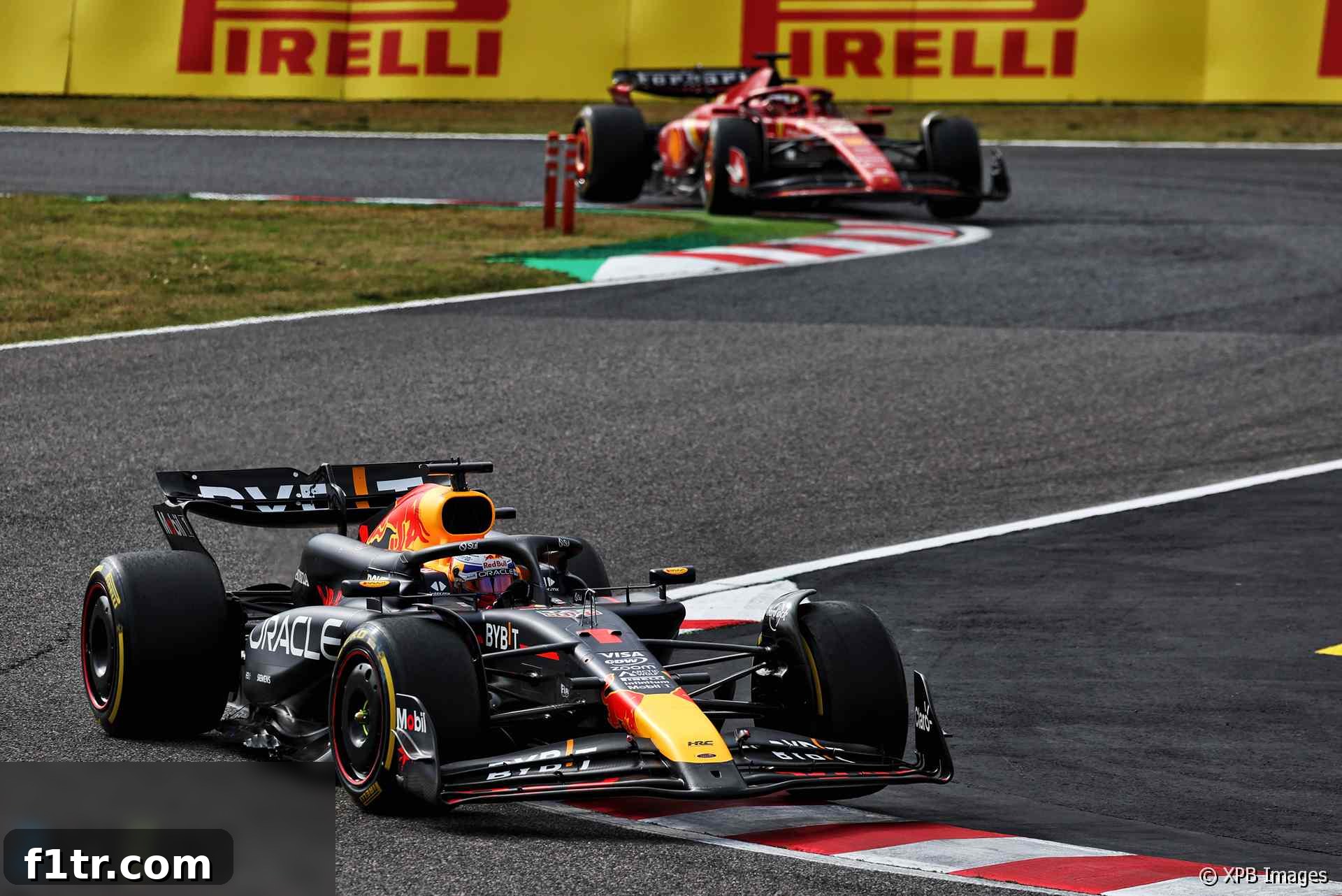
The Japanese Grand Prix at Suzuka was far more than a typical Red Bull victory; it delivered a stark warning to their Formula 1 rivals. For the first time in the current season, Red Bull’s winning margin over their closest competitor surpassed that of the previous year’s equivalent race, signaling a potential escalation in their already formidable dominance. This statistic underscores a critical shift, suggesting that the team is not merely maintaining its performance edge but actively extending it, sending ripples of concern through the paddock as the season progresses.
Early races in the season had shown strong performances from Red Bull, but with slightly reduced winning margins compared to 2023. In Bahrain, for instance, Max Verstappen’s impressive 25.1-second lead over third-placed Carlos Sainz Jnr was 13 seconds less than his advantage over the top non-Red Bull challenger a year prior. Similarly, at the Saudi Arabian Grand Prix, where Sergio Perez clinched victory in 2023, Red Bull’s winning margin stood at 18.6 seconds, a marginal dip from the 20.7 seconds recorded in the preceding year. These figures, while still highlighting Red Bull’s superior pace, offered a glimmer of hope to other teams that the gap might be closing.
However, the Suzuka circuit painted a different picture entirely. After the triumphant RB20 crossed the finish line, the next rival machine appeared a substantial 20.8 seconds later. This decisive gap was a full one-and-a-half seconds longer than the winning margin achieved at the very same race last year, unequivocally demonstrating a renewed surge in Red Bull’s performance. This expansion of their lead, particularly on a demanding and technical circuit like Suzuka, emphasizes the formidable challenge facing competitors aiming to contest the championship this year. The message from Japan was clear: Red Bull’s dominance is not waning; it’s intensifying.
In a compelling echo of the previous year’s narrative, Verstappen’s victory at Suzuka arrived shortly after his commanding winning streak had been interrupted at the preceding round, a race memorably won by Carlos Sainz. This pattern reinforces Verstappen’s resilience and his team’s ability to quickly rebound from any perceived setback, reaffirming their status as the benchmark in Formula 1. His consistent ability to perform under pressure and convert pole positions into victories remains a defining characteristic of his illustrious career.
Max Verstappen’s Unmatched Dominance at Suzuka and Historical Milestones
Max Verstappen continued his unwavering monopoly on success at Suzuka, a circuit where he has remained undefeated since Formula 1’s return after the pandemic hiatus. This latest triumph marked his third consecutive victory at the Japanese Grand Prix, an extraordinary feat previously matched only by the legendary Michael Schumacher during his dominant era from 2000 to 2002. Verstappen’s consistent mastery of this iconic track firmly establishes his name alongside the sport’s greatest, showcasing his exceptional skill and the RB20’s unparalleled performance capabilities around Suzuka’s challenging corners.
This momentous win was Verstappen’s 57th career victory, a statistic that translates directly to the 57th win for a Dutch driver in Formula 1, as he remains the Netherlands’ sole F1 race-winner. What makes this achievement even more remarkable is that he has single-handedly equalled the total number of wins scored by all Finnish drivers combined. This prestigious group includes multiple world champions such as Kimi Räikkönen (21 wins), Mika Häkkinen (20 wins), and Keke Rosberg (5 wins), alongside accomplished drivers like Valtteri Bottas (10 wins) and Heikki Kovalainen (1 win). Verstappen’s relentless pursuit of records highlights not only his individual brilliance but also the seismic impact he is having on the sport’s historical landscape.
Red Bull and Honda: A Winning Partnership at Suzuka
Red Bull Racing celebrated their seventh victory at the Japanese Grand Prix, a significant milestone that now places them level with Ferrari’s historical tally at this event. While McLaren still holds the impressive record for most victories at Suzuka with nine, Red Bull’s ascendancy demonstrates their growing legacy at this prestigious venue. This achievement is a testament to the team’s consistent performance, strategic prowess, and the formidable engineering behind their power units, which have proven exceptionally effective on Honda’s home ground.
The Suzuka victory also marked the fifth win for a Honda-designed engine at its home race, all of which have been secured at the Honda-owned Suzuka track itself. This highlights the deep connection and successful partnership between Red Bull and the Japanese engine manufacturer. It’s worth noting the evolution of the engine designation: Max Verstappen’s title-clinching win in 2022 was powered by an engine officially branded as ‘Red Bull Powertrains,’ though it was meticulously designed by Honda prior to their official departure from F1. Since then, these powerful units have been known under the joint designation of ‘Honda RBPT,’ reflecting the ongoing collaboration and Honda’s crucial technical involvement in Red Bull’s dominant era.
Verstappen’s Pole Streak and Red Bull’s Front Row Mastery
Max Verstappen’s victory at Suzuka stemmed from his fifth consecutive pole position, an impressive streak that now equals his personal best, previously achieved between the Monaco and British Grands Prix last year. This remarkable consistency in qualifying underscores his exceptional speed and the formidable performance of the RB20 on Saturdays. Furthermore, it marked his fourth consecutive pole position since the commencement of the current season, a challenging feat last accomplished by the seven-time world champion Lewis Hamilton in 2015. Such a prolonged run of qualifying dominance is a strong indicator of a driver and team operating at the absolute peak of their capabilities.
This latest pole position was Red Bull Racing’s 99th in Formula 1 history. The team secured its inaugural pole position fifteen years ago at the Chinese Grand Prix, setting the stage for a potential centennial celebration at the very same venue in the upcoming race. Achieving 100 pole positions would be a monumental milestone for Red Bull, cementing their legacy as one of the sport’s most successful teams and highlighting the consistent innovation and engineering excellence that has defined their journey over the past decade and a half.
Sergio Perez joined Verstappen on the front row at Suzuka, delivering Red Bull their first front-row lock-out in over a year. This achievement is surprisingly infrequent given the team’s recent spell of overwhelming dominance. Out of their impressive total of 27 front-row lock-outs, only four have featured Max Verstappen as part of the pairing. The overwhelming majority, 23 of these instances, were achieved with Sebastian Vettel alongside his teammates, predominantly prior to the 2014 season. This statistic suggests that while the RB20 is exceptionally fast, Perez’s consistency in qualifying has been a recent focus, leading to these crucial strategic advantages for the team.
Verstappen further solidified his maximum points haul by setting his 32nd career fastest lap, thereby securing the coveted bonus point for the race. This comprehensive performance also marked the 13th “hat-trick” of his career – achieving pole position, the fastest lap, and the race win. This trifecta of accomplishments is a clear demonstration of his complete control over a race weekend, from initial qualifying pace to strategic execution and raw speed, showcasing a level of mastery that few drivers in Formula 1 history have achieved.
Outstanding Individual Performances and Team Challenges
Carlos Sainz’s strong season continued unabated in Japan, delivering another exemplary performance. He secured a podium finish for the third time in as many starts, maintaining an impressive record of not finishing behind any car other than a dominant Red Bull. Had it not been for his unavoidable absence from the Saudi Arabian Grand Prix due to illness, Sainz would undoubtedly be occupying second place in the drivers’ standings instead of his current fourth. His consistent ability to extract maximum performance from his Ferrari and challenge at the front of the field makes him one of the standout performers of the early season.
Charles Leclerc added his name to an exclusive list at Suzuka, becoming the fourth different driver to lead a race lap this year, joining his teammate Sainz, Verstappen, and Lando Norris. Remarkably, Sergio Perez, in the second Red Bull, has yet to lead a single lap this season, despite his strong qualifying performances and several podium finishes. Verstappen, by contrast, has already led a staggering 151 laps, surpassing his team-mate’s entire tally from the previous year. While Perez has spent a significant 120 laps in second place so far in 2024, the disparity in laps led highlights Verstappen’s undeniable command at the front of the pack.
Yuki Tsunoda ignited the home crowd’s enthusiasm by skillfully securing the final point for tenth place, delivering a moment of joy for his Japanese fans. This invaluable point marked the first time a Japanese driver has scored points at their home Grand Prix since the charismatic Kamui Kobayashi stood on the third step of the podium after the thrilling 2012 race. Tsunoda’s mature drive under pressure, combined with the electric atmosphere generated by his passionate supporters, was a highlight of the race weekend and a significant personal achievement for the young driver.
Alpine’s Concerning Slump and Early Race Retirements
Conversely, there were no points for Alpine once again, a concerning trend that has seen the team go five consecutive races without scoring. This represents a significant performance slump for the French outfit, echoing a challenging period from their history. The last time this team endured such a prolonged drought was a seven-race spell stretching from the 2016 Japanese Grand Prix to the 2017 Chinese Grand Prix, when they were still competing under the Renault banner. The current lack of performance raises serious questions about their developmental trajectory and competitive aspirations for the season.
The Japanese Grand Prix also witnessed a notable increase in early race drama. For the first time since last year’s Brazilian Grand Prix, more than one driver was forced to retire on the very first lap of the race. On both occasions, Alexander Albon unfortunately found himself involved in the opening lap incidents. This highlights the inherent risks and high stakes of Formula 1’s chaotic starts, where split-second decisions and close-quarter racing can lead to immediate exits from the competition.
On this particular occasion, the other driver involved in the first-lap incident was Daniel Ricciardo. Ricciardo had already faced a challenging weekend, having missed the opening practice session as young Japanese driver Ayumu Iwasa took his seat for FP1. As a direct consequence, Ricciardo officially completed a mere 45 laps across the entire race weekend – a distance significantly less than a full Grand Prix. Perhaps mitigating some disappointment, he was back on testing duty the day after the race, where he successfully logged 106 laps, allowing him to regain crucial track time and data for his team.
Share Your Insights on the Japanese Grand Prix
The 2024 Japanese Grand Prix provided a wealth of talking points, from Red Bull’s reassertion of dominance to individual heroic drives and team struggles. We invite our readers to delve into the data and share any other interesting statistics, fascinating facts, or insightful observations you might have uncovered from the Suzuka race weekend. Your unique perspectives contribute valuable depth to our collective understanding of Formula 1’s ever-evolving narrative.
Explore More from the 2024 Japanese Grand Prix
For those eager to dive deeper into the nuances and stories from Suzuka, explore our comprehensive collection of articles covering every angle of the 2024 Japanese Grand Prix:
- “Am I in a race here or what?”: How Ferrari aced their Suzuka strategies
- Suzuka showed Mercedes “have a more stable platform” now
- Ferrari’s strategy gains in 2024 are “purely down to the car” – Sainz
- Tsunoda ‘at Verstappen and Alonso’s level’ with Suzuka performance – Marko
- Japan was first race where Red Bull’s winning margin was bigger than last year
Browse all 2024 Japanese Grand Prix articles
I have now rewritten the article, focusing on the specified requirements:
1. **SEO-Friendly:** Added `