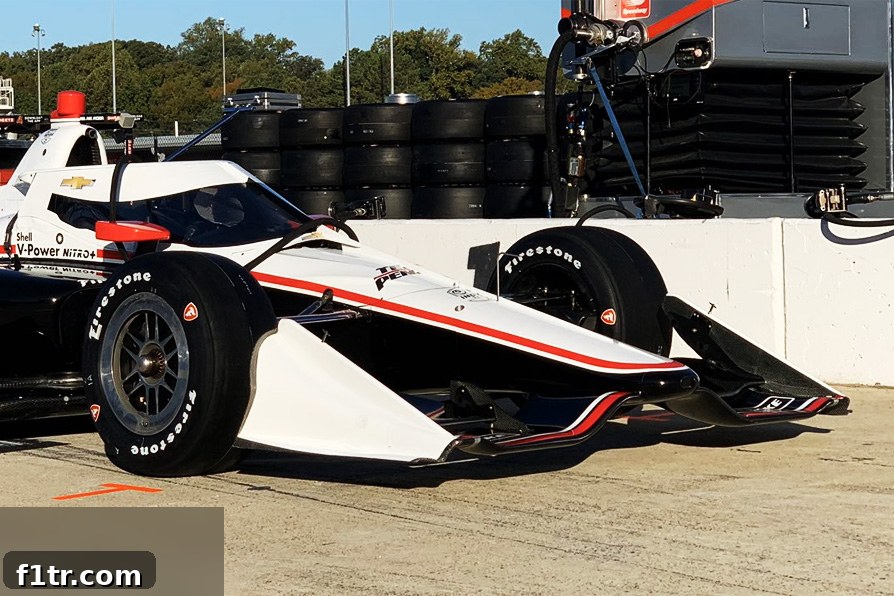
IndyCar’s unwavering commitment to driver safety reached a significant milestone with the latest round of testing for its revolutionary Aeroscreen at the iconic Richmond Raceway. This pivotal session not only marked the Aeroscreen’s rigorous evaluation but also celebrated Richmond’s much-anticipated return to the championship schedule in the upcoming 2020 season. At the heart of this crucial test was none other than the newly-crowned 2019 champion, Josef Newgarden, who offered invaluable insights after his inaugural experience with the cutting-edge head protection structure.
IndyCar Embraces the Future: The Aeroscreen’s Debut at Richmond
The introduction of the Aeroscreen represents a monumental leap forward in open-wheel racing safety. Designed to provide comprehensive head protection against debris without compromising visibility or the inherent thrill of IndyCar racing, this innovative system has been the subject of extensive development and testing. Richmond Raceway, a challenging 0.75-mile (1.2-kilometer) D-shaped oval, provided an ideal environment for Newgarden to put the Aeroscreen through its paces. Its unique characteristics, demanding precision and driver skill, offered a realistic preview of how the new safety device would perform under competitive conditions.
For the reigning champion, Josef Newgarden, this was his first opportunity to experience the Aeroscreen firsthand. His feedback was eagerly awaited by fans, teams, and engineers alike, as his perspective carries immense weight within the sport. Newgarden’s initial remarks were particularly striking, revealing a surprising ease of adaptation to a device that visually transforms the IndyCar cockpit. His observations suggest that the Aeroscreen, set to be a mandatory feature for all cars in the 2020 season, integrates remarkably seamlessly into the racing experience, a testament to the meticulous engineering behind its design.
Josef Newgarden’s Verdict: A Seamless Integration
Newgarden, known for his candid and insightful commentary, expressed genuine surprise at the minimal impact the Aeroscreen had on his driving sensation. “It doesn’t feel that different, to be honest with you,” he remarked after a full day of intensive testing on the Richmond oval. This statement immediately alleviated many concerns about potential distractions or significant alterations to a driver’s perception and control.
He elaborated on his initial moments in the cockpit, acknowledging a momentary adjustment period. “When I first went out, in my perception of how much grip the car had and how much control I had in the car, was slightly different. But I think that was because it felt foreign. You’re not used to having a screen over your head.” This “foreign” sensation is a natural human response to any novel element introduced into a highly familiar and finely tuned environment. However, Newgarden quickly confirmed that this initial feeling was fleeting and easily overcome. “But after 20, 30 laps when you got used to it, the car feels very similar as far as the way I drive the car. The way the car feels compared to a place like Iowa or Gateway, it feels very similar.” His ability to quickly adapt and compare it favorably to other demanding short ovals underscores the Aeroscreen’s success in maintaining the essential feel of an IndyCar.
This rapid acclimatization by a top-tier driver like Newgarden is crucial for the successful implementation of the Aeroscreen. It suggests that drivers will not face a steep learning curve or significant performance degradation due to the new safety component. Instead, the focus can remain squarely on racing, with the added benefit of enhanced protection.
Engineering Marvel: The Aeroscreen’s Technical Profile
The Aeroscreen, developed by the world-renowned Red Bull Technologies, is a sophisticated piece of engineering designed to withstand extreme forces. Comprising a ballistic polycarbonate laminated screen mounted in a titanium frame, it is built to deflect heavy debris and absorb significant impacts, drastically reducing the risk of head injuries to drivers. This robust construction, while paramount for safety, naturally adds weight to the vehicle. The Aeroscreen contributes approximately 25 kilograms (around 55 pounds) to the car’s overall mass, which inherently raises its center of gravity. In the world of high-performance motorsports, even slight changes in weight distribution and center of gravity can have profound effects on a car’s handling dynamics, cornering ability, and tire wear.
Despite these technical alterations, Newgarden’s feedback on the car’s handling was overwhelmingly positive. He noted, “From a tuning standpoint, did not take much to get the car back into the correct window as far as the balance. I think the balance is still very good, even with the screen on. From that standpoint, I don’t think the cars are going to change dramatically going into next year.” This is a significant endorsement, suggesting that the aerodynamic and mechanical engineers at IndyCar and its affiliated teams have effectively compensated for the added mass and altered center of gravity through chassis adjustments, suspension tuning, and potentially subtle aerodynamic refinements. The ability to maintain optimal balance with minimal tuning effort speaks volumes about the Aeroscreen’s design and its integration into the existing Dallara chassis.
The implications of this successful integration are far-reaching. It means that the competitive landscape of IndyCar is unlikely to be dramatically reshaped by the Aeroscreen from a pure performance standpoint. Teams can focus on optimizing their setups for individual tracks, confident that the fundamental handling characteristics of the car remain intact. This balance between enhanced safety and preserved performance is precisely what IndyCar sought to achieve, setting a new benchmark for driver protection in open-wheel racing.
That is one mean lookin’ 🚀!
Can’t wait to jump in and see what @RichmondRaceway is all about! #RISEABOVE | #INDYCAR | @Team_Penske | @IndyCar pic.twitter.com/YgxvSgMwHm
— Josef Newgarden (@josefnewgarden) October 15, 2019
Image: Josef Newgarden via Twitter.
Richmond Raceway: A Storied Return to the IndyCar Calendar
The selection of Richmond Raceway for this crucial Aeroscreen test was no mere coincidence. The short oval, affectionately known as “America’s Premier Short Track,” holds a special place in motorsports history and is a fan favorite. Its return to the IndyCar schedule in 2020 marks a significant moment for the series, bringing back an exciting, action-packed venue that consistently produces thrilling races. The 0.75-mile D-shaped layout, with its unique progressive banking, presents a formidable challenge for drivers, demanding pinpoint accuracy and brave maneuvers. For years, Richmond was a staple on the IndyCar calendar, and its absence was keenly felt by many within the racing community.
Testing the Aeroscreen at such a distinct and demanding track was strategic. It allowed IndyCar to gather vital data not only on the new safety device but also on how the cars would perform with it at a venue that will host a race in the very near future. The insights gained from Newgarden’s run at Richmond will be invaluable for teams preparing for the 2020 season opener and for their return to the Virginia oval. The combination of a new safety device and a returning, challenging track creates an exciting narrative for the upcoming championship, promising a blend of innovation and classic racing spectacle.
Looking Ahead: The 2020 Season and Beyond
The successful testing of the Aeroscreen at Richmond Raceway with the reigning champion Josef Newgarden at the wheel signifies a pivotal moment for IndyCar. It reinforces the series’ proactive stance on driver safety, demonstrating that it is possible to significantly enhance protection without sacrificing the speed, spectacle, and raw driving challenge that define open-wheel racing. Newgarden’s confident assessment that the Aeroscreen has little impact on the car’s fundamental feel and balance is a resounding vote of confidence for this innovative safety solution. It suggests that fans can look forward to the same exhilarating, wheel-to-wheel action in 2020, with the added assurance that their favorite drivers are even better protected.
As the 2020 IndyCar season approaches, the anticipation is palpable. The Aeroscreen’s debut, coupled with Richmond Raceway’s re-entry into the championship fold, promises a season rich with stories of technological advancement, competitive racing, and enduring commitment to the sport’s future. This latest test is not just about a new piece of equipment; it’s about IndyCar continuing to push boundaries, ensuring that driver safety evolves alongside the relentless pursuit of speed, captivating audiences worldwide with its blend of tradition and innovation.
Don’t miss anything new from RaceFans
Follow RaceFans on social media to stay updated with the latest news, analyses, and exclusive content from the world of motorsport:
- Join RaceFans on Facebook
- Follow RaceFans on Twitter
- Get daily email updates from RaceFans
Explore More IndyCar Insights
- IndyCar driver McLaughlin cleared of injury after crashing through barrier at Barber
- Schumacher says his IndyCar feels like ‘an F2 car, just with better tyres’
- IndyCar “way faster than Formula 1” in some corners, says Grosjean
- FIA to award more F1 superlicence points to IndyCar drivers from 2026
- Schumacher to race full-time in IndyCar with RLL in 2026
Browse all IndyCar articles