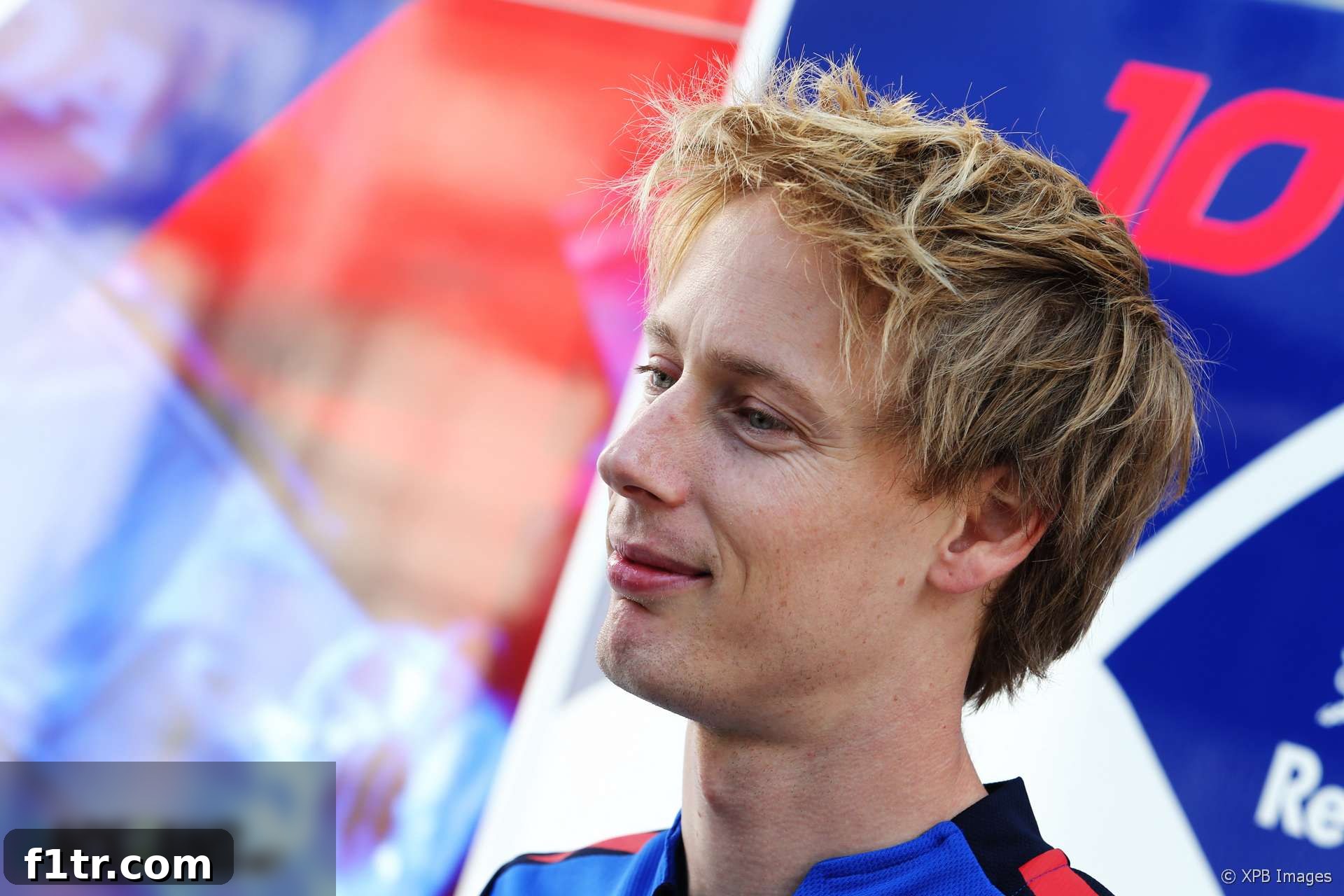
F1 Driver Brendon Hartley Addresses Toro Rosso Future Amid Performance Scrutiny
In the competitive world of Formula 1, driver performance is under constant scrutiny. Brendon Hartley, the New Zealand driver for Toro Rosso, recently faced a barrage of speculation regarding his seat amidst challenging race weekends. Despite a near-miss in Azerbaijan and a heavy crash in Spain, Hartley remains confident in his position, citing his contract and growing comfort in the car. This round-up delves into Hartley’s perspective, key F1 social media highlights, pressing technical and strategic links, and the ongoing debate surrounding tire nomenclature in the sport.
Hartley Dismisses Toro Rosso Seat Rumours: “I Have a Contract”
The spotlight on Formula 1 drivers is unforgiving, and Brendon Hartley has certainly felt its intensity in recent weeks. Following two particularly difficult race weekends – an alarming near-miss with his team mate Pierre Gasly in Azerbaijan and a significant crash in Spain – rumours began circulating about the security of his seat at Scuderia Toro Rosso. However, Hartley himself has come forward to unequivocally dismiss these suggestions, reaffirming his commitment and contract with the team.
In a sport where driver careers can be notoriously short-lived and contracts often hold more caveats than certainties, Hartley’s calmness in the face of speculation is noteworthy. “I was surprised to hear about [the rumours] because I have a contract,” he stated, highlighting the formal agreement that underpins his position. This simple statement serves as a potent reminder that despite the ever-present media narrative and public opinion, there are legal frameworks in place that dictate a driver’s tenure.
Beyond the contractual aspect, Hartley emphasized a crucial element of driver performance: confidence. “I’m feeling more and more confident in a Formula One car,” he explained. This sentiment is critical for any driver adapting to the pinnacle of motorsport, especially for one who joined the grid relatively late in his career after a successful stint in endurance racing. Building confidence in the incredibly complex and high-speed F1 machinery is a gradual process, and Hartley believes he is on an upward trajectory despite the recent setbacks.
The New Zealander also acknowledged the inherent nature of F1’s critical environment. “F1 moves quickly, there’s a lot of critics, but obviously as a driver you’re your own biggest critic,” he reflected. This self-awareness is a common trait among elite athletes, understanding that internal standards often surpass external expectations. While external criticism can be harsh and immediate, a driver’s introspection about their own performance is often the most profound.
Addressing the specific incidents, Hartley provided context for his “not completely clean” weekends. He pointed out that he scored his first Formula 1 point in Azerbaijan, a significant milestone for any rookie driver. Furthermore, he noted his competitive edge over team mate Pierre Gasly in qualifying sessions during the initial weekends of the season, being ahead in two out of three. This comparison is vital within a team, as intra-team performance is often the most direct benchmark. However, he also admitted to the overarching challenge: “ultimately we haven’t had the pace to be in the points all the time.” This highlights the limitations of the car itself, a factor often overlooked by external critics who focus solely on driver error.
Regarding the Spanish Grand Prix, Hartley expressed satisfaction with his race day performance despite the qualifying crash. “I was really happy with my race in Barcelona on Sunday. Again we didn’t have the pace to move much further up the grid but I felt I did more or less what I could,” he asserted. This statement speaks to a driver’s ability to extract the maximum performance from the available package, even when that maximum isn’t enough for headline-grabbing results. In Formula 1, sometimes the most commendable performances are those where a driver flawlessly executes a challenging race in a less competitive car, mitigating errors and capitalizing on any slight opportunity. Hartley’s assertion suggests a professional approach, focusing on personal execution rather than being disheartened by the car’s inherent pace deficit.
Quotes: Dieter Rencken
Advert | Become a RaceFans supporter andgo ad-free
Social Media Pulse: F1 Insights and Paddock Glimpses
Social media has become an indispensable platform for Formula 1 news, behind-the-scenes glimpses, and real-time updates from the paddock. It allows fans to connect directly with the sport, offering immediate reactions and expert analysis. Here’s a look at some notable posts from Twitter, Instagram, and other platforms, providing a snapshot of the buzz around the F1 world, particularly as teams prepared for the prestigious Monaco Grand Prix.
Power unit update: All Ferrari-power drivers now on their second units apart from Vettel. Both Haas and Sauber drivers are using new ICE, TC and MGU-Hs in Monaco. Also new MGU-K for Verstappen and ES for Perez. #F1 #MonacoGP pic.twitter.com/we31BrEoA1
— RaceFans (@racefansdotnet) May 24, 2018
This detailed update from RaceFans highlights the critical strategic decisions teams make regarding power unit components. In Formula 1, each driver is allocated a limited number of power unit elements (Internal Combustion Engine (ICE), Turbocharger (TC), Motor Generator Unit-Heat (MGU-H), Motor Generator Unit-Kinetic (MGU-K), Energy Store (ES), Control Electronics (CE)) for the entire season. Exceeding this limit incurs grid penalties. The fact that all Ferrari-powered drivers except Sebastian Vettel were moving to their second units for Monaco indicates a specific team strategy, potentially aiming for a fresh component for the demanding streets of Monte Carlo. Similarly, the specific changes for Haas, Sauber, Max Verstappen, and Sergio Perez underscore the constant battle for reliability and performance upgrades throughout the season, with each component change carrying significant implications for race weekend performance and long-term strategy.
Missing the point of the book, I think. #superyacht #f1 pic.twitter.com/Lw6hioKGOe
— Stuart Codling (@CoddersF1) May 24, 2018
Stuart Codling’s tweet, likely accompanied by an image, offers a subtle commentary on the perceived disconnect between the extravagant glamour of the Monaco Grand Prix and the core essence of motor racing. Monaco is famed for its superyachts, celebrity attendees, and opulent lifestyle, which often overshadow the pure sporting spectacle for some. Codling’s remark hints at a possible misinterpretation of what makes Formula 1 truly captivating, perhaps suggesting that the focus should remain on the competitive racing, technical innovation, and human skill, rather than just the luxurious backdrop. It sparks a conversation about the balance between F1 as a sport and F1 as a global spectacle and entertainment product.
You notice this as you go up and down the stairs inside the Williams motor home #F1 #MonacoGP pic.twitter.com/Bw6gPFpvGO
— Alan Baldwin (@alanbaldwinf1) May 24, 2018
Alan Baldwin’s tweet provides a rare, intimate glimpse into the inner workings of an F1 team’s hospitality unit. The Williams motorhome, like those of other teams, serves as a crucial hub for engineers, drivers, and staff during race weekends. These temporary structures are meticulously designed to provide functional workspaces, meeting rooms, and rest areas. Baldwin’s observation implies a unique detail or design element noticed within the motorhome, showcasing the attention to detail even in temporary structures and reinforcing the highly professional yet often unseen world of F1 logistics and operations. It offers a small but fascinating insight into the environment where crucial race decisions are made.
No action on Verstappen for reversing onto the track in first practice, say the stewards:
“Car 33 (VER) had to reverse on to the track to rejoin but did so under yellow flags and in a manner that posed no danger to the other drivers.” #F1 #MonacoGP
— RaceFans (@racefansdotnet) May 24, 2018
This RaceFans update clarifies a potentially controversial incident involving Max Verstappen during the first practice session of the Monaco Grand Prix. Reversing onto a live track, especially under yellow flags (which indicate a hazard and require drivers to slow down), can be a serious safety concern and often warrants penalties. The stewards’ decision to take no action, citing that Verstappen “did so under yellow flags and in a manner that posed no danger to the other drivers,” is significant. It highlights the nuanced judgments made by race officials, taking into account the specific circumstances of an incident. In Monaco’s tight confines, drivers sometimes find themselves in awkward positions, and the stewards’ ruling underscores their practical approach to ensuring safety without unduly penalizing drivers for minor procedural infringements when no real danger is present. This decision provides transparency and context to a situation that could have easily led to a penalty for a less cautious maneuver.
- Find more official F1 accounts to follow in the F1 Twitter Directory
Essential Motor Racing Reads: Deeper Dives into F1 Headlines
For enthusiasts seeking a more comprehensive understanding of the intricate world of Formula 1, external articles and detailed analyses offer invaluable insights. These links delve beyond the immediate headlines, exploring strategic narratives, technical controversies, and driver perspectives that shape the F1 landscape.
Advert | Become a Supporter & go ad-free
Ricciardo seeks Monaco redemption after pit stop error in 2016 (The Guardian)
“There’s a lot of intensity and the risk and reward is the best of the year. Hopefully, I’ll also get some redemption.””
Daniel Ricciardo’s quest for redemption at the Monaco Grand Prix is a narrative steeped in sporting drama. The 2016 race saw Ricciardo dominate qualifying and much of the race, only to lose victory due to a botched pit stop by his Red Bull team. That missed opportunity at one of F1’s most iconic races left a lasting mark on the popular Australian driver. His desire for “redemption” underscores the emotional weight of such an event and the unique challenge of Monaco, where driver skill and car precision are pushed to their absolute limits. The article likely explores how Ricciardo has mentally prepared for this return to a circuit that offered him both triumph and heartbreak, highlighting the psychological aspect of elite motorsport performance.
Ferrari controversial F1 ERS system (Motorsport magazine)
“What has been speculated from this year by rivals is whether this might allow a system whereby a second energy output to the ERS-K could be used to momentarily boost the energy flow beyond the 120kW limit, by-passing the FIA sensors, possibly by way of a chip modulating the resistance between the two outputs.”
Technical controversies are a recurring theme in Formula 1, often pushing the boundaries of regulations and prompting intense scrutiny from rival teams and the FIA. This Motorsport Magazine article delves into speculations surrounding Ferrari’s Energy Recovery System (ERS), specifically focusing on whether their system might be exploiting a loophole to gain a performance advantage. The detailed explanation about a “second energy output” and bypassing “FIA sensors” highlights the incredible complexity of modern F1 power units and the lengths to which teams go to find marginal gains. Such discussions are crucial for maintaining fairness and integrity in the sport, as any unauthorized boost in power could significantly impact the championship battle. The article likely unpacks the technical specifics, the regulatory context, and the implications for Ferrari’s competitors.
We always endeavour to credit original sources. If you have a tip for a link to feature in the next RaceFans round-up please send it in here:
- Contact RaceFans
Advert | Become a RaceFans supporter andgo ad-free
Comment of the Day: The Great F1 Tyre Naming Debate of 2019
The intricate world of Formula 1 often sparks passionate debates among fans, and the proposed changes to tyre names for the 2019 F1 season have certainly ignited a lively discussion. The question at hand: Is simplifying the tyre nomenclature a genuine step forward for the sport, or does it dilute the technical richness for dedicated followers?
I think that’s fine for the TV audience. Then the geeks like us can easily enough translate soft/medium/hard to which compound that refers to in the full range.
It might make some elements of commentary a bit more difficult for the broadcasters, comments such as “well in previous races Mercedes has struggled to get the F tyre to switch on”, but overall I think it’s more intuitive and understandable.
This week I was struggling to remember which was softer between a hyper-soft and an ultra-soft (shame on me), so I can only imagine the casual viewer would have little chance of knowing this.
Keith Campbell (@keithedin)
Keith Campbell’s insightful “Comment of the Day” perfectly encapsulates the core arguments for and against the proposed changes. Pirelli, F1’s sole tyre supplier, has historically provided a range of seven dry-weather compounds, each with a distinct name (e.g., hard, medium, soft, super-soft, ultra-soft, hyper-soft). For each race weekend, three compounds are selected, and visually identified by specific sidewall colours. However, these colours would change from race to race, leading to confusion for many viewers trying to keep track of which specific compound “soft” or “hard” referred to on any given weekend.
The proposed 2019 change aims to simplify this by always using “Soft,” “Medium,” and “Hard” for the three chosen compounds at every race, with consistent red, yellow, and white sidewall colours, respectively. As Campbell points out, this move is primarily beneficial for the “TV audience” and “casual viewer,” making the sport immediately “more intuitive and understandable.” For those new to F1 or who only tune in occasionally, deciphering the difference between a “hyper-soft” and an “ultra-soft” has indeed been a source of genuine bewilderment. By streamlining the system, F1 hopes to lower the barrier to entry for understanding a crucial strategic element of the race.
However, Campbell also acknowledges the potential downsides, particularly for the “geeks like us” – the dedicated fans and commentators who appreciate the technical intricacies. The simplification might obscure the nuances of specific tyre compounds. For instance, a “soft” tyre at one race might be equivalent to a “super-soft” from the previous range, while a “soft” at another track could be an “ultra-soft.” This subtlety is lost in the new generic naming. As he correctly identifies, commentary might become more challenging, as referencing the historical performance of a specific compound (e.g., “Mercedes struggled with the F tyre”) would lose its direct relevance if the internal designation isn’t publicly known or easily cross-referenced.
Ultimately, the debate revolves around balancing accessibility for a broader audience with the desire to retain the technical depth that appeals to hardcore fans. Campbell’s personal admission of struggling to differentiate between “hyper-soft” and “ultra-soft” highlights a very real problem even for engaged viewers, lending strong credence to the argument for simplification. While purists might mourn the loss of specific compound names, the overarching goal is to make F1 more digestible and engaging for a global audience, fostering new fans and enhancing the viewing experience.
Celebrating F1 Community Milestones: Happy Birthday!
Part of the vibrant Formula 1 community extends beyond the track, celebrating the personal milestones of its members. We extend our warmest wishes to those marking another year. Happy birthday to Sumedh and Joe Papp!
If you want a birthday shout-out for yourself or a fellow F1 enthusiast, please let us know when yours is via the contact form or by adding to the list here. We love to celebrate with our dedicated readers!
On This Day in F1 History: Hamilton’s Monaco Mastery in 2008
Formula 1 is a sport rich with history, and looking back at past events often provides fascinating context for the present. On this day, exactly ten years ago, the legendary streets of Monte Carlo witnessed a truly memorable performance from a future seven-time world champion.
- 10 years ago today Lewis Hamilton won the Monaco Grand Prix despite hitting a barrier on a damp track
The 2008 Monaco Grand Prix stands out as a testament to Lewis Hamilton’s burgeoning talent and tenacity, particularly in challenging conditions. The race began on a damp track, notorious for catching out even the most experienced drivers in Monaco’s tight confines. Early in the race, Hamilton suffered a puncture after clipping a barrier at Tabac, an incident that forced an unscheduled pit stop and dropped him down the order. However, through a combination of masterful driving, strategic pit calls by McLaren, and some uncharacteristic mistakes from Ferrari rivals, Hamilton fought his way back through the field.
His victory that day was not just a testament to his raw speed but also his mental fortitude and ability to recover from adversity. It solidified his reputation as a formidable competitor, especially in tricky conditions, and played a crucial role in his eventual maiden World Championship title campaign that year. Monaco, being one of F1’s crown jewels, ensures that a victory there holds extra prestige, and Hamilton’s 2008 triumph remains a significant highlight in his illustrious career, remembered for its drama, tactical brilliance, and the sheer driving skill required to conquer the principality’s streets.