After a much-needed four-week hiatus, the Formula 1 paddock returned with the customary high expectations for a straightforward race weekend. However, as the sport settled back into its groove for the second half of what promised to be the most demanding F1 calendar to date, the notoriously unpredictable microclimate surrounding the legendary Spa-Francorchamps circuit had other plans. What was anticipated to be a gentle return to racing instead threatened to unfold into one of the most challenging Sundays for all ten teams and twenty drivers throughout the 2021 season.
Advert | Become a Supporter & go ad-free
The intrigue surrounding the Belgian Grand Prix was already palpable before the adverse weather conditions even factored in. Yet, with a staggering 80% chance of rain forecast for the 3 PM local start time, the race was poised to become a major wildcard, potentially descending into a chaotic afternoon for the entire field. The iconic Ardennes track, known for its thrilling high-speed sections and dramatic elevation changes, often presents unique challenges, but the prospect of a truly wet race adds an entirely new layer of complexity, demanding exceptional skill, strategic agility, and a touch of luck from every participant.
At the very sharpest end of the grid, Max Verstappen had meticulously positioned himself to turn the tide in the fiercely contested championship battle. Having secured pole position, Verstappen – who had only managed a mere five points in the preceding two rounds – demonstrated superior pace over his championship rival Lewis Hamilton throughout the opening two days of the weekend. This prime starting spot presented a golden opportunity for the Red Bull driver to regain the championship lead, heading into his de facto home Grand Prix next weekend with renewed momentum and confidence. The pressure, however, remained immense, with every eye on how he would convert pole into a significant points haul.
However, the driver starting alongside him introduced a fascinating element of unpredictability to the race, particularly if the heavens were to open as expected.
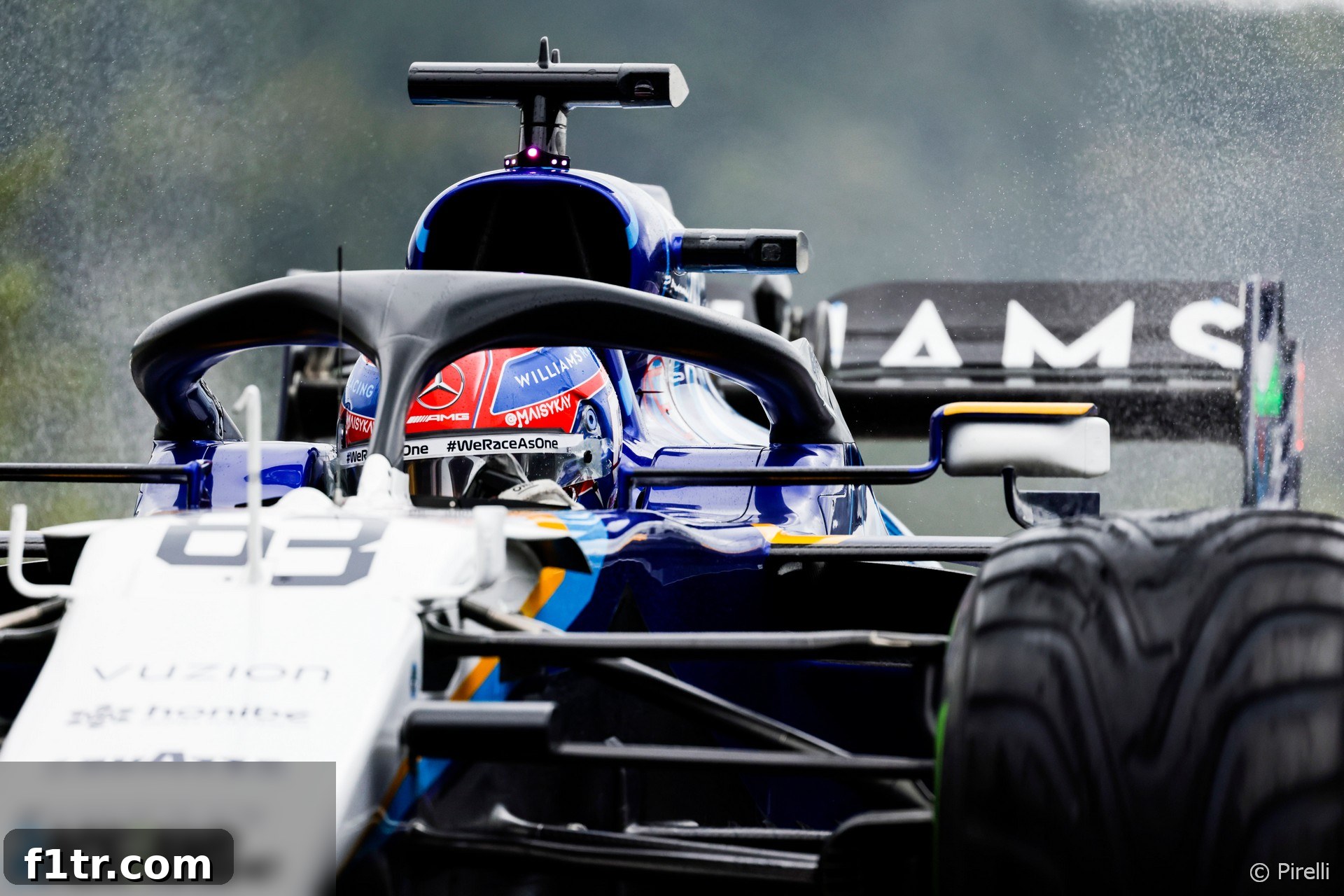
Lining up in a remarkable second place on the grid, George Russell, despite being a Williams driver, found himself in an enviable position for Mercedes. His proximity to Verstappen at the start was certainly a welcome sight for the Silver Arrows. This scenario brought back memories of his infamous accident with Valtteri Bottas at Imola in April, which led to a rather uncomfortable, yet ultimately enlightening, conversation with Mercedes team principal Toto Wolff. Following that incident, Russell openly acknowledged that even though he wasn’t driving a factory Mercedes car, he needed to treat their drivers with more caution on track, recognising his integral position within the broader Mercedes family. “Lewis and Valtteri are team mates to me of sorts,” Russell had reflected after the Imola crash, understanding that his career trajectory was inextricably linked to Mercedes’ fortunes.
“I am in this position because of Mercedes,” he asserted, a sentiment that underscored the delicate balance he would need to strike. While Russell’s ambition to deliver a stellar result for Williams was undeniable, and he might very well launch an aggressive attack on Verstappen if an opportunity presented itself at the start, his loyalty to Mercedes could come into play. With Hamilton and Mercedes’ championship lead vulnerable to Verstappen and Red Bull, it was highly probable that Russell would be reluctant to unduly impede Hamilton, especially if he were to emerge from the challenging La Source hairpin ahead of the current championship leader. His performance in the opening laps would be scrutinised, not just for his raw pace, but for the strategic implications it carried for the title fight.
On the other side of the Mercedes garage, their second driver, Valtteri Bottas, faced a considerably tougher challenge. He was set to start from a lowly 13th on the grid, a consequence of two significant setbacks. Firstly, he struggled to generate sufficient temperature in his intermediate tyres during his final Q3 run, compromising his performance. Secondly, he carried a five-place grid penalty stemming from his botched braking incident at the Hungarian Grand Prix in Budapest, which further relegated him down the order. This dual blow placed him deep within the midfield, making any hopes of a strong finish seem distant.
Despite his compromised starting position, Bottas remained optimistic, targeting a top-three finish. His confidence stemmed from Mercedes’ decision to run a low-downforce setup for the weekend. This configuration was specifically designed to maximise straight-line speed, which Bottas believed would give him a significant advantage on the long straights of Spa, enabling him to systematically pick off the cars ahead during the race. “We should have an advantage on the straights to most cars,” Bottas stated, expressing his hope that the race would eventually see some dry periods, further aiding his overtaking prowess. His ability to navigate the traffic and manage his tyres would be crucial for any meaningful recovery drive.
Bottas might also find himself starting near another driver out of his usual position: Lando Norris. The McLaren driver endured a terrifying high-speed crash into the Raidillon tyre wall during qualifying, raising significant concerns about the extent of damage to his car. Depending on the repairs required overnight, Norris could face a five-place grid penalty if a gearbox change was necessary, potentially lining him up 14th, just ahead of Bottas. Should the damage be more severe, necessitating additional drastic repairs, he might even be forced to start from the pitlane. However, Norris has proven to be one of the grid’s most adept talents this season, consistently extracting the maximum from his McLaren.
Regardless of his starting position or the conditions, spectators could expect the orange McLaren to relentlessly carve its way through the field. If Norris was indeed relegated to a pitlane start, it would at least offer him the strategic advantage of being able to adjust his wing levels precisely to suit whatever capricious conditions Spa-Francorchamps decided to throw at the start of the race, a flexibility not afforded to drivers starting from the grid. His resilience and skill would be heavily tested, but his season-long performance suggested he was more than capable of rising to the occasion.
Advert | Become a RaceFans supporter andgo ad-free
However, the overarching and most critical factor for all drivers, assuming the race necessitated the use of wet weather tyres at some stage, would be the delicate art of managing Pirelli’s temperamental wet and intermediate compounds. These tyres possess a notoriously narrow operating window, meaning they perform optimally only within a very specific temperature range. Both Bottas and Hamilton demonstrated the perils of failing to generate enough energy into their intermediate tyres during Q3, resulting in a lack of grip and compromised lap times. Conversely, Fernando Alonso attributed his Q2 exit to overheating his intermediates, having pushed too hard in a frantic rush to cross the timing line before the chequered flag, illustrating the razor’s edge on which tyre management rests in mixed conditions.
The Spa circuit, with its vast length and varied topography, often experiences constantly changing track conditions across different corners. One section might be relatively dry, while another could be soaked, presenting a perpetual dilemma for drivers and strategists alike. This inherent variability significantly increases the risk of Safety Car deployments, Virtual Safety Cars, and even red flag stoppages and restarts. Such interruptions can completely overturn pre-planned strategies, forcing teams and drivers to react instantly and adapt to rapidly evolving circumstances. In such a scenario, the ability to think on one’s feet and make split-second decisions often proves more valuable than any pre-race calculations.
Alpine executive director Marcin Budkowski articulated the stark contrast in strategic approaches: “We know what we will do if it’s a dry race. It’s quite a simple, clear strategy if it’s a dry race.” However, the official FIA weather forecast released on Saturday evening painted a very different picture, stating that the chance of rain for the race was over 80%. This figure cast a long shadow over any straightforward dry-race plans, pushing the focus firmly onto wet weather contingencies. “If it’s a wet-dry race… it’s all up in the air,” Budkowski continued, highlighting the immense challenge. “You could do a whole race on an inter if it’s wet, but if it’s drying they go away very quickly. So it could be a quite interesting race tomorrow if the conditions are wet-drying-wet-drying.” This scenario of fluctuating conditions promised a strategic chess match, where tire choices and pit stop timings would be paramount.
Amidst this strategic uncertainty, one team emerged with a potential advantage in handling the anticipated mixed conditions: Red Bull Racing. Christian Horner, Red Bull’s team principal, revealed a crucial detail to Sky after qualifying, which took place amidst another heavy downpour: “Both drivers have managed to retain a set of inters.” He added, “I think we’re the only team in the top 10 to have that. So if it’s like this – more ‘summer’ conditions – tomorrow, then at least we’ve got something up our sleeve.” This strategic foresight in conserving a fresh set of intermediate tyres could prove to be an invaluable asset for Red Bull, offering their drivers, Max Verstappen and Sergio Perez, greater flexibility and a critical performance edge should the race oscillate between wet and drying phases. This banked advantage underscored the meticulous preparation and strategic depth required to contend at the pinnacle of motorsport, especially at a venue as unpredictable as Spa.
Go ad-free for just £1 per month>> Find out more and sign up
Quotes: Dieter Rencken
Advert | Become a RaceFans supporter andgo ad-free
2021 Belgian Grand Prix: Full Qualifying Results
The qualifying session at Spa-Francorchamps was a dramatic affair, setting the stage for what promised to be an unforgettable race. Here are the full qualifying times:
| Driver | Car | Q1 | Q2 (vs Q1) | Q3 (vs Q2) | |
| 1 | Max Verstappen | Red Bull | 1’58.717 | 1’56.559 (-2.158) | 1’59.765 (+3.206) |
| 2 | George Russell | Williams | 1’59.864 | 1’56.950 (-2.914) | 2’00.086 (+3.136) |
| 3 | Lewis Hamilton | Mercedes | 1’59.218 | 1’56.229 (-2.989) | 2’00.099 (+3.870) |
| 4 | Daniel Ricciardo | McLaren | 2’01.583 | 1’57.127 (-4.456) | 2’00.864 (+3.737) |
| 5 | Sebastian Vettel | Aston Martin | 2’00.175 | 1’56.814 (-3.361) | 2’00.935 (+4.121) |
| 6 | Pierre Gasly | AlphaTauri | 2’00.387 | 1’56.440 (-3.947) | 2’01.164 (+4.724) |
| 7 | Sergio Perez | Red Bull | 1’59.334 | 1’56.886 (-2.448) | 2’02.112 (+5.226) |
| 8 | Valtteri Bottas | Mercedes | 1’59.870 | 1’56.295 (-3.575) | 2’02.502 (+6.207) |
| 9 | Esteban Ocon | Alpine | 2’01.824 | 1’57.354 (-4.470) | 2’03.513 (+6.159) |
| 10 | Lando Norris | McLaren | 1’58.301 | 1’56.025 (-2.276) | |
| 11 | Charles Leclerc | Ferrari | 2’00.728 | 1’57.721 (-3.007) | |
| 12 | Nicholas Latifi | Williams | 2’00.966 | 1’58.056 (-2.910) | |
| 13 | Carlos Sainz Jnr | Ferrari | 2’01.184 | 1’58.137 (-3.047) | |
| 14 | Fernando Alonso | Alpine | 2’01.653 | 1’58.205 (-3.448) | |
| 15 | Lance Stroll | Aston Martin | 2’01.597 | 1’58.231 (-3.366) | |
| 16 | Antonio Giovinazzi | Alfa Romeo | 2’02.306 | ||
| 17 | Yuki Tsunoda | AlphaTauri | 2’02.413 | ||
| 18 | Mick Schumacher | Haas | 2’03.973 | ||
| 19 | Kimi Raikkonen | Alfa Romeo | 2’04.452 | ||
| 20 | Nikita Mazepin | Haas | 2’04.939 |
Critical Sector Times from Qualifying
An analysis of sector times provides insight into where drivers gained or lost crucial milliseconds around the extensive Spa circuit:
| Driver | Sector 1 | Sector 2 | Sector 3 |
|---|---|---|---|
| Max Verstappen | 32.756 (13) | 52.662 (4) | 30.969 (1) |
| George Russell | 32.419 (5) | 53.209 (7) | 31.322 (12) |
| Lewis Hamilton | 32.257 (1) | 52.989 (6) | 30.983 (2) |
| Daniel Ricciardo | 32.532 (7) | 53.521 (10) | 31.074 (5) |
| Sebastian Vettel | 32.343 (3) | 53.247 (9) | 31.200 (8) |
| Pierre Gasly | 32.334 (2) | 52.657 (3) | 31.244 (10) |
| Sergio Perez | 32.939 (14) | 52.598 (2) | 31.110 (6) |
| Valtteri Bottas | 32.390 (4) | 52.764 (5) | 31.141 (7) |
| Esteban Ocon | 32.603 (9) | 53.233 (8) | 31.518 (13) |
| Lando Norris | 32.741 (12) | 52.116 (1) | 31.063 (3) |
| Charles Leclerc | 32.595 (8) | 53.684 (14) | 31.215 (9) |
| Nicholas Latifi | 32.643 (10) | 53.542 (11) | 31.540 (14) |
| Carlos Sainz Jnr | 32.531 (6) | 54.170 (15) | 31.312 (11) |
| Fernando Alonso | 32.717 (11) | 53.614 (12) | 31.874 (15) |
| Lance Stroll | 33.158 (15) | 53.683 (13) | 31.071 (4) |
| Antonio Giovinazzi | 33.354 (17) | 56.986 (17) | 31.966 (16) |
| Yuki Tsunoda | 33.290 (16) | 56.510 (16) | 32.075 (17) |
| Mick Schumacher | 33.815 (18) | 57.282 (18) | 32.559 (19) |
| Kimi Raikkonen | 33.936 (20) | 58.004 (20) | 32.359 (18) |
| Nikita Mazepin | 33.855 (19) | 57.521 (19) | 32.628 (20) |
Qualifying Speed Trap Analysis
The speed trap data from qualifying reveals insights into car setups and straight-line performance, crucial for overtaking at Spa:
| Pos | Driver | Car | Engine | Speed (kph/mph) | Gap |
|---|---|---|---|---|---|
| 1 | Daniel Ricciardo | McLaren | Mercedes | 308.9 (191.9) | |
| 2 | George Russell | Williams | Mercedes | 308.5 (191.7) | -0.4 |
| 3 | Lewis Hamilton | Mercedes | Mercedes | 307.6 (191.1) | -1.3 |
| 4 | Lando Norris | McLaren | Mercedes | 307.3 (190.9) | -1.6 |
| 5 | Pierre Gasly | AlphaTauri | Honda | 306.2 (190.3) | -2.7 |
| 6 | Nicholas Latifi | Williams | Mercedes | 305.7 (190.0) | -3.2 |
| 7 | Sebastian Vettel | Aston Martin”>Aston Martin | Mercedes | 305.1 (189.6) | -3.8 |
| 8 | Carlos Sainz Jnr | Ferrari | Ferrari | 304.2 (189.0) | -4.7 |
| 9 | Esteban Ocon | Alpine | Renault | 302.4 (187.9) | -6.5 |
| 10 | Charles Leclerc | Ferrari | Ferrari | 301.7 (187.5) | -7.2 |
| 11 | Fernando Alonso | Alpine | Renault | 301.3 (187.2) | -7.6 |
| 12 | Max Verstappen | Red Bull | Honda | 301.1 (187.1) | -7.8 |
| 13 | Valtteri Bottas | Mercedes | Mercedes | 297.2 (184.7) | -11.7 |
| 14 | Antonio Giovinazzi | Alfa Romeo | Ferrari | 294.5 (183.0) | -14.4 |
| 15 | Sergio Perez | Red Bull | Honda | 292.8 (181.9) | -16.1 |
| 16 | Lance Stroll | Aston Martin | Mercedes | 292.5 (181.8) | -16.4 |
| 17 | Yuki Tsunoda | AlphaTauri | Honda | 286.3 (177.9) | -22.6 |
| 18 | Mick Schumacher | Haas | Ferrari | 284.3 (176.7) | -24.6 |
| 19 | Nikita Mazepin | Haas | Ferrari | 278.1 (172.8) | -30.8 |
| 20 | Kimi Raikkonen | Alfa Romeo | Ferrari | 274.7 (170.7) | -34.2 |
What to Expect from the 2021 Belgian Grand Prix
As the drivers prepare for what promises to be a thrilling and unpredictable race day, several key questions hang in the balance. Will Max Verstappen capitalise on his pole position to reclaim the championship lead from Lewis Hamilton, especially with Red Bull’s potential tyre advantage? Could the chaotic conditions pave the way for a shocking winner, perhaps a dark horse from the midfield capitalising on strategic errors? And how effectively can Valtteri Bottas and Lando Norris, both starting from compromised grid positions, navigate the challenging Spa circuit to salvage valuable points or even challenge for podium places? The Belgian Grand Prix at Spa-Francorchamps is renowned for its drama, and with the specter of rain looming large, the 2021 edition is set to deliver an unforgettable spectacle of Formula 1 racing, where skill, strategy, and sheer bravery will be tested to their absolute limits.
Share your predictions and analysis of the Belgian Grand Prix in the comments below!
Explore More 2021 Belgian Grand Prix Content
- Spa spectators who saw no racing offered prize draw for 2022 tickets
- ‘Wrong to award points for a couple of laps behind the Safety Car’ – Horner
- Hamilton offers “exclusive gift” to fans who attended Belgian GP wash-out
- Change rules to give points for qualifying if race can’t happen – Seidl
- “I apologised to the entire team for my mistake” – Perez
Browse all 2021 Belgian Grand Prix articles