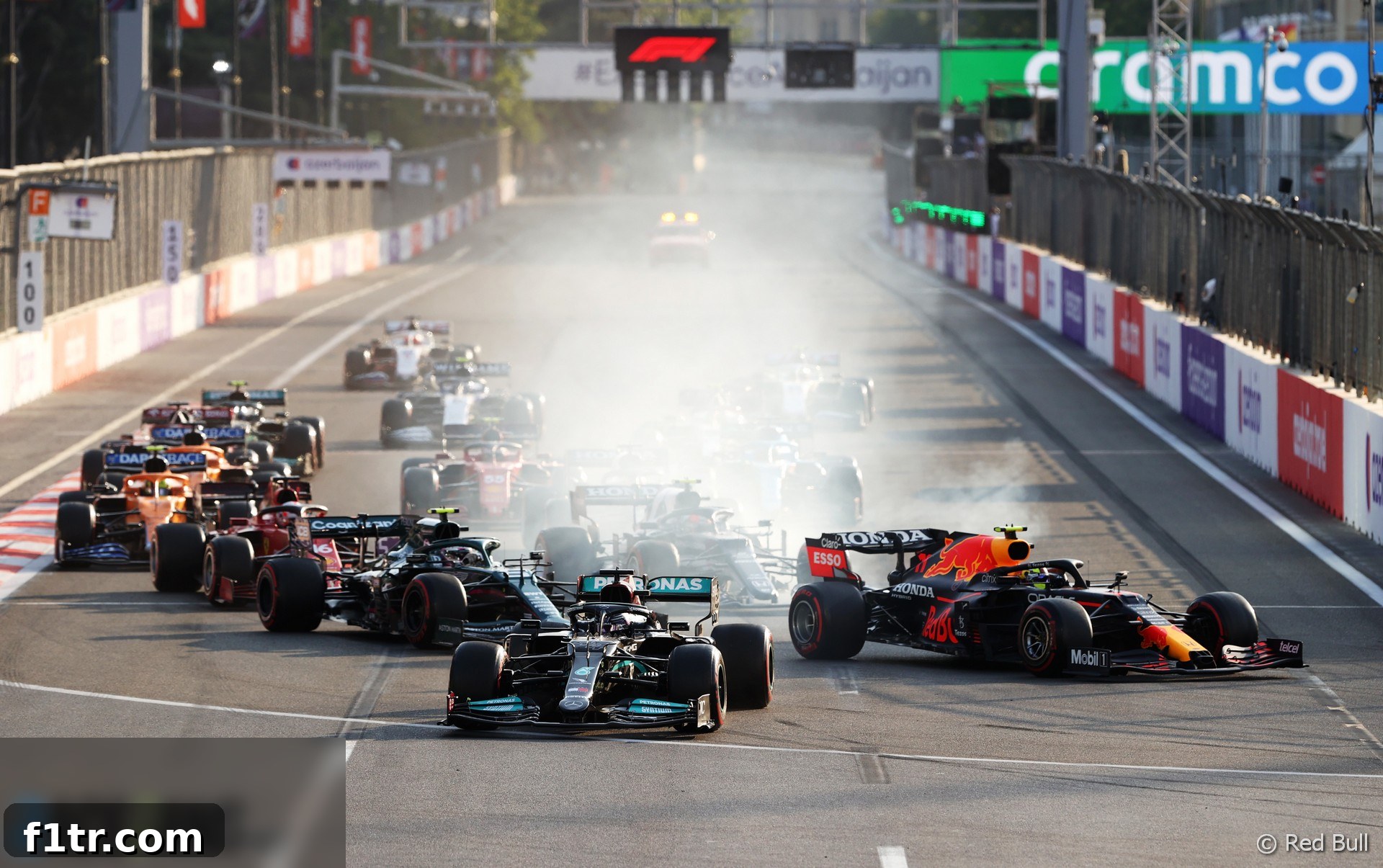
The 2021 Formula 1 Azerbaijan Grand Prix delivered a spectacle of high drama and unexpected twists, culminating in a critical moment that saw seven-time world champion Lewis Hamilton make a rare and costly error. While Hamilton, in typical fashion, accepted full responsibility for his misjudgment during the late-race restart in Baku, Mercedes’ technical director, Mike Elliott, swiftly stepped forward to acknowledge the team’s shared culpability. This incident sparked a vital discussion within the Mercedes-AMG Petronas F1 Team, leading to a commitment to implement systemic changes to prevent similar occurrences in future races.
The incident unfolded in the most nail-biting circumstances, with just two laps remaining and the race restarting after a red flag period. Hamilton, driving with his characteristic blend of aggression and precision, had made an electrifying start from the grid, immediately challenging Sergio Perez for the lead. As the two championship contenders jostled for position into Turn 1, a split-second, inadvertent action by Hamilton set off a chain of events that would ultimately derail his race. In a moment of intense concentration and high G-force maneuvering, Hamilton accidentally activated a brake-warming mode, a system Mercedes affectionately refers to as ‘brake magic’. This specific mode, designed for use primarily during Safety Car periods to keep the brake temperatures optimal, drastically reduced the effectiveness of his brakes at a crucial moment. The outcome was instantaneous and catastrophic: a severe lock-up, sending his Mercedes W12 careening off the track, costing him the lead, and ultimately, a potential victory and crucial championship points.
Reflecting on the specifics of the incident, Mike Elliott provided valuable insight into the sequence of events. He confirmed that Hamilton had diligently followed all pre-restart protocols. “Lewis had done all the right things,” Elliott stated. “He got the car to the grid, he switched off the various buttons and settings he needed to switch off, switched on the ones he needed to switch on, it was all set to start the race properly.” The meticulous preparation, a hallmark of both Hamilton and Mercedes, made the subsequent error all the more astonishing. Elliott elaborated further, explaining the precise trigger: “He made a fantastic start, he got himself up alongside Perez and as he and Perez were sort of shuffling position Lewis swerved and in the process of swerving he just clipped the magic button and unfortunately he didn’t feel he had done it. So he had completely no awareness he was going to have a problem.” This detail underscores the razor-thin margins in Formula 1, where a fractional movement or an imperceptible touch can have profound consequences.
The ‘brake magic’ system itself is a testament to the cutting-edge technology prevalent in modern Formula 1. Its primary function is to allow drivers to strategically heat their front brakes during Safety Car deployments or other neutralised periods. By shifting the brake balance heavily towards the front, the system generates more heat, ensuring the brakes are within their optimal operating window when racing resumes. This is crucial for immediate braking performance and tyre management upon restart. However, as the Baku incident starkly demonstrated, activating this system during full-speed racing, particularly when braking hard into a corner, can lead to a complete loss of front braking capability, making the car incredibly unstable and almost impossible to stop effectively. It highlights the inherent complexity of contemporary F1 steering wheels, which are veritable cockpits of buttons, dials, and switches, each controlling a myriad of intricate car settings. Drivers must manage these controls with incredible dexterity and precision, often at speeds exceeding 300 km/h, leaving virtually no room for error.
Despite the technical nuances, Lewis Hamilton, true to his character as a leader and a competitor, immediately shouldered the blame for the mistake. Post-race, he openly admitted hitting the button by accident, expressing profound disappointment. “I know, speaking to Lewis, that Lewis sort of feels a chunk of blame for that,” Elliot conceded. Yet, Elliott was quick to contextualize Hamilton’s error within his remarkable career, emphasizing the rarity of such missteps. “But the reality is Lewis makes so few mistakes and that’s what really sets him apart from some of the other drivers.” This acknowledgment from his technical director is a testament to Hamilton’s consistent excellence and a tacit understanding that even the greatest athletes are susceptible to human error, especially under immense pressure and in an environment where milliseconds dictate outcomes. For a driver renowned for his precision and mental fortitude, this incident was a stark reminder of the unforgiving nature of top-tier motorsport.
Mercedes’ response to the incident was characteristic of a championship-winning team: not to dwell on blame, but to focus on solutions and continuous improvement. Mike Elliott articulated this philosophy clearly, stating, “It’s our duty to try and give him a car where it’s more difficult for him to make mistakes. We need to take our share of that, look at how we can improve that and that’s something we will put in place for the next race.” This proactive approach underscores Mercedes’ commitment to supporting their drivers and eliminating potential vulnerabilities within their sophisticated machinery. The team’s ‘no-blame culture’ in such high-stakes environments is crucial for fostering an atmosphere where errors are seen as learning opportunities rather than punitive events. It encourages open communication and a collective drive towards perfection, ensuring that every component, every system, and every protocol is meticulously reviewed and refined.
Looking ahead, the commitment to implement changes for the subsequent race indicates a swift and decisive internal review process. While the exact modifications were not publicly detailed, potential improvements could range from physical alterations to the steering wheel layout – perhaps relocating the ‘brake magic’ button, adding a protective guard, or changing its activation mechanism to require a more deliberate action. Software interlocks could also be introduced, potentially preventing the ‘brake magic’ mode from being activated outside of specific, pre-defined race conditions (e.g., only when the Safety Car is deployed and speed is below a certain threshold). Such changes would aim to minimize the risk of accidental activation without compromising the system’s intended benefits during Safety Car periods. This incident serves as a powerful reminder that even in a sport defined by technological prowess, the interface between human and machine remains paramount, and optimizing this interaction is a perpetual challenge for engineering teams.
The Baku incident, while costly, also provides a valuable case study in the broader context of Formula 1’s evolving technology. Modern F1 cars are marvels of engineering, integrating hundreds of complex systems managed through a driver’s steering wheel. These multi-function devices control everything from engine modes and differential settings to brake bias and energy recovery. While these advancements have pushed the boundaries of performance, they have simultaneously increased the cognitive load on drivers. There have been other historical instances where complex controls led to errors, from drivers accidentally hitting pit lane speed limiters to misactivating recovery systems. This ongoing tension between technological sophistication and driver usability is a constant area of focus for all F1 teams. The challenge lies in creating systems that are powerful and effective, yet intuitive and fail-safe, particularly in the white-heat of competition where every decision is made in a fraction of a second.
Furthermore, the ramifications of this error extended beyond just the immediate race result. The 2021 season was shaping up to be one of the most fiercely contested F1 championship battles in recent memory, with Lewis Hamilton and Max Verstappen locked in a thrilling head-to-head. Losing a potential 25 points in Baku due to this unforeseen incident had significant implications for the championship standings and the psychological momentum of both Hamilton and the Mercedes team. It added an extra layer of intensity and pressure to an already high-stakes season, underscoring how even a single, seemingly minor error can profoundly influence the course of an entire championship campaign. The team’s response to this setback, their ability to analyze, adapt, and move forward, became a critical test of their resilience and commitment to reclaiming their dominant form.
In conclusion, the 2021 Azerbaijan Grand Prix delivered a poignant lesson in the intricate interplay between human skill and advanced technology in Formula 1. Lewis Hamilton’s accidental activation of the ‘brake magic’ system in Baku was a rare misstep by a driver celebrated for his near-flawless execution. However, the subsequent response from the Mercedes-AMG Petronas F1 Team, spearheaded by Mike Elliott, highlighted their unwavering dedication to engineering excellence and a shared responsibility for their performance. By acknowledging their part in creating a system that, under extreme circumstances, could contribute to a driver error, Mercedes reinforced their reputation as a team committed to continuous improvement. Such incidents, while momentarily painful, often serve as catalysts for innovation, driving advancements that ultimately make the cars safer, more robust, and even more formidable on the world stage. The commitment to learn and evolve from every challenge remains a cornerstone of success in the relentless pursuit of Formula 1 glory.
2021 Azerbaijan Grand Prix Related Articles
- Aston Martin also confirms it followed Pirelli’s tyre restrictions before crash
- Pirelli confirm teams not to blame for Baku tyre failures following investigation
- “Tyres should not explode like that” says Villeneuve as Pirelli prepares to reveal findings
- Why Alonso is able to enjoy F1 more now than when he left
- Penalty for Safety Car error was just one of Latifi’s frustrations in Baku
Browse all 2021 Azerbaijan Grand Prix articles