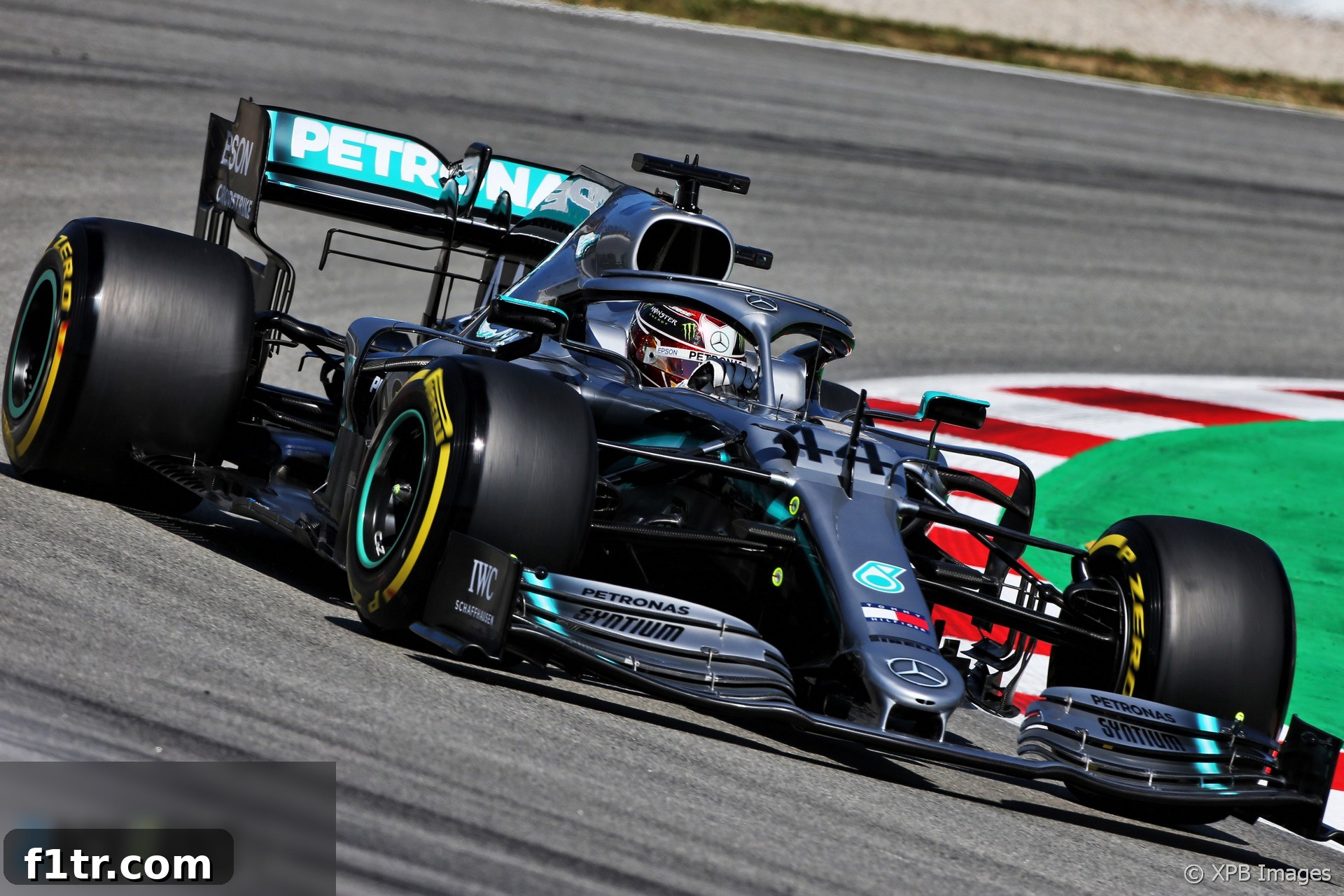
The Unforeseen Setback: Unpacking Lewis Hamilton’s Qualifying Deficit to Valtteri Bottas
The exhilarating world of Formula 1 qualifying often hinges on fractions of a second, where meticulous preparation, split-second decisions, and a touch of fortune coalesce to determine grid positions. In a particular session that captured significant attention, Lewis Hamilton, a titan of the sport, found himself significantly adrift from his Mercedes teammate, Valtteri Bottas. Hamilton qualified a substantial 0.634 seconds slower than Bottas, who went on to secure his third consecutive pole position of the season. This gap, unusual for the fiercely competitive seven-time world champion, wasn’t merely a reflection of a single misstep but rather a cascading series of unfortunate events and strategic dilemmas, as revealed by Mercedes team principal Toto Wolff.
Wolff offered crucial insights into the complexities of Hamilton’s session, pinpointing the critical moment in Q2 that initiated a chain reaction. “It was a bit of an unfortunate session for Lewis because we couldn’t charge the battery properly because he pitted in Q2,” Wolff explained to Sky Sports. This seemingly minor incident had far-reaching implications, severely compromising Hamilton’s initial run in the decisive Q3 session. The intricate dance of managing modern F1 power units and their energy recovery systems (ERS) means that every detail can dramatically alter performance.
The Critical Q2 Incident: Yellow Flags and Battery Dilemmas
The genesis of Hamilton’s qualifying woes can be traced back to the penultimate segment of qualifying, Q2. As Hamilton was on his final flying lap, pushing the limits to secure his place in Q3, yellow flags were deployed on the track. In Formula 1, yellow flags necessitate an immediate reduction in speed in the affected sector, a safety measure to protect drivers and marshals from hazards. Adhering to these regulations, Hamilton made the prudent decision to abort his lap. While this decision was crucial for safety and compliance, it inadvertently triggered a significant technical disadvantage.
Modern Formula 1 cars are equipped with sophisticated Energy Recovery Systems (ERS), which comprise two motor-generator units (MGU-K and MGU-H) and a high-capacity battery pack. A significant portion of the car’s power delivery, especially during qualifying laps, relies on the strategic deployment of electrical energy stored in this battery. Crucially, these batteries are primarily charged through the MGU-H (recovering energy from the turbocharger) and MGU-K (recovering kinetic energy from braking). When a driver completes a full, uninterrupted flying lap, the system is designed to charge the battery efficiently, ensuring optimal energy levels for subsequent runs. However, by aborting his Q2 lap, Hamilton was unable to complete this vital charging cycle on track. Furthermore, F1 regulations strictly prohibit teams from charging the ERS battery in the pit lane, leaving Hamilton in a precarious energy deficit as he prepared for Q3.
Q3: The High-Stakes Balancing Act and Compromised Performance
Entering Q3, the final and most critical phase of qualifying, Hamilton faced a unique and challenging predicament. With his ERS battery not fully charged from Q2, he desperately needed to replenish its energy levels. The most effective way to do this is by driving quickly on the out-lap, forcing the ERS to recover maximum energy. However, this necessity clashed directly with another vital aspect of qualifying performance: tyre management. The soft compound tyres, designed for ultimate grip over a single flying lap, are highly sensitive to temperature. Overheating them on the out-lap can significantly degrade their performance for the subsequent timed lap, leading to reduced grip and slower times.
Hamilton found himself caught in an unenviable strategic bind. To charge the battery, he needed to push the car hard on the out-lap. Yet, his race engineer was concurrently urging him to back off, specifically to prevent the delicate soft tyres from reaching critical temperatures. This conflicting set of demands meant that Hamilton could not fully commit to either objective without compromising the other. The consequence was a suboptimal out-lap where he couldn’t achieve a complete battery charge, nor could he ensure the tyres were in their absolute optimal operating window. As a direct result, his first flying lap in Q3 was considerably slower than Bottas’s, reflecting the cumulative impact of these technical and strategic compromises.
The Dynamic Track: Shifting Conditions and Further Challenges
As if the battery and tyre management issues weren’t enough, Hamilton’s second attempt in Q3 was met with an entirely new challenge: rapidly deteriorating track conditions. Formula 1 circuits are dynamic environments, constantly evolving throughout a session. Factors such as track temperature, rubber laid down by cars, and the accumulation of dirt or debris can drastically alter grip levels and, consequently, lap times. As Wolff elaborated, the track conditions worsened considerably between the first and second Q3 runs.
“It could have either been track temperature or a lot of dirt,” Wolff commented, highlighting the unpredictable nature of the circuit. He specifically pointed out evidence of “massive gravel” in one of the corners, underscoring the severity of the track degradation. This phenomenon was not isolated to Hamilton alone; Wolff noted that “the last sector was really down for everybody.” For a driver already playing catch-up, such a sudden downturn in track performance proved to be another insurmountable hurdle. While Bottas had already banked an exceptional lap, Hamilton, needing to find significant time, was now attempting to do so on a less forgiving surface. This combination of an unoptimized car and an uncooperative track effectively sealed his fate for that qualifying session.
Valtteri Bottas’s Stellar Performance: A Deserved Pole
Amidst Hamilton’s challenges, Valtteri Bottas delivered a truly commanding performance, demonstrating exceptional pace and precision. Securing his third consecutive pole position of the season was a testament to his strong form and unwavering focus. Bottas’s session was comparatively free of the technical and strategic dilemmas that plagued Hamilton, allowing him to extract maximum performance from his Mercedes W10 (assuming this was the 2019 season). His ability to consistently hook up clean, fast laps underlined his talent and competitive edge, earning him a deserved pole position. His performance served as a stark contrast to the complexities faced by his teammate, highlighting the fine margins that separate success from struggle at the pinnacle of motorsport.
The Broader Implications: F1’s Technical Intricacy and Team Transparency
Toto Wolff’s candid explanation not only shed light on Hamilton’s specific qualifying issues but also underscored the incredible technical complexity inherent in modern Formula 1. The ERS system, tyre management, and dynamic track conditions are just a few of the myriad variables that drivers and teams must master in real-time. A single unforeseen event, such as a yellow flag, can trigger a domino effect that impacts performance several laps later. This incident served as a powerful reminder that even the most dominant teams and accomplished drivers are susceptible to the unpredictable nature of the sport and its highly advanced machinery.
Furthermore, Wolff’s transparency in discussing the team’s challenges reinforces the culture of open communication within Mercedes. By clearly articulating the reasons behind Hamilton’s performance deficit, the team avoids speculation and offers a technical, data-driven explanation for what might otherwise appear as a simple lack of pace. This level of detail provides fans with a deeper understanding of the sport’s intricacies and the relentless pursuit of perfection that defines Formula 1 racing.
Looking Ahead: The Race Day Challenge
While qualifying establishes the starting grid, it is merely the prologue to the main event: the race itself. Starting behind his teammate and with rivals eager to capitalize on any perceived weakness, Hamilton’s task for race day would be challenging. However, his legendary racecraft and the inherent pace of the Mercedes car meant that a strong comeback was always a possibility. The qualifying session served as a crucial lesson in the delicate balance required in F1, where the smallest procedural misstep or a sudden change in conditions can have significant ramifications for the sport’s biggest names. It highlighted that even for a driver of Hamilton’s caliber, success is not a given but the result of perfectly executed strategies, flawless driving, and a touch of good fortune, often tested under immense pressure.
The intricate details of Lewis Hamilton’s compromised qualifying session offer a fascinating glimpse into the high-stakes world of Formula 1, where technology, strategy, and sheer driving talent converge. It’s a powerful testament to the fact that even for the very best, the path to pole position is fraught with challenges and unpredictable variables, making every qualifying battle a unique drama.
2019 F1 season
- Crying in the Melbourne car park at 2019 grand prix was my career low – Ocon
- McLaren Racing reports reduced £71 million loss in 2019
- Kvyat: Hockenheim podium last year was “my biggest achievement” so far
- How the FIA’s new encrypted fuel flow meter targets Ferrari’s suspected ‘aliasing’ trick
- “He smashed my office door”: 23 must-see moments from ‘Drive to Survive’ season two
Browse all 2019 F1 season articles