Azerbaijan Grand Prix: The Controversial Final Lap Driver Swap Attempt
Advert | Become a Supporter & go ad-free
The exhilarating world of Formula 1 is often defined by fractions of a second, audacious overtakes, and the relentless pursuit of victory. Yet, sometimes, the drama unfolds not in wheel-to-wheel combat, but within the intricate strategic decisions of a team, often leading to controversial moments that captivate fans and spark widespread debate. One such incident transpired during the gripping final lap of the Azerbaijan Grand Prix, where a team’s attempt to execute a driver swap between Lewis Hamilton and Charles Leclerc ultimately backfired in a spectacular fashion.
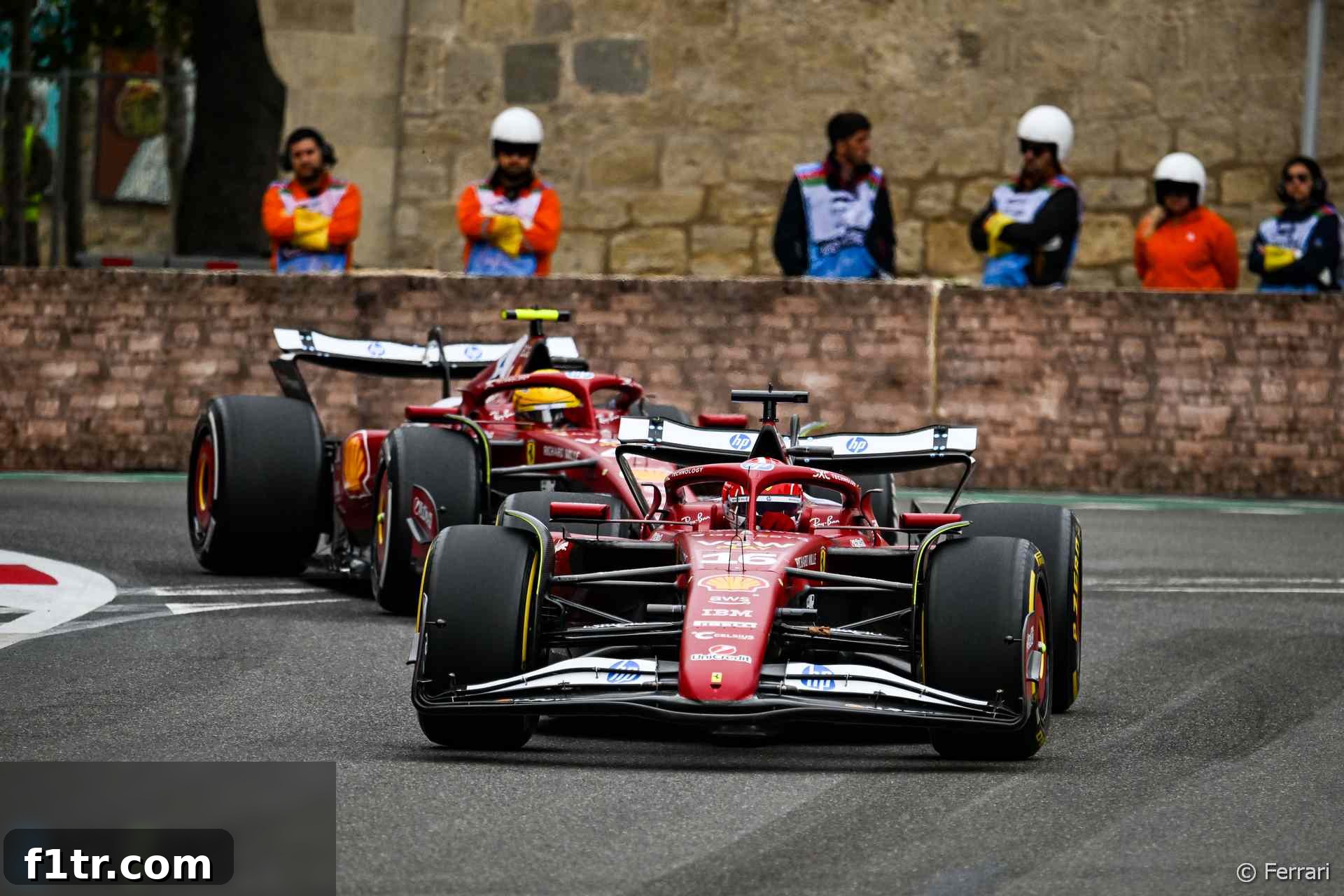
As the cars hurtled towards the chequered flag, the airwaves crackled with urgent instructions. Lewis Hamilton’s race engineer issued a direct command: allow his teammate to pass. Despite Hamilton’s immediate reaction to slow his car, the execution was imperfect, and he crossed the finish line fractionally ahead of the other car. This seemingly minor misstep on the final straight ignited a firestorm of discussion, highlighting the delicate balance between team strategy, driver compliance, and the unforgiving nature of top-tier motorsport.
The Strategic Rationale: An Early Race Swap and Tire Tactics
The seeds of this late-race drama were sown much earlier in the Grand Prix. The team had initially instructed Charles Leclerc to cede position to Lewis Hamilton. This decision stemmed from a strategic divergence within the team’s garage; Hamilton had pitted onto the medium tyre compound later in the race, a move designed to offer a potential performance advantage during the closing stages. The hope was that with Hamilton on fresher, potentially faster tyres, he would be able to carve his way through the field and overtake rivals ahead, thereby improving the team’s overall race position and points haul.
Leclerc’s race engineer, Bryan Bozzi, conveyed the order with precision: “So, Charles, we want to swap the cars in turn one and let Lewis try with the mediums.” Demonstrating impeccable team discipline, Leclerc promptly slowed down at Turn One, allowing Hamilton to pass without incident. This initial swap was a clear display of tactical foresight, aiming to optimize the team’s chances on a circuit known for its unpredictable nature and strategic complexity.
Baku’s Demanding Circuit and Strategy Challenges
The Baku City Circuit is renowned for its unique blend of ultra-fast straights and incredibly tight, technical sections, particularly around the historic old town. This configuration presents a formidable challenge for race engineers and strategists, as tyre degradation, fuel management, and the ever-present threat of safety cars can dramatically alter race outcomes. Overtaking opportunities, while present on the long main straight, require precise timing and a significant pace advantage. The team’s decision to split strategies and make an early swap reflected an aggressive approach to maximize their potential in these demanding conditions.
Hamilton’s Unfulfilled Promise: No Progress on Mediums
Despite the strategic sacrifice made by Leclerc, Hamilton’s stint on the medium tyres did not yield the desired results. As the laps dwindled, he found himself unable to make significant progress through the field. Whether due to traffic, a lack of outright pace compared to the cars ahead, or perhaps an unexpected level of degradation from his “fresher” tyres, Hamilton began the final lap still in eighth place, just ahead of his teammate. The initial gamble, which saw Leclerc drop a position, had not paid off in terms of gaining ground on their competitors.
The Crucial Final Lap: The Order to Swap Back
With Hamilton unable to capitalize on the strategic advantage, the team faced a dilemma. To restore the positions and potentially reward Leclerc for his earlier compliance, a counter-order was issued for the final lap. Bozzi communicated to Leclerc: “We will swap back at the end of the lap on the main straight if Lewis doesn’t overtake.” This instruction made it clear that if Hamilton had failed to gain positions, Leclerc’s original standing would be reinstated.
As the cars surged out of the final corner, Turn 16, for the last time, the urgency in Bozzi’s voice intensified, reiterating the instruction to Leclerc: “Lewis will let you by on the main straight.” Simultaneously, Lewis Hamilton’s race engineer, Ricardo Adami, conveyed the same message to his driver: “You can let Charles by, he’s one and a half behind you.” Adami also prudently cautioned Hamilton to be aware of Isack Hadjar, who was lurking just behind them in tenth place, highlighting the ongoing pressure from competitors even in a team-internal maneuver.
Advert | Become a RaceFans supporter andgo ad-free
The instructions were clear and repeated. “This is the last lap,” Adami emphasized to Hamilton. “Behind him is Hadjar, two seconds, Charles 1.5 behind. Let him by.” The stage was set for a straightforward position swap, a common if often unpopular, tactic in Formula 1 aimed at maximizing the team’s championship points or rewarding a driver for earlier compliance.
The Misjudgment at the Line: A Dramatic Finish
As they hurtled down the start-finish straight, Hamilton attempted to comply with the team’s directive. He slowed his car, lifting off the throttle and applying the brakes, creating a gap for Leclerc to pass. However, in the high-speed, high-pressure environment of a Grand Prix finish, even a slight miscalculation can have significant consequences. Hamilton’s deceleration was not enough, and he still crossed the finishing line ahead of Leclerc, albeit by a mere 0.464 seconds.
Hamilton’s Perspective: “I Just Misjudged It”
Speaking to Viaplay after the race, a visibly reflective Hamilton offered his explanation for the failed swap. “Ultimately I just misjudged it,” he admitted. “He told me right at the end and I did lift and brake but he missed it by four tenths, so it was just mis-judged.” His words suggested an honest error in judgment rather than deliberate non-compliance. The timing of the instruction, combined with the blistering pace of an F1 car and the razor-thin margins involved, made the precise execution of such a maneuver incredibly challenging.
The Impact on Team Dynamics and Trust
Such incidents, while occasionally chalked up to human error, can have subtle but lasting impacts on team dynamics. The trust between drivers, and between drivers and their engineers, is paramount. When a team order, particularly one designed to restore positions, is not perfectly executed, it can lead to frustration and questions, even if unintentional. For Leclerc, who had dutifully let Hamilton by earlier, the failure to reclaim his position might have been a bitter pill, despite the explanation.
The Broader Implications for F1 and Team Orders
The Azerbaijan Grand Prix incident reignited the perennial debate surrounding team orders in Formula 1. While officially allowed since 2011 (after a ban following the controversial “multi-21” incident), they remain a contentious aspect of the sport. Fans often decry them as undermining the purity of racing, preferring to see drivers compete head-to-head without interference. However, from a team’s perspective, they are a vital strategic tool, especially in championship battles, to maximize points and manage risks.
This event in Baku serves as a stark reminder of the complexities inherent in team orders:
- Communication Clarity: The need for unambiguous instructions, especially at high speed.
- Driver Compliance vs. Racing Instinct: The inherent challenge for racing drivers to consciously slow down or yield.
- Execution under Pressure: The difficulty of precise maneuvers on the limit.
- Perception vs. Reality: How such incidents are perceived by fans versus the internal logic of the team.
Conclusion: A Moment of Unintended Drama in Baku
The Azerbaijan Grand Prix has a reputation for delivering unpredictable races and dramatic finishes, and this controversial driver swap attempt certainly added another chapter to its lore. While the incident may have concluded with an unintended outcome, it underscored the intricate dance between strategy, communication, and human fallibility that defines Formula 1. It was a moment of high-stakes drama, illustrating that even with the best intentions and clear instructions, the execution of complex team orders on the final lap of a Grand Prix is far from guaranteed, leaving fans and pundits to dissect the “what ifs” and “why nots” for races to come.
Miss nothing from RaceFans
Get a daily email with all our latest stories – and nothing else. No marketing, no ads. Sign up here:
Related Articles: Exploring the Azerbaijan Grand Prix
- The Evolution of F1 Team Strategies in Baku
- Key Overtaking Zones and Defensive Masterclasses at Baku
- Iconic Moments and Incidents from the Azerbaijan Grand Prix History
- Driver Perspectives: Mastering the Demands of the Baku City Circuit
- Analyzing Tire Management and Pit Stop Strategies in Baku
Browse all Azerbaijan Grand Prix incidents and analyses