Lewis Hamilton’s Challenging United States Grand Prix Weekend: A Deep Dive into Austin’s Disappointment
The recent United States Grand Prix in Austin, Texas, delivered an unexpectedly dire and profoundly challenging weekend for seven-time Formula 1 World Champion Lewis Hamilton. What began with the usual high aspirations for a strong performance quickly unraveled into a series of frustrations, culminating in a highly uncharacteristic on-track spin during the Grand Prix itself. This comprehensive review delves into the various facets of Hamilton’s struggles throughout the event, examining the specifics of the incident, the underlying car performance issues faced by Mercedes-AMG Petronas, and the broader implications for his final races with the team before his high-profile move to Ferrari.
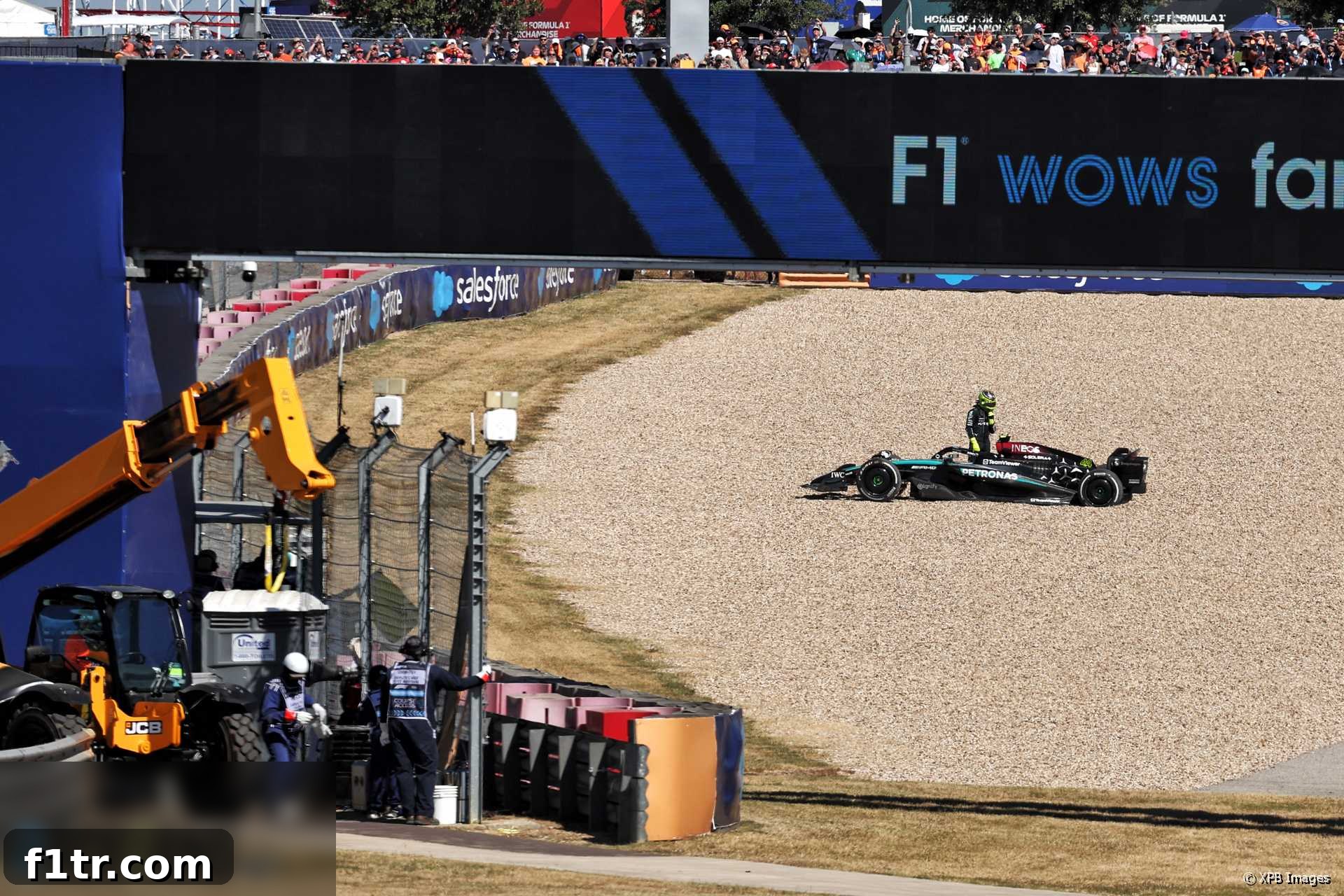
For a driver of Lewis Hamilton’s unparalleled caliber, consistency, precision, and the avoidance of significant errors are hallmarks of his legendary career. Yet, the Circuit of the Americas (COTA) presented an unprecedented challenge, marked by a dramatic spin into the gravel trap on the second lap of the main race. This incident, shocking in its rarity and impact, not only derailed his Grand Prix but also encapsulated a weekend that Hamilton himself would undoubtedly prefer to erase from memory.
The Uncharacteristic Spin: A Champion’s Rare Misstep at COTA
The Grand Prix itself started with a fleeting glimmer of hope amidst the pre-race gloom. Having qualified in a dismal 17th position, Lewis Hamilton, utilizing the durable hard tyre compound, displayed his characteristic race craft by making impressive gains on the opening lap. He skillfully maneuvered through the field, climbing several places to reach 12th position, suggesting a potential recovery drive was in the making. However, this promising start was tragically short-lived. As he navigated the challenging Turn 19, a high-speed, sweeping left-hander that leads onto the circuit’s main straight, his Mercedes W15 unexpectedly snapped away from him, sending him pirouetting into the run-off area and ultimately into the gravel.
Recounting the disorienting moment to the official F1 channel, Hamilton expressed his profound bewilderment and frustration: “I had a great start, obviously shot up the inside and got up to 12th. And at that point, it was only the second lap, so I’m not flat out and not pushing particularly, just trying to manage the tyres and the car started bouncing on the way in and then it just lost all out of the rear and it just went around on me.” The sheer surprise in his voice underscored the unexpected nature of the incident, particularly given his immense experience.
The veteran driver further emphasized the almost unprecedented rarity of such an event in his illustrious career. “I’ve never spun in the race before, not that I remember at least, and if I have it can only be once, maybe, before in all these years,” he added, highlighting the anomaly. “So definitely frustrating but I do know that it’s not that I wasn’t focussed or anything, it was just unfortunate.” Mercedes’ subsequent press release offered a more technical, and perhaps mitigating, explanation for the loss of control, quoting Hamilton attributing the incident to external environmental factors: “We measured a large gust of wind, up to 40 kph, as I turned in which likely didn’t help.” This detail points to the incredibly delicate balance and aerodynamic sensitivity of modern Formula 1 cars, where even a sudden, strong gust of wind can have profound and destabilizing effects on their stability and grip.
The Anatomy of Turn 19 at the Circuit of the Americas
Turn 19 at COTA is notorious for being a high-commitment corner, demanding absolute precision and confidence from the drivers. Competitors approach it at incredible speeds, often carrying significant momentum through the preceding Turns 16, 17, and 18, which form part of the complex stadium section. The unique undulations and elevation changes characteristic of the Austin circuit, combined with its wide, open nature, can make this particular section highly susceptible to crosswinds. For a driver of Hamilton’s experience and skill to lose the rear of the car under these conditions, especially while attempting to manage tyre temperatures and wear early in the race, vividly underscores the fine margins at play in elite motorsport. While a 40 kph gust of wind might seem like a relatively minor factor to an outside observer, for an F1 car pushing the very limits of physics and aerodynamic performance, it can be the critical difference between maintaining tenacious grip and experiencing a catastrophic loss of traction, particularly when the car is already operating on the edge due due to inherent handling characteristics or suboptimal setup.
A Weekend Plagued by Frustration: Beyond the Race Spin
The dramatic race spin, while visually shocking and highly uncharacteristic, was merely the unfortunate climax of what had been a profoundly frustrating and largely unrewarding weekend for Lewis Hamilton and the entire Mercedes-AMG Petronas F1 Team. From the very outset of the Austin Grand Prix, the event seemed determined to test their collective resolve, presenting a series of setbacks that continually compounded the team’s ongoing struggles to unlock consistent, top-tier performance from their W15 challenger.
Qualifying Heartbreak: A Shocking Q1 Exit
Perhaps the most significant and unexpected blow to Hamilton’s weekend aspirations came during the qualifying session for the main Grand Prix. In a truly stunning turn of events that sent shockwaves through the Formula 1 paddock, Hamilton failed to make it out of the Q1 segment of qualifying. For a driver who holds the record for the most pole positions in Formula 1 history, a Q1 elimination is not just rare; it is almost unthinkable. This unexpected failure immediately consigned him to a back-of-the-grid start in 17th position, effectively crippling his chances of achieving a strong finish even before the race itself began. Immediate speculation naturally turned to the car’s setup choices, the challenging and ever-evolving track conditions, and whether Mercedes had truly understood the optimal operating window for their overall package. This Q1 exit served as a stark, undeniable reminder of the team’s difficulties in consistently finding outright pace, particularly on Fridays and Saturdays, which are absolutely crucial for laying the foundation for any race day success.
Sprint Weekend Challenges: Yellow Flags and Car Issues Add to the Woes
The modern sprint race format, designed specifically to add an extra layer of excitement and unpredictability to the F1 weekend, only served to amplify Hamilton’s woes in Austin. During the Sprint Shootout, the dedicated qualifying session that determines the grid for the sprint race, Hamilton initially looked competitive, showing encouraging signs of the underlying pace he and the team genuinely believed they possessed. However, his efforts to secure a higher grid position were unfortunately thwarted when he encountered yellow flags while approaching the demanding Turn 12 section of the circuit. This unavoidable incident forced him to back off significantly, compromising his qualifying lap and ultimately preventing him from securing a more advantageous starting position for the sprint race, leaving him to begin from seventh on the grid.
The sprint race itself, a shorter and more intense burst of racing, brought very little solace or redemption for Hamilton. Despite starting seventh, he reported an inexplicable issue with his car relatively early on in the race, suggesting an underlying problem that severely hampered his overall performance and ability to push. Consequently, he was only able to gain a single position throughout the entire duration of the sprint, finishing the race in a modest sixth place. This noticeable lack of progress in the shorter, high-intensity format further highlighted the persistent difficulties in consistently maximizing the W15’s performance across varied track conditions and under intense pressure, underscoring the team’s ongoing and often elusive search for a consistent sweet spot in its setup and operational strategy.
The Broader Context: Mercedes’ Struggles and the Ferrari Move
Lewis Hamilton’s undeniably difficult Austin weekend cannot, and indeed should not, be viewed in isolation. It is intricately linked to the broader, overarching narrative of Mercedes’ performance struggles over the past few seasons, particularly under the current generation of ground effect regulations, and the seismic announcement of his impending transfer to Ferrari. These two significant factors collectively cast a long and often speculative shadow over his current season, raising pertinent questions about his immediate focus and the team’s development trajectory in the short to medium term.
The Persistent Performance Puzzle of the Mercedes W15
The Mercedes-AMG Petronas F1 Team has been remarkably open and transparent in acknowledging the profound challenges they have faced in developing a consistently competitive car under the stringent new ground effect regulations introduced in recent years. The W15, while occasionally showing tantalizing flashes of genuine potential and pace, has often been described by both drivers as an unpredictable, temperamental, and inherently difficult car to drive, especially when pushed to its absolute limits. Recurring issues with ride height stability, the dreaded phenomenon of ‘porpoising’, and an inconsistent aerodynamic platform have plagued their efforts, making it incredibly difficult to extract maximum, repeatable performance across diverse tracks and varying conditions. Hamilton’s spin, which he partly attributed to the car “bouncing” and then suddenly losing the rear, is a classic symptom of these underlying, deeply rooted handling characteristics. The team’s inability to provide a stable, predictable, and confidence-inspiring platform consistently forces their incredibly talented drivers to operate at the very edge of control, thereby significantly increasing the risk of errors, even for champions of Hamilton’s unparalleled experience and skill.
The Ferrari Factor: A Champion’s Mindset in Transition
With just five rounds remaining in his contract at Mercedes before he embarks on an entirely new and groundbreaking chapter with Ferrari, the psychological and emotional aspect of Lewis Hamilton’s current situation cannot be understated. While a professional of his exceptional stature and unwavering commitment would undoubtedly remain dedicated to his current team until the very end, the highly publicized and impending move introduces a unique and complex dynamic. Is there a subconscious shift in focus, however subtle, towards his future? Is he perhaps experimenting more aggressively with car setups, knowing that these are his final, precious opportunities to explore the limits of the Mercedes machinery? Or, conversely, are the team’s valuable resources and long-term development efforts naturally beginning to subtly pivot towards their own future, potentially impacting the present performance and attention given to the outgoing star driver?
The announcement of his move to Ferrari sent genuine shockwaves throughout the entire Formula 1 world, and while it undeniably promises an incredibly exciting future chapter in his career, it inevitably adds a complex and intricate layer to his current, final season with Mercedes. Champions like Hamilton thrive on the relentless pursuit of victory and consistent performance, and a weekend as profoundly challenging and unrewarding as the United States Grand Prix can be particularly demoralizing when nearing the emotional and professional culmination of a long, incredibly successful, and deeply storied relationship with a team.
Contrasting Fortunes: George Russell’s Resilient Recovery
Adding another intriguing layer to the complex narrative of the Austin Grand Prix was the remarkably contrasting performance of Hamilton’s teammate, George Russell. Russell also experienced his own significant setback during the weekend, crashing in the qualifying session at precisely the same challenging Turn 19 where Lewis Hamilton’s race would later dramatically unravel. This shared vulnerability at such a critical and demanding corner highlights the inherent difficulties of the Mercedes W15 car and the demanding, unforgiving nature of the COTA circuit itself.
However, Russell’s weekend subsequently took a notably different and ultimately more successful trajectory. Following his qualifying incident, the Mercedes team made the bold and strategic decision to implement significant changes to his car’s setup, a move that necessitated a pit lane start for the Grand Prix. This calculated gamble ultimately paid off handsomely. Displaying impressive pace, unwavering consistency, and mature race craft throughout the Grand Prix, Russell masterfully navigated his way through the field, executing a superb recovery drive to finish in a highly respectable sixth position. His remarkable ability to salvage a strong result from such a difficult starting point vividly underscores both his individual driving prowess and the team’s capacity for strategic recovery, albeit after undertaking a significant car reset and starting from the very back.
The direct comparison between the two Mercedes drivers’ weekends provides a nuanced and insightful view. While both encountered significant issues at the same critical corner, Russell’s subsequent recovery drive clearly demonstrates that genuine potential was still present within the W15 package, even if extracting it required a radical and aggressive setup change. This distinction further raises pertinent questions about Lewis Hamilton’s specific setup choices for the weekend, or perhaps suggests a touch more ill-fortune on his side of the garage, ultimately leading to a more disappointing outcome.
Circuit of the Americas: A Demanding Test of Skill and Car Performance
The Circuit of the Americas (COTA) has swiftly established itself as a modern classic on the Formula 1 calendar, universally renowned for its challenging and captivating layout that masterfully blends high-speed sections with highly technical corners and significant, dramatic elevation changes. The iconic uphill run to the blind apex of Turn 1, immediately followed by a thrilling series of fast, flowing esses (Turns 2-10), unequivocally demands a Formula 1 car that is supremely agile, aerodynamically stable, and exceptionally well-balanced across its various axes.
The lengthy back straight offers prime overtaking opportunities, but this is quickly followed by the subsequent tight hairpin of Turn 11 and the complex, slower-speed stadium section (Turns 12-18), which collectively require immense precision, strong traction out of corners, and careful management of tyre temperatures. As previously discussed in detail, Turn 19, which proved to be the pivotal scene of both Mercedes drivers’ incidents, is a critical high-speed corner that feeds directly onto the main straight. Its open and exposed nature makes it particularly vulnerable to sudden, powerful gusts of wind, which, as Lewis Hamilton’s incident showed, can dramatically disrupt the delicate aerodynamic balance of an F1 car and induce unexpected instability. The track’s notoriously abrasive surface also contributes significantly to tyre degradation, adding yet another complex layer of strategic management and planning to the Grand Prix. COTA, therefore, demands a harmonious and finely tuned relationship between the driver, the car, and the ever-present external environmental conditions, making it a true and comprehensive test of a team’s deep understanding of its technical package and a driver’s exceptional ability to adapt under pressure.
Conclusion: Lessons Learned and the Road Ahead for Hamilton and Mercedes
Lewis Hamilton’s United States Grand Prix weekend was, by any objective measure, an incredibly challenging and ultimately frustrating experience for a driver so profoundly accustomed to consistently fighting at the very front of the grid. The highly rare on-track spin, the surprising and unprecedented Q1 exit, and the general struggles to consistently extract optimal performance from the Mercedes W15 throughout the event collectively paint a clear picture of a team and driver navigating a complex and particularly demanding period in their storied partnership.
While the measured gust of wind offers a plausible and indeed validated explanation for the race incident, it does not, by itself, fully account for the overall lack of pace, the persistent setup difficulties, and the inconsistent performance observed throughout the entire weekend. It serves as a stark and humbling reminder that even the greatest drivers in the history of the sport are susceptible to the inherent unpredictability and unforgiving nature of Formula 1, particularly when these factors are compounded by a car that demands constant wrestling, compromise, and a delicate touch. As Lewis Hamilton rapidly approaches the twilight of his illustrious Mercedes career and meticulously prepares for a groundbreaking and highly anticipated move to Ferrari, these remaining races are not just about collecting points or individual results. They are fundamentally about learning, adapting, pushing boundaries, and finding a way to extract every last ounce of performance and insight from the current machinery. The valuable lessons learned and the profound frustrations experienced in Austin will undoubtedly feed into the team’s meticulous analysis for the remaining rounds of the season, as both Hamilton and Mercedes strive with unwavering determination to end their incredibly successful and transformative partnership on a stronger, more characteristic, and ultimately more positive note. The road ahead for both parties promises to be watched with intense interest and keen anticipation as the Formula 1 season progresses towards its dramatic conclusion.