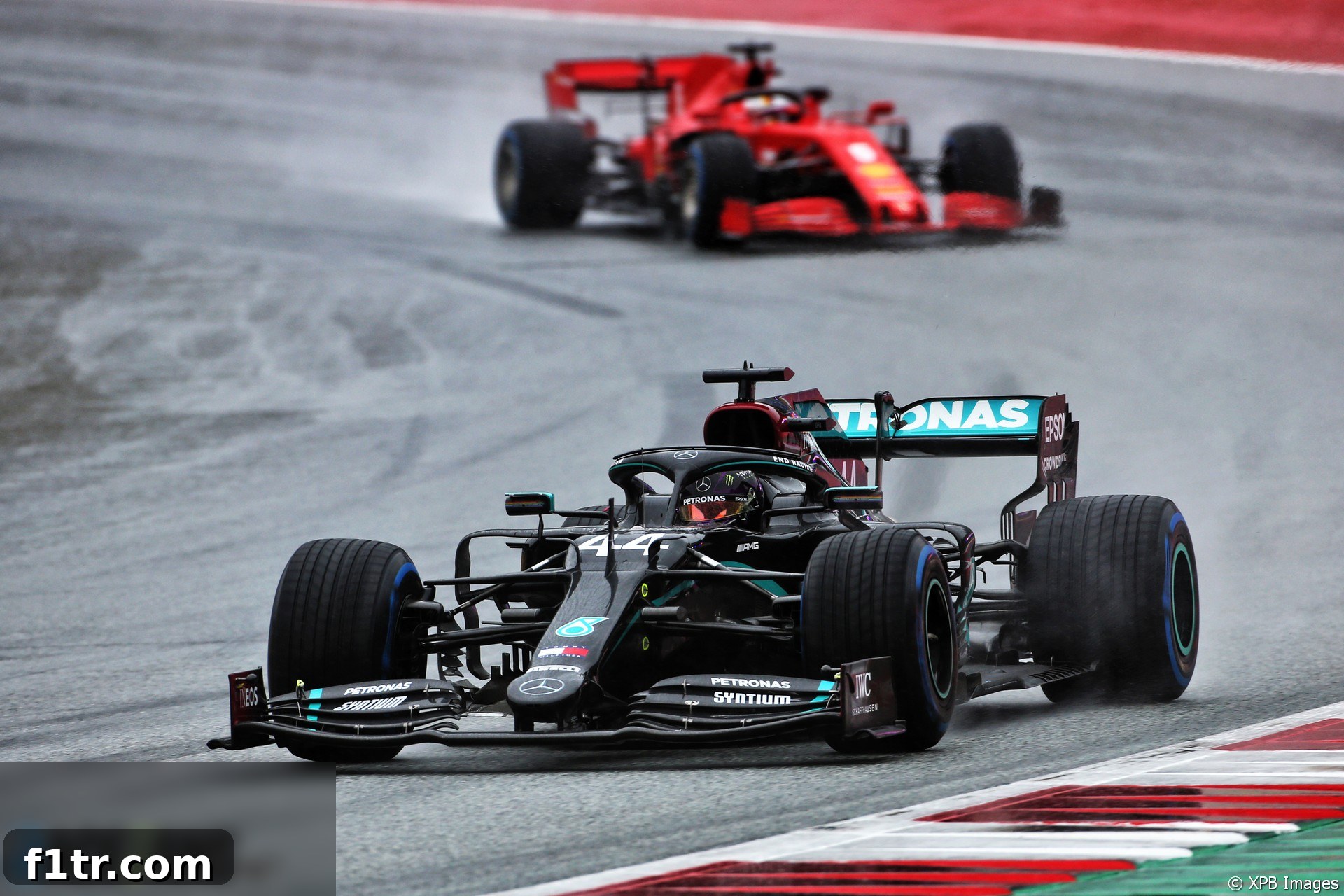
The stage was set for an unforgettable qualifying session at the Red Bull Ring, but Mother Nature had other plans. A deluge of rain transformed the Austrian circuit into a challenging aquatic arena, testing the mettle of every Formula 1 driver. Amidst the spray and treacherous conditions, Lewis Hamilton delivered a performance nothing short of extraordinary, securing pole position with a staggering 1.2-second advantage over his closest rival, Max Verstappen. It was a demonstration of raw talent and precision driving that left the paddock in awe, highlighting why Hamilton stands as one of the sport’s all-time greats.
The dramatic session also saw Carlos Sainz Jnr impress, piloting his McLaren to a commendable third place, ensuring three different constructors were represented in the top three. The young Spaniard’s stellar effort meant he would share the second row of the grid with Valtteri Bottas, the previous week’s race winner, who experienced a more challenging session than his teammate. This qualifying session was not merely about raw pace; it was a brutal test of adaptability, courage, and the ability to find grip where seemingly none existed.
A Rain-Soaked Red Bull Ring: Qualifying Drama Unfolds
Anticipation hung heavy in the air over the Red Bull Ring on Saturday. A persistent, heavy downpour had already led to the cancellation of the final practice session, underscoring the severity of the weather. As the clock ticked closer to the scheduled qualifying start time, there was a fleeting moment of hope as the rain seemed to relent. However, this was merely a tease, as the heavens soon reopened with renewed intensity, making the track conditions entirely unsuitable for racing. The inevitable decision to postpone qualifying was made, much to the frustration of teams and fans alike, but safety remained paramount.
After a tension-filled 46-minute delay, the pit lane finally buzzed to life. The track was thoroughly soaked, but deemed just about passable, requiring all competitors to equip full wet weather tyres. Drivers queued eagerly at the pit lane exit, some waiting for over two minutes, jostling for position and desperate to be among the first out. The strategy was clear: hit the track early, assess the conditions, and try to capitalize on any momentary improvements before the rain potentially worsened. Leading the charge was Sebastian Vettel, reflecting the collective anxiety to get this crucial session underway.
Q1: The Opening Salvo in the Wet
Despite the treacherous conditions, the majority of Q1 unfolded without significant interruption, a testament to the skill of the drivers. Lap times steadily improved as the session progressed, with drivers finding rhythm and confidence in the deluge. Crucially, a largely flawless display of driving by the entire field meant cars were kept out of the unforgiving barriers, which loomed large on the sodden circuit. Every lap was a delicate dance between pushing the limits and avoiding costly mistakes, a fine balance that only the best can maintain.
However, not everyone escaped unscathed. Romain Grosjean, ironically the last driver to venture out onto the track, was also the first to encounter trouble. On his out-lap, his Haas dramatically skidded into the gravel trap at turn four. Although he managed to rejoin the track, his session was effectively over as he limped back to the pits, stopping with a suspected water pump problem. His early exit meant he took no further part in qualifying, a frustrating end to what promised to be a challenging but potentially rewarding day.
As Q1 wore on, tyre strategy became a key talking point. Most drivers opted for a second, fresh set of full wet weather tyres to benefit from the superior grip offered by unworn tread. The difference in grip could be substantial, shaving vital tenths off lap times. However, a select group of seven drivers resisted this temptation, believing their existing tyres were sufficient or that saving a fresh set for later rounds was more prudent. This group notably included both Mercedes and both McLaren drivers, confident in their car’s setup and their own ability to manage tyre wear. The Red Bull pair also stuck with their initial set, though Alexander Albon found himself perilously close to elimination in 14th place, highlighting the fine margins involved. Daniel Ricciardo followed suit, while both Ferrari drivers managed to scrape through to Q2, albeit without significant margin.
One of the standout performances of Q1 came from George Russell. The young Brit masterfully exploited the adverse conditions, showcasing his exceptional car control to secure Williams’ first appearance in Q2 for over a year. It was a remarkable achievement for the struggling team, bringing a much-needed morale boost. The session, however, met an abrupt and dramatic end when Antonio Giovinazzi crashed his Alfa Romeo at the conclusion of his lap. Despite being instructed to rejoin the track, he inadvertently dragged significant debris onto the racing line, leading to a red flag and the immediate cessation of the session. His car eventually came to a halt, compounding the team’s woes.
Giovinazzi’s incident effectively sealed the fate of several drivers. Kimi Raikkonen joined his Alfa Romeo teammate in elimination, having struggled to find pace in the demanding conditions. Nicholas Latifi, in the other Williams, was over a second off his impressive teammate Russell’s pace, resulting in his exit. Sergio Perez, driving for Racing Point, also found himself on the sidelines alongside the unfortunate Grosjean. Q1 proved to be a brutal opening act, claiming some unexpected scalps and setting the tone for a dramatic qualifying session.
Drivers eliminated in Q1
| 16 | Kimi Raikkonen | Alfa Romeo-Ferrari | 1’21.372 |
| 17 | Sergio Perez | Racing Point-Mercedes | 1’21.607 |
| 18 | Nicholas Latifi | Williams-Mercedes | 1’21.759 |
| 19 | Antonio Giovinazzi | Alfa Romeo-Ferrari | 1’21.831 |
| 20 | Romain Grosjean | Haas-Ferrari |
Q2: The Battle Intensifies
As Q2 commenced, the rain continued to fall, though perhaps with slightly less intensity than the peak of Q1. The battle at the front quickly solidified into a captivating duel between Hamilton and Verstappen. The two titans traded fastest times throughout the session, pushing each other to the absolute limit, with a mere tenth of a second separating them at the chequered flag. Their pace was in a league of its own, half a second clear of the chasing pack, underscoring their dominance even in the most challenging environments. It was a preview of the high-stakes showdown that awaited in Q3.
Leading the rest of the field was Lando Norris, the McLaren driver putting in another impressive performance. His strong showing was particularly notable given he had received therapy for discomfort experienced the previous day, showcasing his resilience and talent. Norris’s ability to extract performance from his car under pressure solidified McLaren’s strong weekend trajectory. A week prior, only one Ferrari driver had made the cut for Q3, a statistic that unfortunately repeated itself. This time, it was Charles Leclerc who failed to progress beyond Q2, a significant blow for the Scuderia and a clear indication of their ongoing struggles with car performance in the wet.
Sebastian Vettel, Leclerc’s teammate, had his own nervy moment, encountering the kerbs at the exit of turn one in a rather messy fashion. However, the experienced German managed to gather his car and composed himself to claim the final spot in the top 10, progressing to Q3 by the slimmest of margins – a mere tenth of a second ahead of his teammate. It was a testament to his experience, but also highlighted Ferrari’s precarious position.
Following the two Ferraris, George Russell continued to impress, securing 12th place for Williams. His consistent performance in the challenging conditions was truly remarkable and generated considerable buzz in the paddock. Daniil Kvyat, who had an incident with Leclerc earlier in the session, also found himself eliminated alongside the Ferrari driver. The second Racing Point of Lance Stroll and Kevin Magnussen in the Haas were likewise unable to advance, concluding their qualifying efforts in Q2. The session reinforced the notion that wet weather qualifying often shuffles the established order, but the cream of the crop still finds a way to rise.
Drivers eliminated in Q2
| 11 | Charles Leclerc | Ferrari | 1’19.628 |
| 12 | George Russell | Williams-Mercedes | 1’19.636 |
| 13 | Lance Stroll | Racing Point-Mercedes | 1’19.645 |
| 14 | Daniil Kvyat | AlphaTauri-Honda | 1’19.717 |
| 15 | Kevin Magnussen | Haas-Ferrari | 1’20.211 |
Q3: Hamilton’s Masterclass
As the final 10 drivers emerged for the pole position shoot-out, the conditions had visibly worsened, intensifying the challenge. Water spray plumed high into the air, reducing visibility and making the already slick track even more treacherous. Max Verstappen initially set a strong pace, demonstrating his natural ability in the wet, and for a moment, it looked like the young Dutchman might have the upper hand. However, Lewis Hamilton was merely biding his time, ready to unleash the full potential of his Mercedes W11 in his final two runs.
Hamilton’s first critical run was a pure display of genius. He expertly navigated the slippery circuit, finding grip and confidence where others struggled, lifting his black W11 seven-tenths of a second clear of the entire field. The gap was significant, but Hamilton wasn’t done. With his final, breathtaking effort, he found another half a second, extending his lead to a colossal 1.2 seconds. It was a truly phenomenal performance, a masterclass in wet-weather driving that underlined his status as one of the greatest drivers in Formula 1 history. Every micro-correction, every throttle application was perfectly judged, creating a lap that will be remembered for years.
Meanwhile, Red Bull, sensing Hamilton’s growing dominance, urged Verstappen with a desperate message: “we’ll give you all the performance for this final lap.” Verstappen responded, beginning his decisive run with the fastest time through sector one, looking poised for a substantial improvement. But fate intervened. As he approached turn nine, a crucial corner, he encountered a pit-bound Sebastian Vettel at the apex, forcing him to take evasive action. The Red Bull snapped sideways in a terrifying moment, and although Verstappen’s awesome reflexes kept the car out of the wall, his chance to challenge Hamilton’s time was gone. It was a frustrating end to what had been a promising lap for the Dutchman, though he nonetheless secured a well-deserved second spot on the front row.
Pierre Gasly briefly elevated his AlphaTauri into an impressive third place, a testament to his growing confidence and the car’s performance in the wet. However, as the final runs concluded and the track continued to evolve, he slipped back down the order. Carlos Sainz Jnr capitalized on these late shifts, placing his McLaren in a superb third position. His exuberance was palpable, cheering “ole, ole, ole” over the team radio as the result was confirmed, a moment of pure joy for the Spaniard and his team. Esteban Ocon, who had endured a disappointing qualifying session just one week earlier, redeemed himself with an excellent fifth place for Renault, demonstrating strong progress. Valtteri Bottas, Hamilton’s teammate, finished fourth, separating Sainz and Ocon.
Having been a strong third in Q2, Lando Norris ended Q3 in a somewhat disappointed sixth. However, a grid penalty from the previous race meant he would drop three places, starting ninth. This penalty had a domino effect, promoting Alexander Albon, Pierre Gasly, and Daniel Ricciardo up the grid, adding another layer of intrigue to the race start. Sebastian Vettel ultimately qualified tenth, a result that reflected Ferrari’s challenging weekend in the difficult conditions. The grid was now set, promising a thrilling race with a mix of established stars and hungry dark horses all eager to make their mark.
Top ten in Q3
| 1 | Lewis Hamilton | Mercedes | 1’19.273 |
| 2 | Max Verstappen | Red Bull-Honda | 1’20.489 |
| 3 | Carlos Sainz Jnr | McLaren-Renault | 1’20.671 |
| 4 | Valtteri Bottas | Mercedes | 1’20.701 |
| 5 | Esteban Ocon | Renault | 1’20.922 |
| 6 | Lando Norris | McLaren-Renault | 1’20.925 |
| 7 | Alexander Albon | Red Bull-Honda | 1’21.011 |
| 8 | Pierre Gasly | AlphaTauri-Honda | 1’21.028 |
| 9 | Daniel Ricciardo | Renault | 1’21.192 |
| 10 | Sebastian Vettel | Ferrari | 1’21.651 |
Final Thoughts and Race Outlook
The 2020 Styrian Grand Prix qualifying delivered an unforgettable spectacle, dominated by Lewis Hamilton’s sheer brilliance in the rain-soaked conditions. His pole position, secured by an astounding margin, serves as a powerful reminder of his unparalleled skill and mastery in challenging environments. Max Verstappen, despite his late incident, demonstrated his formidable talent, ensuring he remains a significant threat from the front row. The impressive performances of Carlos Sainz Jnr and Esteban Ocon also hint at an exciting race ahead, where strategy, car reliability, and driver skill will be paramount.
As the teams prepare for Sunday’s race, with a slightly reshuffled grid due to penalties, the questions linger: Will Hamilton maintain his dominance in potentially drier conditions? Can Verstappen challenge for the win from second? And what role will the midfield drivers, particularly the McLarens and Renaults, play in upsetting the established order? This qualifying session has set the stage for a truly thrilling Grand Prix, leaving fans eager to see how the drama unfolds on race day.
Related Articles: 2020 Styrian Grand Prix
- Binotto expects 16-year-old Mugello lap record to fall at Tuscan Grand Prix
- Bottas edges Hamilton, Perez a tenth away in final practice
- Mercedes still “not 100% clear” what caused gearbox problems
- 2020 Styrian Grand Prix Star Performers
- F1’s trophy robots are ‘a bit over the top’ – Hamilton
Browse all 2020 Styrian Grand Prix articles