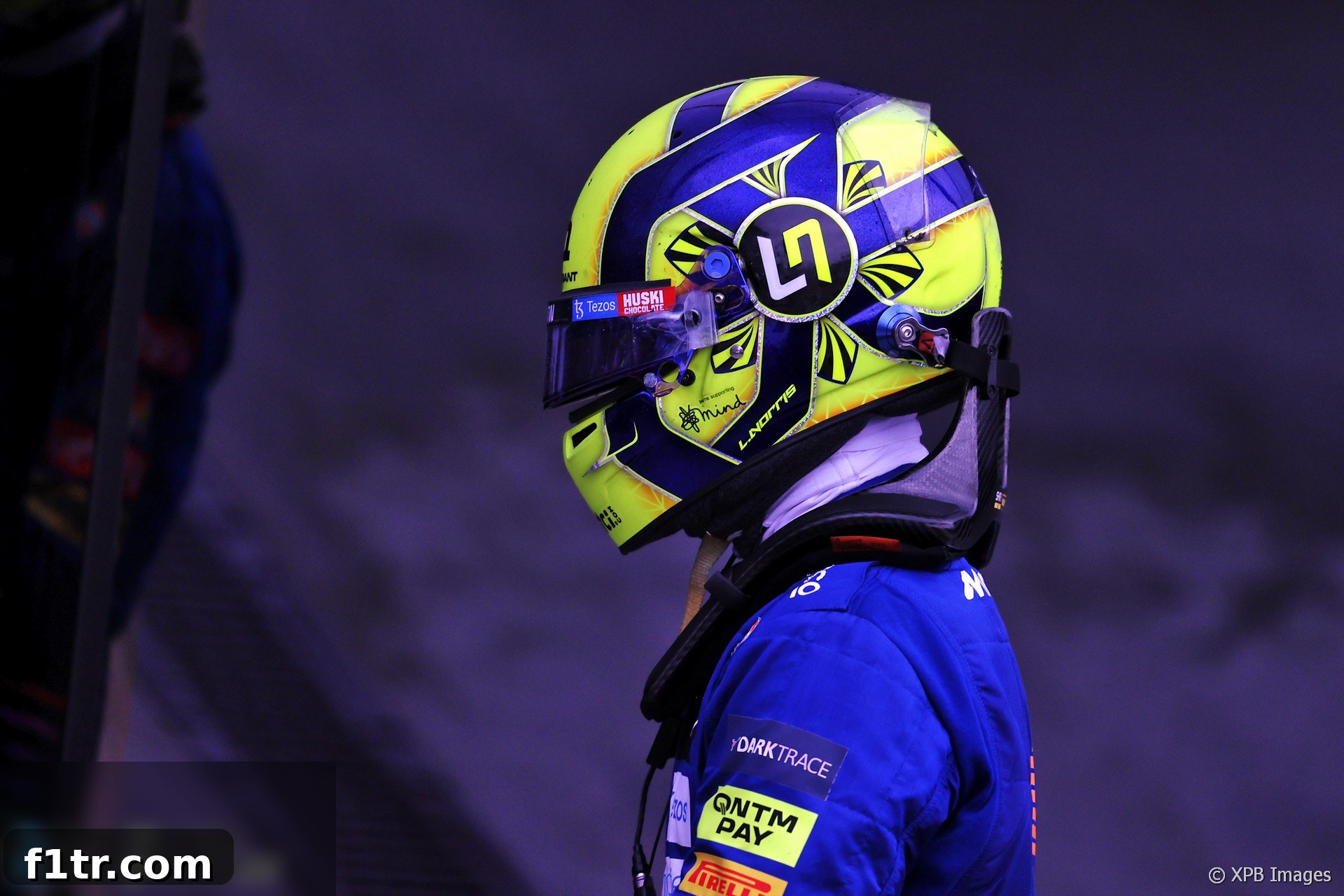
Lando Norris Defends Pivotal Russian Grand Prix Tire Call Amidst Heartbreak
The 2021 Formula 1 Russian Grand Prix delivered a heart-stopping finale, etching itself into the memories of fans and, most significantly, Lando Norris. What began as a dream weekend for the young McLaren star, marked by his maiden pole position and a dominant race lead, culminated in a strategic gamble that saw victory slip agonizingly through his fingers in the torrential final laps. As the rain intensified at the Sochi Autodrom, Norris controversially opted to remain on slick tires, a decision he steadfastly defended in the aftermath, despite conceding the win to a charging Lewis Hamilton who had pitted for intermediates.
Norris’s decision not to pit for intermediate tires as the heavens opened proved to be the defining moment of a captivating race. While chasing Norris, Hamilton made the decisive call to switch to the wet weather rubber, a move that secured him a landmark 100th Grand Prix victory. For Norris, who had expertly managed the race from pole position for much of its duration, the outcome was a cruel blow, underscoring the razor-thin margins and unforgiving nature of Formula 1 strategy.
A Maiden Pole Position and a Command Performance
Lando Norris arrived at the Sochi Autodrom with a burgeoning reputation, but few expected him to snatch pole position in such emphatic fashion. His Saturday qualifying performance was nothing short of brilliant, securing him the prime starting spot for Sunday’s race – a career first for the British driver. This achievement ignited hopes of a maiden F1 victory, a milestone eagerly anticipated by fans and the McLaren team alike. From the moment the lights went out, Norris demonstrated composure beyond his years, navigating the opening laps flawlessly and establishing a commanding lead. He expertly managed his tires, fended off early challenges, and maintained a controlled pace, appearing poised to convert his pole position into a historic win. The young driver’s performance was a testament to his talent and the significant progress McLaren had made that season, marking them as genuine contenders for race wins.
The Shifting Skies: A Strategic Conundrum Unfolds
As the race entered its critical final stages, the weather began to turn. A light drizzle quickly escalated into a more substantial downpour, transforming the racing surface into a treacherous skating rink. This sudden change presented an immediate and complex strategic dilemma for all teams, particularly for Norris and McLaren, who were leading. The choice was stark: stay out on the faster, but increasingly perilous, slick tires, or make a crucial pit stop for intermediate tires, risking track position but gaining much-needed grip. Lewis Hamilton, who had been methodically climbing through the field after an earlier pit stop and was closing in on Norris, faced a similar choice. His Mercedes team, with years of experience in high-pressure situations, made the decisive call to bring him in for intermediates, a decision that would ultimately prove to be inspired. This moment epitomized the high-stakes chess match that often defines Formula 1, where split-second decisions under immense pressure can alter the course of an entire championship.
Norris Defends His Call: A Question of Information
In the immediate aftermath of the race, a visibly dejected but resolute Lando Norris faced the media, offering a clear defense of his tire strategy. He emphasized the rapid and unpredictable nature of the weather change, stating, “From one lap one to the other, the whole thing changed. The game changed completely.” Norris explained that when the critical pit wall communication came, asking about a switch to intermediates, the slick tires were, in his estimation, still the correct choice for the conditions he had just experienced. “That final lap when Lewis boxed the slick tyre was still the tyre to be on,” he elaborated. “On that lap they asked ‘do you want to go on to the inter?’ And for the lap I just did, I didn’t, because the slick tyre was easily the correct tyre.”
His primary argument centered on the lack of real-time information regarding the *severity* and *duration* of the impending rain. “Of course, now that’s the wrong decision. But my feeling I had I didn’t know there was going to be a lot more rain and there’s no way of me knowing unless they told me there’s going to be a lot more rain, which they didn’t.” Norris refuted the idea that his decision was a “gamble,” insisting that based on the limited information available to him and the team at that precise moment, the slick tires were still optimal. “From the information I had there was no gamble on doing what we [did]. It wasn’t a gambling situation. It was dry and raining in a couple of corners and the slick tyre was the correct one to be on. So there was no gamble with that. We were on the best tyre.” His explanation highlighted the inherent difficulty for drivers to make perfect calls from inside the cockpit, often relying on incomplete or rapidly changing data from their engineers.
The Agonizing Moment: Victory Slips Away
The consequences of Norris’s decision manifested brutally and swiftly. As the rain intensified further on the subsequent laps, the slick tires lost all semblance of grip. Trapped on an increasingly soaked track, Norris found himself battling not just Hamilton, but the unforgiving conditions themselves. His McLaren began to slide uncontrollably, first running wide and then enduring a terrifying moment where he briefly lost control, allowing Hamilton, now on intermediates, to sweep past effortlessly. The vision of his brightly colored car struggling for traction while Hamilton glided by was a heart-wrenching sight for Norris and his supporters. The dream of a first Formula 1 victory, which had seemed so tangible just moments earlier, evaporated in an instant, replaced by the bitter taste of what might have been. It was a cruel lesson in the unpredictable nature of motorsport and the fine line between triumph and despair.
Post-Race Reflections: Devastation and Future Analysis
The emotional toll of losing such a hard-fought victory was evident in Norris’s post-race comments. Speaking to Sky Sports, he admitted he was “devastated” and described the feeling as “just a bit of heartbreak.” Despite the crushing disappointment, he expressed pride in his performance, particularly how he had fended off Hamilton for so long even as the conditions deteriorated. “I feel like I did everything I could, even when it got tricky at the end, I made a couple of mistakes, but still kept Lewis behind and started to pull away a little bit,” he reflected.
Looking ahead, Norris acknowledged the need for a thorough review within the McLaren camp. “It rained a lot more than I got told or that they knew, and if they knew they didn’t tell me to box. But this is something we will talk through.” While taking responsibility for his part in the decision, he also defended the team’s collective process: “We did what we thought was best at the time and I can’t fault them for that. I’ve got to stand by their decision and my decision and we’ll review it.” This commitment to learning from mistakes, rather than dwelling on blame, showcased Norris’s maturity and professionalism. The incident served as a stark reminder that even the most talented drivers and well-prepared teams can be caught out by the unpredictable elements, especially in the high-stakes environment of a Formula 1 Grand Prix.
Impact on McLaren and Norris’s Trajectory
The 2021 Russian Grand Prix was undoubtedly a painful experience for Lando Norris and McLaren. However, such moments, while devastating at the time, often serve as crucial learning opportunities that forge stronger individuals and teams. For Norris, it was a harsh introduction to the unique pressures of converting a pole position into a race win under extreme conditions. The experience likely sharpened his race craft, his communication with the pit wall, and his ability to process information rapidly in high-stress scenarios. It also underscored his immense talent, as he demonstrated the pace and composure required to lead a Grand Prix from start to finish. For McLaren, the incident initiated a deep dive into their weather forecasting, communication protocols, and strategic decision-making processes during rapidly changing conditions. While the immediate outcome was disappointment, the long-term impact likely contributed to the team’s continuous improvement and Norris’s development into an even more formidable competitor on the Formula 1 grid. This near-miss, though painful, became a significant chapter in his journey towards eventually securing his elusive first F1 victory, demonstrating the resilience and analytical approach necessary to thrive at the pinnacle of motorsport.
The Broader Championship Battle Context
The 2021 Formula 1 season was defined by one of the most intense and dramatic championship battles in recent history, pitting Lewis Hamilton against Max Verstappen. Hamilton’s victory at the Russian Grand Prix was not just a personal milestone; it was a crucial moment in his quest for a record-breaking eighth world title. By capitalizing on Norris’s misfortune, Hamilton gained valuable points that proved vital in the tightly contested championship race. While Norris and McLaren were not direct contenders for the drivers’ or constructors’ championships, their performance throughout the season, including this near-win, significantly impacted the wider narrative. McLaren’s strong showing, including Norris’s consistent points finishes and Daniel Ricciardo’s victory at Monza, demonstrated their capability to challenge the front-runners and occasionally disrupt the Hamilton-Verstappen duopoly. The Sochi drama served as a vivid illustration of how every race, every strategic call, and every point gained or lost could swing the momentum in a championship battle of such epic proportions.
2021 Russian Grand Prix: Further Insights
- Norris reflects on missed opportunities during his 110-race wait for a first F1 victory
- Sochi disappointment will strengthen Norris and McLaren, according to Seidl
- F1 considering earlier race start times to prevent Spa-like wash-outs
- Binotto highlights new power unit technology as vital for Ferrari’s 2022 prospects
- Wolff admits Mercedes has squandered too many points
Browse all articles related to the 2021 Russian Grand Prix