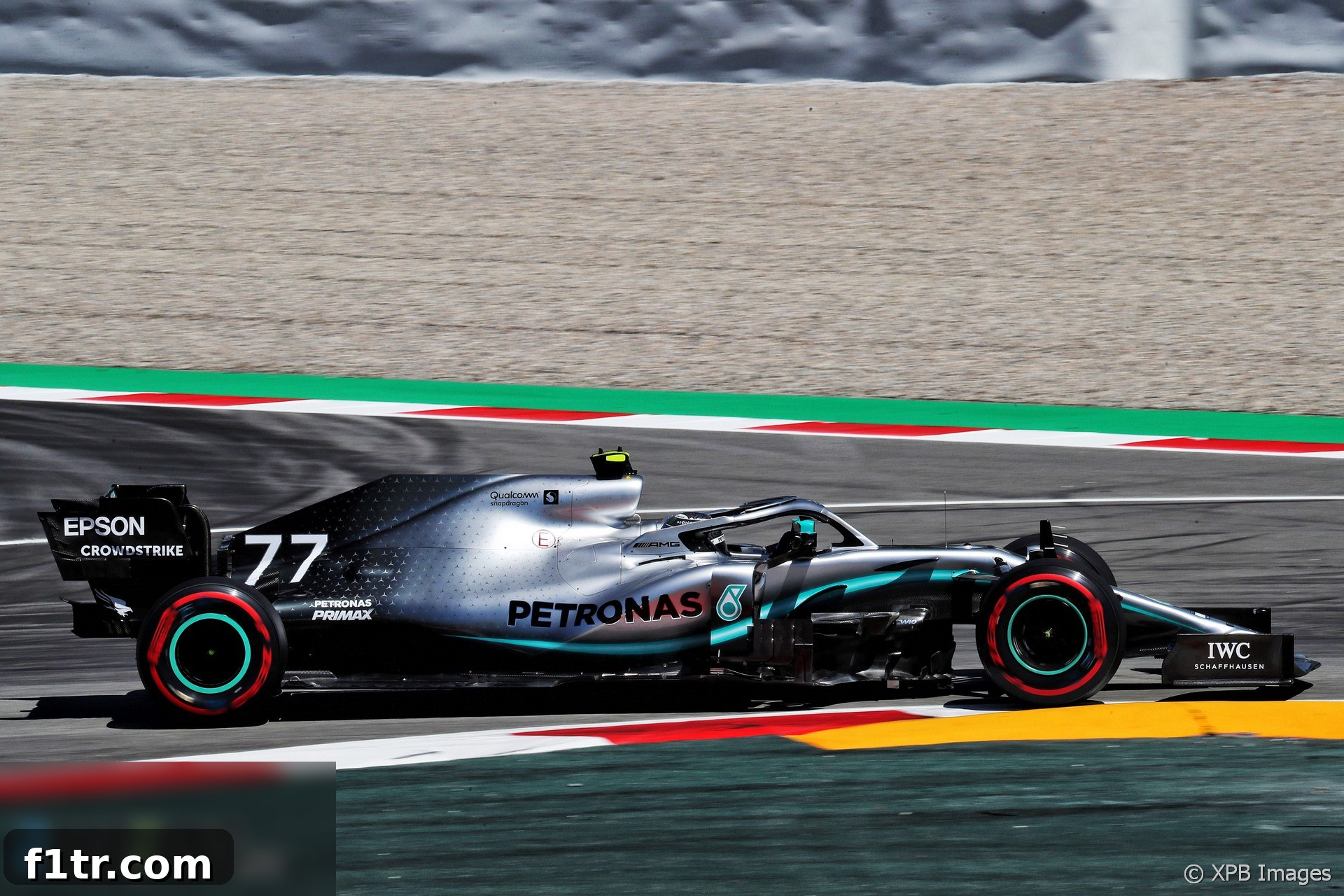
The highly anticipated Spanish Grand Prix weekend kicked off with a dramatic shift in form, as Mercedes driver Valtteri Bottas dominated Friday practice sessions at the iconic Circuit de Catalunya. His stellar performance immediately ignited conversations about the significant progress made by the Silver Arrows since pre-season testing at the very same venue. Bottas, currently leading the world championship standings, expressed profound satisfaction, stating his Mercedes W10 felt “completely different” and markedly improved compared to its winter iteration.
Advert | Become a Supporter & go ad-free
The Finn’s blistering pace in the second practice session saw him clock a lap time three-tenths of a second faster than his closest rivals at Ferrari, signaling a potential power shift at the front of the grid. This impressive turnaround comes after Mercedes introduced a comprehensive package of upgrades to both their W10 cars, meticulously designed to address perceived weaknesses and unlock greater performance. The upgrades included various aerodynamic refinements, which appear to have immediately translated into tangible gains on track, providing a much-needed boost for the reigning champions as the 2019 F1 season progresses.
Mercedes W10 Upgrades: A Game-Changer in Barcelona
For any Formula 1 team, the Spanish Grand Prix holds particular significance. Its location at the Circuit de Catalunya, a familiar stomping ground from pre-season testing, makes it an ideal proving ground for car development and the effectiveness of new components. Valtteri Bottas highlighted this importance, noting, “It’s always an interesting day when you’re bringing new parts to the car to get a feel for it and see if they bring the performance they should.” The initial indications from Friday’s sessions strongly suggest that Mercedes’ engineering efforts have paid dividends, reaffirming their commitment to continuous innovation and improvement.
During the earlier winter testing phase, Mercedes appeared to be trailing Ferrari, with the Italian Scuderia often setting the benchmark times and demonstrating impressive long-run pace. This raised questions about Mercedes’ ability to maintain their dominance in the new season. However, Bottas’s feedback from Friday painted a drastically different picture. “It felt really good today, completely different to how it was in winter testing,” he explained, underscoring the dramatic transformation the W10 has undergone. This stark contrast suggests that Mercedes has effectively leveraged the data gathered during testing and the initial races to pinpoint areas for improvement, implementing targeted upgrades that have fundamentally altered the car’s characteristics for the better.
Enhanced Cornering and Balance Propel Mercedes Forward
A key aspect of the W10’s improved performance, according to Bottas, lies in its enhanced cornering capabilities and overall balance. “It seems like our cornering performance has improved. The balance around the lap is also better, so it looks like we’ve taken the right direction since the winter,” he elaborated. The Circuit de Catalunya is renowned for its demanding sequence of corners, ranging from fast sweeps to technical chicanes, making strong aerodynamic performance and a well-balanced chassis critical for lap time. The ability to carry more speed through these corners, combined with greater stability, allows drivers to extract maximum performance from the tires and push the limits with more confidence.
The positive feedback from both drivers, coupled with Bottas’s chart-topping performance, indicates that the aerodynamic package introduced by Mercedes – reportedly taking cues from rival designs while incorporating their own innovative solutions – is delivering as intended. This includes optimized front wings, revised bargeboards, and potentially floor modifications, all aimed at generating more downforce and improving airflow management around the car. Such upgrades are crucial in modern Formula 1, where marginal gains can translate into significant advantages on the stopwatch, especially on a circuit that heavily rewards aerodynamic efficiency.
Despite the encouraging start, Bottas remained grounded and cautious, a characteristic trait of a seasoned championship contender. He acknowledged the fierce competition from their closest rivals. “Today was good, but it’s only Friday and Ferrari are very close. It feels like we’ve made a good step forward, but we need to wait and see what tomorrow holds.” This sentiment reflects the ever-present challenge in F1, where rivals can quickly analyze data, fine-tune their setups overnight, and mount a strong challenge in qualifying and the race. The three-tenths gap, while significant, is by no means insurmountable for a team of Ferrari’s caliber.
Lewis Hamilton’s Perspective on the New Package
Reigning world champion Lewis Hamilton, while slightly slower than his teammate Bottas, also expressed optimism regarding the new upgrades. His fastest lap was less than five-hundredths of a second off Bottas’s benchmark, underscoring the competitive spirit and close performance within the Mercedes garage. Hamilton commended the collective effort behind the development, stating, “Everyone worked really hard to bring the new package here and a huge amount of effort has gone in to it.” This acknowledges the tireless work of hundreds of engineers, designers, and mechanics who contribute to pushing the boundaries of performance.
Advert | Become a RaceFans supporter andgo ad-free
Hamilton’s comments also provided a crucial insight into a driver’s perception of new components: “It seems like it’s working, but it’s hard to feel it because this track is so different to [Baku].” This highlights the vastly different demands imposed by various circuits on an F1 car. The previous race in Baku, Azerbaijan, is a unique street circuit characterized by long straights and specific low-downforce requirements, contrasting sharply with Barcelona’s high-downforce, technical layout. A car that performs well in Baku might feel quite different in Barcelona, requiring a different setup philosophy and driver approach. The subtlety of feeling aerodynamic changes, especially when adapting to a new track dynamic, speaks to the immense skill and sensitivity required by Formula 1 drivers to provide accurate feedback to their teams.
The Battle Ahead: Ferrari’s Challenge and Championship Implications
While Mercedes celebrated a strong Friday, the threat from Ferrari remains very real. Ferrari demonstrated considerable pace during pre-season testing and has shown glimpses of their true potential in the early races. The three-tenths deficit in practice could be attributed to different testing programs, fuel loads, or engine modes. The Maranello-based squad will undoubtedly be poring over their data, seeking to optimize their SF90 for qualifying and the race. Their drivers, Sebastian Vettel and Charles Leclerc, are formidable competitors known for their ability to extract performance when it matters most.
The Spanish Grand Prix often serves as a barometer for the rest of the European season. A strong performance here can build momentum and confidence, while struggles can indicate deeper issues. Mercedes’ apparent resurgence is a significant development in the ongoing 2019 F1 season championship battle, which has seen fierce competition and fluctuating fortunes between the top teams. The psychological advantage gained from a dominant Friday can be crucial, setting the tone for the remainder of the weekend and potentially influencing strategic decisions. The stage is now set for a thrilling qualifying session and a strategic race, where tire management, pit stop execution, and driver skill will all play pivotal roles in determining the outcome.
The Spanish Grand Prix weekend promises to deliver more exciting action as teams push their cars and drivers to the absolute limit. With Mercedes seemingly having found their stride and Ferrari keen to prove their capabilities, the battle for pole position and ultimately, victory, will be intense. Fans can expect a captivating spectacle as the world’s best drivers and engineers fight for every tenth of a second at the iconic Circuit de Catalunya.
2019 F1 season
- Crying in the Melbourne car park at 2019 grand prix was my career low – Ocon
- McLaren Racing reports reduced £71 million loss in 2019
- Kvyat: Hockenheim podium last year was “my biggest achievement” so far
- How the FIA’s new encrypted fuel flow meter targets Ferrari’s suspected ‘aliasing’ trick
- “He smashed my office door”: 23 must-see moments from ‘Drive to Survive’ season two
Browse all 2019 F1 season articles