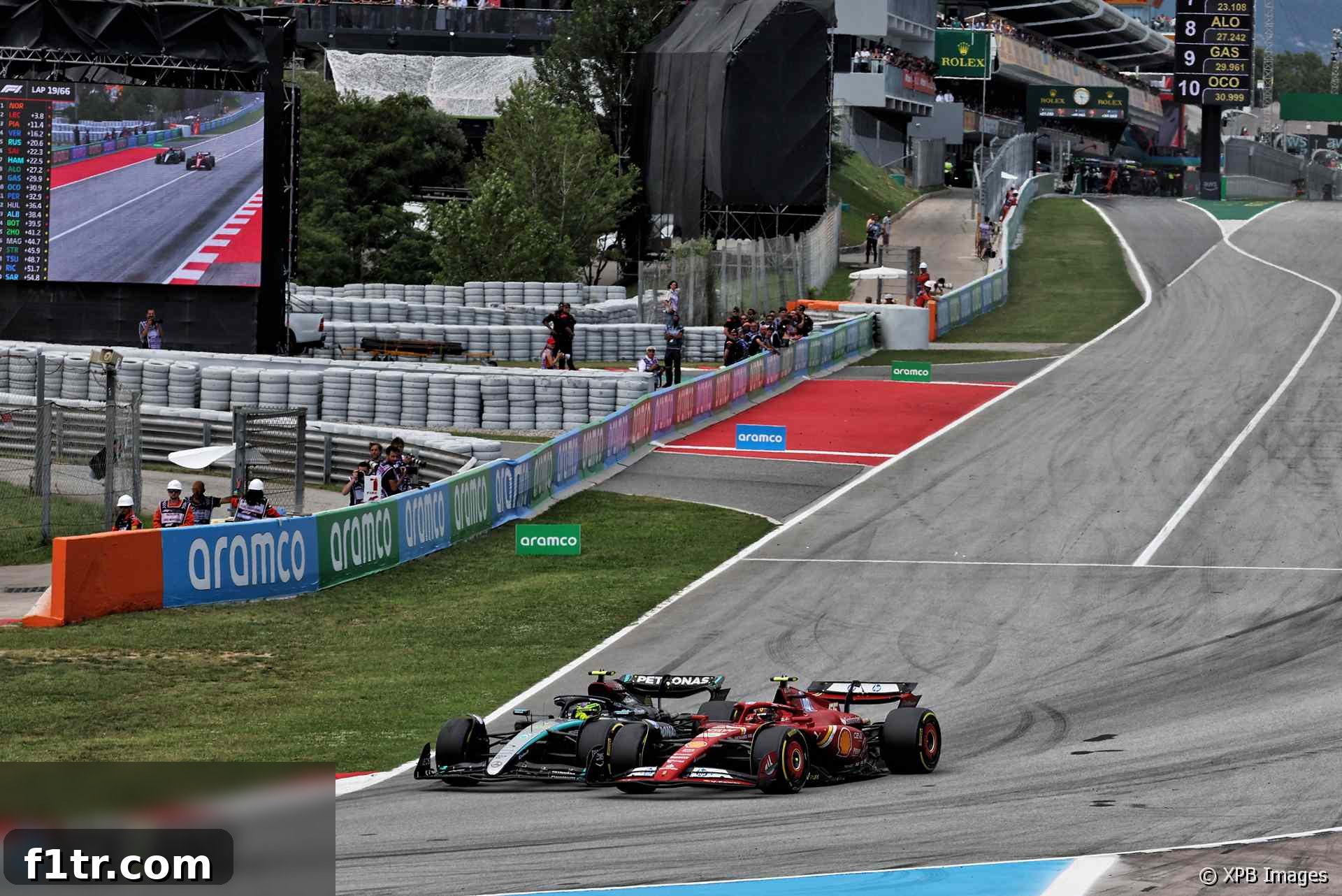
Lewis Hamilton, one of Formula 1’s most decorated drivers, recently highlighted a significant challenge faced by competitors at the Circuit de Catalunya: the decision to shorten a crucial DRS (Drag Reduction System) zone. According to Hamilton, this change made the already intricate art of overtaking considerably more difficult during the race. This sentiment was echoed by other drivers, shedding light on the ongoing complexities of racing in the current era of Formula 1 regulations.
Advert | Become a Supporter & go ad-free
The Shortened DRS Zone: A Deeper Look at Circuit de Catalunya
The modification at the Circuit de Catalunya involved moving the activation point for the DRS zone on the pit straight. Compared to the previous year, this point was repositioned 100 meters further away from the final corner. For those unfamiliar, the Drag Reduction System is a movable flap on the rear wing of an F1 car, designed to reduce aerodynamic drag when opened. This allows the car to achieve a higher top speed on designated straight sections of the track, thereby aiding overtaking. By shortening the DRS zone, drivers have less time and distance to capitalize on this speed advantage, making it harder to close the gap to a competitor and execute a pass.
This particular change reignited discussions around the effectiveness and balance of DRS in modern Formula 1. The FIA, the sport’s governing body, had previously experimented with shortening DRS zones at certain circuits early last year. However, these trials were eventually halted following considerable feedback and complaints from a number of drivers who felt these adjustments hindered rather than enhanced the racing spectacle. The primary goal of DRS is to facilitate overtaking and improve racing dynamics, but if the zones are too short, they can negate the system’s intended purpose, leading to frustration among drivers and potentially less thrilling on-track action for fans.
Hamilton’s Masterclass: Overcoming the Odds
Despite the added difficulty posed by the shortened DRS zone, Mercedes driver Lewis Hamilton demonstrated his exceptional skill and racecraft with a memorable overtake on Carlos Sainz Jnr into turn one. This move was so impressive that his team principal, Toto Wolff, hailed it as one of “the best overtakes I’ve seen in a long time.” Wolff’s high praise underscores the challenge and precision required for such a maneuver, especially under the revised DRS conditions.
Hamilton himself elaborated on the tactical execution of the pass, shedding light on the intricate decisions made in split seconds. “They shortened the DRS, so it was not so easy to follow through the last corner,” Hamilton explained to the official F1 channel. “I really had to pull this move off as early as possible.” This statement highlights the urgency and forward-thinking required; with less DRS assistance, initiating the overtake sooner became paramount. He continued, describing the critical moment: “He moved over, but didn’t completely cover the inside, so I went for the inside. It was very, very close between us, he tried to hold and stay on the outside, I left him a little bit of room, but it was nice and tight.”
This detailed account paints a vivid picture of the intense wheel-to-wheel battle. Hamilton’s ability to read Sainz’s defensive line, spot a minimal opening, and commit to an aggressive yet controlled inside pass exemplifies why he is considered one of the sport’s all-time greats. The fact that such a move was singled out for praise by a seasoned team principal like Wolff speaks volumes about the level of difficulty drivers are now facing in executing overtakes, especially when traditional aids like DRS are curtailed.
The Persistent Challenge of Dirty Air in Modern F1
Beyond the specific issue of DRS zone length, the broader conversation around overtaking in Formula 1 invariably circles back to the pervasive problem of “dirty air.” In the third year of F1’s current technical regulations, which were specifically designed to enable cars to follow each other more closely and improve racing, drivers are increasingly warning that following other cars has become more difficult due to the turbulent air they produce. Dirty air is essentially the disrupted, less aerodynamically efficient air that trails behind a car, causing a significant loss of downforce for any following vehicle. This turbulence makes it harder for the chasing car to maintain grip, manage tire temperatures, and ultimately, get close enough to attempt an overtake.
Lando Norris, the McLaren driver, provided a stark illustration of this challenge during the Spanish Grand Prix. He explained how dirty air prevented him from effectively attacking George Russell during the first stint of the race, shortly after Max Verstappen had managed to pass the Mercedes. “There’s so much dirty air,” Norris lamented, articulating a common complaint among his peers. He pinpointed a narrow window of opportunity for offensive maneuvers: “The first three laps of a stint, you can [attack] because the tyres are so good. So at the beginning of a stint, I was good and I could, but that was Max’s opportunity to get past George, he did that.”
This observation from Norris is crucial. It suggests that while the current regulations aimed to reduce dirty air effects, they have not fully succeeded in creating sustained close-quarters racing throughout a stint. The initial phase of a stint, when tires are fresh and operating at optimal temperatures, offers a brief period where drivers can push harder and potentially make a move. However, this window quickly closes. As Norris further elaborated, “After, the tyres just get so hot, you just can’t do different lines, and you can’t go out of the dirty air and cut back and things like that. So there was nothing else I could have done. It was just as simple as everyone kind of falls in line a little bit.”
The impact of dirty air is multifaceted. It not only reduces aerodynamic performance but also causes tires to overheat more rapidly when a car is stuck in another’s wake. This overheating compromises tire grip and forces drivers to back off, preventing them from exploring different racing lines that might allow them to find clean air or gain an advantage. Consequently, races can often devolve into a procession, where cars maintain a safe distance from one another, and strategic overtakes become increasingly rare outside of pit stop cycles or major performance differentials. This “falling in line” phenomenon directly impacts the excitement and competitive nature of Formula 1, creating a challenge for both drivers and the sport’s administrators.
Advert | Become a RaceFans supporter andgo ad-free
The Interplay of DRS and Dirty Air: A Balancing Act for F1’s Future
The discussions surrounding the shortened DRS zone at Circuit de Catalunya and the persistent issues with dirty air highlight a fundamental tension within modern Formula 1: the ongoing quest to find a perfect balance between aiding overtaking and preserving the challenge of racing. DRS was introduced specifically to combat the difficulty of overtaking caused by turbulent air, providing drivers with a tool to momentarily overcome some of the aerodynamic disadvantages of following closely. However, if DRS zones are deemed too effective, they can make overtakes feel artificial or too easy. Conversely, shortening them, as seen in Spain, exacerbates the inherent problems of dirty air, leading to fewer genuine opportunities for drivers to battle on track.
The current regulations, implemented in 2022, aimed to design cars that would generate less turbulent air and allow for closer racing. While there have been instances of improved close-quarters battling, the consistent feedback from drivers like Hamilton and Norris suggests that the “dirty air” effect remains a significant hurdle. This places Formula 1 in a perpetual state of refinement, constantly evaluating track designs, DRS parameters, and aerodynamic regulations to strike an optimal balance. The goal is to ensure races remain thrilling and unpredictable, rewarding driver skill and strategy without making overtakes feel overly simplistic or impossibly difficult.
For fans, understanding these nuances adds another layer to their appreciation of the sport. Every overtake, especially one as expertly executed as Hamilton’s on Sainz, becomes even more remarkable when viewed through the lens of shortened DRS zones and the pervasive impact of dirty air. As Formula 1 continues to evolve, the dialogue between drivers, teams, and the FIA will be critical in shaping the future of racing, striving for a spectacle that is both fiercely competitive and genuinely exciting.
Miss nothing from RaceFans
Get a daily email with all our latest stories – and nothing else. No marketing, no ads. Sign up here:
2024 Spanish Grand Prix Coverage and Analysis
For more in-depth coverage and expert analysis from the 2024 Spanish Grand Prix, explore our collection of articles:
- Russell ensures Norris has still never kept his lead from pole position
- Williams repeatedly switch floors in search for Sargeant’s missing downforce
- “Why’s he not defending?”: How Russell sank to fourth after stunning start
- What radio calls reveal about Verstappen’s controlled pace and Perez’s struggles
- 2024 Spanish Grand Prix weekend F1 driver ratings
Browse all 2024 Spanish Grand Prix articles