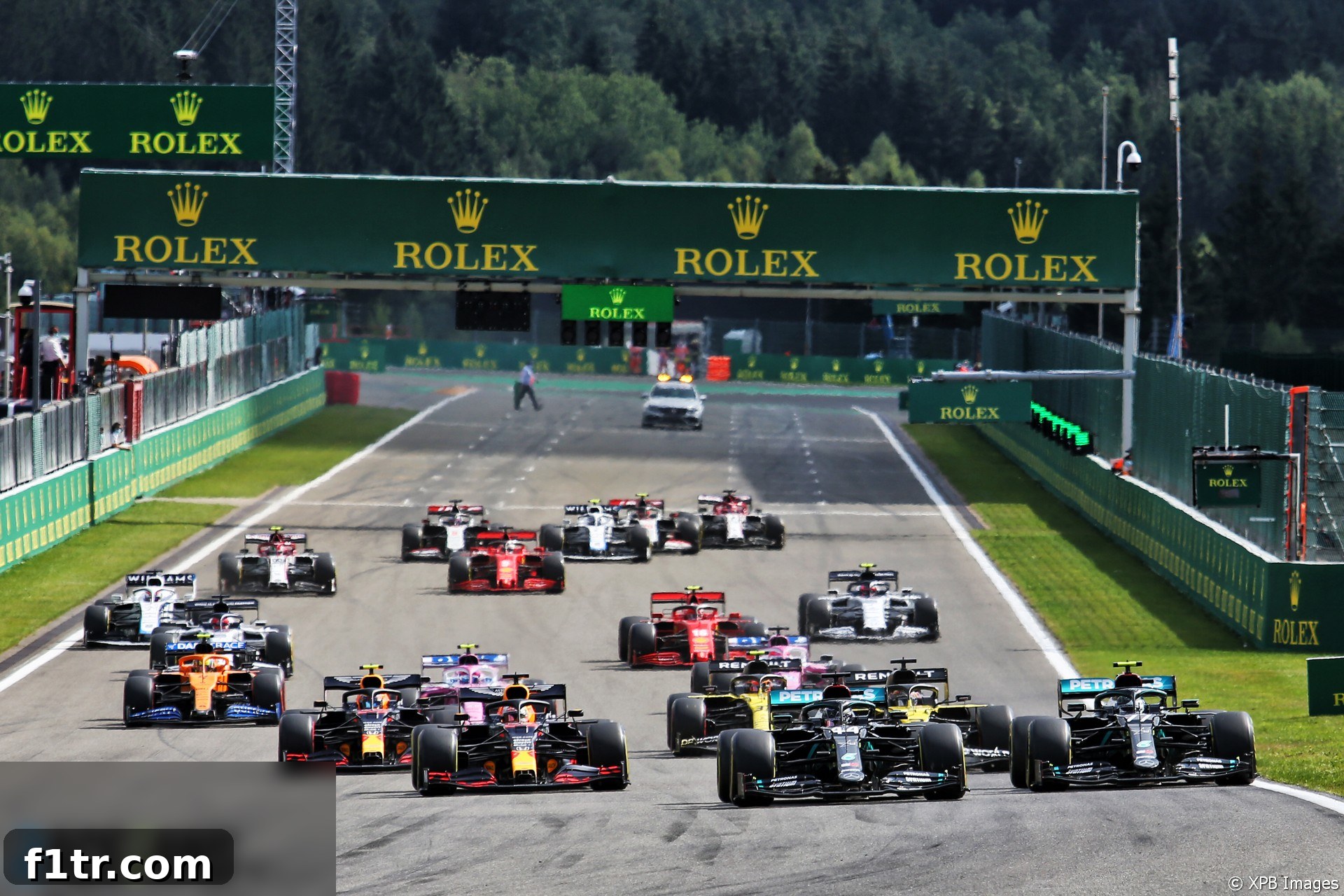
The storied, seven-decade history of the Formula One World Championship has witnessed countless moments of triumph, despair, and unexpected outcomes. Yet, rarely has a Grand Prix presented such a stark contrast between a predictable front-runner victory and a monumental fall from grace as the 2020 Belgian Grand Prix at the iconic Spa-Francorchamps circuit.
Millions of fans, whether watching on television or battling buffering on streaming platforms, bore witness to a watershed moment in Formula 1 history. While the race unfolded with what appeared to be another routine masterclass from Lewis Hamilton, perfectly flanked by his Mercedes teammate Valtteri Bottas and Red Bull’s Max Verstappen, the true drama lay further down the field. The seemingly mundane procession at the front masked an astonishing collapse by Formula 1’s most decorated and prestigious entity: Scuderia Ferrari. This was a Grand Prix where the Prancing Horse, a symbol of unparalleled success, was reduced to a mere also-ran, an unthinkable scenario just a few seasons prior.
Ferrari’s Unprecedented Struggle: A Grim Weekend at Spa
The writing for Ferrari’s challenging weekend was etched in bold long before Sunday’s race. From the moment cars hit the track on Friday, a pervasive sense of gloom settled over the Maranello garage. Practice sessions yielded abysmal results, with Sebastian Vettel and Charles Leclerc languishing in 15th and 17th positions respectively. Despite the clear lack of pace, four-time world champion Vettel initially tried to maintain a semblance of calm, clinging to a fading hope.
“The car was difficult and tricky to drive, but I guess that also means that we’re not quite where we should be,” he conceded. “We’ll reset and try again and try something different. I’m sure tomorrow will be a bit better.”
Tragically for the Tifosi, “better” was a distant dream. Saturday morning brought further humiliation, with Vettel clocking the slowest time of all competitors. The team barely salvaged some pride by having both drivers escape elimination in Q1, but the stark reality was undeniable. Just twelve months after Leclerc led the field into La Source on their way to victory in 2019, Ferrari found their SF1000 machines relegated to the seventh row of the grid for the 2020 Belgian Grand Prix. Astonishingly, they were the only team among the ten constructors to be slower than their previous year’s performance at the same circuit. There were no excuses left; the true picture of their struggling pace was laid bare.
Vettel openly admitted that the performance was a “true picture” of the team’s struggles, a raw and honest assessment. Charles Leclerc, known for his fierce competitiveness, voiced his deep frustration, not just for himself and the team, but for the millions of loyal Ferrari fans around the globe. “I can understand the fans at home that are very disappointed,” he stated, his voice heavy with resignation. “Us drivers all try to make the best race possible tomorrow, even though we can’t expect any miracles.” His words served as a grim premonition for what was to come.
Advert | Become a RaceFans supporter andgo ad-free
The Start: Hamilton’s Dominance and Midfield Mayhem
As Sunday dawned over the Ardennes, it felt as though only a miracle could prevent Lewis Hamilton, Valtteri Bottas, and Max Verstappen from occupying their now-customary positions on the podium. Hamilton, the six-time world champion, had delivered yet another spirit-crushing qualifying lap to extend his incredible pole position tally to 93. Bottas, surprisingly confident, preferred his second-place grid slot, believing it offered an advantage on the long run up to Les Combes.
Behind the top three, Saturday had been a phenomenal success for Daniel Ricciardo in the Renault and Carlos Sainz Jnr of McLaren. Both teams had embraced low-downforce, low-drag packages, perfectly suited for Spa’s high-speed sectors. However, Sainz, who counts the iconic Belgian circuit as his favorite, was cruelly robbed of his race before it even began. An exhaust problem during his reconnaissance lap meant he was doomed to be Spa’s sole permitted spectator for the afternoon, a bitter pill to swallow for the Spaniard.
As the red lights extinguished, Hamilton, as anticipated, surged ahead into La Source. Rounding the tight hairpin, his Mercedes briefly broke traction under throttle, requiring a swift correction on exit. Bottas, theoretically in a prime position to challenge on the run up through Eau Rouge and Radillon, found himself too close. A pass into Eau Rouge would have demanded an impossible braking point, leaving him no option but to ease off and follow his teammate. This gave Verstappen a golden opportunity to draft Bottas along the legendary Kemmel Straight. Fortunately for Bottas, Verstappen lacked the crucial momentum to slingshot past, and instead found his mirrors filled with flashes of yellow as Ricciardo had a daring look up the inside into Les Combes. The pair engaged in a thrilling side-by-side battle through Malmedy and down to Bruxelles, with the Red Bull ultimately emerging ahead.
Further back, amidst the inherent chaos of a Formula 1 start, Charles Leclerc momentarily capitalized on the situation. He gained four places, moving up to ninth, ahead of Lando Norris in the sole remaining McLaren. Norris, acutely aware of his McLaren’s performance advantage over the struggling Ferrari on that particular weekend, quickly set his sights on passing Leclerc. He attempted an ambitious move around the outside heading into Les Combes. However, misfortune struck: the fluid leaked from Sainz’s earlier exhaust failure had deposited itself on the track, and Norris’s McLaren found it. He got crossed up, forced to use the escape road, and fell back to 12th.
Advert | Become a RaceFans supporter andgo ad-free
Ferrari’s Fleeting Hope and Swift Decline
Unexpectedly, Charles Leclerc’s Ferrari was running in eighth after a successful move past Sergio Perez’s Racing Point at the Bus Stop chicane on the opening lap. For a brief, fleeting moment, a flicker of hope ignited for the Scuderia. Perhaps, despite all the predictions, it wouldn’t be such a disastrous afternoon for Ferrari, especially given Leclerc’s remarkable ability to often extract decent results from challenging situations throughout the 2020 season. However, this optimism was short-lived and brutally extinguished. Once DRS was activated, the Ferrari’s critical weakness – its crippling lack of straight-line speed – became painfully evident.
In just five agonizing laps, Leclerc plummeted down the order, losing four positions. Pierre Gasly, then Perez, then Norris, and finally Daniil Kvyat, all effortlessly swept past. Each time, Leclerc was powerless, unable to mount any form of effective defense against the superior straight-line performance of his rivals. “I’m struggling so much on the straights,” a frustrated and defeated Leclerc relayed over team radio, his voice echoing the powerlessness that defined Ferrari’s performance that day.
Safety Car Intervenes: A Strategic Twist
Before the race, the conventional wisdom amongst teams pointed towards a one-stop strategy as the optimal path. The field settled into an early rhythm, with the top three leaders comfortably circulating on medium compound tyres. However, the serene pace was abruptly shattered on lap 11 by a violent incident that would trigger a flurry of activity in the pit lane. Antonio Giovinazzi, pushing hard, lost control of his Alfa Romeo on the exit of the fast Fagnes corner. A touch too much throttle, followed by an excessive dab of opposite lock, sent him spearing into the outside tyre barriers. The force of the impact bounced his car back across the track, directly into the path of George Russell’s unsuspecting Williams.
The severity of the collision was evident as a wheel was jettisoned from the Alfa Romeo, leaving Russell with no time or space to avoid it. Tens of thousands of pounds worth of meticulously manufactured suspension arms on the Williams collapsed instantly on impact, turning the car into a mere passenger as it too collected the outside tyre barrier. With two heavily wrecked Formula 1 cars stranded on the circuit and large chunks of carbon fibre littering the track, the Safety Car was deployed. Race control determined that a full red flag was not necessary, allowing for a swift clean-up operation.
Post-incident, Giovinazzi candidly admitted his error stemmed from simply pushing too hard. Russell, remarkably unharmed, expressed profound gratitude for the Halo device, which, though not directly needed in this specific impact, had been there to shield his body from the errant wheel had circumstances been different, underscoring its vital safety role.
Mid-Race Reassessment: Ferrari’s Deeper Pains
Over the subsequent two laps under the Safety Car, nearly every driver, save for Gasly and Perez, seized the opportunity to pit for fresh tyres. While a one-stop strategy was the original intention for most, asking even the durable hard compound tyres to cover over 30 laps to the checkered flag would be a significant challenge. This early pit stop shuffled the order and reset tyre strategies for many.
Hamilton masterfully led the field away at the restart on lap 15. This time, Bottas’s issue wasn’t being too close to his teammate on the ascent to the Kemmel Straight, but rather too far, unable to mount an effective challenge. Meanwhile, Ferrari’s woes deepened. Sebastian Vettel restarted the race in 12th, while Charles Leclerc, after a protracted pit stop, had fallen further back to 14th. In perhaps the most glaring illustration of just how badly the SF-1000 was struggling, Vettel could only watch as his former Ferrari teammate Kimi Raikkonen, driving an Alfa Romeo equipped with the identical Ferrari power unit, effortlessly cruised up alongside and then past him on the Kemmel Straight. This moment was a brutal indictment of Ferrari’s own chassis and aerodynamic package, or perhaps the calibration of their customer engine was simply better.
Seemingly unable to challenge anyone beyond the backmarker Haas cars and Nicholas Latifi’s sole remaining Williams, Vettel and Leclerc found themselves battling each other, a sad reflection of their fallen status. Leclerc, utilizing DRS, made a run on his teammate. Vettel, experienced enough to know that outside moves at Les Combes are rarely successful, positioned his car defensively. Leclerc nearly clipped his teammate’s rear left as they rounded the left-hander, but significant contact was narrowly avoided. This was a battle for a lowly 12th position – a far cry from Ferrari’s usual aspirations.
Leclerc was subsequently called in for a second stop, switching to medium tyres. This was another slow stop, as Ferrari took the precaution of topping up pneumatic pressure on his car’s engine, hinting at underlying issues. Aware that his teammate had now pitted twice, Vettel, less than enthusiastic about the prospect of nursing his tires for another 20 laps, began lobbying the team for a similar opportunity. “Okay, I’m not going to pass these guys in front,” he radioed. “Think about pitting. I’m happy to box.” The reply, “Understood,” offered little comfort. Ultimately, Vettel was instructed to endure, forcing him to complete a solitary one-stop strategy.
The Podium Procession and Midfield Climax
Out in front, an all-too-familiar gap emerged between the leading Mercedes duo and Verstappen, separating them decisively from the rest of the field. This dominance was further amplified by Pierre Gasly, running an impressive fourth for AlphaTauri, being the only driver in the field yet to make a pit stop. Behind him, Daniel Ricciardo was enjoying a fantastic weekend for Renault. Having already outperformed expectations on Saturday to line up fourth on the grid, the Australian was relishing his Renault’s natural preference for low-downforce, high-speed circuits, extracting every ounce of performance.
Behind Ricciardo, Alexander Albon was the sole driver to have switched to medium tyres under the Safety Car. While the Red Bull driver managed to stay in contact with Ricciardo, he was ultimately unable to mount any genuine challenge for position. With no more significant strategic gambles to be played, the 2020 Belgian Grand Prix transitioned into a phase of acute tyre conservation. Drivers meticulously nursed their Pirellis, aiming to stretch them safely to the checkered flag, asking as little as possible from the rubber.
For the Mercedes team, anxiety loomed. Fearing a repeat of the dramatic tyre failures witnessed at Silverstone, engineers picked up a vibration on Bottas’s W11. However, the Finn calmly reassured his team that it wasn’t a problem. Even the front-runners weren’t immune to minor errors under the pressure of tyre management. Hamilton made a rare mistake under braking for the Bus Stop chicane, running wide and taking to the inside escape road. Bottas, too far back to capitalize, emulated his teammate with a near-identical error just a few laps later. Despite the underlying tension of managing fragile tyres, the laps wound down, and the gaps between the top three protagonists widened sufficiently to preclude any late-race drama at the very front.
Further back, Albon was struggling significantly. His medium tyres, by now well past their prime, made his Red Bull vulnerable. He came under renewed attack from Esteban Ocon in the second Renault, who in turn was being rapidly reeled in by Norris in the McLaren. As the race entered its final laps, Ocon was within striking distance. Despite a couple of opportunities utilizing DRS, Albon bravely managed to repel the initial assaults. However, on the very final lap, Ocon found an exceptional run along the Kemmel Straight, seizing fifth place from Albon. With Ricciardo having secured fourth, this result locked in Renault’s strongest performance of the season, a truly commendable effort. Norris, not far behind, lamented his inability to make a move: “We just needed one more lap,” the McLaren driver sighed.
Hamilton’s Routine Win, Ferrari’s Unfathomable Reality
Lewis Hamilton duly ticked off the remaining laps, securing his fifth victory of the 2020 Formula 1 season. This dominant performance further extended his already substantial championship lead to a commanding 47 points over Max Verstappen. Valtteri Bottas crossed the finish line just over six seconds behind, with Verstappen a further six seconds adrift, solidifying the predictable podium. While a routine result for the top three, all three drivers concurred after the race that the extensive tyre management had made it a rather unexciting race from behind the wheel.
In parc fermé, just as he had after qualifying, Hamilton paid a moving tribute to the memory of actor Chadwick Boseman, who had recently passed away. Hamilton had previously spoken of how inspirational Boseman’s portrayal of Marvel superhero Black Panther had been, not only to young people of color worldwide but also to him personally.
Daniel Ricciardo capped off Renault’s strongest weekend since joining the team in 2019 by setting the fastest lap of the race, a feat achieved despite team principal Cyril Abiteboul’s initial reluctance to allow him to turn up his engine. Ricciardo himself seemed unfazed, laughing, “I was f***ing pushing. I f***ing sent that one.”
However, amidst all the post-race celebrations and reflections, the most profoundly shocking and outstanding result belonged to the two Ferraris, languishing in 13th and 14th place respectively. This was not a race compromised by freak accidents, ill-timed safety car interventions, or adverse weather conditions. This was Ferrari finishing well outside the points, simply because their SF1000 had nothing more to give. It was an unfathomable reality for a team of their stature.
With the grim reality having been apparent since Friday, there was little shock left for the Scuderia’s two drivers. “It’s not unreal, it’s the reality,” Sebastian Vettel accepted with a heavy heart. “I think in any sport, you always have to face the reality, even if it’s very harsh. We didn’t crash on the first lap, have to change the front wing, were 20 seconds off the end of the field and came back to be 13th. No, we were racing hard. We raced without any big mistakes. And we finished 13th and 14th. So it’s the reality.”
The underlying factors behind Ferrari’s severe power unit deficit and aerodynamic inefficiency in the 2020 season were, by then, no longer a mystery. What was perhaps most concerning for the team was that even Team Principal Mattia Binotto struggled to explain why they had been so comprehensively beaten by Alfa Romeo, a customer team running the same engine. “Power and aero efficiency is the first part,” Binotto acknowledged, “But that’s not sufficient to explain our performance of this weekend because anyway I don’t think that the pattern with our customer teams is where we are expecting to be. So there is something more which we are looking at which at the moment we do not [understand].”
Quotes: Dieter Rencken
With just one week before the team was scheduled to race at their spiritual home of Monza, there was precious little time for Ferrari to uncover answers to these profound unknowns. For the passionate Tifosi, their absence from the stands at the Italian Grand Prix, due to pandemic restrictions, might have been a blessing in disguise, sparing them the sight of their beloved team enduring further struggles on home soil.
2020 Belgian Grand Prix
- 2020 Belgian Grand Prix Star Performers
- Ricciardo believes Renault’s Spa set-up breakthrough will work on other tracks
- ‘He should have let me pass’: How Raikkonen saw Giovinazzi’s crash
- Sub-54 second laps will produce a “big mess” in qualifying on Bahrain Outer circuit
- McLaren expect Ferrari will “strike back” after Monza
Browse all 2020 Belgian Grand Prix articles
F1 race reviews
- Antonelli lucks in for second win and becomes youngest F1 championship leader
- Emotional Antonelli grabs first Formula 1 victory in Chinese Grand Prix
- Russell sees off Ferrari threat to lead Mercedes one-two in Melbourne
- Norris clinches F1 title by two points as Verstappen wins finale at Yas Marina
- McLaren strategy blunder in Losail hands Verstappen crucial win and shot at title
Read all F1 race reviews