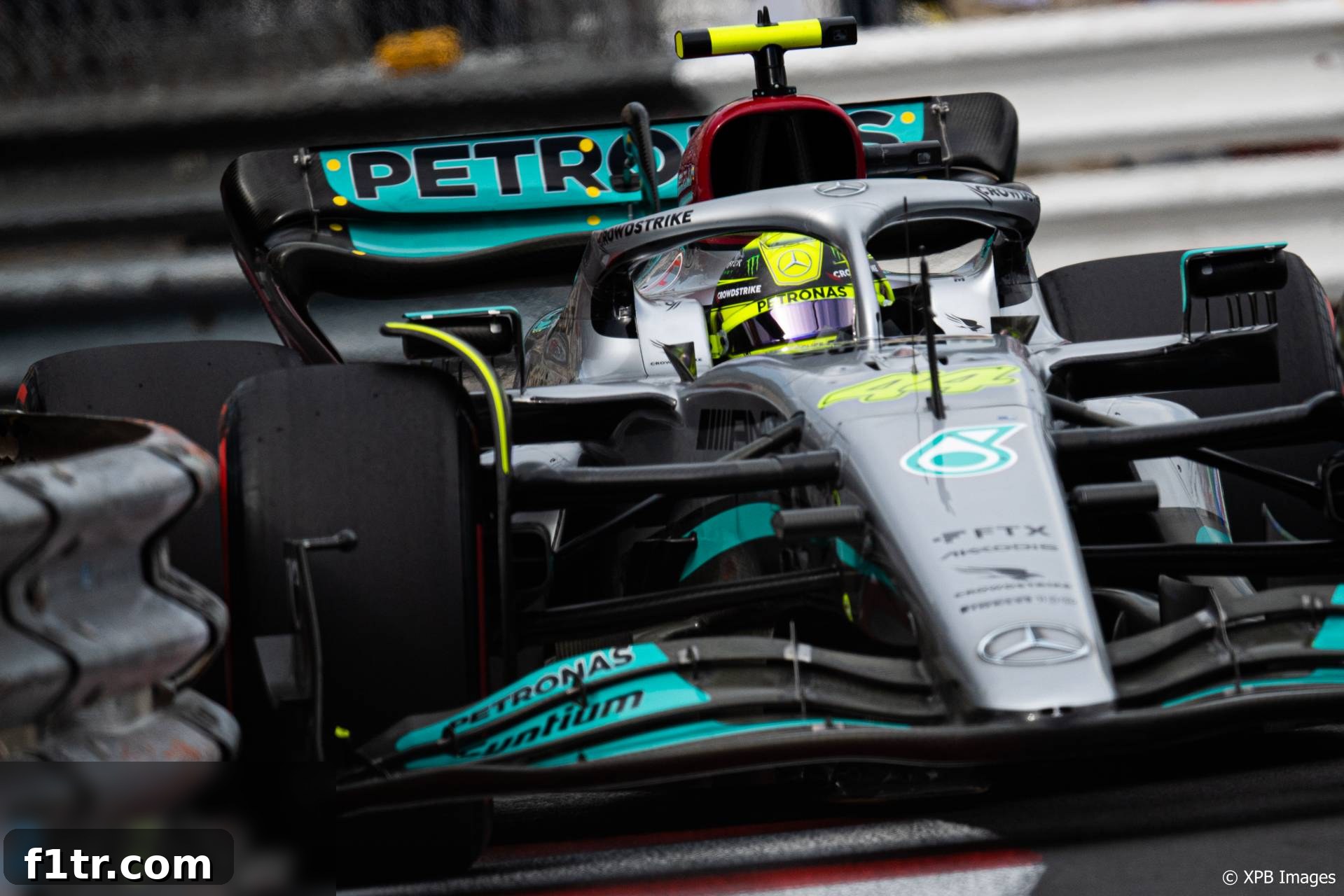
In the high-stakes world of Formula 1, where every millisecond counts and technological evolution is relentless, teams constantly grapple with the delicate balance of perfecting their current machinery while simultaneously laying the groundwork for future success. For Mercedes-AMG Petronas F1 Team, a dominant force for nearly a decade, the 2022 season presented an unprecedented challenge with the introduction of new aerodynamic regulations. As the team navigated the complexities of their W13 challenger, seven-time world champion Lewis Hamilton made it clear: understanding and resolving the car’s current issues must take precedence over any premature pivot to its successor.
Hamilton’s philosophy stems from a deep well of experience, recognizing that true progress is built upon a foundation of fundamental understanding. His pragmatic stance underscores a critical engineering principle: if the core problems of the current design are not fully comprehended and rectified, there is a significant risk of those same flaws being inadvertently carried over or replicated in the next iteration. This methodical approach is vital for a team like Mercedes, known for its meticulous engineering and unwavering pursuit of perfection. Abandoning the W13 without a complete diagnosis would be akin to solving a complex puzzle by guessing, rather than by carefully analyzing each piece. For Hamilton, whose championship aspirations for 2022 had realistically faded by this point, the focus shifted from individual glory to the collective long-term health and competitiveness of the team.
Deciphering the W13: Porpoising vs. Bottoming Out
The W13’s journey through the early races of the 2022 season was marred by a series of perplexing performance issues, most notably “porpoising.” This aerodynamic phenomenon, characterized by an uncontrolled high-frequency oscillation of the car at high speeds, emerged as a direct consequence of the new ground effect regulations. Mercedes, like several other teams, struggled to contain this bouncing, which not only compromised performance but also subjected its drivers to immense physical discomfort. Significant efforts were channeled into understanding and mitigating porpoising, leading to a series of upgrades introduced at the Spanish Grand Prix. These developments showed promising results, seemingly reducing the severity of the bouncing and improving the W13’s overall stability and pace.
However, the relief was short-lived. As the F1 circus descended upon the iconic streets of Monaco, a circuit renowned for its tight corners and undulating surface, new challenges arose. Drivers once again reported a jarring, uncomfortable ride, leading to initial concerns that porpoising had made an unwelcome return. Team Principal Toto Wolff was quick to clarify the nature of these renewed issues, differentiating them from the earlier porpoising problems. “I think we haven’t had porpoising returning,” Wolff stated. “We are bottoming out. We are just hitting the ground in a very different way; the car is too stiff, too low.”
Advert | Become a RaceFans Supporter & go ad-free
Wolff’s explanation highlighted a distinct problem: rather than the aerodynamic oscillations of porpoising, the W13 was physically striking the track surface. This “bottoming out” occurs when a car’s suspension is too stiff or its ride height is set too low for a given track, causing the underbody to repeatedly make contact with the asphalt, especially over bumps or during compression. Monaco, with its bumpy old-school street layout and requirement for maximum downforce, inherently demands a softer setup and higher ride height to manage its uneven characteristics. The W13, designed with a focus on maximizing ground effect aerodynamics on smoother circuits, found itself ill-suited to the principality’s unique demands, exposing a fundamental stiffness and ride height inflexibility that the team needed to address.
The Perils of Premature Development and Hamilton’s Input
Hamilton’s insistence on a thorough understanding of the W13’s current issues before embarking on the W14’s design cycle is not merely a philosophical stance; it’s a strategic imperative. The risk of prematurely shifting focus to next year’s car without resolving the root causes of the W13’s struggles is substantial. Such a move could lead to a ‘reboot’ that, instead of innovating, merely inherits the same deep-seated problems under a new guise. “I’ve really not thought about that,” Hamilton said when asked about focusing on the 2023 car. “I think we’ve got to figure out what’s wrong with this car before we can make another car. If we just started making another car we could easily get it wrong.” This powerful statement underscores the potential for costly errors and the critical need for comprehensive data analysis and engineering insight.
The 2022 regulations brought about a seismic shift in Formula 1 car design, particularly with the reintroduction of ground effect aerodynamics. Teams were essentially navigating uncharted territory, and the learning curve was steep. For Mercedes, a team accustomed to fine-tuning existing, highly optimized concepts, the W13 represented a complete departure. Therefore, every piece of data, every driver feedback, and every engineering analysis from the current car is invaluable in shaping the direction of the W14. It forms the crucial feedback loop that prevents repeating past mistakes and ensures that future designs are built on a more stable and effective foundation. The lessons learned, often painful, from the W13’s development and racing struggles are directly transferable to the 2023 car, making the current car an essential, albeit challenging, learning platform.
Hamilton, despite the team’s struggles, remains an integral part of the development process. His extensive experience, accumulated over nearly two decades at the pinnacle of motorsport, provides invaluable insights that data alone cannot fully capture. He is not merely a driver but a critical feedback mechanism, translating the nuanced behavior of the car into actionable engineering directives. Even as he emphasizes understanding the current car, he has already begun outlining specific characteristics he wishes to avoid in the next design. “However, there’s definitely loads of things that I would not want from this car onto next year’s car, so I’ve already put those in,” he revealed. This direct input, drawn from the visceral experience of pushing the W13 to its limits, will be crucial in guiding the design philosophy and technical specifications of the W14, ensuring that the team moves forward with clear, informed objectives.
Mercedes’ Performance in Monaco: A Realistic Assessment
The Monaco Grand Prix, often described as the jewel in the F1 crown, is a unique beast that can expose a car’s weaknesses like no other circuit. For Mercedes, qualifying proved to be a stark reflection of their current standing in the pecking order. The team found itself as the fourth-quickest outfit, a position far removed from their accustomed dominance. George Russell, demonstrating remarkable consistency in his debut season with Mercedes, managed to qualify his W13 in sixth place. Lewis Hamilton, unfortunately, had his final qualifying run disrupted by a red flag incident, ultimately placing him two spots behind his teammate in eighth. While the red flag undoubtedly impacted Hamilton’s potential, the overall pace deficit to the front-runners was undeniable.
Toto Wolff, ever pragmatic, acknowledged the team’s realistic position. He drew parallels with their performance at the Spanish Grand Prix, where a substantial gap to the leading teams was also evident. “So it’s probably realistic where we ended up. The car is good for fifth and sixth, and Norris beat us to it. But we shouldn’t have expected any miracles, particularly in Monaco,” Wolff commented. His assessment highlighted that Monaco, while special, did not fundamentally alter their competitive landscape. It merely confirmed the W13’s current performance ceiling relative to its rivals, particularly Red Bull and Ferrari, who had established themselves as the clear front-runners. The demanding nature of Monaco amplified the W13’s inherent stiffness and ride height limitations, preventing the drivers from extracting maximum performance and demonstrating that even their significant upgrades had yet to fully bridge the gap to the championship contenders.
The Road Ahead: Balancing Present Solutions with Future Innovations
The dilemma faced by Mercedes – whether to continue investing heavily in the current W13 or to divert resources towards the W14 – is a common mid-season quandary for any F1 team experiencing performance struggles. However, Hamilton’s firm stance provides a clear directive: the immediate priority must be a comprehensive understanding and resolution of the W13’s fundamental flaws. This isn’t about chasing the 2022 championship, which, as Hamilton noted, was largely out of reach. Instead, it’s about safeguarding the team’s long-term competitive health and ensuring a return to championship contention in the seasons to come.
The insights gained from meticulously dissecting the W13’s performance, particularly its porpoising and bottoming-out characteristics, will be invaluable. This data will inform every aspect of the W14’s design, from its aerodynamic philosophy and suspension geometry to its chassis stiffness and weight distribution. Mercedes’ history is steeped in engineering excellence and an unwavering commitment to innovation. Their ability to overcome technical hurdles has been a cornerstone of their success. The current challenges represent a severe test of that resolve, but also an opportunity to demonstrate their engineering prowess once again.
Advert | Become a RaceFans Supporter andgo ad-free
Conclusion: A Critical Juncture for the Silver Arrows
Mercedes finds itself at a critical juncture in its Formula 1 journey. The 2022 season, with its new regulations and the unforeseen challenges of the W13, forced the team to confront its vulnerabilities. Lewis Hamilton’s leadership, characterized by his pragmatic focus on foundational problem-solving, is more crucial than ever. By prioritizing a deep understanding of the current car’s technical intricacies – differentiating between porpoising and bottoming out, and dissecting why certain track characteristics exacerbate these issues – Mercedes is laying the essential groundwork for its future success. This methodical approach, coupled with direct driver feedback on what must be avoided in the next car, is the surest path back to the front of the grid. The Silver Arrows’ road to recovery is a testament to the complex interplay of engineering, strategy, and human input in the relentless pursuit of Formula 1 supremacy.
2022 Monaco Grand Prix
- Whatever triggered it, Verstappen’s defiance of his own team makes little sense
- Transcript: How Red Bull seized a win that ‘Ferrari looked like they had in the bag’
- Verstappen now has as many poles as Leclerc – but six times as many wins
- Schumacher’s chassis-splitting crash shows effects of rising car weight – Alonso
- Norris still can’t drive McLaren the way he wants to, despite strong results
Browse all 2022 Monaco Grand Prix articles