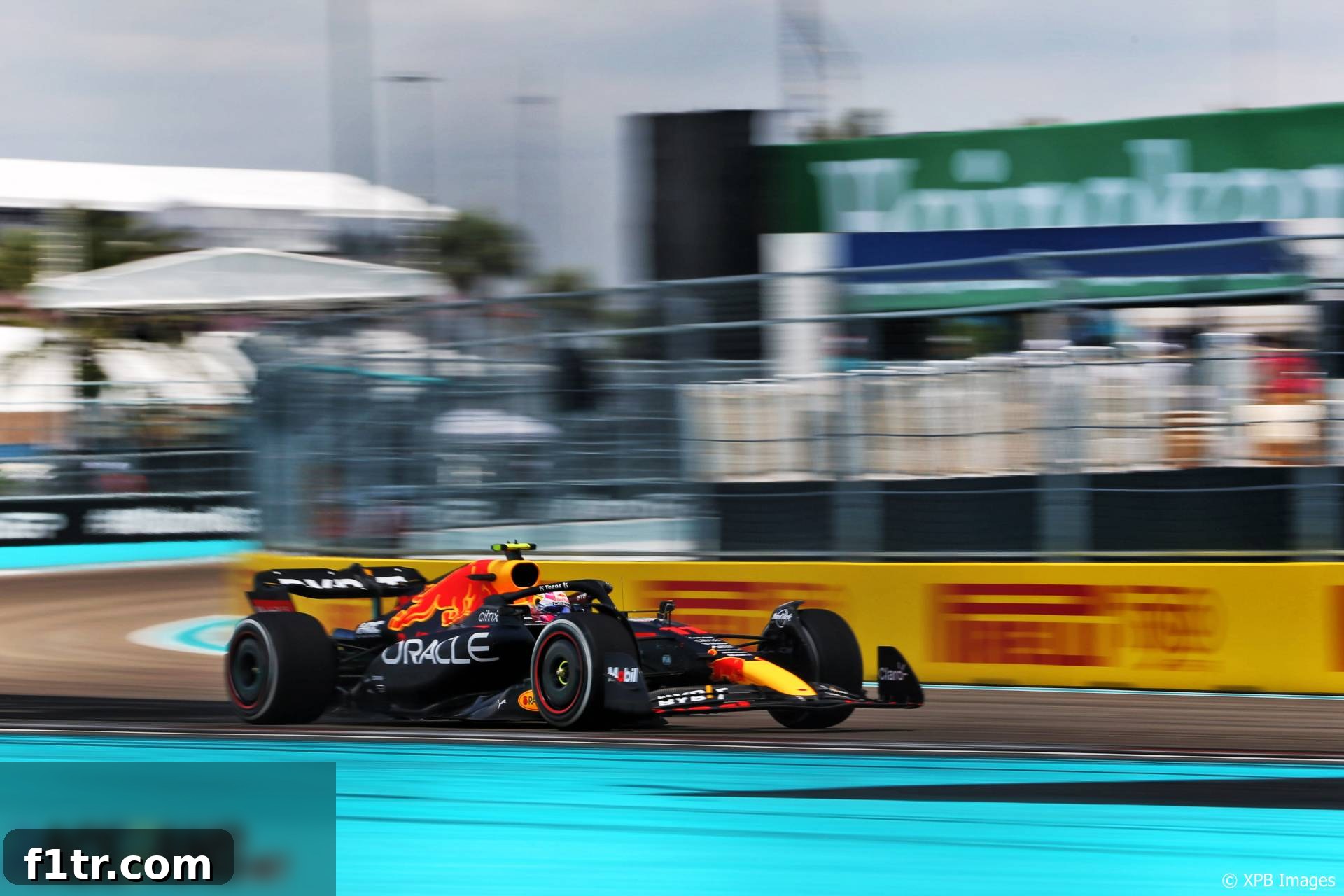
Red Bull Racing driver Sergio Perez endured a challenging Miami Grand Prix, battling not only his competitors on track but also a critical technical issue within his RB18. The Mexican driver was fortunate to even complete the race, as a sensor fault on his power unit severely compromised his performance, leading to a significant loss of power throughout key stages of the event.
The highly anticipated Miami Grand Prix, held in May 2022, was a spectacle of speed and glamour, but for Perez, it quickly turned into a test of resilience. The race, which saw his teammate Max Verstappen clinch victory, could have unfolded very differently for Perez had his car performed optimally. Instead, a persistent power unit anomaly transformed his fight for a podium finish into a desperate attempt to salvage points.
Advert | Become a Supporter & go ad-free
The Critical Sensor Fault: A Race-Altering Glitch
The technical woes for Sergio Perez began when he was fiercely pursuing Carlos Sainz Jnr of Ferrari for third place. This crucial battle for a podium spot was abruptly undermined by the sensor fault. Perez himself later confirmed the issue, stating, “I think it was a sensor issue that we had. It was working well but then when we had the sensor issue we lost like seven seconds in two laps. And then it was just a poor race.” This substantial time deficit, equivalent to losing over three seconds per lap, put him at a severe disadvantage against the Ferrari of Sainz, which was already proving a formidable competitor.
In the high-stakes world of Formula 1, where tenths of a second can determine positions, a loss of “seven seconds in two laps” is catastrophic. Such a performance drop fundamentally alters a driver’s ability to maintain pace, defend positions, or launch an attack. It transforms a competitive battle into a struggle to merely stay on track and manage the car’s compromised state. The power unit, supplied by Honda Racing Corporation (HRC) and rebranded as Red Bull Powertrains, is a complex piece of engineering, and a single faulty sensor can cascade into significant performance degradation, highlighting the razor-thin margins of F1 technology.
Chasing the Podium: An Uphill Battle Against Sainz
Despite the debilitating power deficit, Perez displayed commendable tenacity. A mid-race Safety Car period, triggered by a collision between Lando Norris and Pierre Gasly, offered a glimmer of hope. This intervention effectively neutralized the time gap Perez had accumulated due to his car’s issues, bringing him back into contention with Carlos Sainz. The restart provided a fresh opportunity to challenge for third place, reinvigorating the Red Bull pit wall and Perez himself.
However, the underlying sensor problem continued to plague the RB18. On the restart, Perez immediately attempted to capitalize on the fresh tyres and the close proximity to Sainz. He made an aggressive move at Turn One, a notoriously challenging corner for overtaking due to its tight entry and subsequent long run-off. Despite his best efforts, the attempt proved unsuccessful. Perez explained the difficulties he faced: “Even with the DRS I couldn’t get close to Carlos. The deficit on the straight line was quite hard.”
The Drag Reduction System (DRS), designed to aid overtaking, was rendered largely ineffective by the significant power loss. DRS typically provides a speed advantage of 10-15 km/h on the straights, but with his engine down on power, Perez found that even with the DRS open, he couldn’t generate enough speed to truly challenge Sainz. Furthermore, the dirty air created by the car in front, combined with the compromised handling of his own car, made it incredibly difficult to maintain close quarters through the corners without overheating his tyres. “I was pushing really hard to stay close to him on the corners. My tyres were overheating so as soon as I had an opportunity, I went for it. It was too dirty off-line. After that I just couldn’t get close,” Perez elaborated, painting a vivid picture of his struggle. The off-line conditions, often covered in rubber marbles and dust, offer minimal grip, making aggressive overtaking maneuvers even riskier and less effective when a car is already compromised.
Red Bull’s Persistent Reliability Concerns
The sensor fault in Miami was not an isolated incident for Red Bull Racing in the 2022 Formula 1 season. The team had already faced three retirements due to technical faults by this point in the championship, most notably affecting Max Verstappen in the opening rounds. Verstappen had suffered DNF’s in Bahrain due to a fuel pump issue and in Australia due to a hydraulic problem, costing him crucial championship points. This pattern of reliability issues, stemming from different technical components, has been a significant concern for the Milton Keynes-based squad.
Perez’s frustrations were palpable as he addressed the ongoing challenges: “We need to keep working hard because every time we’re fighting different issues. Luckily we managed to finish the race. I think at one point it was really close to be over.” This statement underscores the critical nature of the problem, indicating that the team is grappling with a variety of technical vulnerabilities rather than a single, easily identifiable flaw. The fact that Perez was “really close to be over” and managed to finish the race in fourth place, salvaging valuable points, speaks volumes about the team’s reactive problem-solving capabilities during the event and Perez’s sheer determination. Finishing fourth under such duress was a testament to his racecraft and the mechanics’ quick thinking.
Team Principal Horner’s Confirmation and Future Focus
Team principal Christian Horner corroborated Perez’s account, highlighting the severity of the situation. He confirmed that Perez was indeed “very close” to retirement at one stage due to the “issue with a sensor on one of the cylinders.” Horner further elaborated on the impact, stating, “He lost a lot of track time. The guys managed to move the sensors around and he was down probably 20 kilowatts in power as a result.” A loss of 20 kilowatts, roughly equivalent to 27 horsepower, is a substantial amount in Formula 1, severely hampering straight-line speed and acceleration, especially critical on a track like Miami with its long straights.
Horner’s assessment provided a clearer picture of what Perez’s true potential could have been without the technical setback. “So even with the advantage of the new tyre he had, he was probably half a second off what the car was capable off in straight-line speed. I think without that he would have probably even been P2 today.” This estimation suggests that Perez, despite starting fourth and finishing fourth, was capable of a significantly better result, potentially even a Red Bull 1-2 finish, which would have been a major championship statement against Ferrari.
Looking ahead, Horner emphasized the collaborative effort required to mitigate such incidents. “It’s something we’ll work closely with HRC [Honda Racing Corporation] to try and understand and ensure it doesn’t happen in the future,” he added. The partnership with Honda, responsible for the power unit development and support, is crucial. Addressing these “different issues” effectively and promptly is paramount for Red Bull Racing’s championship aspirations, as every point becomes critical in a tightly contested season.
Advert | Become a RaceFans supporter andgo ad-free
Championship Implications and The Road Ahead
The recurring reliability issues for Red Bull Racing, while seemingly varied in their nature, pose a significant threat to their ambitions in the Constructors’ and Drivers’ Championships. While Max Verstappen has demonstrated phenomenal pace and an ability to recover from setbacks, the cumulative effect of technical failures can erode leads and psychological advantage. For Sergio Perez, who is tasked with providing consistent support and contending for wins, these issues undermine his ability to fulfill that role effectively, especially when fighting against a highly competitive Ferrari team. Every DNF or compromised race due to technical problems hands a significant advantage to their rivals.
The Miami Grand Prix served as a stark reminder that while Red Bull possesses one of the fastest cars on the grid, its reliability needs to match its performance. The commitment from Christian Horner to work closely with HRC is a testament to the urgency of the situation. As the Formula 1 season progresses, the ability of Red Bull and Honda to iron out these “different issues” will undoubtedly play a pivotal role in determining the outcome of what promises to be one of the most thrilling championship battles in recent memory. Consistency, both from the drivers and the machinery, will be the ultimate differentiator.
2022 Miami Grand Prix
- Why TecPro barriers weren’t used at Miami chicane where Sainz and Ocon crashed
- Miami’s track surface is ‘a safety issue and does not offer good racing’ – Russell
- Miami Grand Prix draws F1’s largest live US television audience
- Alpine complain they had no say over penalty which cost Alonso points
- Red Bull wary of Ferrari’s high-speed cornering strength in Barcelona
Browse all 2022 Miami Grand Prix articles