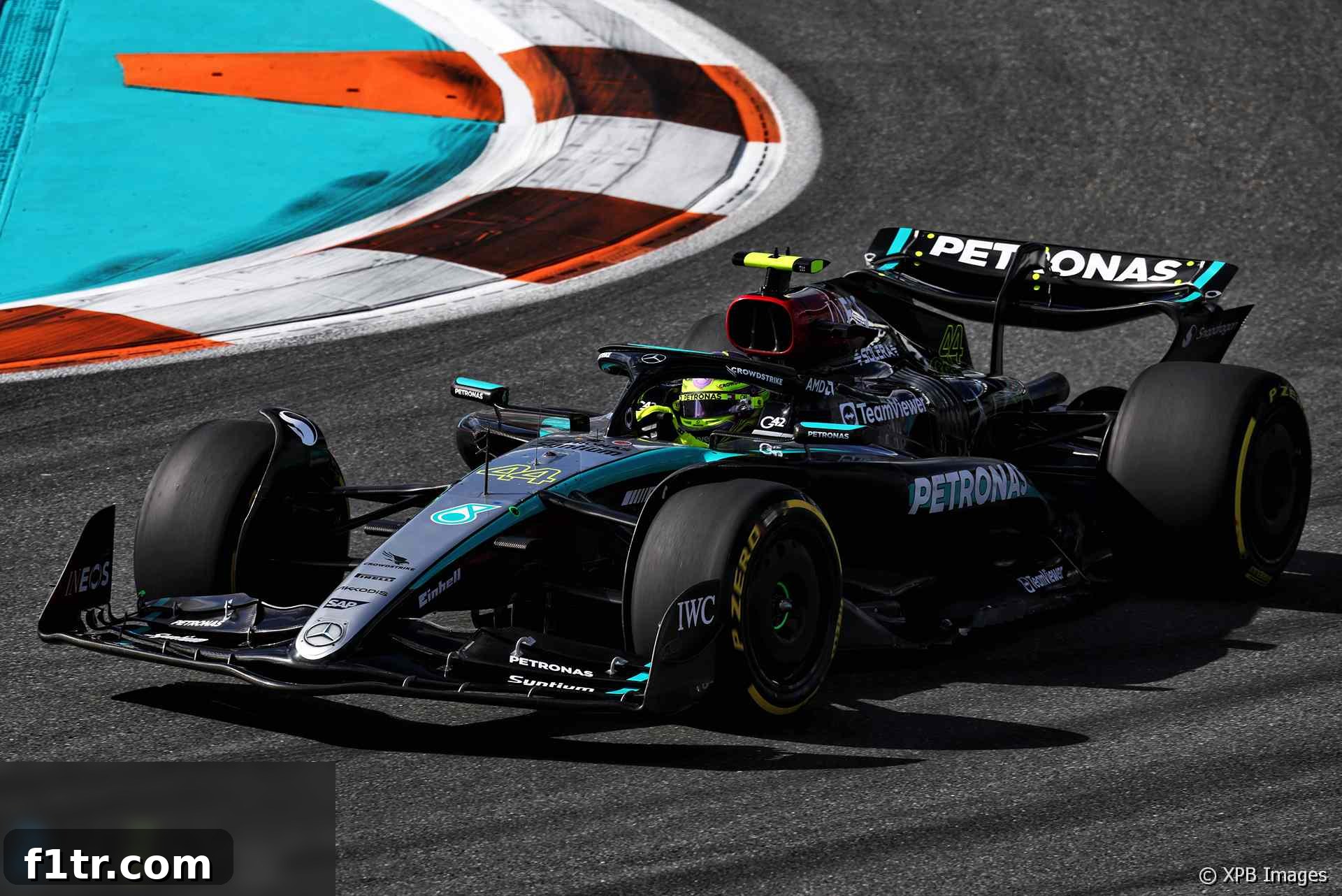
Lewis Hamilton, the seven-time Formula 1 world champion, openly acknowledged the stark reality of Mercedes’ current performance after securing a disappointing 12th position on the grid for the Miami Grand Prix sprint race. His candid assessment highlighted a significant seven-tenths of a second deficit to the front-runners, a gap he believes accurately reflects the underlying pace of the W15 challenger.
The Mercedes team faced a challenging sprint qualifying session in Miami, with both Hamilton and his teammate George Russell failing to advance into the top 10. This outcome, unfortunately, mirrors a recurring theme throughout the current season, where the Silver Arrows have struggled to consistently compete at the sharp end of the grid. Hamilton, known for his relentless pursuit of perfection and often experimenting with aggressive car setups, noted a peculiar pattern: the car often feels more promising before substantial adjustments are made.
“The car felt really good in [first practice],” Hamilton shared with the official F1 channel, reflecting on the initial optimism that quickly dissipated. “And then in [sprint race qualifying], I mean, it didn’t feel terrible; it’s just we’re seven-tenths off. That’s just, I think, the pace of our car.” This statement underscores a profound realization within the team – that despite their best efforts, the inherent performance ceiling of the W15 remains a significant hurdle. The consistent deficit, regardless of setup tweaks, points to more fundamental aerodynamic and mechanical challenges.
For Hamilton, a driver who has spent over a decade at the pinnacle of the sport, accepting such a significant performance gap is undoubtedly a difficult pill to swallow. His past races have often seen him push the boundaries of car setup, sometimes with mixed results. However, he clarified that this particular weekend in Miami was different. “This weekend we’ve just been [doing] no more experiments, just trying to make the car work,” he stated. This shift in approach suggests a move away from radical changes and towards optimizing the existing package, implying a period of consolidation and fine-tuning rather than revolutionary development.
The veteran driver emphasized the team’s diligent efforts: “So I feel like we extracted everything from the car and that’s just our pace, we just have to accept it for the moment that we’re seven-tenths off.” This admission highlights the maximal effort put in by both drivers and engineers, yet the outcome remained unchanged. It reinforces the notion that the issue lies not in driver performance or setup errors, but rather in the inherent capabilities of the W15 when compared to its rivals. The seven-tenths gap is not merely a statistical figure; it represents a chasm in performance, making it exceedingly difficult to challenge for podiums or even consistent points finishes.
Adding another layer of complexity to the Miami weekend, Mercedes arrived with an anticipated upgrade package for their car. Hopes were cautiously high that these enhancements could help narrow the performance deficit. However, the sprint qualifying results painted a sobering picture, suggesting that these initial upgrades might not have delivered the immediate step-change in performance that the team desperately needs. Hamilton’s downbeat prognosis for the sprint race further dampened spirits.
“The sprint race is going to be tough,” he conceded. “We’re in 12th, so I don’t expect a huge amount from there, to be honest.” The reality of starting from the middle of the pack on a circuit notorious for its challenging overtaking opportunities means that any significant climb through the field would be an uphill battle. Points in a sprint race are only awarded to the top eight finishers, making a strong result from 12th position a formidable task for even a driver of Hamilton’s caliber.
The characteristics of the Miami International Autodrome further complicate matters for Mercedes. The circuit’s layout, featuring a mix of high-speed sections and tighter corners, combined with limited true overtaking zones, presents a formidable challenge for a car that is struggling for outright pace. “It’s not an easy circuit to overtake on or to follow,” Hamilton explained, outlining his strategy: “[I’ll] just try to step into the points somehow, if we can.” This ambition, while modest for a driver of his stature, speaks volumes about the current struggles faced by the Mercedes team in their quest for performance.
George Russell, Hamilton’s teammate, echoed similar sentiments regarding the car’s inconsistent performance, particularly highlighting the disparity between tire compounds. Russell noted that the W15 felt considerably more compliant and competitive on the soft tires earlier in the day during free practice, where he managed a respectable P4. However, the mandatory use of medium compound tires during the initial two phases of sprint qualifying revealed a different story.
“In practice, the soft tyre was feeling really good on our car. The pace was good, it was P4,” Russell elaborated, painting a picture of brief optimism. “On the medium, we just couldn’t get the sweet spot and I found myself on the wrong side of it.” This struggle to unlock performance on the medium tires is a critical issue, as these compounds are often crucial for race stints and consistency. Finding the “sweet spot” – the optimal operating window for the tires and car setup – proved elusive for Russell, leading to a drop in pace and ultimately, his failure to progress to SQ3.
Russell further emphasized the intense competition within the midfield, where even marginal differences can dictate progression. “It was tight out there. We shouldn’t have been in a position to be that close to the margin to the cut-off,” he admitted. This statement reflects a frustration shared by the entire team – that a top-tier outfit like Mercedes should not be fighting on the knife-edge of qualifying cut-offs. The narrow margins underscore the depth of competition in modern Formula 1 and the critical need for every tenth of a second.
Looking ahead, Russell conveyed a clear message regarding the team’s immediate priorities. “We need to work overnight and make some improvements for the main quali,” he urged. This call for overnight analysis and adjustments highlights the relentless nature of Formula 1, where every session and every data point is crucial for continuous improvement. The team’s engineers will be poring over telemetry, seeking to understand the discrepancies in tire performance and car balance to find solutions before the crucial main qualifying session for Sunday’s Grand Prix.
The performance challenges in Miami are symptomatic of Mercedes’ broader struggles with the current generation of ground-effect cars. Since the introduction of the new technical regulations in 2022, the team has grappled with the inherent characteristics of their chassis, including issues like porpoising and a narrow operating window. While significant progress has been made since the turbulent W13, the W15 still appears to lack the consistent downforce and mechanical grip that characterize the leading cars from Red Bull, Ferrari, and McLaren.
The “no more experiments” stance from Hamilton could signify a pivotal moment for Mercedes. It might indicate a shift towards a more focused development path, moving away from radical setup changes that might occasionally yield flashes of pace but fail to provide sustained performance. Instead, the emphasis appears to be on understanding and maximizing the existing package, laying a more stable foundation for future upgrades that can truly deliver meaningful performance gains. This measured approach, while potentially slower in the short term, could be crucial for long-term championship aspirations.
For the loyal Mercedes fanbase, these comments from Hamilton and Russell serve as a stark reminder of the monumental task ahead. While the team remains committed to returning to the front, the journey is proving to be a formidable one. The Miami Grand Prix sprint qualifying was a microcosm of their season thus far – glimpses of potential, quickly overshadowed by the persistent challenge of unlocking consistent, competitive pace across different tire compounds and circuit conditions. The pressure to deliver increases with each passing race, and the entire team will be working tirelessly to close that seven-tenths gap and reclaim their position among Formula 1’s elite.
2024 Miami Grand Prix Coverage
- McLaren had superior pace before Verstappen’s damage in Miami – Norris
- Sainz ‘struggles to understand’ why he got penalty when Perez didn’t
- Alonso’s unusual brake problem and more unheard Miami team radio
- McLaren’s Miami upgrade success points to even stronger form in coming races
- Norris expects more wins this year and believes “100%” in 2025 title bid
Browse all 2024 Miami Grand Prix articles