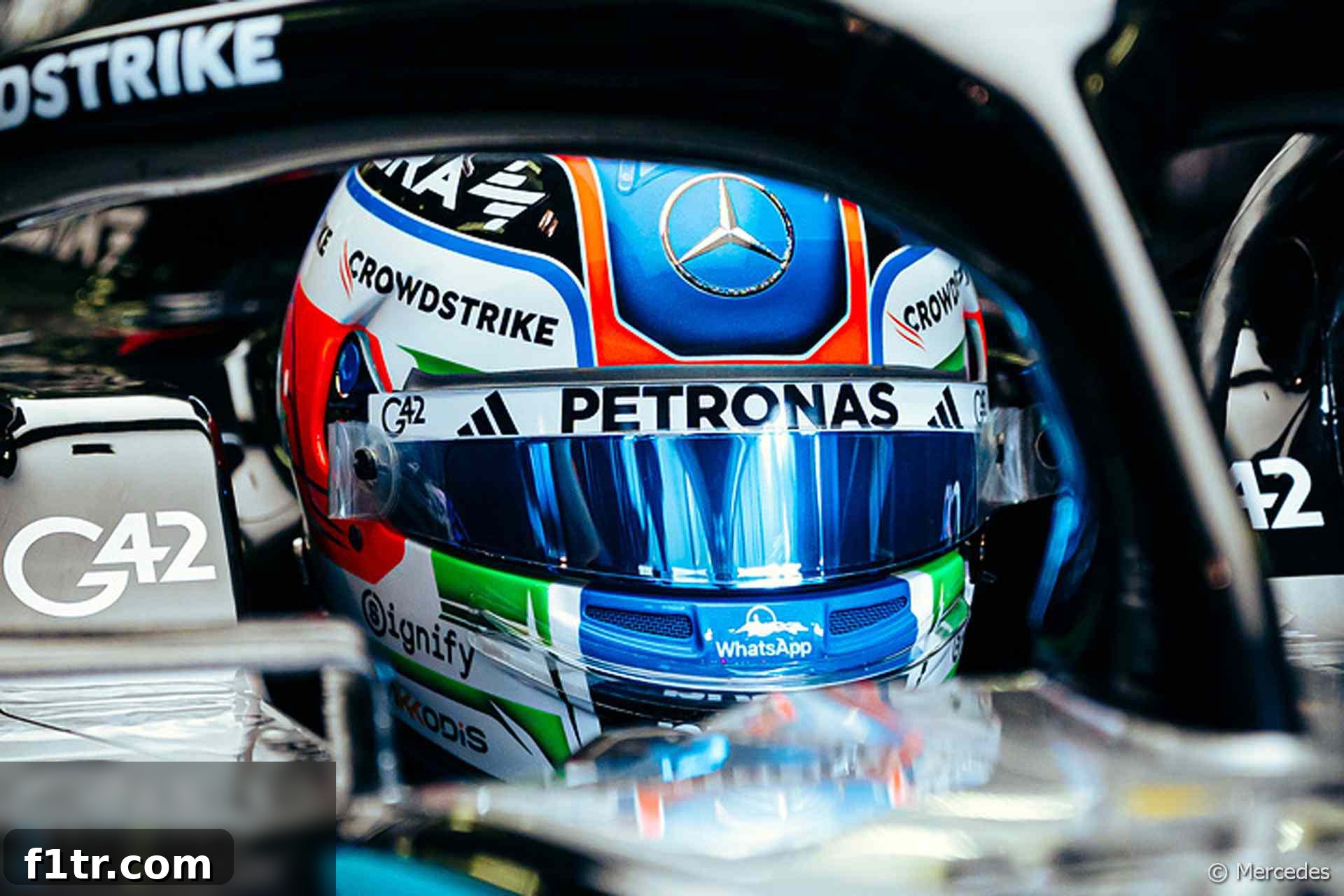
Andrea Kimi Antonelli Puts Mercedes on Top as 2025 F1 Testing Commences in Bahrain
The highly anticipated 2025 Formula 1 season officially kicked off its testing phase at the Bahrain International Circuit, with promising young talent Andrea Kimi Antonelli making an immediate impact. The 18-year-old sensation spearheaded Mercedes’ efforts in the morning session of the first day, clocking the fastest time and signaling a strong start for the Silver Arrows in their preparations for the upcoming championship. Antonelli’s stellar performance quickly captured the attention of the F1 paddock, highlighting his potential and Mercedes’ early pace with their brand-new challenger.
Antonelli’s impressive lap time of 1’31.428 was set aboard the new Mercedes W16 chassis, which had only just turned its first competitive wheels on the Bahrain track the previous day. This rapid adaptation and strong showing from a relatively inexperienced driver in a completely new car underscore both Antonelli’s raw talent and Mercedes’ rigorous development program. The W16, designed to tackle the unique demands of the 2025 regulations, appears to be a capable machine from the outset, providing a solid foundation for the team’s ambitions.
A Productive Morning Session: Early Insights and High Lap Counts
The morning session proved to be exceptionally productive for all participating teams, a crucial outcome for the early stages of a new testing cycle. Drivers and engineers maximized their track time, collectively completing extensive mileage without a single red flag interruption for the entire four hours of running. This seamless operation allowed teams to gather invaluable data on their new cars, focusing on fundamental aspects such as reliability, aerodynamic performance, and tire degradation over longer stints.
Antonelli, who had the honor of leading the cars out onto the circuit at the start of the session, showcased impressive speed and consistency. His best time was approximately 2.3 seconds off the pole position lap set during last year’s Bahrain Grand Prix. While this gap might seem significant, it is entirely expected in early testing. Teams operate with varied fuel loads, engine modes, and setup configurations, making direct comparisons to qualifying pace premature. Importantly, most drivers managed to get within half a second of each other’s times, indicating a tightly contested field even at this preliminary stage. The focus during these early hours is less on outright pace and more on validating simulations, understanding car behavior, and ensuring components function as intended.
Lawson’s Minor Mishap and Red Bull’s Learning Curve
While the session was largely trouble-free, Liam Lawson experienced the most notable incident. The new Red Bull driver briefly spun his RB21 to a halt at the exit of Turn 3. Lawson had ventured slightly wide onto the exit kerb, causing the rear of the car to snap away from him. Demonstrating quick reflexes and car control, he skillfully brought the car to a controlled stop without incurring any damage, a vital factor in testing where every component counts and repairs can eat into precious track time. This minor setback served as a reminder of the fine margins in Formula 1 and the challenges drivers face in pushing the limits of new machinery, especially at demanding corners like Turn 3 at Bahrain. Lawson’s ability to recover swiftly without incident reflects his growing experience and composure behind the wheel.
Endurance and Data Gathering: Lap Counts Tell a Story
One of the key metrics in early testing is the sheer volume of laps completed, as it directly correlates with the amount of data gathered and the reliability of the new chassis. The majority of drivers surpassed a full race distance for the Bahrain Grand Prix, which stands at 57 laps. This demonstrates a high level of reliability across the grid, allowing teams to complete their planned running programs. Andrea Kimi Antonelli, in particular, was a workhorse for Mercedes, logging an impressive 78 laps – the most of any driver during the morning session. This extensive running will provide Mercedes with a wealth of information to fine-tune the W16.
Hot on Antonelli’s heels was Yuki Tsunoda, who completed 77 laps in his Racing Bulls challenger, indicating strong initial reliability for the Faenza-based squad. In contrast, Fernando Alonso covered the least distance among the drivers for Aston Martin. While a lower lap count might sometimes raise concerns, it often reflects a team’s specific testing plan, which might prioritize shorter, performance-focused runs or a different distribution of tasks across the day. Each team has a unique agenda for testing, balancing long runs for reliability and tire data with shorter bursts for aerodynamic validation and setup changes.
Mid-Day Handover: A Strategic Shift for Afternoon Runs
As the morning session concluded, all ten drivers were scheduled to hand over their cars to their respective teammates for the afternoon session. This common testing strategy allows teams to maximize driver feedback and diversify their data collection. By having two drivers experience the car on the same day, teams can compare subjective feedback, assess different driving styles, and validate setup changes more efficiently. It also provides valuable track time for a wider pool of talent, including rookies and test drivers, who often play a crucial role in the development cycle. The transition between sessions is meticulously planned, with engineers making necessary adjustments and preparing the cars for their next drivers to continue the intensive development work.
Bahrain 2025 F1 Test: Day One Morning Session Lap Times
| Pos. | Car number | Driver | Team | Model | Best time | Gap | Laps |
|---|---|---|---|---|---|---|---|
| 1 | 12 | Andrea Kimi Antonelli | Mercedes | W16 | 1’31.428 | 78 | |
| 2 | 30 | Liam Lawson | Red Bull | RB21 | 1’31.560 | 0.132 | 58 |
| 3 | 23 | Alexander Albon | Williams | FW47 | 1’31.573 | 0.145 | 63 |
| 4 | 22 | Yuki Tsunoda | Racing Bulls | 02 | 1’31.610 | 0.182 | 77 |
| 5 | 44 | Lewis Hamilton | Ferrari | SF-25 | 1’31.834 | 0.406 | 70 |
| 6 | 7 | Jack Doohan | Alpine | A525 | 1’31.841 | 0.413 | 68 |
| 7 | 14 | Fernando Alonso | Aston Martin | AMR25 | 1’31.874 | 0.446 | 46 |
| 8 | 81 | Oscar Piastri | McLaren | MCL39 | 1’32.084 | 0.656 | 65 |
| 9 | 27 | Nico Hulkenberg | Sauber | C45 | 1’32.169 | 0.741 | 55 |
| 10 | 87 | Oliver Bearman | Haas | VF-25 | 1’35.522 | 4.094 | 72 |
A quick glance at the lap times table reveals a remarkably close field, with the top eight drivers separated by less than a second. This tight competition, even in testing, hints at an exciting 2025 season. Beyond Antonelli’s stellar performance, Liam Lawson’s second place for Red Bull and Alexander Albon’s strong third for Williams are particularly noteworthy. These results showcase the competitive spirit within the paddock and the potential for a thrilling championship fight once the season officially begins.
What to Expect as Testing Progresses and Towards the 2025 Season
The first morning of 2025 Formula 1 testing has delivered a compelling blend of promising performances, intensive data gathering, and a glimpse into the potential pecking order for the upcoming season. While one session’s results are far from conclusive, Andrea Kimi Antonelli’s impressive debut for Mercedes has certainly set a high bar and sparked considerable excitement. The extensive mileage completed by most teams, coupled with the lack of significant incidents, bodes well for a robust and competitive season ahead.
Over the remaining days of testing, teams will continue to refine their setups, conduct long-run simulations, and push the performance boundaries of their new cars. Attention will shift towards understanding tire degradation, validating aerodynamic packages, and optimizing engine performance for race conditions. Every lap and every data point gathered now will be crucial in preparing for the opening grand prix and shaping the development trajectory for the entire 2025 campaign. Fans can anticipate more intriguing insights and potentially shifting hierarchies as teams gradually reveal more of their true potential. The journey to the 2025 F1 World Championship has truly begun, and these early test days are foundational to the season’s unfolding drama.
Explore More Formula 1 Content
Delve deeper into the world of Formula 1 with our comprehensive articles and analyses covering everything from driver insights to technical innovations and historical perspectives.
- F1 returning to India soon after 2027 sounds like wishful thinking
- Verstappen loathes F1’s new generation of cars – but what do his rivals reckon?
- The ‘throwback weekend’ is back in fashion. But it’s a flawed concept – especially for F1
- Is Formula 1’s double race cancellation a blessing in disguise?
- Todt admits Schumacher crashed on purpose – but did it really cost him two titles?
Browse all Formula 1 articles