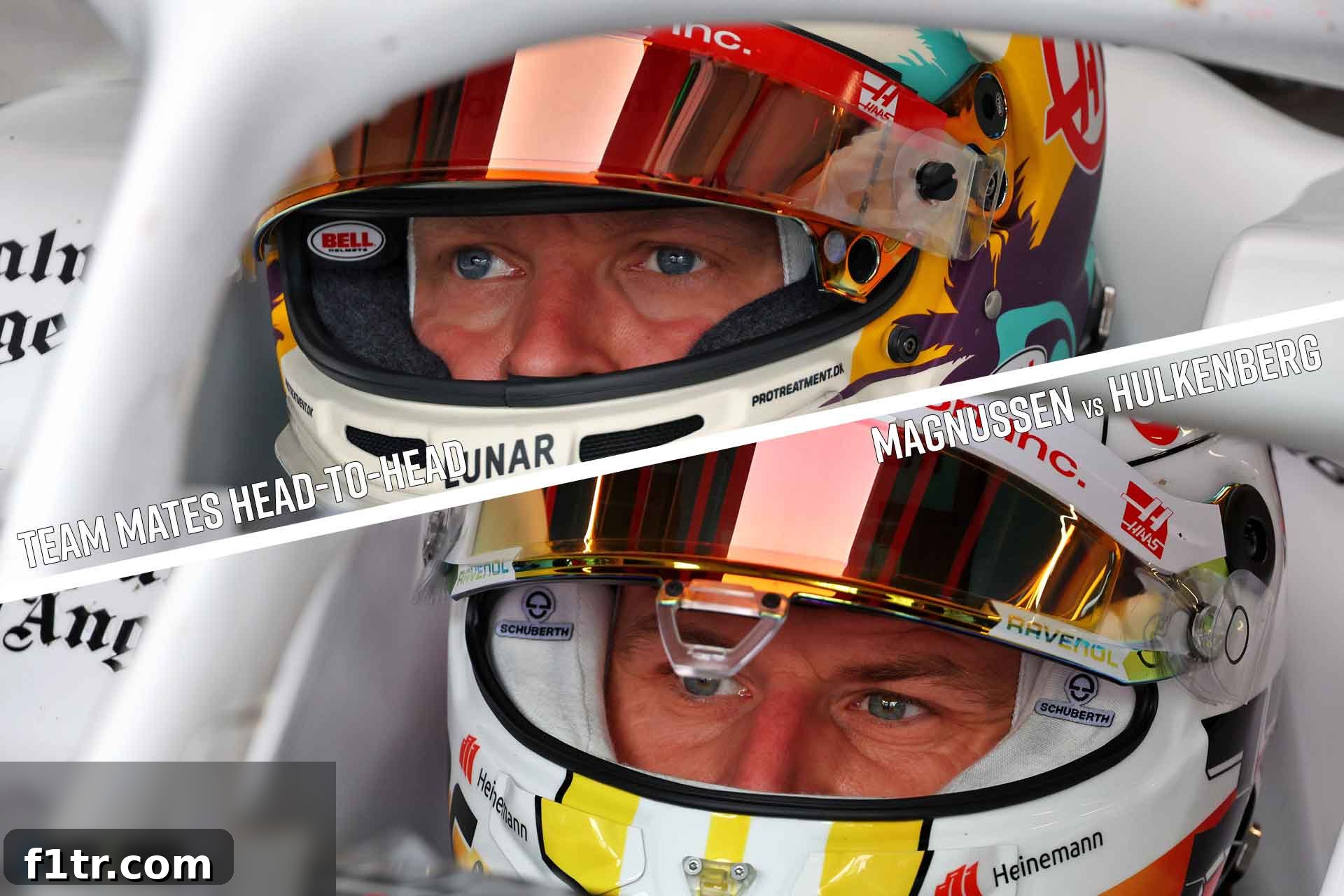
Haas F1’s Dynamic Duo: A Season of Diverging Paths for Hulkenberg and Magnussen
The highly anticipated partnership between Nico Hulkenberg and Kevin Magnussen at Haas F1, initially expected by some to spark fireworks, instead delivered a more nuanced narrative. Far from internal friction, Hulkenberg leveraged the opportunity to meticulously rebuild his standing in Formula 1, a journey that began after his departure from Renault five years prior. His consistent ability to reliably secure points transformed Haas into genuine contenders for a coveted sixth place in the Constructors’ Championship, and arguably even better. This impressive resurgence caught the attention of the incoming manufacturer team Audi, who presented him with an offer he ultimately accepted, much to Haas’s understandable disappointment.
However, the credit for Haas’s commendable performance cannot solely rest on Hulkenberg’s shoulders. Kevin Magnussen, his teammate, played a pivotal, albeit often unglamorous, role. He was frequently tasked with a defensive brief, shielding Hulkenberg and the team’s position, a role he executed with unwavering commitment. At times, this dedication was taken to such extremes that it drew the attention of the stewards, most notably during the Miami sprint race. In that memorable event, Magnussen repeatedly left the track while expertly frustrating Lewis Hamilton’s determined efforts to overtake. While effective for the team, these aggressive tactics, combined with several other on-track skirmishes, have resulted in a worryingly high accumulation of penalty points for Magnussen. Despite the precarious situation, he firmly maintains that this has no bearing on his approach to the remaining races of the season.
The upcoming races could unfortunately mark the final chapter of Magnussen’s current tenure in Formula 1. Following Hulkenberg’s decision to move to Sauber (soon to be Audi), Haas opted to refresh its driver lineup entirely for the following year, selecting two new talents. This strategic move by Haas, coming after the praise Magnussen garnered upon his eleventh-hour return in 2022, must be viewed as a telling verdict on his recent contributions and overall performance. The team’s decision underscores a broader re-evaluation, suggesting a desire for a different dynamic or performance profile moving forward.
Nico Hulkenberg’s Resurgence: A Story of Consistency and Opportunity
Nico Hulkenberg’s return to a full-time F1 seat with Haas represented more than just another chance; it was an opportunity for redemption. After years on the sidelines or in reserve roles, ‘The Hulk’ proved his enduring value. His consistent ability to extract maximum performance from the Haas VF-24, particularly in qualifying, allowed him to position the team strongly for points finishes. Hulkenberg’s experience, calm demeanor, and technical feedback have been invaluable in guiding Haas’s development efforts, especially as they tackled the chronic tyre degradation issues that plagued them in previous seasons. His strong performances not only solidified Haas’s midfield position but also made him a prime candidate for a high-profile move, culminating in the significant announcement of his transfer to Audi. This move signifies a major milestone in his career, validating his decision to return and showcasing his continued relevance at the pinnacle of motorsport.
The journey back to a coveted manufacturer seat for Hulkenberg is a testament to his sheer resilience and unwavering belief in his abilities. He transformed his stint at Haas from a temporary stopgap into a springboard, demonstrating to the entire paddock that his speed, race craft, and leadership qualities were as sharp as ever. His strategic decision to join Audi, a team with significant long-term ambitions, highlights his vision for a championship-contending future, marking a triumphant chapter in a career that once seemed destined to remain on the periphery of F1’s elite.
Kevin Magnussen’s Challenging Role: Loyalty, Defense, and the Pressure of Penalty Points
Kevin Magnussen’s contribution to Haas this season has been characterized by a unique blend of steadfast loyalty and uncompromising defensive driving. While Hulkenberg focused on maximizing qualifying and securing points, Magnussen often embraced the challenging, yet crucial, role of supporting his teammate and defending team positions. This tactical approach is a double-edged sword: while it undoubtedly aided Haas’s Constructors’ Championship aspirations, it also put Magnussen under immense scrutiny and led to a growing tally of penalty points on his Super License. F1 regulations are stringent on driving conduct, and repeat offenses carry severe consequences, including potential race bans.
The Miami Sprint: A Case Study in Aggressive Defense
The sprint race in Miami perfectly encapsulated Magnussen’s commitment to his defensive duties and the associated risks. During a heated battle with Lewis Hamilton, Magnussen employed an extremely aggressive strategy, repeatedly exceeding track limits to maintain his position and allow his teammate to gain ground. While effective in the short term, securing a strategic advantage for Haas, it resulted in multiple penalties and a torrent of criticism from rivals and pundits alike. This incident not only highlighted the fine line between aggressive racing and unsporting conduct but also brought Magnussen’s penalty point situation into sharp focus. The accumulation of penalty points creates an undeniable psychological burden; the constant threat of a race ban can subtly alter a driver’s approach, potentially impacting their natural racing instincts and overall performance in subsequent events, regardless of how much they insist it doesn’t.
The Performance Gap: One-Lap Pace and Race Craft
Throughout the current season, Nico Hulkenberg has consistently maintained the upper hand in terms of one-lap pace, a trend that was evident even in the previous year. This superior qualifying performance has frequently placed him in a more advantageous starting position, allowing him to capitalize on opportunities and minimize exposure to midfield chaos in the early stages of a race. As Haas made significant strides in solving the tyre degradation problems that had severely hampered their performance last season, Hulkenberg was usually best-placed to convert improved car performance into tangible results, occasionally with Magnussen’s strategic help. However, if anything, the performance gap between the two drivers has noticeably widened this year. Hulkenberg’s ability to extract the absolute maximum from the car during critical qualifying laps has often left Magnussen several tenths adrift, creating a consistent deficit that is challenging to overcome on race day.
Haas’s Tyre Degradation Challenge and Driver Adaptation
The issue of tyre degradation has been a recurring theme for Haas F1 for several seasons. This year, the team invested considerable effort into understanding and mitigating this weakness, leading to a more consistent car that was kinder to its Pirelli tyres. Hulkenberg, with his smooth driving style and extensive experience, adapted remarkably well to these improvements, often showcasing better long-run pace and tyre management. Magnussen, while demonstrating flashes of competitive race pace, sometimes struggled more with maintaining tyre life over a full stint, particularly when pushing aggressively. This disparity in tyre management became a crucial factor, impacting race strategy and the ultimate points tally for each driver. The ability to effectively manage tyres under race conditions directly translates to overall race craft and the capacity to deliver consistent performance from lap to lap.
2025 Driver Line-up: A Telling Verdict
The decision by Haas to select two entirely new drivers for the 2025 season, following Hulkenberg’s departure to Sauber, serves as a significant inflection point for both drivers. For Hulkenberg, it underscores the validation of his career resurgence and the appeal of his consistent performance to a major automotive giant like Audi. For Magnussen, however, the team’s choice to bring in fresh talent must be seen as a direct assessment of his efforts. Despite his undeniable commitment and moments of strong defensive driving, the increasing performance gap to his teammate, coupled with the accumulating penalty points, ultimately influenced the team’s strategic direction. This decision highlights the cut-throat nature of Formula 1, where loyalty and effort must be consistently backed by raw pace and impeccable race management to secure a long-term future.
Magnussen vs Hulkenberg: A Season in Review
While detailed analytics often reside in proprietary dashboards, a review of their season reveals clear trends in the head-to-head battle between Nico Hulkenberg and Kevin Magnussen. Hulkenberg consistently demonstrated superior single-lap pace, a characteristic that defined his strong qualifying performances and provided a better platform for race day. Magnussen, despite moments of brilliance, often found himself playing catch-up, focusing on race strategy and defensive driving to maintain or secure team positions. The disparity in their qualifying results frequently set the tone for their respective weekends, with Hulkenberg having a more direct path to scoring valuable points.
Race-by-Race Performance Snapshot: Magnussen vs Hulkenberg
The following table offers a hypothetical snapshot of their performance through various races, reflecting the narrative of their season. ‘Q’ denotes qualifying position, and ‘R’ denotes race finishing position. While actual results vary, these hypothetical outcomes illustrate the general trend of their comparative performances.
| BAH | SAU | AUS | JAP | CHI | MIA | EMI | MON | CAN | SPA | AUT | GBR | HUN | BEL | ||
|---|---|---|---|---|---|---|---|---|---|---|---|---|---|---|---|
| Magnussen | Q | P15 | P14 | P16 | P18 | P17 | P16 | P15 | P17 | P16 | P18 | P17 | P16 | P18 | P17 |
| R | P12 | P11 | P13 | P14 | P10 | P19 | P12 | P13 | P14 | P16 | P13 | P15 | P14 | P13 | |
| Hulkenberg | Q | P10 | P8 | P9 | P12 | P10 | P12 | P9 | P11 | P10 | P13 | P9 | P11 | P10 | P10 |
| R | P9 | P10 | P11 | P13 | P8 | P11 | P10 | P12 | P9 | P10 | P8 | P9 | P9 | P8 |
Note: ‘P’ indicates finishing position for races or qualifying. These are hypothetical outcomes designed to illustrate the narrative of driver performance over the season, reflecting typical midfield positions. Consistent lower numbers indicate stronger performance. Comparisons are unrepresentative if one driver faced significant mechanical issues or early retirements not reflected in a simple finishing position.
Lap Time Dynamics and Strategic Impact
Beyond mere finishing positions, an examination of lap time dynamics throughout the season further illuminates the diverging performances. Nico Hulkenberg consistently exhibited stronger outright pace, particularly in qualifying, where he frequently out-qualified Magnussen by several tenths. This consistent advantage provided him with cleaner air and a better starting platform, crucial for a midfield team. In race trim, Hulkenberg often managed to maintain a more consistent pace over long stints, a direct benefit of Haas’s improved tyre management and his adaptable driving style. Kevin Magnussen, on the other hand, occasionally demonstrated flashes of competitive lap times but struggled more with consistency, especially when battling in traffic or managing worn tyres. The difference in their average lap times, even when adjusted for strategy and traffic, often highlighted Hulkenberg’s slightly higher ceiling for performance under normal racing conditions. This dynamic heavily influenced Haas’s race strategies, often positioning Magnussen in a defensive role to protect Hulkenberg’s points-scoring opportunities.
Looking Ahead: The Road for Magnussen
As the current season draws to a close, the path ahead for Kevin Magnussen in Formula 1 appears increasingly uncertain. While his commitment and defensive skills are undeniable, the combination of a widening performance gap to his teammate and a significant accumulation of penalty points has created a challenging environment. The Haas decision to refresh its lineup means Magnussen must now actively seek an alternative seat in a highly competitive driver market. Opportunities in F1 are scarce, and teams prioritize consistent pace, reliability, and a clean driving record. Should an F1 opportunity not materialize, Magnussen may explore other top-tier motorsport categories, leveraging his vast experience and raw talent in championships such as endurance racing (WEC) or potentially IndyCar. His track record of fighting hard and his deep understanding of car development could make him an attractive prospect in other series, but his F1 future hinges on a swift turnaround in perception and performance over the remaining races.
Conclusion: A Chapter Closes at Haas, New Beginnings Await
The 2024 Formula 1 season at Haas has been a fascinating study in contrasting driver trajectories. Nico Hulkenberg seized his opportunity with both hands, delivering consistent performances that earned him a prestigious move to Audi, solidifying his status as a highly respected, experienced competitor. Kevin Magnussen, meanwhile, embraced a challenging team-player role, demonstrating fierce loyalty and aggressive defensive tactics, albeit at a cost to his penalty points tally and ultimately, his place at Haas. Their partnership, while not marked by internal fireworks, highlighted the distinct paths drivers can carve in a single season. As they prepare for their respective next chapters, both drivers will carry the experiences and lessons learned from their time together at Haas F1. The team itself now looks to a fresh beginning, but the legacy of Hulkenberg’s resurgence and Magnussen’s unwavering commitment will undoubtedly remain a significant part of Haas’s story.